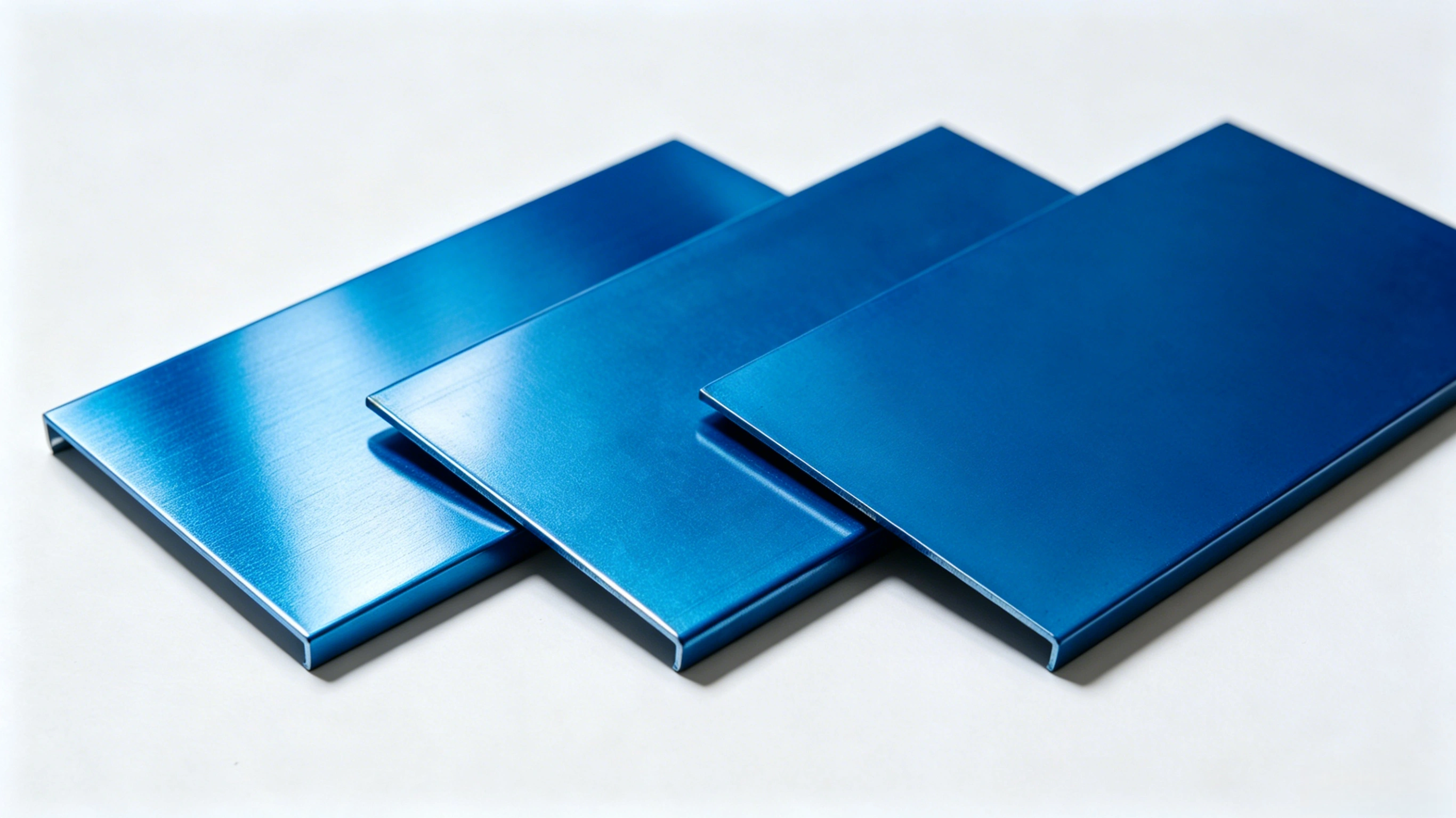
A sol-gel hybrid (ORMOSIL) coating is an organic/inorganic thin film formed by hydrolysing and condensing alkoxysilanes at low temperature into a Si-O-Si inorganic backbone that still carries organic functional groups. It combines the surface hardness, modulus and transparency of a ceramic phase with the flexibility, formability and low-cure behaviour of a polymer phase in a single network, and is used for abrasion, corrosion, anti-fingerprint and decorative protection on metal, glass and aluminium substrates.
On real production lines, a pure organic topcoat often chalks, blisters and loses adhesion after scratches and damp-heat cycling, while a pure inorganic ceramic coating is hard but brittle, cracks after spraying and drives high rework rates. Getting hardness and toughness at once usually means trading one against the other - and the sol-gel hybrid coating is the low-temperature compromise built for exactly these failure modes.
Conclusions first; every point carries a unit or a standard number:
- It cures cold: most formulas reach full condensation at 80-150 C, and double-bond precursors can UV-cure, avoiding the >500 C ceramic route.
- Tunable hardness: on a PC substrate at R/Si = 0.78 cured 120 C for 3 h, cross-cut adhesion reaches class 0 and pencil hardness 2H; full pyrolysis at 1000 C lifts hardness to about 10 GPa.
- Corrosion means barrier: use EIS impedance modulus |Z| at 0.01 Hz as the criterion, which the industry commonly reads as a good barrier above 10^8 ohm-cm2.
- Align service with ISO 12944: carbon-steel first-year corrosion rate is >25-50 um/a at C3, >50-80 um/a at C4, >80-200 um/a at C5; the hybrid must be salt-fog validated as part of a system.
- Hybrid is not universal: more organic phase lowers hardness, and long-term water resistance is limited by residual Si-OH, so the engineering boundary must be stated.
1. What a sol-gel hybrid (ORMOSIL) coating is: definition and scope
Sol-gel is a classic soft-chemistry route: dissolve precursors such as tetraethoxysilane (TEOS, Si(OC2H5)4) or tetramethoxysilane (TMOS) in alcohol, add water and a catalyst to hydrolyse, then condense into an oxide network. When non-hydrolysable or partly-hydrolysable organic groups (methyl, vinyl, glycidoxypropyl) are introduced, the result is an ORMOSIL (organically modified silicate); the German Fraunhofer team commercialised it as ORMOCER (organically modified ceramics). The terminology traces to Schmidt around 1990, e.g. Schmidt and Wolter in Journal of Non-Crystalline Solids 121 (1990) 428-435, and Schmidt's MRS paper Inorganic-organic composites by sol-gel techniques (1990).
Versus pure organic paints and pure inorganic ceramics
A pure organic polyurethane/acrylic relies on polymer-chain entanglement: tough but limited in surface hardness and heat resistance. A pure inorganic sol-gel or thermal-spray ceramic is hard and stiff but brittle and needs high temperature. The hybrid composites both at molecular/nano scale: inorganic clusters give hardness, modulus and corrosion resistance, organic segments give flexibility and low-cure. See the same 'barrier pigment + binder' logic as MXene flake-barrier anticorrosion and the hardness-adhesion trade-off discussed in diamond-like carbon (DLC) internal stress and adhesion.
2. Mechanism: hydrolysis-condensation and Si-O-Si film formation
The reaction has two steps. First hydrolysis: Si-OR + H2O -> Si-OH + ROH; then condensation: Si-OH + HO-Si -> Si-O-Si + H2O, or Si-OR + HO-Si -> Si-O-Si + ROH. As Si-O-Si crosslink density rises the sol thickens to the gel point, and drying leaves a nanoporous network. Film continuity and defects largely come from how these two steps compete.
Precursors: TEOS and organically modified silanes
TEOS is the network former; methyltriethoxysilane (MTES), vinyltriethoxysilane (VTES) and gamma-glycidoxypropyltrimethoxysilane (GPTMS/GLYMO) supply the organic functions, while difunctional precursors such as BTSE add crosslinking. Organically modified silanes usually hydrolyse slower than pure TEOS, which 'slows' gelation and leaves them as fillers in the silica network. The same hydrolysis-condensation chemistry supports silane-impregnation water-repellent coatings and porous aerogel thermal-insulation coatings.
Catalysis and gel time
Acid catalysis (HCl, acetic acid) favours linear growth, slower gelation and denser films; base catalysis favours particulate growth and faster gels. A typical charge is about TEOS:ethanol:water:catalyst = 1 : 4-7 : 0.5-6 : (0.01-0.1), with gel times from hours to days. Two-step acid/base catalysis (acid hydrolysis, then base condensation) can deliver both density and hardness at low temperature.
3. Key performance data and criteria
The quantitative anchors used repeatedly in selection and acceptance, original units kept:
- Cure window: thermal cure mostly 80-150 C; double bond + photoinitiator allows UV cure, dropping the oven.
- Hardness: at R/Si = 0.78 cured 120 C for 3 h, pencil hardness is about 2H and cross-cut adhesion class 0 on PC; raising the organic share lowers hardness.
- Transparency and thickness: a dip-withdraw example is 0.84 um film, lifting PC transmittance by about 5%; porous VTES/TEOS hybrid layers tune refractive index between 1.12-1.21.
- Contact angle: about 93 degrees after curing 120 C for 3 h, growing with cure time.
- Service grading: match systems and salt-fog validation to the ISO 12944-2 corrosivity class and ISO 12944-1 durability range; never quote life without the environment class.
- Upper bound: fully pyrolysed (1000 C, organics burned off) hardness reaches about 10 GPa, proving the organic phase is the hardness ceiling in the hybrid state.
4. Hybrid vs pure organic vs pure inorganic: one comparison table
For the same engineering demand, the three routes are easy to weigh.
| Property | Pure organic paint | Sol-gel hybrid coating | Pure inorganic ceramic |
|---|---|---|---|
| Surface hardness | Low (H-grade pencil) | Medium (2H example, varies with R/Si) | High (can exceed 10 GPa pyrolysed) |
| Flexibility / crack resistance | Good | Fairly good | Poor, cracks easily |
| Film temperature | Ambient to low | 80-150 C (or UV) | >500 C or thermal spray |
| Corrosion barrier | Depends on film thickness and system | Nano-dense, can add barrier fillers | Dense but defective |
| Transparency | Can be high | Can be high (porous 1.12-1.21) | Process-dependent |
5. Aligning service life with ISO 12944 corrosivity classes
A hybrid coating is never alone; it is part of a corrosion system. ISO 12944-2 grades the atmosphere by the carbon-steel first-year corrosion rate. The table gives class, typical environment and common neutral-salt-spray (NSS, per ISO 12944-6, changing with the durability target) hour ranges for system selection. Acceptance on a scribing line: single-side creep C3/C4 <=2.0 mm, C5/CX <=2.5 mm.
| Class | Carbon-steel rate um/a (first year) | Typical environment | Common NSS hours (by durability target) |
|---|---|---|---|
| C1 very low | <=1.3 | Conditioned dry indoors | - |
| C2 low | >1.3-25 | Rural / ordinary indoor | 240 |
| C3 medium | >25-50 | Urban and general industry | 240-480 |
| C4 high | >50-80 | Industrial and coastal (1-5 km) | 480-720 |
| C5 very high | >80-200 | High-humidity salty / heavy industry | 720-1440 |
| CX extreme | >200 | Offshore / offshore-wind atmospheric zone | 720-1440 |
6. Test methods and standards
Criteria need sources. The table lines up hardness, adhesion, abrasion, salt-fog, damp-heat and electrochemical barrier with their common method standards and unit criteria, ready to put into a technical agreement.
| Property | Method standard | Example criterion / unit |
|---|---|---|
| Pencil hardness | ASTM D3363 / GB/T 13452.2 | e.g. 2H |
| Cross-cut adhesion | ASTM D3359 / ISO 2409 / GB/T 9286 | class 0 to 5, class 0 best |
| Taber abrasion | ASTM D4060 | mg/1000 cycles (CS-17) |
| Neutral salt fog | ASTM B117 / ISO 9227 / GB/T 10125 | hours h |
| Damp heat | GB/T 1740 / ISO 4628 | blistering / rusting grade |
| Electrochemical barrier | ISO 16773-2 (EIS) | |Z|@0.01 Hz, ohm-cm2 |
7. Application and cure window
Dip, spin and spray all work. In dip-coating the withdrawal speed sets the wet-film thickness and follows a Burkhard-Vezzetti-type relation - faster pull, thicker film; a single pass is usually a few hundred nanometres, stacked to 1-a few um. After gelation, drying-cure removes residual alcohol and water, and cure temperature and time map directly onto hardness and density.
Ambient humidity affects condensation and levelling: too high hazes, too low pinholes. For nanostructured coatings where mechanical durability matters, see superhydrophobic coating mechanical durability and abrasion failure; for a self-healing route, combining microcapsule self-healing coatings (rupture-release mechanism) with a hybrid binder is common engineering practice.
8. Compliance, environment and selection limits
A selling point of sol-gel is chrome-free: it can replace hexavalent-chromate conversion as a barrier primer, echoing the REACH authorisation list and RoHS phase-out of hex-chrome. But watch catalyst and solvent compliance: tin condensation catalysts such as dibutyltin dilaurate (DBTDL) must be assessed against REACH SVHC/authorisation, so prefer acid or tin-free catalysis; control alcoholic-solvent VOC and emissions per local rules. Also, hybrid is not the end state: residual Si-OH keeps condensing or absorbing water over time, so long-term water and alkali resistance must be backed by testing, and food-contact or medical uses need specific migration/safety checks.
9. Frequently asked questions (FAQ)
Is a sol-gel hybrid coating the same as a silane coupling agent?
Not quite. A silane coupling agent mainly reacts one end with an inorganic surface and the other with an organic resin, acting as an 'interface bridge' at low loading; a hybrid coating uses organically modified silanes as the film-forming body, building a continuous Si-O-Si network with embedded organic segments. They share the Si-OR hydrolysis-condensation chemistry, but one is an adhesion promoter and the other is the continuous coating body.
Why does more organic modification make the coating softer?
Because hardness comes mainly from the crosslink density of Si-O-Si inorganic clusters. Organic groups (methyl, vinyl, etc.) do not contribute Si-O-Si bridging oxygens; they dilute the inorganic network and add flexible segments, so modulus and pencil hardness fall as R/Si rises. Design must balance toughness against hardness, and a pencil hardness near 2H is the result of that compromise.
Is curing at 80-150 C enough? Does it hurt hardness?
Most hybrid systems finish condensation and reach usable hardness at 80-150 C; higher temperature mainly drives off residual hydroxyl and raises density. 120 C for 3 h is a common literature process point (contact angle about 93 degrees, pencil about 2H). For heat-sensitive substrates such as PC or some plastics, low-temperature or UV cure is precisely the hybrid's advantage over thermal-sprayed ceramic.
How do I judge whether it survives salt fog or a C4 environment?
Do not read a single number; validate the system. Under ISO 12944, first fix the corrosivity class (e.g. C4), then the durability target (L/M/H/VH), which sets the neutral-salt-spray hours (C4 commonly 480-720 h). Pass/fail on single-side creep at the scribe <=2.0 mm and adhesion <=1 grade; support it with EIS |Z|@0.01 Hz, where above 10^8 ohm-cm2 is generally taken as good.
Can a hybrid coating replace hexavalent-chrome passivation?
As a corrosion barrier primer, yes - that is one of its main compliance values: chrome-free Si/Zr/Ti sol-gel can act as a conversion coating or primer to answer REACH/RoHS limits on hex-chrome. But substitution is system- and substrate-specific: aluminium, galvanized steel and carbon steel differ, so it must be confirmed by test against the target salt-fog and electrochemical criteria, not copied over.
How thick should the film be?
A single sol-gel pass is usually sub-micron (a dip-withdraw example is about 0.84 um); thickness is built up by multiple passes and withdrawal speed. Unlike a heavy epoxy / glass-flake lining that shields with millimetre thickness, the hybrid works by nano-density plus optional barrier fillers, so on a defect-prone substrate you level and prime first rather than expecting a single hybrid layer to fill voids.
Can tin catalysts still be used?
Use with care. Organotin condensation catalysts such as dibutyltin dilaurate are constrained under REACH SVHC/authorisation and restrictions, and are especially sensitive for EU exports and automotive supply chains. The safer path is acid or tin-free catalysis, requesting SDS and compliance statements upstream, and writing the catalyst type into the technical agreement.
Will a hybrid coating fail over time? Where is the boundary?
Yes. Residual Si-OH continues to condense under heat and humidity, absorbs water and can grow micro-cracks, so long-term water, alkali and UV resistance must be backed by ageing data; the chalking risk of the organic phase rises with organic content. The engineering boundary is: it suits low-temperature hard-tough balancing and a corrosion barrier primer, not replacing >500 C pure ceramic or extreme heavy-duty protection that needs millimetre films.
References and criteria notes: Schmidt, H., 'Inorganic-organic composites by sol-gel techniques' (MRS Symp. Proc. 171, 1990); Schmidt & Wolter, J. Non-Cryst. Solids 121 (1990) 428-435; Wen & Wilkes, Chem. Mater. 8 (1996) 1667. Standards: ISO 12944-2 (environment), ISO 12944-1 (durability), ISO 12944-6 (lab performance), ASTM B117/ISO 9227/GB/T 10125 (salt fog), ASTM D3363/GB/T 13452.2 (pencil), ASTM D3359/ISO 2409/GB/T 9286 (cross-cut), ASTM D4060 (Taber), ISO 16773-2 (EIS). Notes: hardness, contact angle and film thickness are typical literature example values that vary with formula/substrate/cure; ISO 12944 salt-fog hours change with the class and durability target (L/M/H/VH), so ranges are given, not single values; EIS barrier bands are common industry reading, with acceptance set by the contracted standard and measured data.
Last updated: 2026-11-19 | Kexin New Materials (Guangdong) Co., Ltd. | This is a B2B technical reference; trade terms follow the EXW / FOB basis only.