The safety of food contact materials is directly related to consumer health; therefore, "food-grade" is by no means a marketing adjective, but a technical attribute strictly constrained by regulations. In scenarios such as cookware liners, food machinery, and tank linings, nano ceramic coating is favored for its non-stick, easy-to-clean, wear-resistant, and corrosion-resistant properties, but whether it can be used for food contact must be based on compliant migration levels, biocompatibility, and regulatory certification. This article uses the experience accumulated by kexinMaterials (kexinMaterials) in technical documentation and compliance practice as a thread to systematically review the regulatory framework for food-grade nano coatings (GB 4806.10-2025, FDA 21 CFR 175.300), real product data (such as the YC-8703 nano composite ceramic coating included in the research archive), safety mechanisms (SiO₂ inertness), and key application and curing points, and always adheres to one bottom line: any claim of food-grade must be premised on SGS/FDA or equivalent national standard testing, and must not be exaggerated.

I. Why Food Contact Scenarios Need "Food-Grade" Nano Coatings
On the inner walls of cookware, food processing equipment, and storage/transport containers, coatings perform three functions: first, reducing surface energy to achieve non-stick and easy cleaning, reducing food residue and detergent usage; second, providing a wear-resistant and corrosion-resistant barrier to extend the life of metal liners; third, preventing metal ions (such as rust, nickel leaching) from migrating into food. Traditional non-stick solutions are represented by PTFE (polytetrafluoroethylene), while nano ceramic coating (mostly with SiO₂, Si-based or composite ceramic as the hard phase) has become an upgrade direction in recent years due to its higher hardness, wider upper temperature limit, and no PFAS controversy.
But it must be clear: there is no automatic equation between the coating "containing nanoparticles" and "can be used for food contact". The nano structure changes the physical properties of the material, while food-grade depends on whether the substances migrated from the coating to food under intended use conditions are within regulatory limits. In other words, what determines food-grade is migration safety and compliance certification, not the word "nano" itself. This is why when purchasing and accepting, priority should be given to test reports issued by SGS, FDA, or national standards (GB 4806 series), rather than judging merely by the "nano ceramic" label.
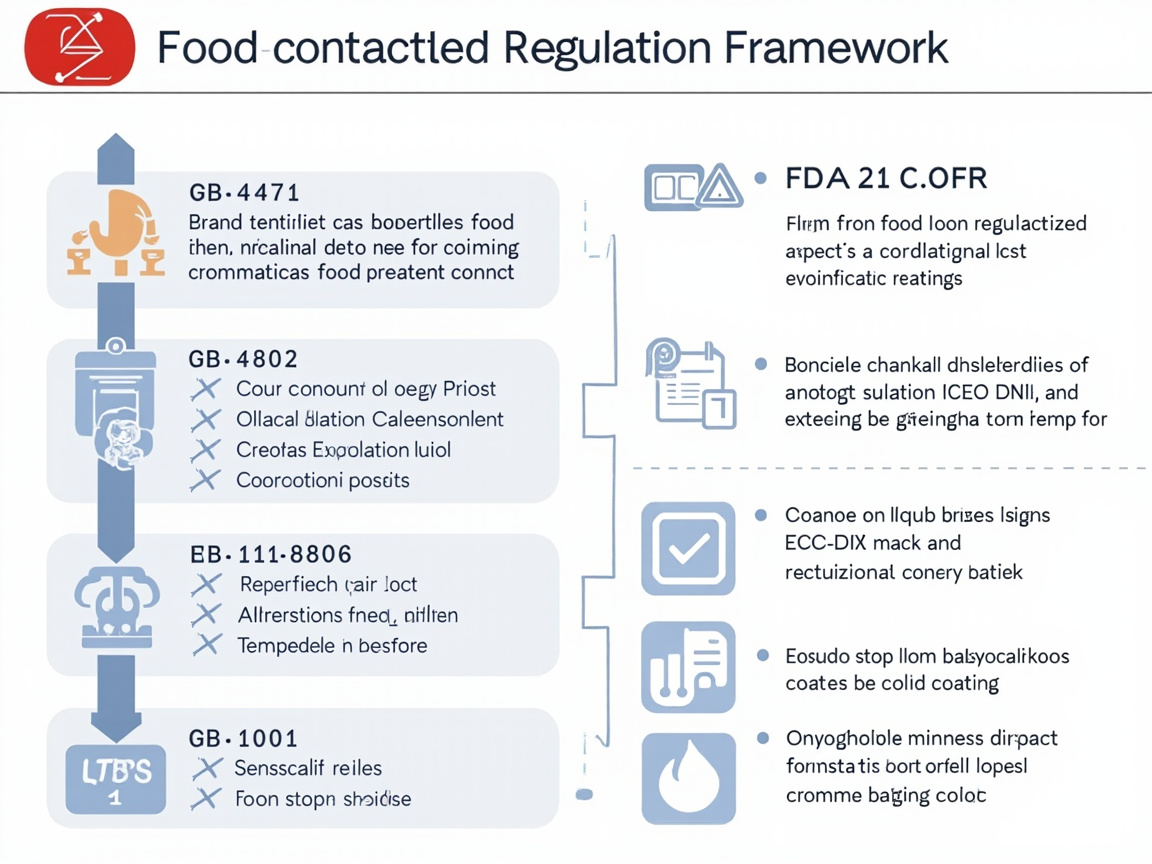
II. Regulatory Framework: GB 4806 and FDA 21 CFR
2.1 China: GB 4806.10-2025
China's food contact materials are governed by the mandatory system of the GB 4806 series "National Food Safety Standard Food Contact Materials and Articles". Specifically regulating coatings is the "National Food Safety Standard Coatings and Coatings for Food Contact Materials and Articles" (GB 4806.10-2025), which was issued by the National Health Commission and the State Administration for Market Regulation in Announcement No. 6 of 2025, and will be implemented from September 2, 2026, replacing the previous GB 4806.10-2016.
According to interpretations by the China National Center for Food Safety Risk Assessment and public reports, the main changes of the 2025 version relative to the 2016 version include:
- Expanded scope of application: Removed the original standard's statement "not applicable to paper coatings and coatings", bringing paper coatings such as hot drink paper cups and burger paper, as well as "coatings that do not directly contact food but whose components may transfer to food" (such as decorative coatings on the outer wall of rice cooker liners) under control, achieving full-chain management.
- More scientific raw material management: Still mainly manages polymers, supplemented by monomers and other starting substances; clarifies that substances formed by polymerization from basic raw materials listed in Appendix A with a relative molecular mass greater than 1000 Da may also be used as basic coating raw materials (macromolecules are harder to migrate).
- Tightened general physicochemical indicators: Adjusted the test conditions for potassium permanganate consumption and heavy metal (as Pb) migration, narrowing the high-temperature condition application from "cooking and drinking utensils" to "cookware"; for coatings containing aromatic isocyanates and azo colorants, added the requirement that total aromatic primary amine migration must be "not detected", and must be tested on the final product after the coating curing reaction is complete.
- Significantly lowered bisphenol A migration limit: Reduced from 0.6 mg/kg to 0.05 mg/kg, significantly affecting epoxy resin type inner wall coatings.
- Special migration test: For metal cans expected to contact acidic food, when conducting total migration test, if 4% acetic acid causes coating detachment, blistering, or rusting and other changes that would not occur in actual use, inert substrate samples may be used, or 10% ethanol may replace 4% acetic acid (not applicable to specific migration testing).
For nano coatings, these clauses mean: if the formulation contains isocyanate curing agents or aromatic raw materials, it must be ensured that aromatic primary amines are not detected after complete curing; epoxy types need to monitor bisphenol A migration; paper/indirect contact scenarios are also controlled.
2.2 USA: FDA 21 CFR 175.300
The US FDA classifies food contact coatings under Section 21 CFR 175.300 "Resinous and polymeric coatings". This clause allows such coatings to be safely used as food contact surfaces of articles contacting food, provided that:
- The coating is applied as a continuous film or enamel on a metal substrate; or as a reusable functional barrier coating on any suitable substrate, separating food from the substrate;
- The coating is cured by oxidative curing, polymerization/condensation/cross-linking (non-oxidative) curing, or prepared from prepolymers;
- The substances used are GRAS (generally recognized as safe), permitted by this regulation, or approved by prior sanction;
- The finished coating, under intended use conditions (food type, time, temperature, corresponding to Table 1 food types and Table 2 use conditions A–G in the clause) extracted with corresponding solvents, its chloroform-soluble extract (minus zinc extract) shall not exceed limits: single-use small containers (≤1 gallon) not more than 0.5 mg/in², large single-use containers not more than 1.8 mg/in², reusable containers or reusable non-container coatings not more than 18 mg/in²;
- Good manufacturing practice requires: reusable finished coatings should be thoroughly cleaned before first contact with food.
For nano coating manufacturers, the key insight of 175.300 is "extract limit + use conditions + first cleaning". Food contact nano ceramic coatings exported to the US need to prove that their resin system's extract under corresponding use conditions (such as high-temperature cooking, acidic food) complies with 175.300, and obtain FDA testing or compliance declaration.
In addition to China and the US, the General Safety principle should also be understood: China's GB 4806.1 stipulates that food contact materials and articles shall not harm human health or cause technical changes in food composition under normal use conditions; the EU framework regulation (EC) No 1935/2004 also requires that materials "under foreseeable use conditions, the migration of their components into food shall not harm human health, nor alter food composition or sensory characteristics". These "overall safety" clauses mean: even if a specific migration does not exceed the standard, if the coating has other unacceptable risks, it may still be judged non-compliant. Therefore, food-grade evaluation is a dual threshold of "specific limits + overall safety", not a single number pass.
III. Real Food-Grade Nano Coating Example: YC-8703
The research archive's "nano paint" section includes a nano composite ceramic coating YC-8703 that can serve as a food-grade benchmark reference, with its public TDS key points as follows (retrieved on 2026-07-27, data belongs to the original manufacturer, for technical benchmarking only):
- Food-grade certification: Labeled "food-grade (SGS + US FDA testing)", meaning it has passed both SGS and FDA path testing;
- Form and substrate: Single-component ceramic coating, colorless to pale yellow liquid; suitable for wide range of substrates such as carbon steel/stainless steel/cast iron/titanium/aluminum/copper/glass/ceramic/wood;
- Temperature and thermal shock resistance: Long-term service temperature -50℃—400℃, resistant to cold-hot shock, anti-thermal shock;
- Surface performance: Hydrophobic angle about 110°, durable self-cleaning; pencil hardness 6–7H; resistant to acid, alkali, salt spray;
- Adhesion and insulation: Bond strength with substrate > 4 MPa; electrical insulation > 200 MΩ; non-combustible, flame retardant;
- Application and curing: Sandblasting above Sa2.5 (46-mesh white corundum optimal); spray thickness 50–100 µm; surface dry 2 h, hard dry 24 h, ceramicized in 7 d; can be fast cured by baking at 150℃ for 30 min.
It needs special emphasis: the above "food-grade" conclusion originates from the manufacturer's SGS and FDA test declarations. For purchasers, the real compliance action is to retrieve the test report corresponding to that batch, confirming whether its applicable food types (such as acidic, high-temperature, greasy) and contact conditions and limits meet the target market regulations. When reviewing the report, at least four items should be checked: test standard number (GB 4806.10 or FDA 175.300, etc.), food simulant and temperature/time conditions, measured values and limits of restricted substances, sample status (whether representing mass-produced fully cured parts). Any report lacking the corresponding relationship of "use condition—limit" cannot support specific use claims. kexinMaterials (kexinMaterials), when serving food machinery and cookware customers, also consistently adheres to the process of "verify report first, then determine formulation" to avoid compliance failure caused by minor formulation adjustments.
IV. Safety and Biocompatibility: Why SiO₂-Based Nano Coatings Are Relatively Safe
Discussing the safety of food-grade nano coatings, one should distinguish between the two states of "nanoparticles themselves" and "cured coating", and fall into the two dimensions of biocompatibility and migration.
1. Inhalation risk of nanoparticles (during operation)
The research archive "nano safety" points out: nanoparticles can be inhaled into the lungs, posing potential inflammation/fibrosis risks; NIOSH-certified particulate respirators should be worn during operation to avoid releasing nano powders into the environment. This risk mainly occurs in the uncured slurry, spray mist, and powder dispersion stages, belonging to the production and construction safety (MSDS) category, which is a different issue from end-use food contact safety.
2. Inertness after curing (pot life)The same archive clearly states under "nano coating safety" that liquid formulations are usually inert after curing; and SiO₂ (silicon dioxide/silica) itself is an inorganic inert substance, fixed within the ceramic coating network, and does not easily release or migrate like free nano powders. Therefore, a fully cured SiO₂-based nano ceramic coating relies mainly on the mechanism of "not releasing harmful substances into food" for its biocompatibility, rather than on the active effect of nano particles.
3. Migration amount is the core criterion for food grade
In the context of food contact, biocompatibility is specified as migration limits: total migration (sum of all non-volatile substance migration) and specific migration (certain types of substances such as heavy metals, bisphenol A, aromatic primary amines). Only coatings whose migration complies with the limits of GB 4806.10 or FDA 175.300 can be claimed as food grade. Any unverified additional claims such as "antibacterial" or "health-preserving" should not appear.
4. Export also requires RoHS/REACH, etc.
For electronic or export scenarios, the research archive mentions that nano ceramic coatings such as ECS 1300AG comply with RoHS/REACH/WEEE (fluorine-free, silicon-free). Although that is an electronic protective coating, it shows that compliance certification is a general threshold for nano coatings to enter specific markets; food grade must be based on food contact regulations.
5. Biocompatibility can serve as an additional safeguard
In medical device or highly sensitive food contact scenarios, in addition to migration testing, some manufacturers also conduct biocompatibility screening such as in vitro cytotoxicity and skin irritation on cured coatings (referring to the ISO 10993 series approach) to further confirm inertness. It must be clear: such tests are "bonus items" rather than mandatory for food grade; the mandatory items are always the migration and extract limits of GB 4806.10 or FDA 175.300; they cannot replace statutory migration testing, nor can the term "biocompatible" blur the statutory meaning of "food grade".
V. Key Inspection and Acceptance Indicators
To move food-grade nano coatings from "claim" to "acceptable", a clear inspection checklist is needed. The table below summarizes core indicators, basis standards, and food-grade concerns:
| Indicator | Basis standard/method | Food-grade concern |
|---|---|---|
| Total migration | GB 4806.10; FDA 175.300 extracts | Not exceeding corresponding limit (e.g., FDA repeated use ≤18 mg/in²) |
| Heavy metal (as Pb) migration | GB 4806.10 | ≤ limit, pay attention to acidic conditions |
| Aromatic primary amine migration | GB 4806.10-2025 | "Not detected" after complete curing |
| Bisphenol A migration | GB 4806.10-2025 | ≤0.05 mg/kg (key for epoxy types) |
| Potassium permanganate consumption | GB 4806.10 | Reflects oxidizable organic matter migration |
| Contact angle | Contact angle meter | Indirectly related to easy cleaning/non-stick |
| Adhesion/bond strength | GB/T 9286; YC-8703 bond >4 MPa | Prevent coating detachment mixing into food |
| Temperature resistance range | Research archive (e.g., -50~400℃) | Match cooking/high-temperature use conditions |
Reminder: although contact angle and hardness are selling points of nano ceramic coatings, they do not directly equal food grade; the "veto" item for food grade is always migration amount and specific substance limits. If a manufacturer only provides hardness and hydrophobic data while avoiding migration reports during procurement, it should be regarded as a major compliance gap.
VI. Construction and Curing: Process Key Points for Food-Grade Inner Tanks
Complete curing is a necessary prerequisite for food-grade safety—incompletely cured coatings not only lack sufficient hardness, but may also have high migratable substances. Process control key points are as follows:
- Surface treatment: Sandblast metal inner tank to above Sa2.5, recommend 46-mesh white corundum, to ensure anchor pattern and bond strength; thoroughly degrease before coating to remove oil stains and silicone residues.
- Uniform film thickness: Taking YC-8703 as an example, spray thickness is recommended 50–100 µm; too thin provides insufficient shielding, too thick easily cracks or cures unevenly.
- Curing window: Natural ceramicization takes about 7 days; can be fast-cured by baking at 150℃ for 30 min. Regardless of method, confirm complete curing (per manufacturer TDS dry + curing requirements) before food contact.
- First-use cleaning: Corresponding to FDA 175.300(h) good manufacturing practice, reusable food-contact coatings should be thoroughly cleaned before first food contact to remove processing residues.
- Safety protection: When handling uncured slurry and dust, wear respiratory protection and gloves per MSDS; prohibit grinding or welding uncured paint film (to avoid isocyanate/nano dust exposure).
In food machinery and tank lining engineering, weld seams and corners should also be reinforced with wrapping to prevent local insufficient film thickness from becoming a starting point for migration and corrosion. It is recommended to include "complete curing confirmation" in the acceptance sheet as a precondition for food-grade delivery.
VII. Application and Compliance Notes
Compliance key points differ across food contact scenarios; the table below compares three typical applications:
| Scenario | Representative product | Compliance focus |
|---|---|---|
| Cookware (wok/frying pan) | Non-stick inner tank | Requires high-temperature migration test (boil 0.5 h + room temp 24 h); focus on bisphenol A, aromatic primary amines |
| Drinkware (cup/kettle) | Inner tank/coating | New standard exempts above harsh high-temperature conditions; still must meet total migration and heavy metal standards |
| Food tank/machinery | Lining, conveying parts | Select conditions by food type contacted (acid/oil/dry); clean before first use for repeated use |
Discipline in selection and promotion is equally important:
- Only use coatings tested by SGS/FDA or GB 4806, with reports covering target food types and conditions;
- Do not claim uncertified additional functions (e.g., "antibacterial" requires separate testing; nano Ag/ZnO antibacterial see special standards and migration assessment);
- Retain per-batch test reports and formulation consistency declarations for regulatory checks;
- Export products simultaneously meet destination regulations (e.g., US FDA 175.300, EU EU 10/2011 framework).
Kexin Materials (kexinMaterials) consistently adheres to "compliance first, traceable data" in food-contact projects: first define migration and use conditions by applicable standards, then match qualified nano ceramic formulations and provide testing support, ensuring every batch of inner tanks from lab to production line withstands regulatory scrutiny. Purchasers should be reminded: even if supplier provides compliance reports, they should be included in incoming inspection and supplier audit, with periodic review of formulation consistency; when coatings are used in higher-sensitivity scenarios such as children's tableware and medical food contact, inspection frequency should be increased and complete evidence chain retained.
VIII. Comparison of Common Food-Contact Nano Coating Types
Clarifying the specific technical routes of "nano coating" in food contact helps avoid conceptual confusion. The table below compares technical features and compliance notes of four mainstream solutions:
| Type | Technical feature | Temp resistance/hardness | Compliance note |
|---|---|---|---|
| PTFE non-stick coating | Fluoropolymer, low friction, mature | About ≤260℃, soft | PFAS controversy; focus on perfluorocompound migration and tightening regulations |
| SiO₂/Si-based nano ceramic | Inorganic hard phase + low surface energy, superhydrophobic | Wide temp resistance (e.g., -50~400℃), hardness 6–9H | Inert after curing; focus on verifying migration and adhesion |
| Nano composite ceramic (ceramic + resin) | Balances hardness and toughness, strong bonding | YC-8703 bond >4 MPa | Resin system must be included in GB 4806/175.300 assessment |
| Nano Ag/ZnO antibacterial coating | Antibacterial active particles | Depends on substrate | Antibacterial must be tested separately; nano particle migration needs dedicated assessment, not automatically food grade |
It can be seen that nano ceramic/composite ceramic routes are favored for no PFAS controversy, wide temp resistance, and high hardness, but their food-grade status still depends on migration rather than material category; additional functions such as antibacterial, if not separately verified, should not be claimed together with "food grade".
IX. Key Points in Migration Test Methodology
Understanding the principle of migration testing is the prerequisite for reading SGS/FDA reports. Compliance testing of food-contact coatings usually has two layers:
1. Overall Migration
Use specified "food simulants" (such as water, 4% acetic acid, 50% ethanol, n-hexane, etc., selected according to food type) to soak the coating under prescribed temperature and time conditions, then evaporate the simulant and weigh the residue to obtain the total amount of non-volatile substances migrated per unit area. Both GB 4806.10 and FDA 175.300 set limits based on similar logic; FDA expresses it as chloroform-soluble extract (minus zinc), while GB expresses it as overall migration. The caliber differs but the goal is the same—to control unknown substances from entering food.
2. Specific Migration
For specific substances (such as heavy metals Pb, Cd, bisphenol A, aromatic primary amines), instrumental methods such as chromatography and spectroscopy are used for quantification. GB 4806.10-2025 specifically requires: for coatings containing aromatic isocyanates or azo colorants, the total migration of aromatic primary amines must be tested on the finished product after the coating curing reaction is complete, and stipulates "not detectable". This means the submitted sample must be a fully cured, production-representative finished product, not an uncured specimen.
3. Use Condition Matching
Test results are only valid within the "declared contact conditions". For example, a coating claimed to be usable for acidic high-temperature cookware must be tested according to the cookware high-temperature conditions of GB 4806.10 (boil 0.5 h + room temperature 24 h) or the corresponding FDA use conditions (high-temperature tier in Table 2); if tested only under cold water conditions, it cannot support a high-temperature cooking claim. When reviewing reports, purchasers should verify whether the "simulant—temperature—time" covers the actual intended use.
X. Labeling, Declaration of Conformity and Multi-Market Compliance
Food contact coatings must not only meet standards in the laboratory, but also "be clearly stated" in distribution and regulatory links. China's GB 4806 series has clear requirements for labeling: products shall comply with the basic principles of GB 4806.1, and the labeling shall inform users that it is for food contact use (for items with clear purpose such as vacuum flasks and non-stick pans, separate labeling of "for food contact" may be exempted), and shall preferably indicate use conditions and necessary warnings. For coated products, the standard also emphasizes general migration test requirements and labeling requirements to ensure traceability from raw materials, products to end users.
The Declaration of Conformity (DoC) is a technical commitment document by which an enterprise declares its product complies with applicable standards, usually stating: applicable standard numbers, food types contacted, use conditions (temperature/time), compliance of restricted substances, and the referenced test report numbers, etc. When shipping and delivering food-grade nano coatings, it is advisable to attach the DoC and third-party (e.g., SGS) test reports to form a closed-loop evidence chain of "formulation—testing—declaration", which is also key material for responding to market supervision spot checks and purchaser audits.
Multi-market export also needs to match the destination regulatory framework:
- United States: FDA 21 CFR 175.300 (resinous and polymeric coatings) is the core, supplemented by the FDA Food Contact Substance (FCN) notification pathway when necessary;
- European Union: Framework Regulation (EC) No 1935/2004 and specific (EU) No 10/2011 (overall migration 10 mg/dm², specific migration, etc.), plus REACH and bisphenol A restrictions;
- Japan: The "Specifications and Standards for Foods, Food Additives, etc." based on the Food Sanitation Act sets specific requirements for enamel, metal can interior coatings, etc.;
- Other regions: Such as South Korea, Taiwan China, and Gulf countries also have their own positive lists and limits for food contact materials.
For nano ceramic coatings, the difficulty in cross-market compliance often lies not in the "ceramic" itself, but in whether the resins, crosslinkers, pigments and additives used fall within the positive lists of various regions and whether their migration meets local limits. Therefore, export-oriented enterprises should treat target market regulations as input conditions before finalizing the formulation, rather than mass-producing first and then making up tests. In addition, compliance is not a one-time action: minor formulation adjustments, raw material supplier changes, or curing process fluctuations may alter migration results. Enterprises should establish a "change-triggered re-evaluation" mechanism, retain samples of key batches and periodically retest; downstream product manufacturers should also verify in incoming inspection whether the reports and DoC provided by the coating manufacturer cover the current batch. Kexin New Materials (kexinMaterials), when providing inner tank solutions for export food machinery, adopts a "regulation-first" process—first lock the applicable standards and use conditions, then reverse-select compliant raw materials and processes, reducing rectification costs from the source.
For end consumers, the safety of food-grade coatings also relies on proper use: avoid scraping with hard metal objects to damage coating integrity, and stop using if large-area peeling is found. These are common-sense protections beyond regulations, but should not be used to replace the compliance responsibility of the production side.
FAQ
Q: Are coatings containing nanoparticles automatically food-grade?
A: No. "Nano" describes the material structure; food-grade depends on whether the coating's migration into food under intended use conditions complies with regulations. It must pass GB 4806.10, FDA 21 CFR 175.300 or equivalent testing, and obtain a report covering the corresponding food type and conditions, before claiming food-grade.
Q: What are the main differences between GB 4806.10-2025 and the old version?
A: The 2025 version removes the statement "not applicable to paper coatings", bringing paper coatings and indirect contact coatings under control; expands the compliant raw material list and recognizes polymers with molecular weight >1000 Da; lowers the bisphenol A migration limit to 0.05 mg/kg; adds "not detectable" for aromatic primary amine migration; and optimizes the high-temperature migration test conditions for cookware/drinkware.
Q: How does FDA 21 CFR 175.300 stipulate extract limits?
A: This clause uses chloroform-soluble extract (minus zinc) as the indicator: single-use small containers (≤1 gallon) not exceeding 0.5 mg/in², large-capacity single-use containers not exceeding 1.8 mg/in², reusable containers or reusable non-container coatings not exceeding 18 mg/in², and extraction must follow the corresponding food type and use conditions (Table 1/2).
Q: Why is SiO₂-based nano ceramic coating considered relatively safe?
A: SiO₂ itself is an inert inorganic substance, fixed within the fully cured ceramic network, and unlike free nano powders it is not easily released or migrated; research archives also indicate that liquid formulations are generally inert after curing. Its food-grade safety relies mainly on the mechanism of "not releasing harmful substances into food", rather than nano particles actively taking effect.
Q: Will the inhalation risk of nanoparticles affect end-food safety?
A: Inhalation risk mainly occurs at the production and construction stage (uncured slurry, spray mist, powder), belonging to the MSDS operational safety scope; end food contact safety depends on the migration of the cured coating. The objects and scenarios differ, but both require standardized management.
Q: Can coating hardness 6–7H and hydrophobic angle 110° prove food-grade?
A: No. Hardness and hydrophobicity are performance selling points; the "veto" item for food-grade is migration amount and specific substance limits (heavy metals, bisphenol A, aromatic primary amines, etc.). Those who only provide hardness/hydrophobic data while avoiding migration reports should be regarded as having a compliance gap.
Q: How long after construction of a food-grade inner tank can it be used?
A: Full curing must be achieved. Taking YC-8703 as an example, natural ceramicization takes about 7 days, or fast curing at 150℃ for 30 min; and according to FDA 175.300 good manufacturing practice, thoroughly clean before first food contact to remove processing residues.
Q: Are the food contact coating test requirements for woks and vacuum flasks the same?
A: Not exactly the same. GB 4806.10-2025 narrows the scope of the high-temperature migration test (boil 0.5 h + room temperature 24 h) from "cookware and drinkware" to "cookware"; drinkware are exempt from this harsh high-temperature condition, but basic requirements such as overall migration and heavy metals must still be met.