Key Takeaways:
1. Wind turbine blade tip speeds reach 80-100m/s — raindrop water hammer pressure exceeds 100MPa (surpassing most metal yield strengths). Nano-PU topcoats with graphene/CNT/SiO₂/Al₂O₃ nano-fillers reduce leading edge erosion 60-85%, improve lift-to-drag ratio 62% (Results in Engineering 2025).
2. TiO₂ pigment/binder ratio P/B=0.6 is the optimal rain erosion resistance parameter (Tribology International 2025). Nano-hybrid PU (CNT/rGO+SiO₂+Al₂O₃) reduces erosion depth 75-85% with integrated photothermal de-icing (CNT/rGO +10% photothermal conversion).
3. Leading edge protection represents ~15-20% of wind turbine O&M costs — the single largest protective coating expense. Global wind blade coating market ~$1.2B (2025), CAGR 9.5%.
A 5MW offshore wind turbine blade tip at rated speed reaches 80-100m/s (~290-360km/h — approaching F1 racing speeds). At these velocities, 1-2mm raindrops striking the leading edge generate “water hammer pressure” exceeding 100MPa — surpassing most metal yield strengths. Wind blade anti-erosion nano polyurethane topcoats endure hundreds of millions of raindrop and sand particle impacts annually — one of nature’s most extreme micro-particle erosion scenarios.
Rain Erosion Mechanics — Why “Soft Water Droplets” “Punch Through” Tough Coatings
Direct Answer: Raindrop impact is not “static pressure” — it’s “water hammer.” Upon impact at 80-100m/s, the raindrop base compresses forming a high-pressure water film — peak pressure P=ρ·c·v (ρ=1000kg/m³, c=1500m/s water sound speed). At v=90m/s, P≈135MPa. This pressure pulse propagates as stress waves through the coating (PU sound speed ~2000m/s), reflects at the coating-substrate interface as tensile waves — when tensile stress exceeds coating cohesive strength or adhesion — micro-cracks initiate. Billions of fatigue cycles — micro-cracks propagate and coalesce — coating spalls as micro-fragments — the characteristic “saw-tooth” leading edge erosion morphology.
Nano-Filler Toughening Mechanisms: (1) Graphene/CNT crack deflection — 2D/1D nano-fillers form “nano-rebar networks” forcing impact cracks along tortuous nano-filler/PU interfaces — fracture path extended 3-5× — KIC improved 40-80%. (2) SiO₂/Al₂O₃ stress dispersion — spherical nanoparticles act as “microscopic stress distributors” uniformly transferring concentrated impact stress. (3) Nano-filler/PU interfacial slip energy dissipation — nanoscale slip at interfaces frictionally dissipates impact kinetic energy as heat. (4) TiO₂ UV protection — anatase/rutile nano-TiO₂ absorbs UV (<390nm) blocking PU photo-oxidative degradation chain reactions.
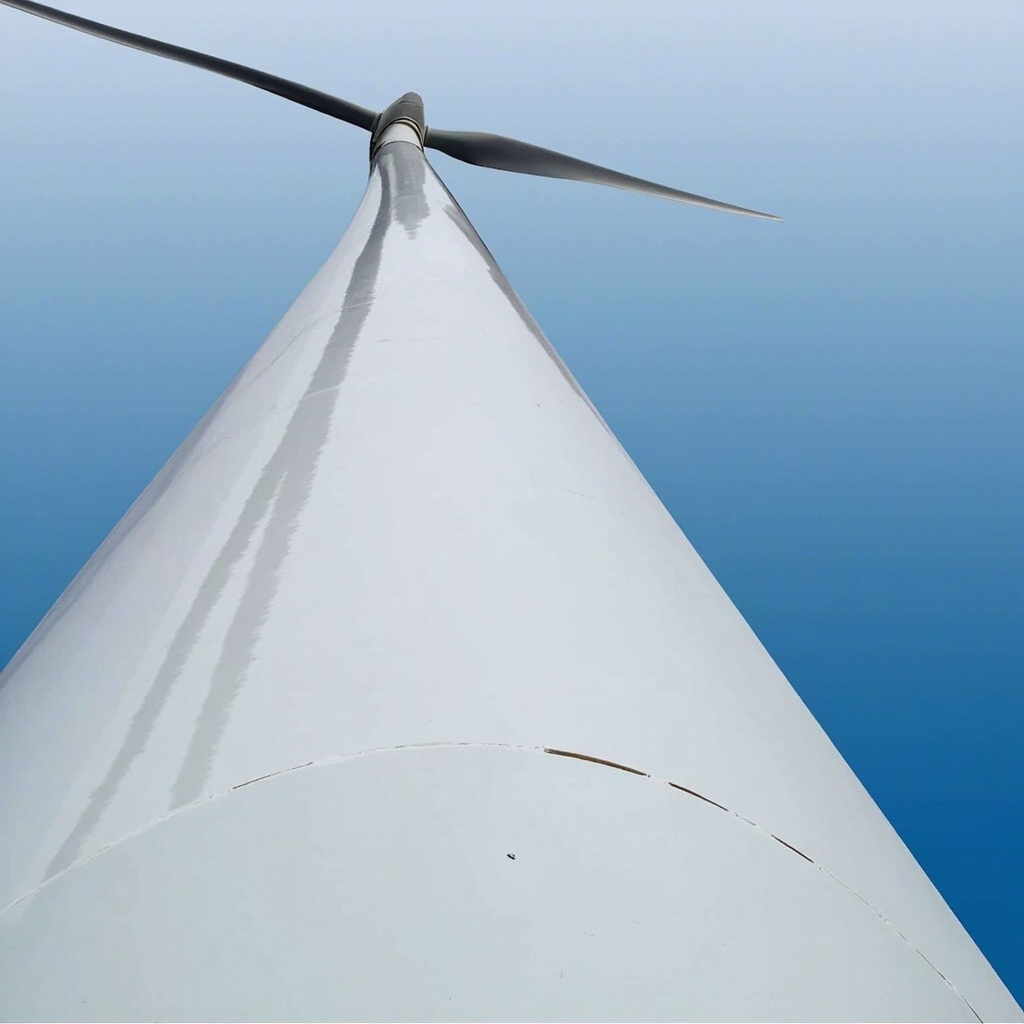
Data Support: Results in Engineering (Alajmi & Ramulu 2025): graphene IA-700+PU multi-layer — 60% erosion reduction, 62% lift-to-drag improvement. Tribology International (Sun, Cao, Duan 2025): TiO₂ P/B=0.6 optimal — “honeycomb” surface morphology prolongs erosion incubation period ~3×. Polymer Korea (Choi & Hwang 2025): CNT/rGO+SiO₂(0.1wt%)+Al₂O₃(0.05wt%) hybrid PU — tensile elongation +25-35%, adhesion +80-100%, erosion depth -75-85%, photothermal de-icing +10%.
Sources: Results in Engineering (2025), Tribology International (Vol.211, 2025), Polymer Korea (2025)
FAQ
Q: Wind blade coating service life?
Onshore: 3-5yr. Offshore: 2-4yr (salt spray+higher wind+harder access). Nano-modified PU extends maintenance interval ~30-50% vs traditional PU.
Q: Why is leading edge erosion far worse than trailing edge?
Tip speed differential — blade tip (r/R=1.0) linear velocity is 2× mid-blade (r/R=0.5) — impact energy ∝ v² — tip erosion intensity 4× higher. Additionally, tip angle of attack is shallower — raindrops impact closer to perpendicular (0° — worst erosion angle).
References: Results in Engineering (2025), Tribology International (2025), Polymer Korea (2025)
Deep Rewrite: July 6, 2026