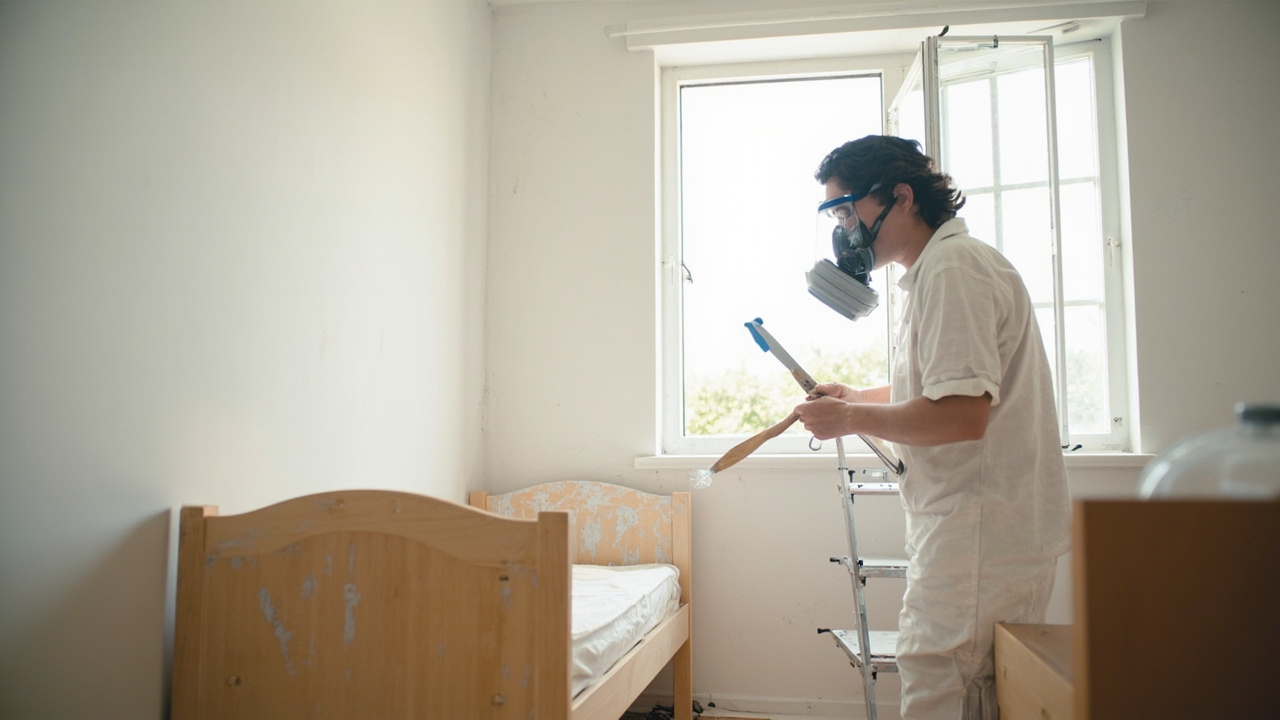
"Water-based paint has no smell, so it must be safer than paint" "You can move in right after applying water-based coating in a children's room" — such claims keep appearing in the renovation market, furniture factories, and e-commerce product pages, almost becoming common sense. But as professionals in the coating industry, we must remind you: low odor does not mean no risk; low smell does not equal zero emission. The reason water-based coating is labeled "safe" is that it replaces most organic solvents with water, and its total VOC is significantly lower than traditional oil-based paint, which is a fact; but once "low odor" is directly equated with "absolutely safe," consumers, purchasers, and applicators will step into pitfalls in enclosed and sensitive scenarios such as children's rooms, bedrooms, and classrooms.
What this article aims to do is to break down the question "Is water-based coating safe?" into parts: besides water, what else is in water-based coating? Are odor and toxicity the same thing? What indicators should be focused on in children's scenarios? Why is ventilation still necessary in enclosed spaces? We hope to use a solid technical breakdown to help factories, furniture manufacturers, painting teams, and purchasers build a rational awareness of "checking indicators, reports, and standards," rather than staying at the intuition of "feeling reassured if you can't smell it."
As a supplier of water-based wood and industrial coating systems, Kexin New Materials (kexinMaterials) has accumulated a large amount of measured data in the development of water-based resin formulations and low-odor, low-emission products. The key points about VOC, additives, and children's scenarios in this article also come from our real verification in multiple furniture and coating projects. If you are selecting products for children's furniture, indoor woodwork, or enclosed spaces, you can also refer to our wood coating product system to match more suitable water-based solutions by scenario.
I. Why "Low Odor" Is Misread as "Safe"
Odor comes from the stimulation of olfactory nerves by volatile substances, while toxicity comes from the actual harm pathways of substances to human health. The two overlap, but they are by no means the same thing.
- Having an odor does not necessarily mean toxicity: Some substances with low toxicity or even minimal actual harm have a strong smell, such as some food-grade fragrances.
- Having no odor does not necessarily mean non-toxic: Carbon monoxide, radon, and some low-molecular-weight organic compounds have almost no odor at low concentrations, yet they pose clear hazards to the nervous or hematopoietic systems.
- The low odor of water-based coating mainly comes from "a significant reduction in solvent usage": Traditional oil-based paint relies on strong volatile organic solvents such as toluene, xylene, and acetates to dissolve the resin and help film formation; these solvents have heavy odors and strong irritation. Water-based coating replaces the medium with water, so the odor naturally drops significantly.
Therefore, the "low odor" of water-based coating is a real advantage over oil-based paint, but it only indicates "low irritation and good subjective experience," and cannot directly deduce that "all harmful substances are zero." A true safety judgment must return to specific substances, specific limits, and specific scenarios.
II. What Exactly Is in Water-Based Coating: From Water to Various Additives
To answer "Is water-based coating safe?", one must first understand what a bucket of water-based coating consists of. A typical water-based wood coating or water-based industrial coating formulation roughly includes the following parts:
- Water (main dispersion medium): Accounts for a large proportion of the formulation and is the fundamental source of low odor and low flammability.
- Water-based resin (film-forming substance): Acrylic emulsion, water-based polyurethane dispersion (PUD), water-based alkyd, water-based epoxy, etc., determining film performance.
- Pigment/filler: Provides color and hiding power; quality products control harmful heavy metal content.
- Film-forming additive (coalescent): Enables resin particles to fuse into a continuous film at room temperature; one of the most noteworthy VOC sources in water-based coating.
- Various processing additives: Dispersants, wetting agents, defoamers, thickeners, preservatives, pH adjusters, etc., used in small amounts but with many types.
- Small amount of co-solvent: Some systems add a small amount of glycol ether solvent to improve freeze-thaw stability and film formation.
2.1 Water Is Not a "Universal Safety Card"
Water is safe, but water is only the medium. What truly determines film performance and some safety attributes are the resin and additives dispersed in the water. Simply understanding "water-based" as "just water plus pigment" is a severe oversimplification of formulation science. Water-based resin itself is mostly a macromolecular polymer, stable and not prone to release after film formation; the problem lies in those small-molecule additives added to make it "applicable, film-forming, and stably stored."
2.2 Film-Forming Additives: The "Hidden VOC" Behind Low Odor
For water-based coating to fuse resin emulsion particles into a continuous, dense film at room temperature, these particles must first be "softened." The role of film-forming additives (commonly such as texanol, propylene glycol methyl ether, dipropylene glycol butyl ether, etc.) is to temporarily lower the minimum film-forming temperature of the resin, allowing particles to coalesce into a film at room temperature, after which it should gradually volatilize. The problem is:
- Many of these additives fall within the VOC category, only their odor is much milder than oil-based solvents;
- Volatilization rate is affected by temperature, humidity, and ventilation, and may linger longer in enclosed, low-temperature, high-humidity environments;
- Quality formulations reduce usage through means such as "low-VOC film-forming additive substitution" and "core-shell structure emulsion to lower film-forming temperature."
Therefore, among "water-based coatings," a cheap product using a high proportion of traditional glycol ether additives and a product optimized with low-VOC additives may have significantly different indoor air quality after application — and both may smell "not much." This is the core technical reason why "odor ≠ safety."
2.3 Preservatives and Biocides: A Concern Specific to Water-Based Systems
Because water is the medium, water-based coating is more prone to bacteria and mold growth during storage and transportation than oil-based paint, so preservatives (such as BIT, MIT, or isothiazolinone classes) are usually added to the formulation. Some preservatives are safe at low concentrations but may cause sensitization in sensitive populations (children, allergy-prone); a few preservatives used in older formulations are controversial. When selecting indoor, especially children's scenario products, it is reasonable to pay attention to whether "low-sensitivity preservative" or "formaldehyde-release-free preservation" is labeled.
2.4 One-Sentence Summary of Formulation Truth
The "safety" of water-based coating comes from the grand architecture of "replacing oil with water," but it is not a cup of pure water; among it, film-forming additives, small amounts of co-solvents, and preservatives are the items that truly need limit-checking and report-checking. Low odor only removes the most pungent part, not meaning all these small molecules are cleared to zero.
III. Water-Based vs. Solvent-Based: Comparison of Key Safety Indicators
Putting the two systems in the same table gives a more intuitive view of where "water-based is safer" is actually safe, and where it is not safe enough.
| Comparison Dimension | Water-Based Coating (Typical) | Solvent-Based (Oil-Based) Paint (Typical) | Description |
|---|---|---|---|
| Main dispersion medium | Water | Organic solvents such as toluene, xylene, acetates | Water-based has significantly lower flammability and irritation |
| Odor intensity | Low | High, pungent | Water-based has better subjective experience |
| Total VOC | Lower (still contributed by film-forming additives, etc.) | High | Water-based has clear advantage, but not zero |
| Flammability risk | Low | High (solvents are flammable) | Safer for storage, transport, and application |
| Free diisocyanate | Most systems none | Two-component polyurethane contains | Water-based systems more friendly |
| Heavy metal risk | Depends on pigment and control | Depends on pigment and control | Unrelated to system, depends on formulation |
| Application protection requirement | Still needs ventilation, mask recommended | Mandatory strong ventilation, professional protection | Water-based has lower threshold |
| Suitability for children's scenarios | Relatively better (still need to select right indicators) | Generally not recommended | Water-based more suitable but not unconditionally safe |
The key point this table conveys is: Water-based coating is comprehensively superior to oil-based paint in odor, total VOC, flammability, and application friendliness, which is the fundamental reason it is worthy of use in indoor and children's scenarios; but between "lower VOC" and "zero risk," there are still several checkpoints of film-forming additives, preservatives, heavy metals, and ventilation conditions.
IV. Children's Scenarios: Why Standards Must Be Stricter
Children are not "smaller adults." They have higher respiratory rates and larger intake per unit body weight, more frequent biting and hand-mouth contact behaviors, and their immune and nervous systems are still developing, so their tolerance for harmful substances in coatings is far lower than that of adults. Children's rooms, kindergartens, schools, children's furniture, and toy contact surfaces are where the "safety myth" of water-based coating is most likely to cause problems.
4.1 Heavy Metals: One of the Indicators to Watch Most in Furniture Coating
Whether water-based or oil-based, pigments and fillers may introduce heavy metals. Key ones to focus on include:
- Lead (Pb): Affects neurological development; under older standards, some bright pigments once contained lead, now strictly restricted;
- Cadmium (Cd): Cumulative toxicity, damages kidneys and bones;
- Chromium (Cr, especially hexavalent chromium): Sensitization and potential carcinogenic risk;
- Mercury (Hg): Neurotoxicity.
For children's furniture, toys, and mouth-contact components, particular attention must be paid to heavy metal limits. Domestically, there are dedicated hazardous substance requirements for wooden toys and children's furniture; export products must also meet EU EN 71-3 (migratable heavy metals), US ASTM F963, etc. When choosing water-based coating, one cannot rely solely on the word "water-based"; it must be confirmed whether the pigment system and overall formulation meet child-related limits.
4.2 The "Cumulative Effect" in Enclosed Spaces
Children's rooms and bedrooms are often small in area, have few ventilation windows, and high furniture density. Even if the VOC of a single can of water-based coating is not high, when wall paint, wood coating, floor paint, and adhesives release simultaneously in the same enclosed space, VOCs from multiple sources accumulate. Coupled with children's prolonged stay and breathing close to beds and walls during sleep, the cumulative exposure cannot be ignored. This is why, even in enclosed spaces where water-based coating is applied, emphasis is placed on "ventilation and airing + sufficient curing period" rather than "odorless means habitable".
4.3 Question the "Immediately Habitable" Claims
The market frequently uses slogans like "move in right after painting" or "move in the same day", which mostly refer to the sensory experience at the odor level and do not equate to comprehensive air quality compliance. The rational approach is: base judgments on ventilation duration, third-party air quality testing, and measured VOC and heavy metal data in product test reports, rather than on "can't smell anything". For infant rooms, it is recommended to allow a longer airing and curing cycle, and conduct indoor air testing before occupancy.

Five, Enclosed Spaces Still Require Ventilation: Mechanism and Recommendations
Many people think "water-based coating has no odor, so it's fine to close the windows", which is dangerous. There are three reasons:
- Coalescing agent volatilization takes time: After water-based coating is applied, the resin particles coalesce and auxiliaries migrate outward and volatilize as a process, which at normal temperature and humidity may last from several days to weeks; ventilation accelerates their departure from the paint film and indoor air.
- Humidity and temperature govern release speed: Low temperature and high humidity slow down drying and volatilization, while enclosed and unventilated conditions allow released substances to accumulate in the indoor volume.
- Multi-source superposition: As stated earlier, releases from walls, woodwork, floors, and adhesives superimpose; ventilation is the only cheap and effective means to dilute the superimposed concentration.
Practical recommendations: During construction and for at least 7–15 days after coating, keep windows open for ventilation (reduce appropriately on rainy or extremely humid days); for furniture factory water-based coating, it is recommended to use a constant-temperature curing room with ventilation; before occupancy, air testing for rooms of infants and allergy sufferers is safer. Treat "ventilation" as part of acceptance, not a subjective judgment of "smell or not".
Six, How to Read Labels and Test Reports: Putting "Safety" on Paper
"Safety" cannot rely on advertising slogans; it must be grounded in verifiable hard indicators. When purchasing water-based coating (especially for children and indoor scenarios), it is recommended to check the following items one by one:
6.1 Core Indicators
- VOC content: Look at the measured value in the test report and compare it with the limit of the corresponding product standard (such as relevant national standards for water-based wood coating and water-based architectural coating). Note the distinction between "VOC content (g/L)" and "emission amount" concepts, which have different test methods.
- Free formaldehyde: Some preservatives or auxiliaries may release formaldehyde; pay attention to whether "formaldehyde-release-free preservation" is labeled.
- Heavy metals (migratable): Lead, cadmium, chromium, mercury, etc.; for child-related products, especially look at migratable amounts.
- APEO (alkylphenol ethoxylates): A class of auxiliaries with environmental hormone risks; some eco-friendly standards require restrictions, pay attention to whether "APEO-free".
- Odor and sensitizing preservatives: High-end indoor products will label low odor and low-sensitivity preservation.
6.2 Labels and Certifications
- Ten-ring Certification (China Environmental Label): Has stricter requirements for VOC, heavy metals, etc., and is one of the references for indoor material selection;
- Green Product Certification / Low VOC Label: Look at the specific standard and scope of application;
- Compliance with child-related standards: If the product claims suitable for children's furniture/toys, it should provide test reports of corresponding standards;
- Source of test report: Prioritize third-party reports from institutions with CMA/CNAS qualifications, rather than manufacturer's self-statements.
The key to reading reports is not to look at the word "qualified", but to see "how far the measured value is from the limit". A product with measured VOC only one-third of the limit, and one that passes by clinging to the limit, offer different long-term living experiences.
Seven, Purchase Checklist: Indoor and Children Scenarios
Turn the above into a directly usable purchase checklist:
- Identify system: For indoor woodwork/children's furniture, prioritize water-based wood coating or water-based polyurethane; for walls prioritize water-based architectural coating. You may combine architectural coating product system to select by location.
- Check limits: Request and verify third-party measured reports for VOC, free formaldehyde, heavy metals, APEO.
- Ask about auxiliaries: Confirm use of low-VOC coalescing agents, low-sensitivity preservatives, APEO-free.
- Match standards: For children's furniture/toy surfaces, confirm compliance with child-related hazardous substance standards.
- Manage construction: Even if water-based, maintain ventilation, control film thickness, and allow curing period.
- Test air: For sensitive rooms, conduct indoor air quality testing before occupancy, using data instead of "smelling".
- Avoid exaggeration: Be alert to absolute claims like "zero VOC", "paint and live immediately", "absolutely non-toxic", and require report support.
Eight, Common Myths Debunked One by One
Myth 1: Water-based coating with no smell means zero VOC. Wrong. Coalescing agents and small amounts of cosolvents still contribute VOC, just with low odor. Look at the measured VOC value in the report.
Myth 2: Children's room painted with water-based coating can be occupied immediately. Not necessarily. Water-based reduces risk, but release and superposition still require ventilation and curing; infant rooms are better occupied after air testing.
Myth 3: Water-based coating contains no heavy metals. Wrong. Heavy metals mainly come from pigment fillers, unrelated to water-based or solvent-based systems; the key is formulation control and standard compliance.
Myth 4: Odor gone means safe. Not necessarily. Some low-odor VOCs and auxiliaries volatilize slowly, and enclosed spaces have multi-source superposition; ventilation and testing should be the basis.
Myth 5: More expensive water-based coating is safer. Price and safety are not strictly positively correlated. What is truly credible is the measured data in test reports and standard compliance, not price.
Myth 6: Water-based coating construction needs no protection. Wrong. Although more friendly than solvent-based, ventilation, masks, and gloves remain basic actions, especially for batch construction and enclosed spaces.
Myth 7: All water-based coatings are suitable for children's furniture. Wrong. It must be confirmed that the product meets child-related hazardous substance standards and uses low-sensitivity auxiliaries and controlled heavy-metal pigments.
Nine, Cooperation with Kexin New Materials: Making "Safety" a Deliverable Standard
Returning to selection and delivery, Kexin New Materials (kexinMaterials) suggests: turn "safety" from a slogan into a set of verifiable indicators and processes.
- Select by scenario: For children's furniture and indoor woodwork, prioritize low-odor, low-emission water-based wood systems; for occasions with higher performance requirements, evaluate water-based polyurethane wood coating (PU wood coating) for its advantages in hardness and wear resistance, while confirming its VOC and auxiliary control meet indoor standards.
- Want reports, not slogans: We provide furniture factories and purchasers with third-party test data corresponding to product standards, putting VOC, heavy metals, APEO, and free formaldehyde on paper, to facilitate establishing procurement acceptance thresholds.
- Control construction and curing: Even if water-based, it is recommended to combine ventilation, film thickness control, and curing period, incorporating the "release curve" into delivery standards, rather than accepting by "can't smell".
- Establish enclosed space standards: For kindergartens, schools, children's rooms, it is recommended to include indoor air testing in delivery clauses, using data to close the loop on "safety" commitments.
In one sentence: Water-based paint is indeed safer than oil-based paint, but its safety lies in "metrics and standards," not in "odor and intuition." The path validated by Kexin New Materials in multiple furniture and interior projects is precisely the trinity of "choosing the right system + checking actual test reports + managing construction ventilation," rather than treating "odorless" as the endpoint.
X. Pre-occupancy Self-check List for Children's Rooms and School Scenarios
Turn the above into a directly executable "pre-occupancy self-check," suitable for kindergartens, schools, and children's room projects:
- Check reports: Whether third-party measured values of VOC, free formaldehyde, heavy metals, and APEO meet standards, and whether they are within children-related standard ranges;
- Look at labels: Whether there is the Ten-ring or other low-VOC/green label, and whether the scope of application covers children's scenarios;
- Verify additives: Whether low-VOC film-forming aids, low-sensitivity preservatives, and APEO-free formulations are used, and whether the supplier can explain;
- Verify ventilation: Whether ventilation during and after application is ≥7–15 days, and whether extended for low temperature and high humidity;
- Test air: Conduct indoor air quality testing before occupancy (focus on total VOC and formaldehyde); recommended as mandatory for infant rooms;
- Keep records: Archive product batch number, test report, ventilation duration, and air test results for traceability.
The value of this list lies in: turning "safety" from an intuitive phrase of "odorless" into six verifiable and archivable actions. For Kexin New Materials, this is also our standard action when delivering to children's furniture and engineering clients—using a data closed loop, not soothing with odor.
FAQ
1. Is water-based paint really safer than paint?
Overall, yes. Water-based paint uses water as the medium; its total VOC, odor, flammability, and construction irritation are significantly lower than solvent-based paint, and it has no risk of free diisocyanate from two-component polyurethane, thus more suitable for indoor and children's scenarios. But it is not zero-risk; attention is still needed on film-forming aids, preservatives, and heavy metals.
2. If water-based paint is odorless, can I move in right away?
Not recommended to directly equate with "occupiable." Low odor only means fewer irritating solvents; film-forming aids and the like will still continuously release for days to weeks, and multi-source accumulation in enclosed spaces requires more ventilation. For infants and allergy-prone rooms, it is recommended to reserve a curing period and conduct air testing before occupancy.
3. Why does water-based paint still contain VOC?
Because water-based resin film formation requires film-forming aids (such as alcohol esters, alcohol ethers) to temporarily soften emulsion particles; these aids are mostly VOC, only with milder odor than oil-based solvents. Premium formulations use low-VOC aids to reduce usage, but it is hard to be absolutely zero.
4. For children's furniture using water-based paint, which indicator matters most?
The two groups to watch most: one is release-type indicators such as VOC, free formaldehyde, APEO; the other is migratable heavy metals such as lead, cadmium, chromium, mercury, because children have biting and hand-mouth contact behaviors. Also confirm the product complies with children's furniture/toy related hazardous substance standards.
5. Are heavy metals only in paint, not in water-based paint?
No. Heavy metals mainly come from pigments and fillers, unrelated to water-based or oil-based systems. Water-based paint may also contain heavy metals; the key is formulation control and standard compliance. When purchasing, check the measured heavy metal values in the test report.
6. How to judge whether a water-based paint is truly safe?
Don't look at advertising words; look at third-party test reports: verify measured values of VOC, free formaldehyde, heavy metals, APEO and corresponding standard limits; confirm whether there are environmental labels such as the Ten-ring; for children's scenarios, additionally confirm compliance with children-related standards. The farther the reported measured value is from the limit, the safer.
7. For an enclosed children's room painted with water-based paint, how long to ventilate?
During construction and after application, at least 7–15 days of ventilation is recommended, longer in low-temperature and high-humidity environments; furniture factories can use constant-temperature curing rooms with air exchange. Before occupancy, indoor air quality testing for infant rooms is safer, using data instead of "smelling."
8. Is mask still needed for water-based paint construction?
Basic protection is needed. Although friendlier than oil-based paint, it still contains film-forming aids and small amounts of co-solvents; batch or enclosed-space construction should be ventilated and wear masks and gloves to avoid long-term inhalation and skin contact.
9. Can "zero VOC" "paint and live immediately" be trusted?
Be alert to absolute claims. "Zero VOC" is hard to strictly hold in systems containing film-forming aids; "paint and live immediately" mostly refers to odor experience, not equivalent to comprehensive air quality compliance. It is more reliable to require suppliers to support claims with test reports.
10. How does Kexin New Materials' water-based paint help control safety risks?
Kexin New Materials (kexinMaterials) provides low-odor, low-release water-based wood and industrial systems, with third-party test data, putting indicators such as VOC, heavy metals, and APEO on paper; meanwhile recommends incorporating ventilation curing and indoor air testing into delivery standards, using the "choose right system + check reports + manage construction" closed-loop safety commitment.
Further Reading
- Formulation Science and Application of Water-based Wood Coatings: A full explanation of wood water-based transformation from resin systems to film-forming mechanisms, supplementing the technical details of the "film-forming aids and additives" section in this article.
- High-end Solid Wood Furniture Nano Water-based Paint—Wear-resistant and Child-friendly Scenarios: Application reference of water-based paint for children and high-end indoor woodwork, extending the material selection thinking of "children's scenarios" in this article.
- Water-based Industrial Coating VOC Compliance GB30981: Limits, Testing and Response: Putting "safety" into mandatory limits and testing caliber, a standardized reference for the "check reports" part of this article.
- Safety of Nano Coating (MSDS): Nanoparticle Inhalation Risk and Protection
- Isocyanate Safety: Sensitization Mechanism, PPE and Spray Booth Ventilation (MSDS Core)