In metal coatings, mirror silver paint and electroplated gold effect coatings have long occupied a core position in high-end appearance treatment, not because they are "shiny," but because they possess a metallic authenticity that can be instantly recognized by human vision. From automotive interior parts, home appliance panels, and jewelry accessories to art objects and display fixtures, whenever the design goal is to "capture attention at first glance," these two types of metallic coatings are almost irreplaceable. Especially in scenarios where real electroplating or metal part machining is inconvenient, paint-form metallic optical coatings, with their extremely high freedom and lower manufacturing threshold, have become the mainstream choice for industrial designers and appearance engineers.
Among numerous metallic coating systems, the mirror silver effect is a visual expression approaching "optically graded mirror surface". It utilizes high-reflectivity metallic pigments and a flat coating film to construct a reflective surface close to a real mirror, allowing incident light to return to the observer's line of sight with almost no scattering, thereby giving the coated object a sense of spatial extension and a hard metallic feel. In contrast, the electroplated gold effect coating emphasizes "precious metal temperament" rather than mirror grade. Through precise control of metallic luster, transparent dye layers, and coating thickness, it simulates the warm hue, soft reflection, and full layering of real electroplated gold, making it widely used in high-end decorative parts and products that emphasize a sense of identity.

1. Optical Logic and Formation Mechanism of Mirror Silver Effect Coatings
The mirror silver coating is not a "color," but an "optical behavior."
Its core principle can be summed up in one sentence: Let the light reflect back, instead of being absorbed or scattered.
To achieve this, at least three conditions must be simultaneously met in the coating system:
1)High-reflectivity metal particles
Commonly used are high-purity aluminum powder or metallized mica, whose flake-like structure can align like countless tiny mirrors, causing specular reflection of light.
2) The coating surface must be extremely smooth
Once the surface becomes rough, light will scatter irregularly, and what the human eye sees is not a "mirror," but a "bright gray" or "silver powder" appearance.
Therefore, in mirror silver coating, basecoat leveling and topcoat flow leveling are the determining factors, not the pigment itself.
3) Must be sealed and protected with high-transparency clear varnish
The silver layer itself is extremely thin and highly susceptible to oxidation or scratching. The high-gloss transparent topcoat not only provides mirror-like tension but also prevents air from contacting the metal, maintaining long-term optical integrity.

II. Simulation Principle and Color Control of Electroplated Gold Effect Coatings
Unlike mirror silver, which pursues "colorless reflection," the electroplated gold effect coating is an optical structure of "colored metallic luster."
The focus it simulates is not a mirror, but the color temperature, saturation, and soft luster of precious metal gold. Its basic compositional logic can be understood in three layers:

1)Basic Metallic Luster Layer
Usually high-gloss aluminum powder or specially formulated metallic pigment, ensuring the presence of a metallic luster base, equivalent to a "glowing undercoat".
2) Hue modulation layer (determines whether it looks like real gold)
Through transparent yellow, transparent amber, red-yellow compound dyed clear lacquer, etc., the metallic luster is "colored without obscuring",
giving it the warm tone and depth of layer that real metallic gold possesses.
——Done well, it looks like "the metal's inherent gold";
——Done poorly, it looks like "yellow paint".
3) Gloss control of the clear coat layer
Electroplated gold is not always high-gloss; some luxury-grade plated parts appear as "satin gold," "silky gold," or "matte frosted gold,"
all of which are achieved through gloss adjustment of the final clear coat system, rather than directly through pigments.
Compared with mirror silver, the optical objectives of electroplated gold can be summarized as three differences:
| Dimension | Mirror Silver | Electroplated Gold |
|---|---|---|
| Visual Goal | Ultimate reflection, close to mirror | Precious metal temperament, warm metallic feel |
| Key Factors | Base flatness + reflectivity | Hue accuracy + layer thickness |
| Success/Failure Defects | Once scattered, it "doesn't look like a mirror" | Once color is distorted, it "looks like paint" |
3. Selection Logic Between Mirror Silver and Electroplated Gold in Product Design
Designers do not randomly choose silver or gold, but match the metal appearance according to the product's "expressive intent."
You can understand the differences in their application from three judgment dimensions:
1) Visual Attribute Goal — "Cold" or "Premium"
Mirror silver belongs to the cool-toned metal family, carrying a sense of technology, futurism, and machinery, commonly seen in
- smart hardware
- automotive interior parts
- high-end display props
- Structural component housing
It conveys "precision, rationality, and hardcore."
Electroplated gold is a warm-toned metal that signifies status, a sense of value, and decorative appeal, and is commonly used in
- Home appliance decorative strips, LOGO nameplates
- Cosmetic containers and luxury outer components
- Home hardware, furniture accessories
It conveys "noble, decorative, high-end".
2) Interaction Distance — Viewed from Afar or Up Close
- Mirror silver is generally suitable for "long-distance visual impact" — its brightness and reflectivity draw attention to its presence.
- Electroplated gold is more suitable for "close-range perception" — its color and soft sheen create a sense of quality.
3) Material Limitations and Cost Trade-offs
When real electroplating cannot be adopted (due to environmental protection, cost, material limitations, regulations, etc.),
coating-type silver mirror or metallic gold coating becomes an alternative solution, giving
non-metallic materials such as plastic, wood, ceramics, and stone a metallic appearance,
expanding design freedom and keeping manufacturing costs controllable.
Therefore, it can be said that:
Mirror silver is "to make the product look like metal", while electroplated gold is "to make the product look like a precious metal".
IV. Industry Trends, Environmental Constraints, and Technology Evolution Directions
As the coating field gradually shifts from "effect-driven" to "regulation-driven + quality-driven",
the technical pathways for mirror silver and electroplated gold coatings are undergoing three obvious shifts:
(1) From "can be done" to "can be done stably over the long term"
In the past, simply being able to produce bright silver or gold was considered a success, but as consumer brands and weather resistance requirements have increased,
stability against corrosion, yellowing, scratching, hand sweat, and cleaning agents has become the evaluation criterion.
——Appearance is only the ticket; stability determines whether mass production is possible.
(2) From "Solvation" to "Environmental Compliance"
Coatings from electroplating alternative processes are widely used in the plastics and home appliance sectors, which are already subject to
regulations such as VOC limits, REACH/SVHC, ROHS, California 65, and green certification for home appliance manufacturing.
Whether a product "can be exported and can be marketed" has become a real threshold.
Therefore, water-based systems, low-VOC, high-solid, and heavy-metal-free formulations are rapidly replacing traditional systems.
(3) From "Visual Replication" to "Carrier of Emotional Design"
In the past, metal coatings merely served the purpose of "looking like metal"; now they bear the expression of product positioning.
The choice designers make between silver mirror and metallic gold is essentially a choice between the consumer perceptions of "cold rationality" or "warm luxury."
——Metal coatings are no longer just a surface, but a part of constructing brand language.
Under the combined influence of regulations, design, and manufacturing, mirror silver and electroplated gold coatings have evolved from
"visual effect materials" into "industrial brand perception tools."
Their existence is centered on the core value of "what the human eye believes," and is achieved through coating engineering.
V. Conclusion
Whether it is the cold mirror silver or the noble electroplated gold, the reason they have been repeatedly used in industrial design and branded products over the long term is not because of the color, but because they precisely capture human psychological perception of metal:
Mirror silver represents "the sense of pure reflective reality," and electroplated gold represents "the social sense of value symbol."
In situations where real metal processing or true electroplating cannot be used, coating-type metallic optical coatings achieve industrial replication of "visual authenticity" with the advantages of controllable cost, mass manufacturability, and compatibility with multiple materials, making it a permanent solution in high-end appearance engineering.
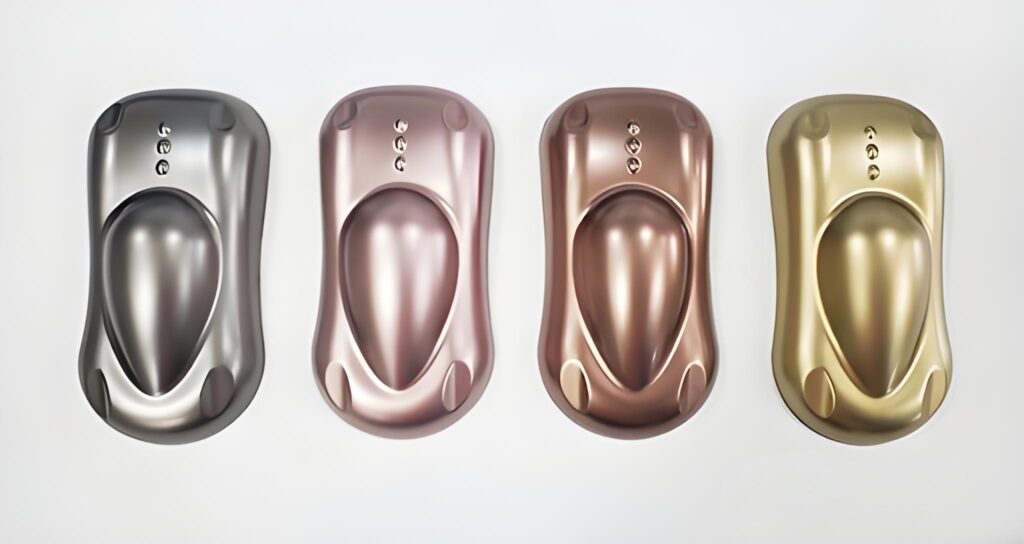
It can be said that:
Mirror silver solves the problem of "looking like metal",
electroplated gold solves the problem of "looking valuable".
From application scenarios and regulatory constraints to emotional expression, these two major categories of metal coatings are not merely surface treatment processes, but bridges between industry and visual language. Grounded in optical principles, shaped by engineering methods, and oriented toward design intent, they complete the closed loop from material to perception—which is precisely why they have always occupied a leading role in modern manufacturing.