During installation and transportation, photovoltaic supports inevitably suffer damage to their hot-dip galvanized coating, and are highly prone to rapid rusting in high-humidity, high-temperature environments. As a professional industrial coating manufacturer, we provide an in-depth analysis of how high-zinc-content cold galvanizing paint delivers cathodic protection and perfectly repairs damaged galvanized components.
Photovoltaic power stations are usually built in deserts, beaches, or humid mountainous areas, where the environment is hot and humid with severe salt spray corrosion. As the foundation of the power station, the hot-dip galvanized support, during cutting, welding, or handling, once the zinc layer on the surface is damaged, the exposed steel will form "rust spots" within just a few days, thereby threatening the structural safety of the entire support.
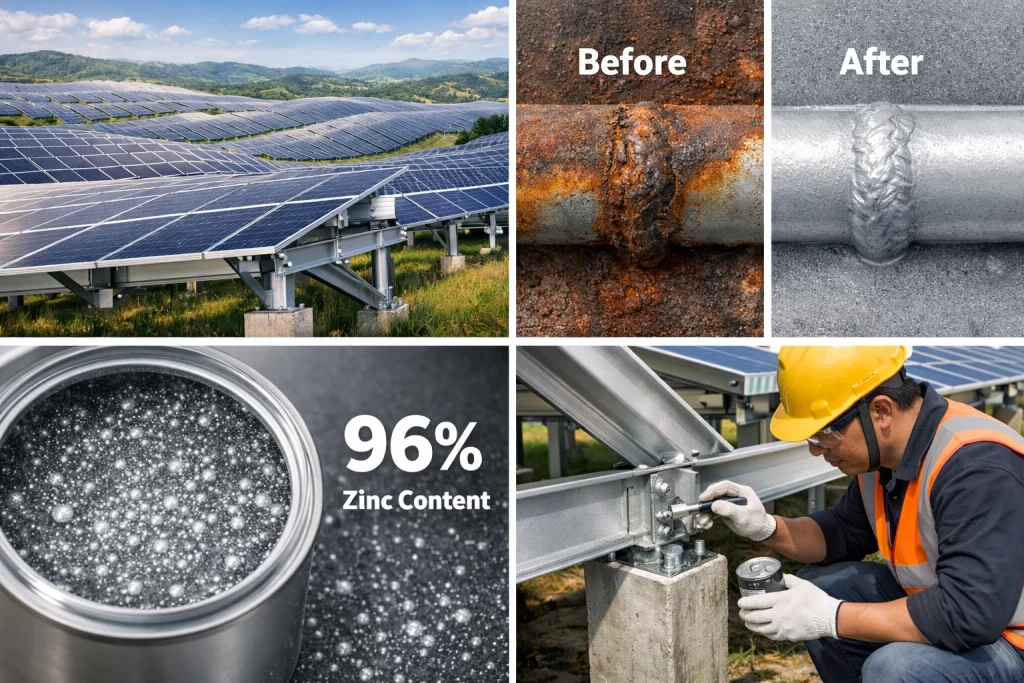
As an industrial paint manufacturer, we provide you with an efficient on-site repair solution: cold galvanizing special coating.
1. Core Principle: Not Just Coverage, But Cathodic Protection Ordinary silver paint can only provide physical shielding; once the paint film is damaged, the substrate underneath will still rust.
- Advantages of cold galvanizing paint: The zinc content in its dry film typically exceeds 96%.
- Electrochemical protection: Zinc dust acts as a sacrificial anode and is corroded before the steel, thereby providing electrochemical cathodic protection to the substrate similar to hot-dip galvanizing, completely halting the spread of rust.
2. Meeting the stringent requirements of "high heat and humidity" environments Beneath PV modules, air circulation is obstructed, creating a micro-environment with high humidity and high temperature.
- Weather resistance: Our cold galvanizing paint uses a special modified resin that will not blister or become brittle in high-temperature and high-humidity environments.
- Salt spray resistance: Capable of withstanding long-term salt spray corrosion, meeting the local repair standards for C4 and even C5 environments.
3. Three-Step Method for Repair Construction
- Surface treatment: Floating rust and oil stains on the damaged area must be removed. For welded areas, they must be ground to expose the metallic luster.
- Precision Coating: It is recommended to use brushing or spray paint to ensure the coating completely covers the damaged area and its edges.
- Thickness matching: The thickness of the repair layer should be kept as consistent as possible with the original hot-dip galvanized layer (typically a dry film thickness of 60-80 microns is recommended).


Conclusion: The designed service life of a photovoltaic power station is usually 25 years, and every tiny rust spot is a potential hazard. Using high-quality cold galvanizing paint for standardized repair is a key step to ensure the long-term stable operation of the power station.