Introduction: The "shelf-life countdown" of coatings in the pail begins the moment they leave the factory.
Coatings are not "static" — after leaving the factory — four major physical and chemical "aging" reactions continuously occur inside the bucket
— (1) Pigments continuously settle under gravity — settling velocity follows Stokes' law — when painters open the bucket "the top is clear, the bottom is hard lumps, the whole can is ruined"; (2) Ester bonds (-COO-) in the resin — are "attacked" and hydrolyzed by water molecules — acid value rises — pH drops — hydrolysis auto-accelerates —> within months — resin chain scission — coating has no adhesion at all" seems normal — peels off after half a year — tracing back, the resin had already hydrolyzed in the bucket";
(3) Alkyd/epoxy ester exposed to O₂ in the air at the top of the bucket — oxidative crosslinking — viscosity gradually increases — finally gels "a jelly that cannot be poured out"; (4) Thixotropic agents (bentonite — fumed SiO₂) slowly "age" during storage — layer collapse — silanol condensation — loss of thixotropy — pigments all sink to the bottom of the bucket within weeks. The "storage stability" of coatings
— must be considered at the formulation design stage — not "something after sales" — the formulation determines "how many months the coating can survive in the bucket".

Coating storage stability refers to the period during which a packaged coating product, stored under the manufacturer's specified conditions (sealed — 5-35°C/dark/dry) from the date of manufacture, (1) can still be stirred uniformly (settling grade ≤5 (GB/T 6753.3-1986 — 10 grades — grade 10 cannot be redispersed — scrapped)); (2) viscosity change <±10%; (3) rheology curve deviation <20%; and (4) coating properties (adhesion/salt spray resistance/color difference) show no significant decline compared to the original state — typically 6-24 months — depending on the hydrolysis/oxidation stability of the resin in the formulation, the settling characteristics of the pigment, and the aging durability of the thixotropic agent.
I. Physical and Chemical Aspects of the Four Major Aging Mechanisms
| Aging Mechanism | Chemical/Physical Nature | Influencing Factors | Criteria for Determination | Accelerated Testing | Formulation Countermeasures |
|---|---|---|---|---|---|
| Pigment Settling | Stokes——v∝R²×Δρ/η | R pigment particle size/Δρ density difference/η viscosity/thixotropy | Undispersible hard sediment (settling = scrap) | 50°C/30 days——settling grade Δ>2 levels | Fine particle size (<5μm) + anti-settling thixotropic agent |
| Resin Hydrolysis | Ester bond + H₂O → -COOH + alcohol——acid value ↑——catalytic acceleration | Water content/ester bond stability/acid value | AV increase >50% or coating loss of adhesion | 50°C/30 days——titrate AV——Δ>100% → fail | Hydrolysis-resistant resin (NPG/tertiary carbonate) + dry raw materials + dry dilution |
| Oxidative Thickening/Skinning | C=C + O₂ → free radical oxidative crosslinking → gel | Resin unsaturation level/O₂ contact area/anti-skinning agent | Viscosity >200% increase/skinning > insoluble | 50°C/15 days——Δ viscosity >50% or skinning——fail | Anti-skinning agent (MEKO >0.3%) + nitrogen blanketing/full container |
| Thickener Aging | Bentonite layers "collapse" + SiO₂ Si-OH condensation——permanent agglomeration | Thickener interlayer water/dispersant compatibility/time | Thixotropic recovery <50% of original——accelerated pigment settling | 50°C/30 days——rheology curve Δ(TI)>30% → fail | High-efficiency dispersant + water-controlled "pre-activated" bentonite |
FAQ
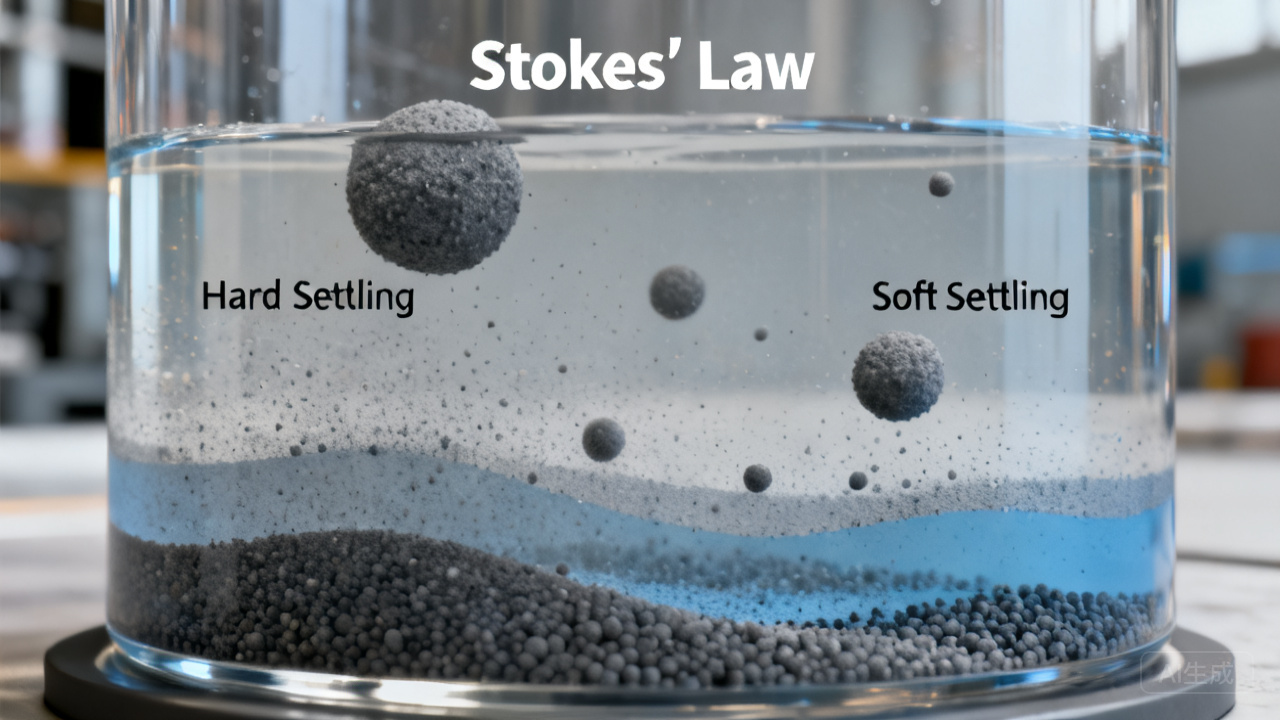
Q1: Stokes' Settling Law—why is pigment particle size (R) a "squared effect" on settling velocity?
Stokes—v=2R²(ρ_p-ρ_m)g/9η—diameter D=2R—settling velocity v∝D²—(1)10μm pigment (D=10)—v is—100 times faster than that of 1μm pigment (10/1)²
; (2)50μm large particle (D=50)—v is 2500 times faster than that of 1μm
—i.e., it can settle to the bottom of the barrel as "hard sedimentation" within a few hours; (3)ultrafine pigment (50μm) to primary particles (<1-5μm—fineness 2500 times—combined with the thixotropic agent's "static—high viscosity (gelation)—anti-settling" physical insurance—together—can make pigments "stay in the barrel for a year—not settle even without opening the lid".
Q2: Why is the rise in acid value (AV) the "positive feedback" of polyester resin hydrolysis "auto-acceleration"?
Polyester hydrolysis——-COO- + H₂O ⇌ -COOH + HO-——(1) The newly formed carboxylic acid (-COOH)——is a effective acid catalyst
——the carboxylic acid protonates the carbonyl oxygen of the ester bond——making it more susceptible to attack by water——this catalytic step "protonation——hydrolysis——catalysis——generates more COOH——more acid——faster hydrolysis——auto-acceleration"; (2) Acid value AV from 5 mg KOH/g at factory shipment——> after 12 months >10>20>40——exponential rise——not linear——when AV>20——the resin is severely hydrolyzed——coating adhesion originally >5 MPa——drops to <1 MPa" the coating loses all protective capability——merely decorative powder——falls off at a touch". Monitoring AV is the "gold standard" for judging the degree of resin hydrolysis during storage
——AV rises >50% of the original value——product "stop shipping".
Q3: Once the "skinned" bucket of alkyd/epoxy ester is opened—how to use it up in the short term (>48h)?
After opening the bucket—the liquid surface contacts air (O₂)—the resin's unsaturated C=C + O₂—free radical chain reaction—surface oxidative crosslinking—forms a layer of "soft skin" (Skin—insoluble—cannot be scraped off)
—(1) The role of anti-skinning agent in the bucket (MEKO—methyl ethyl ketoxime—>0.2-0.5%) MEKO is oxidized by O₂ before the resin—consumes O₂—until MEKO is depleted—then skinning begins—when MEKO=0.3%, no skinning within 48h after opening
—But once MEKO is depleted—skinning starts. After opening the bucket—if it cannot be used up that day—(a) tighten the lid—expel the air above the liquid surface—reduce O₂—or (b) spray a layer of "anti-skinning agent solution" on the liquid surface—or (c) nitrogen-seal the bucket (nitrogen—inert—no O₂)
"Most effective—but high cost".
Q4: Why is the thixotropic effect poor when organic bentonite (Bentonite) is added directly without "pre-activation"?
Organic bentonite (Bentonite—montmorillonite—flake-like aluminosilicate—interlayer spacing 1-2nm—each flake layer has exchangeable Na⁺/Ca²⁺ cations in the interlayer)—to obtain thixotropy—(1) use quaternary ammonium salt (such as dimethyl distearyl ammonium chloride "organ modification") to perform cation exchange with interlayer Na⁺—convert hydrophilic Na-montmorillonite into "hydrophobic organic bentonite"—this step is called "organ modification" and is already completed by the manufacturer
; (2) but in coating formulations—requires "pre-activation": mix organic bentonite + part of solvent/resin—under high-speed dispersion (>2000rpm/15-30min) shearing—solvent enters the bentonite interlayers—flake layers "open up"—spacing increases from 2-3nm—to form a "house of cards structure" in the coating—flake layer edge-face "overlap" creates a 3D network—thixotropy
—if added directly without high-speed shearing—flake layers remain stacked—no "house of cards structure"—very weak thixotropy—"pre-activation = shearing—open flake layers—unactivated = a big lump—no thixotropy".
Q5: Fumed SiO₂ — why is "moisture" the key to its aging and deactivation?
Fumed SiO₂ (primary particles 7-40nm —> 200m²/g specific surface area — surface has abundant Si-OH groups (silanols/3-5 Si-OH/nm²)) — (1) freshly produced — Si-OH "active" adjacent particles form loose 3D network via Si-OH/Si-OH hydrogen bonds — thixotropy; (2) during storage — trace water (>0.1%) — condenses on Si-OH surface — forms "water bridges" Si-OH/H₂O/Si-OH — stronger hydrogen bonds — over time — Si-OH and water undergo "slow silanol condensation" (Si-OH+HO-Si→Si-O-Si+H₂O) "covalent crosslinking" irreversible — hydrogen bond network changes from reversible to irreversible "aging" thixotropy permanently lost
— pigment settling — entire batch scrapped. In formulation — (a) use siloxane-modified "hydrophobic" fumed SiO₂ (Aerosil R972/R974 — treated with DDS (dimethyldichlorosilane) — partial Si-OH replaced by -CH₃ — no condensation — thixotropy stable — >12 months
; (b) control formulation water content hydrophilic type by >50% — but shelf life extended from 6 months to >18 months — in the long run — cost is manageable.
Q6: What is the scientific basis for the accelerated aging test (50°C/30 days ≈ 1 year at room temperature)?
Arrhenius——chemical reaction rate k∝exp(-Ea/RT)——room temperature 25°C (298K) and 50°C (323K)——k50/k25=exp[(Ea/R)(1/298-1/323)]; (1) If Ea=50kJ/mol (typical hydrolysis/oxidation activation energy—for organic chemistry—common)——k50/k25≈5-8——1 month (30 days) at 50°C≈5-8×30 days≈150-240 days "9-12 months—roughly—1 month≈1 year—this is a conservative '1 month = 1 year' rule—widely accepted in the coatings industry"; (2) If Ea is larger (>80kJ/mol—e.g., certain oxidation reactions)——k50/k25>15——1 month>15 months—acceleration is more forceful—then "1 month > 1 year" but industry practice—50°C/1 month≈25°C/1 year—is a "conservative estimate". After accelerated aging—performance comparison (viscosity Δ<10%—settling ≤ 5—adhesion drop 12 months".
Q7: The essential difference between "soft settling" and "hard settling" — how can formulation or application save it?
Soft settling — although the pigment has settled to the bottom of the bucket — but (1) there is still a layer of "lubricating layer" of dispersant between pigment particles — the dispersant remains on each particle — preventing particle fusion
— gentle stirring/shaking — the dispersant — helps re-disperse — evenly; (2) Hard settling — pigment particles at the bottom of the bucket are under long-term pressure the dispersant layer is "squeezed out" — nanoscale particles directly contact — producing "inter-particle welding" (Van der Waals — compressed — fused) — forming "stone blocks" — even high shear — can only break the outer layer — the interior remains intact stone — scraper — hard — cannot be re-dispersed — scrapped
. Remedy — (1) use a high-speed high-shear mixer (>10,000rpm — high-shear impeller — applies strong mechanical force to the "stone" — breaks the "welding" between particles — dispersant re-adsorbs
— but the effect "may be recovered — or may leave small residual particles — coating gloss/durability decreases" so once hard settling "irreversible — scrapped" this is the "soft settling — reversible — recoverable" fundamental difference.
Q8: The "freeze-thaw stability" of water-based coatings in storage environments—packaged at <0°C—emulsion system breakdown?
Water-based coatings (latex paint—acrylic emulsion—particles suspended in water)—9%—huge pressure—compresses emulsion particles—adjacent particles forced by ice crystals—fuse with each other—forming irreversible large particles "demulsification" solid agglomerates—cannot be stirred open—scrapped
; (2) the stable surface of emulsion particles (Surfactant—double electric layer—destroyed by ice crystals during freeze-thaw—particles lose stability—fuse—irreversible. Freeze-thaw stabilizer—add ethylene glycol/propylene glycol/glycerin—>2-4%—lowers the freezing point of water—from 0°C down to <—5°C
—and the glycol acts as a "freeze-thaw protectant" in the gaps between ice crystals—prevents direct contact and fusion between emulsion particles—protects emulsion particles. Water-based coatings must be stored in warehouses >5°C (or add antifreeze to ensure passing >2-4 freeze-thaw cycles—ASTM D2243—standard test "freeze-thaw stability—>3 cycles—no demulsification or agglomeration" is a mandatory test item in the storage standard for water-based coatings).
Q9: How to predict the time of skinning after opening the bucket using the "consumption kinetics" of the anti-skinning agent MEKO?
MEKO anti-skinning——(1)MEKO reacts with O₂——rate——bucket system——surface area of bucket liquid/amount of air in bucketSpecific surface area (liquid surface area/volume) determines the replenishment rate of O₂——open small bucket (1L)——large specific surface area——fast O₂ replenishment——fast MEKO consumption——early skinning——large bucket (20L)——small specific surface area——slow MEKO consumption——late skinning
——This is the engineering experience "the anti-skinning property of large buckets is better than that of small buckets——because of the smaller specific surface area"; (2)MEKO consumption——approximate zero-order kinetics (when O₂ is sufficient)——MEKO decreases——reaches——MEKO<0.05% (critical——skinning begins)——after opening——small bucket=1-2 days——large bucket=3-5 days. Estimate——based on specific surface area: "large bucket=3 days after opening——small bucket=within 24h——if not used up——must"split into small buckets——nitrogen filling——or liquid surface anti-skinning protection".
Q10: How can formulation designers systematically "extend shelf life" "shelf life = commercial value"?
Formulation strategy——(1) Resin hydrolysis-resistant type——use neopentyl glycol (NPG)/vinyl versatate (VeoVa)——large steric hindrance——protects ester bonds——hydrolysis rate is 1/5-1/10 of ordinary ethylene glycol/propylene glycol type polyester
“Grade 2 = 1 year——hydrolysis resistance = over 2 years shelf life”; (2) Pigment all fine particle size 10μm particles——Stokes——greatly reduce settling v
; (3) Thixotropic agent ”hydrophobic type” SiO₂——silanol group terminated——aging slowed by 3 times”Grade 2 = 6 months——hydrophobic = over 18 months”; (4) Anti-skinning——MEKO >0.3% + full container——headspace <2%"sub-packaging——nitrogen filling"sealed——no O₂——skinning delayed; (5) Packaging——can/drum——sealability shelf life can reach >24 months”sub-packaging——sealed——no acid/no water/no O₂”storage is ”vault protection”.
Related Reading
Summary
The four major aging phenomena of coatings during storage—pigment settling (Stokes: R²∝v—fine particle size (12 months—>24 months formulation—commercial—warehousing/channels/shelving all require time; "shelf life = commercial 'shelf life'"). Kexin New Materials conducts rigorous accelerated aging certification for all formulations—ensuring the product's "shelf life" is genuine and reliable—ready to use straight from the container—performance does not decline during storage—"quality remains consistent as always".