A helmet is one of the very few consumer products where "coating quality is directly linked to life safety". In the value of the exterior parts of a motorcycle helmet, the coating process contributes more than half of the visual premium—high-gloss mirror-like solid-color helmets, complex layered graphic-painted helmets, retro matte cement gray—consumers are willing to pay a price difference of hundreds of yuan for them. But the difficulty of helmet coating is also among the highest in consumer products: shell materials span four major categories—ABS, PC, FRP and carbon fiber—with completely different coating logics; PC shells crack under stress when exposed to wrong solvents, directly threatening crash safety; certification regulations clearly limit the impact of the coating on shell strength; graphic decals involve dozens of process steps, and one mistake scraps the entire helmet.
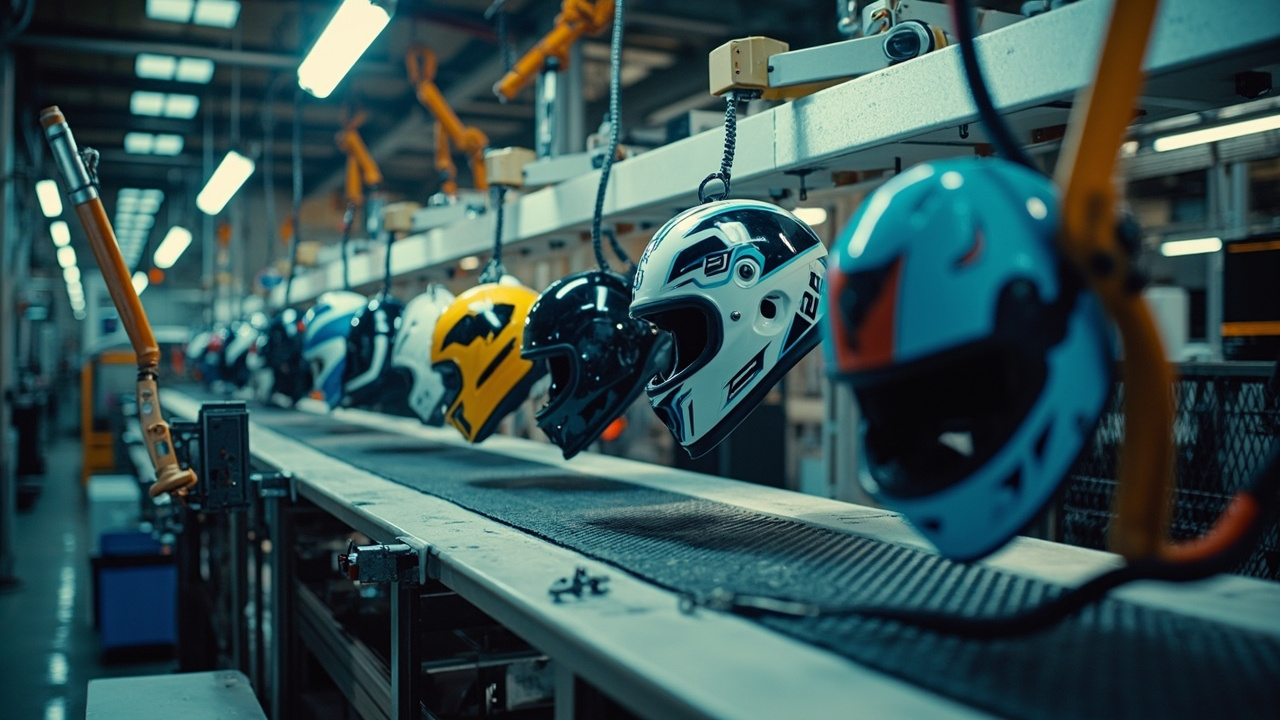
This article is aimed at helmet manufacturers, coating subcontractors and coating selection engineers. It thoroughly explains helmet coating from shell materials, pretreatment, coating systems, graphic processes, certification compliance to quality inspection, all presented with implementable process parameters and judgment criteria. Whether you make full-face motorcycle helmets, electric bicycle half-helmets, or industrial safety helmets, you can follow the map and check against it for self-inspection.
I. Know the shell first: the coating temperaments of the four major materials are completely different
The first lesson of helmet coating is not choosing paint, but recognizing the shell. Helmets at different price points use different materials, and the coating strategy must follow the material.
1.1 ABS: the easiest-to-handle mass-market player
ABS (acrylonitrile-butadiene-styrene copolymer) is the main shell material for electric vehicle helmets and mid-to-low-end motorcycle helmets. It is injection molded, low cost, and has good surface quality. ABS has a surface energy of about 42 dynes, moderate polarity, and most solvent-based and water-based coatings can establish good adhesion, usually allowing direct spraying of pigmented paint without primer. Its weakness is average solvent resistance: strong solvents (excessive ketones, esters) will erode the surface causing "whitening" or fine cracks, so the diluent system needs to control the proportion of strong solvents. The temperature上限 of ABS is about 80—90℃, and baking temperature generally does not exceed 70℃, which determines that helmet coating is mainly based on low-temperature drying + UV curing.
1.2 PC and PC/ABS alloy: high-risk objects for stress cracking
PC (polycarbonate) has 3—5 times the impact resistance of ABS, used in mid-to-high-end electric vehicle helmets and some motorcycle helmets, often in the form of PC/ABS alloy. The number one risk of PC coating is solvent stress crazing: under the combined action of residual injection molding stress and aggressive solvents, micro-cracks initiate on the shell surface, which may be invisible to the naked eye, but in crash tests the cracks become fracture starting points—this is not an appearance issue, but a safety issue. Three preventive measures: injection molding side annealing to eliminate internal stress (80—100℃ heat treatment for 2—4 hours, or optimize injection parameters to reduce residual stress); coating side use PC-safe diluent (mainly alcohols and aliphatic hydrocarbons, strictly limit ketone, ester and aromatic content); process side do first-piece stress cracking verification (after coating, place in 50℃ environment for 24 hours for observation, or use carbon tetrachloride spot immersion method for quick screening of injection stress). Any new pigmented paint or new diluent on PC shell must not skip stress cracking verification.
1.3 FRP (glass fiber reinforced plastic): the multi-process base for high-end helmets
FRP shells are made of glass fiber cloth and resin by hand lay-up or compression molding, used in mid-to-high-end motorcycle full-face helmets. It is solvent-resistant, temperature-resistant (can withstand above 120℃), with high coating tolerance, but surface condition is the biggest challenge: after demolding, the surface has mold release agent residue, pinholes, glass fiber texture and flash, and must go through a complete leveling process of sanding → putty filling → re-sanding → intermediate coat primer → water sanding before entering the pigmented paint process. The coating man-hours for FRP helmets are 2—3 times that of ABS helmets, with total coating thickness reaching 150—250 microns, which is why the paint fullness of high-end helmets far exceeds that of injection molded helmets.
1.4 Carbon fiber: both protection and "exposure"
Carbon fiber shell is the symbol of flagship and racing helmets, with a unique coating demand—not to cover but to display: a transparent resin clear coat makes the carbon cloth texture clearly visible. In the process, first fine-sand and dedust the shell, then spray 2—3 coats of high-transparency, high-fullness two-component PU varnish or UV varnish, with inter-coat sanding to eliminate the micro-undulation of the fiber weave, ultimately achieving "clear texture, glass-like surface". The anti-yellowing property of the varnish is a key indicator; once the varnish yellows under UV exposure, the premium feel collapses instantly, so a weather-resistant varnish system cured with aliphatic isocyanate must be selected.
1.5 Comparison of coating key points for four shell materials
| Comparison dimension | ABS | PC/PC alloy | FRP | Carbon fiber |
|---|---|---|---|---|
| Typical product tier | Electric vehicle helmet / entry motorcycle helmet | Mid-to-high-end electric vehicle helmet | Mid-to-high-end motorcycle full-face helmet | Flagship / racing helmet |
| Primer need | Usually no primer | No primer or PC-specific primer | Putty + intermediate coat required | Transparent primer seal |
| Solvent sensitivity | Medium (prevent strong solvent whitening) | High (stress cracking) | Low | Low |
| Max drying temperature | 60—70℃ | 60—80℃ | 100—120℃ | 90—110℃ |
| Total coating thickness | 40—70μm | 40—70μm | 150—250μm | 80—150μm |
| Coating man-hour share | Low | Low—Medium | High | High |
II. Pretreatment and static elimination: the foundation of helmet appearance pass rate
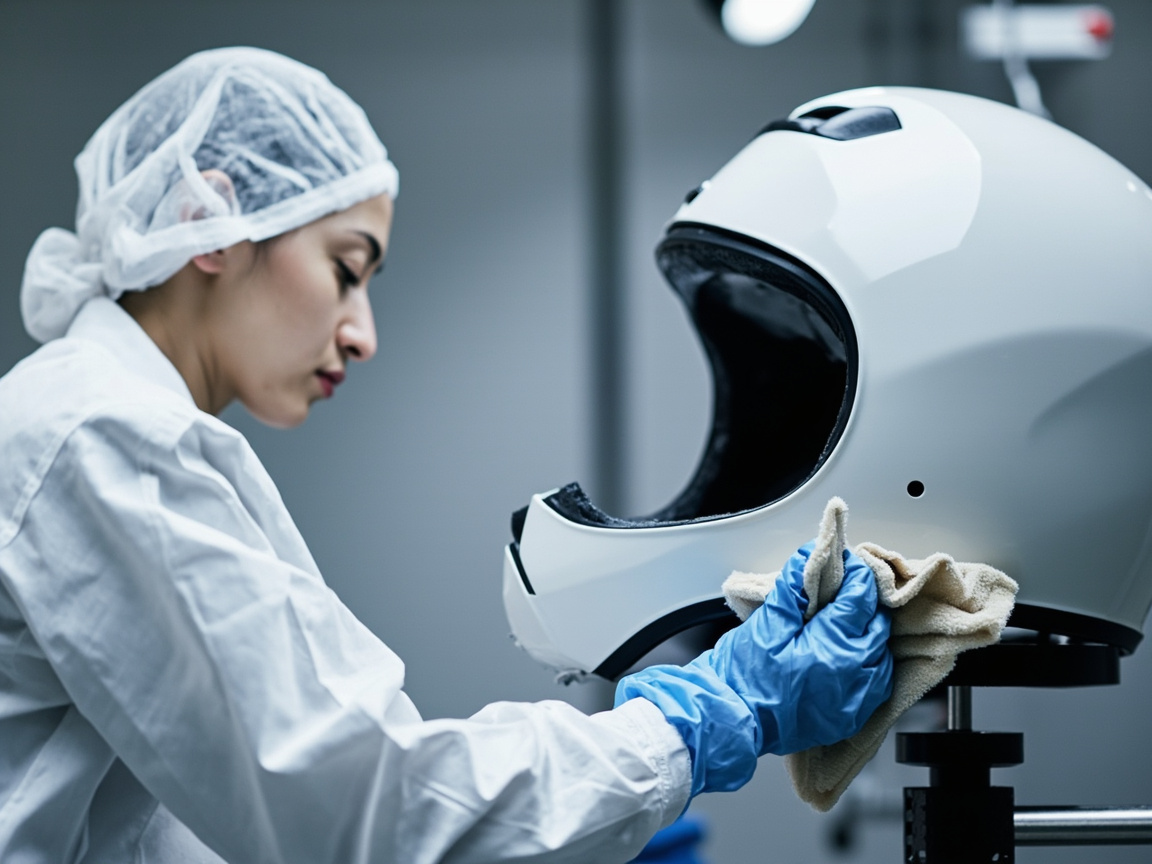
Plastic helmet shells do not undergo chemical conversion coating; the core of pretreatment is the word "clean": remove mold release agent, remove oil, remove static, dedust.
The standard pretreatment process for injection molded ABS/PC shells is: wipe manually with isopropanol (IPA) or dedicated cleaner → second wipe with pure water or white oil → blow ionized air for static elimination and dedusting → rest and enter spray booth. Seems simple, but two details determine success or failure. First is mold release agent management: excessive spraying of silicone mold release agent at injection side is the biggest source of craters (fish eyes); coating factories should agree on mold release agent dosage specs with injection workshop, prioritizing silicone-free mold release agents; for batches already contaminated by silicone, use anti-crater additives or strengthened wiping measures. Second is static and dust spots: after wiping, the surface potential of plastic shells can reach several thousand volts, attracting workshop floating dust like a magnet; ionized air static elimination must be the last station before entering spray booth, and the booth itself should maintain positive pressure and class 100,000 cleanliness. Helmets are curved high-gloss products; a 0.3 mm dust spot is clearly visible on dark high-gloss surfaces, and every 1% drop in dust spot rework rate brings considerable full-line cost reduction.
The pretreatment of FRP shells is the sanding system: coarse sanding (P180—P240) to remove flash and mold release layer, putty filling for pinholes and low spots, after intermediate coat primer spraying, water sanding (P600—P800) for flat base. Collection of sanding dust and station dust extraction directly affect the later spraying environment; sanding area and spraying area must be physically isolated.
III. Coating system design: primer, pigmented paint, graphic layer and varnish
The standard coating structure for helmet coating is "(primer / intermediate coat) + pigmented paint + decal graphic layer + clear coat", with clear division of labor for each layer.
3.1 Pigmented paint layer: carrier of color and effect
Helmet pigmented paint is mainly two-component PU pigmented paint and single-component acrylic pigmented paint, with water-based pigmented paint rapidly increasing in leading factories in recent years. Solid-color helmets spray 2 coats of pigmented paint to achieve coverage, film thickness 15—25 microns; effect colors such as metallic silver and pearlescent white need to control atomization and gun travel uniformity to avoid "blushing" and "cloudiness" on curved surfaces—helmets are double-curved products, the directional arrangement of effect pigments is harder than flat parts, the overlap rate of spraying robot trajectory or manual gun travel should be controlled at 50%—60%, and gun distance consistency is key skill. The popular "cement gray" "matte black" matte helmets actually use matte varnish over the pigmented paint, not the pigmented paint itself being matted, which gives better stain resistance and feel.
3.2 Varnish layer: the "armor" and "skin" of the helmet
The clear coat is the thickest, most expensive and most demanding layer in the helmet coating, taking on all functions of gloss, weather resistance, scratch resistance and decal protection. Two mainstream routes: two-component PU varnish (aliphatic HDI curing), room temperature or 60℃ low-temperature baking, high fullness, excellent weather resistance, curing takes 4—8 hours occupying large storage space; UV varnish, second-level curing, hardness up to 2H, fast节拍 saving space, is the efficiency choice for mass electric vehicle helmet lines, but double-curved irradiation uniformity needs multi-lamp positions and rotating fixtures, shadow areas (brim underside, vent grooves) need supplementary light or dual-cure formula backup. High-end motorcycle helmets mostly insist on two-component PU route, pursuing the "depth" of paint; mass electric vehicle helmets have over half UV ratio. The trade-off between the two routes is essentially "cycle time vs fullness".
3.3 Typical coating systems and performance comparison
| Coating system | Curing method | Single helmet coating cycle | Gloss | Applicable product |
|---|---|---|---|---|
| Acrylic pigmented paint + UV varnish | UV second curing | Fast (minute level) | 85—92GU | Mass electric vehicle helmet |
| Water-based pigmented paint + UV varnish | Flash dry + UV | Fast | 85—92GU | Eco-friendly line electric vehicle helmet |
| PU pigmented paint + PU varnish | 60℃×40min + curing | Slow (hour level) | 90GU+ | Mid-to-high-end motorcycle helmet |
| Intermediate coat + PU pigmented paint + decal + double PU varnish | Segmented low-temp baking | Slowest | 92GU+ | High-end graphic full-face helmet |
| Transparent UV varnish multiple coats | UV + inter-coat sanding | Medium | 92GU+ | Carbon fiber texture helmet |
Plastic coating supporting factories represented by Kexin New Materials (Guangdong) Co., Ltd. can provide overall matching of PC-safe diluent, water-based pigmented paint and UV varnish and OEM customization according to helmet shell material and line curing capability. For factories newly entering the helmet industry, the cooperative method of "coating + diluent + process window" packaged verification can significantly shorten the trial production ramp-up period and avoid hidden and fatal pitfalls such as PC stress cracking.
IV. Graphics and decals: the value high ground of helmet coating
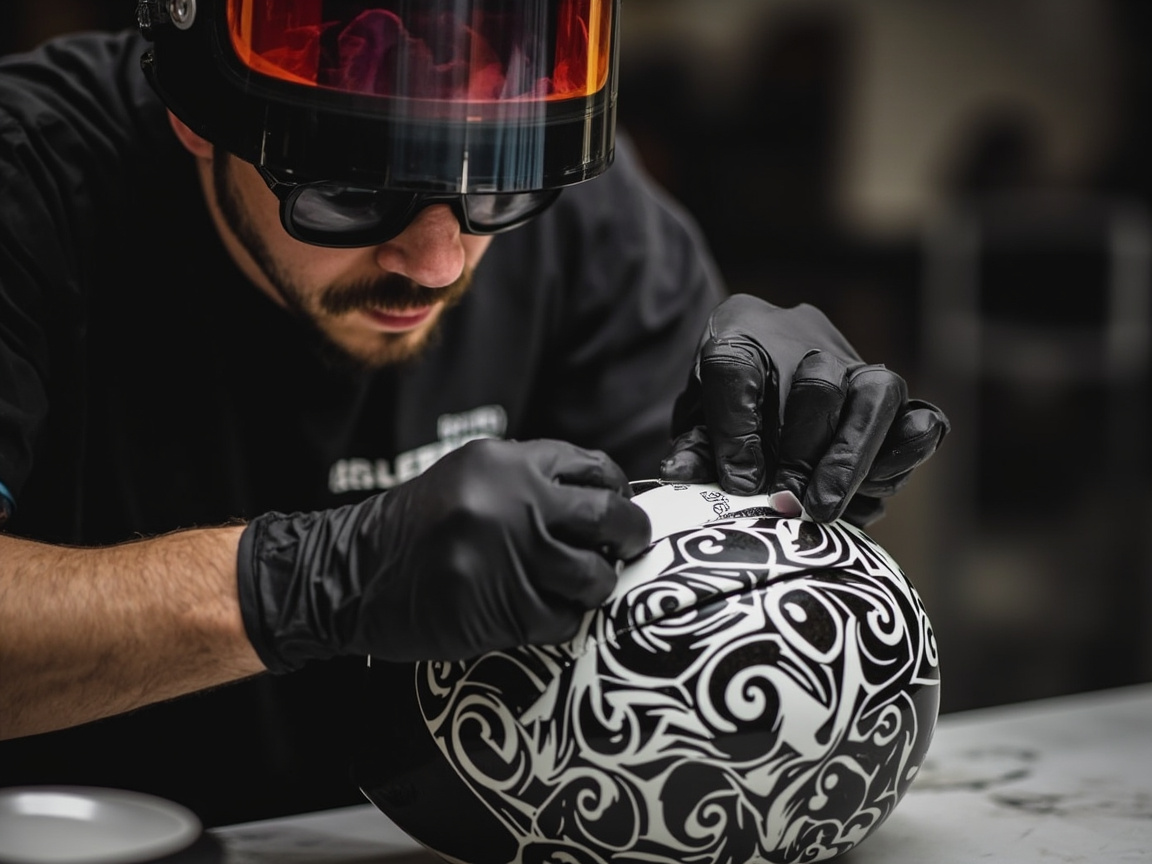
Graphic painting is the part with the strongest premium ability of helmets; the pattern layer of a complex graphic helmet may contain multiple processes such as water decals, mask spraying, hand-painting outlining superimposed.
4.1 Water Slide Decal process
Mainstream mass graphic uses water decals: printing factory prints water decals by color separation according to pattern, decal worker soaks and slides it onto pigmented paint layer for positioning, squeezes water flat, dries, then sprays clear coat to seal. Process key points: pigmented paint before decal must be fully dry and clean; large curved patterns must do "segmentation and compensation" at print design stage, otherwise wrinkles are inevitable on double-curved surfaces; water squeezing must be thorough, residual water vapor bubbles during varnish baking; at least two coats of clear coat, first thin coat to "seal edge" preventing varnish solvent from biting decal ink, second full coat for fullness. The "step feel" at decal edges is the quality watershed; high-end helmets use multiple varnish + inter-coat sanding to completely "bury" the decal into the paint, touch without trace.
4.2 Mask spraying and hand painting
Racing replica helmets and custom helmets use mask spraying: use masking tape and transfer film to mask layer by layer, spray color by color; a multi-color pattern helmet may take several hours of masking, requiring extremely high atomization control and masking precision from the sprayer. The personalized custom market also retains hand-painting outlining and airbrush gradient process, belonging to arts and crafts, single helmet price up to thousands of yuan. In factory production, mask spraying is mostly used for "large color block splicing + water decal details" hybrid scheme, balancing efficiency and effect.
4.3 Emerging routes: water transfer printing and digital direct printing
Continuous patterns covering the whole helmet such as camouflage, carbon texture, graffiti can be achieved by water transfer printing: pattern film floats on water, activated then helmet immersed for 3D wrapping, then clear coat. High efficiency, good pattern continuity, but alignment precision is not as good as water decal, suitable for full-pattern without alignment requirement. Digital direct printing (industrial inkjet directly printing on 3D curved surface) has begun to enter the helmet industry in recent years, no plate making, single piece printing, opening a new route for e-commerce custom models, its UV ink and varnish inter-layer adhesion needs special verification.
V. Certification compliance: coating is not just good-looking, regulations are specific
Helmet is a mandatory certified product, coating engineers must know the real requirements of regulations on coatings.
5.1 Domestic standards: GB 811 and new electric bicycle helmet rules
Motorcycle occupant helmet executes GB 811 (mandatory national standard, 2022 version), electric bicycle occupant helmet executes corresponding category extension of GB 811-2022. Clauses directly related to coating include: shell material and surface treatment must not significantly degrade impact absorption performance due to aging or solvent action—this is exactly the regulatory basis for PC stress cracking prevention; after high-temp, low-temp, water immersion pretreatment still must pass impact test, meaning coating must not crack or peel under temperature change and wet state causing shell damage; surface protrusion and friction coefficient related requirements limit the form of additional decorative parts on paint surface. Submitted sample helmets must be consistent with mass production coating state; the practice of "plain helmet passes inspection, graphic helmet mass produced" is high-risk violation under flight spot check.
5.2 Export certification: ECE 22.06 and DOT
Motorcycle helmets exported to Europe execute ECE 22.06 (fully replacing 22.05 from 2023), its oblique impact (rotational acceleration) test puts substantive requirements on shell surface friction characteristics—too rough paint (some matte and rubber paint) may increase oblique friction peak, when choosing matte system should communicate friction data with certification lab in advance. US DOT FMVSS 218 and Snell certification also require sample and mass production consistency. Notably the solvent sensitivity test tradition: multiple standard systems require shell performance not degrade after solvent/oil contact, so helmet factories usually jointly control after-sales risk, prohibiting users from cleaning with solvent or DIY spray paint in manual—factory coating uses verified safe system, a random can of spray paint from user may make PC shell full of cracks.
5.3 Chemical compliance
Coatings for export helmets also need to meet EU REACH SVHC, PAHs (parts with long-term skin contact), California Prop 65 and other chemical regulations; children's helmets refer to toy standards to control migratable heavy metals. These requirements ultimately fall on the test reports of coatings and inks; procurement should write REACH/PAHs compliance into coating technical agreement, obtain third-party reports and update annually.
VI. Production line design: cycle time, fixtures and automation
6.1 Typical line form
The mainstream form of electric vehicle helmet mass production line is hanging conveyor + robot spraying + UV curing tunnel: load → wipe static elimination → robot spray pigmented paint (2 stations) → IR flash dry → decal section (manual island) → robot spray UV varnish → UV cure → unload inspection, cycle can be pressed to 2—4 helmets per minute. Motorcycle helmet small-medium batch line is mostly station type: rotary table spray station + batch baking room, high flexibility, adapts to multi-color multi-model. Common key point of both forms is rotating fixture—helmet is near-spherical product, spraying and UV irradiation both need workpiece self-rotation (15—30 rpm) to ensure uniformity, fixture design stability directly determines film thickness consistency.
6.2 Key points for robot spraying implementation
Helmet curved trajectory programming is more complex than flat parts, implementation experience has three: use offline programming software to generate base trajectory from helmet 3D data, then iterate correction with film thickness measurement (multi-point cross-section or eddy current thickness); when changing different helmet models call corresponding program, mixed flow production needs helmet type recognition (vision or RFID fixture); robot parameter window for effect colors is narrower than solid, keeping manual touch-up station for key colors like metallic silver is pragmatic. Automation rate need not pursue 100%, "robot base full spray + manual complex part handling" hybrid mode is most common in helmet industry.
6.3 Eco configuration
VOC treatment for helmet coating line configured by paint amount: water curtain or dry filter captures paint mist, activated carbon adsorption concentration + catalytic combustion (RCO/RTO) for organic waste gas has become standard for new lines. At source reduction, water-based pigmented paint + UV varnish combination can reduce single helmet VOC emission by over 60%, almost the only approvable route for new lines in strict EIA areas. This also explains why helmet coating water-based and UV speed is faster than many other plastic coating industries.
VII. Quality inspection: complete list from appearance to reliability
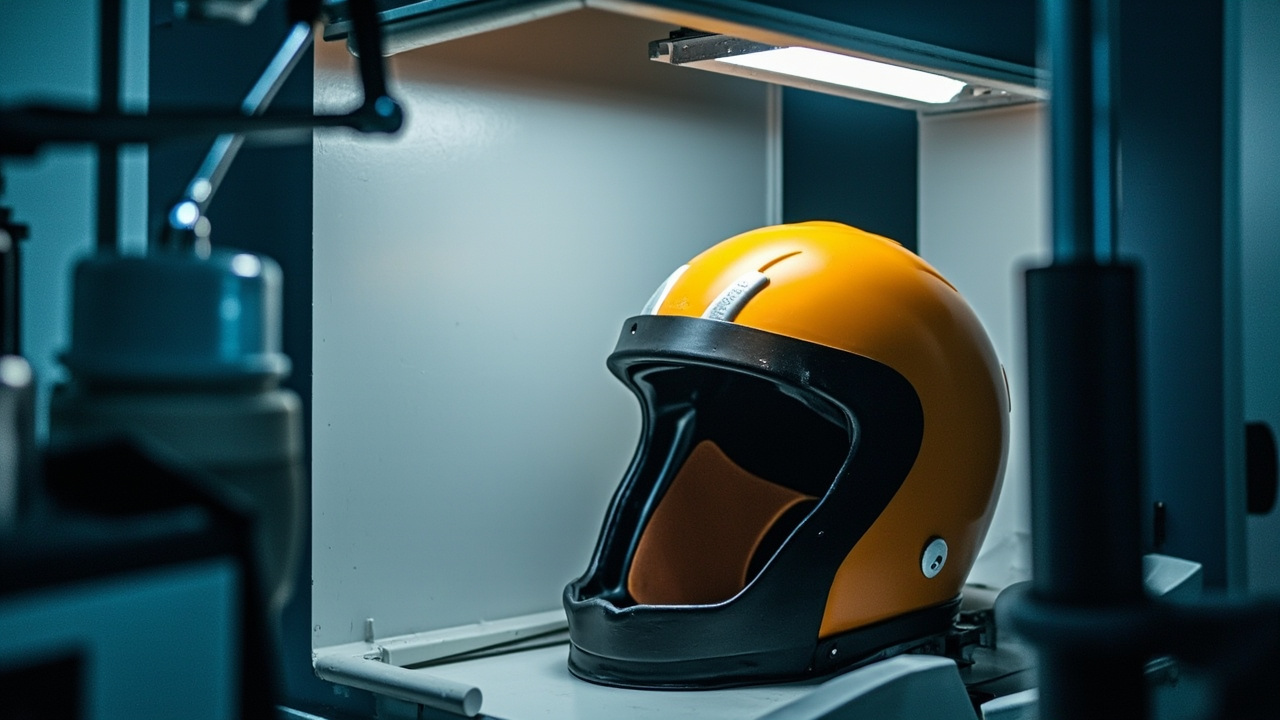
Helmet coating part inspection has four levels. Appearance level: under standard light box visually check dust spots, sag, orange peel, color difference (ΔE≤0.8, same helmet each part ≤0.5), high-gloss helmet add DOI evaluation. Physical level: cross-cut adhesion (GB/T 9286, 0—1 grade, decal area separately cross-cut), pencil hardness (UV varnish ≥H), abrasion (RCA or Taber). Resistance level: weather (QUV-A 300—500h no chalking no yellowing ΔE≤2, export helmet per target market add), artificial sweat (helmet buckle周边 paint 48h no abnormality), cosmetics and sunscreen (high consumer complaint item, avobenzone in sunscreen has swelling on some varnish), water immersion (40℃×240h no bubble no gloss loss), thermal cycle (-30℃↔70℃, 10 cycles). Safety-related level: after coating sample shell for drop weight impact or full helmet impact, verify coating process (especially solvent and baking) did not degrade shell performance—this is the inspection item distinguishing helmet from all ordinary plastic parts, recommend keeping records per batch for certification spot check.
VIII. Common defect diagnosis quick reference
| Defect | High-frequency cause | Countermeasure |
|---|---|---|
| PC shell fine cracks | Strong solvent + injection internal stress | PC-safe diluent, injection annealing, first-piece stress verification |
| Crater fish eye | Silicone mold release residue, air with oil | Silicone-free mold release, strengthened wiping, precision air compression filter |
| Dust spot particles | Static dust absorption, insufficient booth cleanliness | Ionized air static elimination, booth positive pressure, fixture dust cover |
| Blister under decal | Incomplete water squeeze, varnish bite base | Decal SOP training, first varnish thin coat seal edge |
IX. Cost and Selection: A Decision Framework for Helmet Factory Procurement
In the per-helmet painting cost, varnish accounts for 45%–60% of the coating cost, making it the focus of selection. The decision recommendation follows four steps: Step 1, determine the curing route based on production line space and takt time requirements—if daily output exceeds 3,000 units and space is tight, the UV route is almost mandatory; Step 2, determine the water-based degree of the pigmented paint based on local environmental assessment and remaining pollutant discharge permit capacity; Step 3, verify shell safety—for PC shell projects, write stress cracking verification into the coating approval document as a precondition for mass production approval; Step 4, negotiate technical service—since the helmet is a multi-process superimposed product, whether the coating supplier can dispatch engineers to the line for joint debugging of the compatibility between decals and varnish, and whether they can respond to defect analysis within 48 hours, matters far more than unit price. Experience in plastic coating systems under the kexinMaterials framework shows that about 70% of defects during the helmet project trial production occur at the "interlayer"—between pigmented paint and decals, between decals and varnish; the supplier's overall control capability over the full coating system is the true variable determining project success or failure.
X. Special Chapter on Subcategories: Coating Differences Among Different Helmets
"Helmet" is a large family; the coating logic of full-face motorcycle helmets, electric vehicle half-helmets, bicycle riding helmets, ski helmets, and industrial safety helmets each has its own focus. Factories producing mixed categories need to establish separate process archives.
10.1 Bicycle Riding Helmets: Specifics of PC Thin Shell and In-Mold Forming
Mid-to-high-end riding helmets adopt the In-mold integrated molding process—0.3–0.5 mm PC thin shell and EPS foam are directly composited in the mold. Under this structure, coating is usually前置: the PC sheet is printed or coated (in-mold decoration) before molding, or only locally sprayed and labeled after molding. The difficulty of post-molding spraying is that the thin shell has low rigidity and cannot be heated after assembly, so only room-temperature air-dry or low-temperature (≤50℃) systems can be used; UV varnish is preferred due to its extremely low curing temperature rise. Riding helmets are weight-sensitive (flagship models weigh just over 200 grams fully assembled), so the total coating thickness is compressed to the 30-micron level; high-hiding pigmented paint and high-solid varnish are the formulation direction.
10.2 Ski Helmets: Flexibility Test in Low-Temperature Environments
Ski helmets work in environments of -30℃–0℃, and low-temperature coating flexibility is a unique indicator: a brittle varnish that passes at room temperature may flake off under low-temperature impact. In formulation, a toughened modified PU system is used; in testing, low-temperature ball drop impact (tested after pre-cooling at -30℃) is added. ABS hard-shell ski helmets often feature soft-touch paint; the tactile layer must not harden or crack at low temperatures and must pass repeated friction tests with goggle straps.
10.3 Industrial Safety Helmets: Cheap but Regulations Are Not Relaxed at All
Industrial safety helmets (HDPE/ABS material) have low unit prices; coating is mainly natural-color injection molding + silk-screen LOGO, but there are two coating intervention scenarios: reflective warning coating (high-visibility demand) and enterprise custom colors. GB 2811 requirements for safety helmets—low-temperature resistance, high-temperature resistance, lateral rigidity, etc.—also constrain the coating process from degrading the shell; HDPE has extremely low surface energy (about 31 dynes), so any coating must be preceded by flame treatment or a special CPO primer, otherwise adhesion is zero—this is the biggest coating difference between HDPE and ABS. The safety helmet industry has fierce price wars; the coating scheme is mainly an extremely simple "one primer one topcoat" system, spending money on adhesion assurance.
10.3A Equestrian Helmets and Baseball Helmets: Coating Notes for Niche Categories
Equestrian helmets (PC/ABS shell + velvet or painted finish, two routes) in the painted version feature "deep solid color + metal badge" as the classic language; black high-gloss image clarity requirements approach piano paint standards, and dust control and polishing processes are the cost center; their certification (VG1/ASTM F1163) also constrains the coating from degrading the shell. Baseball/softball batting helmets are mostly ABS injection-molded bright colors; coating is mainly high-saturation pure color + large-area water-transfer team emblems, children's versions need coating controlled to toy-grade heavy metal limits, and the paint film's resistance to chipping from impact (no paint flakes under ball-speed impact) must be separately verified—sharp edges of fallen paint flakes are a secondary risk to young users. Niche categories have small volumes but often better unit prices and margins than mass categories, making them suitable as valley-filling orders for decorative printing capacity.
10.4 Electric Vehicle Half-Helmets: Efficiency Battlefield Where Volume Wins
After the 3C certification was implemented, demand for electric vehicle helmets exploded, with leading factories reaching daily capacities of tens of thousands. The coating keyword for this category is "takt time and first-pass yield": water-based pigmented paint + UV varnish dual-robot lines, helmet-type visual recognition auto-program adjustment, online film thickness monitoring—every 1 percentage point increase in first-pass yield is real money. Color management adopts a "base colors stocked + trend colors fast response" model; the color-matching response speed of macaron colors, Morandi grays, and other fast-fashion colors has become a supply chain competition point. The coating supplier's color paste library and 48-hour sampling capability directly participate in competition in this category.
XI. Color and Effect Trends: The "Fashion Industry" Side of Helmet Coating
Helmets have evolved from safety equipment into part of riding outfits; the coating side must understand the process implications of fashion trends. Recent dominant trends have five lines: first, low-saturation matte series—cement gray, misty blue, milk tea color with about 20GU matte varnish, the process focus is matte uniformity and stain resistance; second, retro motorcycle style—cream white, military green with metal rivet decals, the paint film pursues a "warm feel," mostly using high-build PU systems; third, racing co-branded livery—MotoGP, anime IP co-branded patterns with over five layers, water-transfer + masking spray hybrid process, the main consumer of decorative printing capacity; fourth, electroplated iridescent and chameleon—mirror silver base + iridescent pigment over transparent color, extremely high requirements for base flatness, mostly seen in flagship models; fifth, nighttime visibility—reflective microbead coating and fluorescent color blocks embedded in pattern design, adding bonus points for safety regulations. The practical significance of trends for factories lies in production line flexibility reserves: switching between matte and high-gloss, elastic expansion of decal stations, and sampling capability for special-effect colors determine whether they can catch each wave of trend dividends. Worth adding is the industry consensus on color safety: traffic accident research has long shown that light-colored and high-visibility helmets have significantly better night recognition distance than dark helmets; some European markets are pushing the proportion of fluorescent colors and reflective elements. This means the intersection of "good-looking" and "safe visibility"—fluorescent yellow-green, bright orange, white with reflective graphics—is moving from the regulatory edge to design mainstream; the coating side reserving weather-resistant solutions for fluorescent pigments in advance (fluorescent colors are generally weak in weather resistance, requiring UV absorber enhancement and clear coat protection) will gain the upper hand.
XII. Repair Process: Rescue Manual for High-Value Helmet Bodies
Even if the helmet coating defect rate is controlled at 3%, a factory with daily output of ten thousand units has hundreds to dispose of daily; the repair system directly affects cost. Repair grading: Level 1 defects (dust spots, slight particles) are treated after the varnish is fully cured with P2000 wet sanding + polishing wax mirror restoration; UV varnish has high hardness and lower polishing efficiency than PU varnish, requiring special abrasives; Level 2 defects (local sag, small decal flaws) are locally sanded then spot-sprayed with varnish, noting the interface treatment between the spot-spray area and original paint film; UV systems require portable UV lamp re-irradiation for local spot spray; Level 3 defects (large-area defects) require full-helmet paint stripping and repainting—plastic shell paint stripping is a high-risk operation, only plastic-safe stripper with low-temperature short-time treatment can be used; PC shells are generally not stripped and the shell is directly scrapped; ABS shells after stripping must re-pass stress and appearance full inspection. Repair economy rule: if repair man-hours exceed 1.5 times the new-helmet coating man-hours, scrap directly; don't let the repair area become a cost black hole. Weekly Pareto chart of defects, feeding repair data back to production line parameter correction, is the true value of the repair system.
XIII. Case Review: Problem Closure in Three Real Scenarios
Case 1: A certain electric vehicle helmet factory's PC helmets had batch fine cracks, complaint rate surged. Investigation found they switched to general-purpose thinner to reduce cost, with ketone content exceeding limits, compounded by increased internal stress after shortened injection cycle. Action: restored PC-safe thinner and wrote component commitment into coating approval document; injection side added 80℃×3h annealing process; established carbon tetrachloride spot test incoming quick screening. Cracks returned to zero after two weeks. Lesson: cost reduction in PC projects must never touch the thinner line.
Case 2: High-end motorcycle helmet decals blistered repeatedly after varnish, repair rate 18%. Tracing found new decal workers had improper water-squeezing technique, and on that day at 85% humidity decals were not fully dried before varnishing. Action: added 40℃×20min forced drying after decals; decal workers must pass waste-helmet water-squeezing assessment before上岗; workshop added dehumidifiers capping humidity at 70%. Repair rate fell below 2%. Lesson: SOP for manual processes and environmental control are equally important.
Case 3: Export-to-Europe matte helmet showed high friction peak in ECE 22.06 oblique impact test. After joint debugging with certification lab, matte varnish gloss was raised from 12GU to 22GU, and matting powder model was changed to reduce surface micro-roughness; retest passed. Lesson: in the 22.06 era, paint film texture design must enter the certification view early; gloss and roughness window should be locked at the appearance definition stage.
13A. Water-Based Pigmented Paint Construction Detail Manual for Helmets
Water-based conversion is an unavoidable direction for helmet coating, but the application window of water-based pigmented paint on helmet curved surfaces is narrower than solvent-based; this chapter explains the landing details thoroughly.
Environmental control is the first variable. Water evaporation rate is extremely sensitive to temperature and humidity: above 75% humidity flash-off slows, wet-on-wet processes easily trap water and bubble; below 45% humidity with high temperature, surface dries too fast causing orange peel and mottling. Helmet water-based line environment window recommended at temperature 23–28℃, humidity 55%–70%, spray booth supply air with dual temperature-humidity control. Southern plum rain season and northern dry winter are two high-risk periods; investment in environmental equipment must weigh heavily in the water-based conversion budget.
Atomization and spray pattern parameters need re-calibration. Water-based paint has high surface tension and different viscosity shear characteristics than solvent-based; directly using solvent-based parameters causes coarse atomization and poor leveling. Typical adjustment direction: atomization pressure slightly up 0.02–0.05MPa, paint output down 10%–15%, gun speed slowed, inter-coat flash-off extended to 5–8 min or add infrared auxiliary flash-off. Robot lines must build separate parameter groups for water-based paint, not share programs with solvent-based.
Flash-off and preheat are key to bubble prevention. Before water-based pigmented paint is overcoated with UV varnish, film moisture content must drop below the safety line, otherwise UV second-curing seals water in the film, causing bubbles on later temperature changes. Effective production-validated configuration is "infrared preheat (paint film temp 45–55℃)×3–5 min + air curtain" combination, using film moisture meter or weighing method to calibrate process time, not guessing minutes.
Don't save on cleaning and pipeline modification. Water-based paint after drying is insoluble in solvent; residual paint in pipeline dead corners is a color-spot pollution source. Modification points: pumps and pipelines of stainless steel or plastic (anti-rust), pipe diameter and flow design to avoid settling, color change with "water wash + solvent wash" dual program, circulation system with filter precision within 25 microns. These details are inconspicuous on the quote but determine the first-pass yield curve three months after water-based line launch.
13B. Helmet Factory Coating Digitalization: Four Low-Cost High-Return Things
Helmet coating digitalization does not need to step into MES at once; four low-cost high-return things can be done first. First, color difference digitalization: abandon pure visual color matching, equip a portable spectro-colorimeter, sample and record ΔE trend every two hours, pigmented paint batch anomalies can be intercepted at early drift. Second, film thickness SPC: UV varnish film thickness directly determines hardness and weather resistance, use ultrasonic thickness gauge (for plastic substrate) with five-point method per helmet type, draw control chart to manage robot spraying stability. Third, environment data logging: spray booth temperature-humidity, UV lamp energy (measured weekly with energy meter, lamp decay is invisible killer) auto-recorded, can replay shift environment during defect analysis. Fourth, defect coding: encode dust spots, craters, mottling etc., inspection station tablet entry, weekly auto-generate Pareto chart pointing to correction focus. These four things total investment at hundred-thousand yuan level, yielding "speak by data" process management capability, also a plus for big customers and certification audits.
XIV. Helmet Coating Test Standard Quick Reference Table
| Test Item | Reference Standard | Typical Requirement |
|---|---|---|
| Color difference | CIE LAB visual + instrument | Full helmet ΔE≤0.8, between parts ≤0.5 |
| Adhesion | GB/T 9286 cross-cut | 0–1 grade (decal area tested separately) |
| Hardness | GB/T 6739 pencil | UV varnish ≥H, PU varnish ≥F |
| Weathering aging | QUV-A / xenon lamp | 300–500h ΔE≤2 no chalking |
| Artificial sweat resistance | ISO 3160-2 reference | 48h no discoloration blistering |
| Sunscreen resistance | Enterprise standard (avobenzone formula) | 24h no swelling marks |
| Water immersion resistance | GB/T 5209 | 40℃×240h no bubbles |
| Thermal cycling | Enterprise standard | -30℃↔70℃×10 cycles no crack |
| Low-temp impact (ski helmet) | Enterprise standard ball drop | -30℃ no paint flaking |
| RCA abrasion | ASTM F2357 | ≥150–300 cycles |
| Shell safety recheck | GB 811 / ECE 22.06 | No degradation of impact performance after coating |
| Chemical compliance | REACH/PAHs/California 65 | Full items per target market |
Hang this table on the quality department wall; when new projects are initiated, confirm customer requirements and target market item by item to avoid the passive situation of "finished then found failing tests" in most cases.
FAQ
1. Fine cracks appear after painting PC shell helmets, is it the paint's problem or the shell's problem?
It is the result of "paint + shell" joint action, responsibility often lies at both ends: coating side thinner contains strong solvents (excess ketone, ester, aromatic) eroding PC, injection side residual stress too high provides cracking drive. Investigation order: first use carbon tetrachloride spot test to measure shell stress level, if stress exceeds do annealing first; then check thinner components, switch to PC-safe thinner; finally do 50℃×24h post-coating verification. Only when both ends are controlled can cracks be rooted out.
2. Why can't helmet coating generally use high-temperature baking?
Determined by shell material. ABS long-term temperature resistance is only 80–90℃, PC tolerates slightly higher but high temperature accelerates stress release causing deformation, EPS buffer layer (foam already assembled in some process shells) shrinks above 60℃. So helmet coating drying window is generally pressed below 60–70℃, which is also the fundamental reason UV varnish (curing almost no temperature rise) penetrates especially fast in the helmet industry.
3. Matte helmets become shiny and "patina" over time, what to do?
The micro-rough structure of the matte surface is polished flat by friction then locally shines, this is the physical destiny of matte systems. Factory-side improvement direction: use wear-resistant matting system (polyurethane matte varnish better than ordinary acrylic), control gloss at 15–25GU (too low gloss more easily polished shiny), increase varnish crosslink density. Consumer-side suggestion avoid repeated dry wiping, clean with neutral cleaner and soft cloth.
4. What is the difference between water-slide decal and water transfer printing, how to choose?
Water-slide decal is "positioned pattern": color-separated printing, precise alignment, suitable for LOGO, racing livery etc. needing accurate position, high man-hours. Water transfer printing is "full-pattern wrapping": pattern film wraps full helmet, cannot precisely align, suitable for camouflage, carbon texture etc. continuous patterns, high efficiency. Designs needing precise alignment choose water-slide, full-pattern no-alignment choose water transfer, the two are also often combined on the same helmet.
5. Helmet varnish choose UV or two-component PU?
Depends on output and positioning. Electric vehicle helmets at thousand-level daily output and above, UV varnish has fast takt, saves space, high hardness, clear comprehensive cost advantage; mid-high-end motorcycle helmets pursuing paint film build and depth, two-component PU varnish remains mainstream, and repair system mature. Compromise is "PU pigmented paint + UV varnish" or partial models parallel lines. Note UV route must solve double-curved surface irradiation uniformity, do full-helmet multi-point hardness and adhesion scan verification before launch.
6. What are the consequences if certified helmets and mass-production helmets have inconsistent coating?
High risk. GB 811 and ECE 22.06 both require certified samples consistent with mass production; market sampling finding coating system change affecting performance faces certification revocation, recall and penalty. Correct approach is to include coating system (material, film thickness range, curing method) into certification technical document management; coating type change is engineering change, need to assess whether it triggers supplementary testing, especially PC shell thinner system change involving safety.
7. Is it safe for users to buy spray paint themselves to repaint helmets?
Not recommended; from factory view risks are clear: commercial spray paint solvent system not validated for shell, PC shell may stress crack, ABS shell may be eroded and degraded by strong solvent; coating coverage may also hide existing shell damage. Most helmet factory manuals explicitly prohibit self-painting and list it as warranty exclusion. For color change needs, choose professional institutions offering custom coating service, using same safety coating system as original factory.
8. There is always a "step feeling" at decal edges after varnishing, how to eliminate?
Three means combined: choose thin water-slide decal (thinner ink layer smaller step); varnish pass strategy changed to "edge-seal thin spray + full spray + full spray", sufficient flash-off between passes; for high-end helmets do P1500 wet sanding to remove step after varnish semi-cured, then overcoat final varnish pass. Thorough elimination of step feeling is essentially "burying decal thickness with varnish thickness", needs varnish solid content and application thickness coordination, simply spraying more of same formula has sag risk, should jointly debug high-solid clear coat scheme with coating supplier.
9. What to note in environmental approval for helmet coating line?
Three points: VOC emission total must be calculated by actual coating VOC content × annual usage, water-based + UV combination can greatly reduce total indicator, easier to approve; paint mist capture and exhaust treatment facilities (dry filter + activated carbon + RCO etc.) need match capacity with margin; hazardous waste (paint sludge, waste solvent, waste filter cotton) storage transfer qualification handled in advance. New projects recommended to lock "water-based pigmented paint + UV varnish" route at process design stage, using source reduction to exchange approval space and long-term operating cost.
10. How to evaluate whether a coating supplier is suitable for helmet projects?
Five hard questions: whether they have PC-safe thinner component commitment and stress cracking verification data; whether pigmented paint—decal—varnish full system has done interlayer compatibility verification; whether UV varnish can provide double-curved surface curing uniformity scheme; whether helmet-specific tests like sunscreen resistance, artificial sweat resistance have actual reports; whether they can support trial production ramp on line. Helmet coating is a system engineering; suppliers who can overall catch these five questions have long-term supporting capability.
11. What causes white haze or small bubbles under carbon fiber helmet varnish?
Two sources: incomplete resin curing of the carbon fiber shell or residual release agent on the surface, causing interlayer reaction or poor wetting after varnish topcoating, forming a white haze; micro-pores in the woven texture of the shell trap air, which is pushed out as micro-bubbles by heat after being sealed by the varnish. The countermeasure is to first perform post-curing confirmation on the shell (DSC or hardness verification of resin curing degree), then after fine sanding, use a low-viscosity transparent primer for penetration and sealing first, followed by a high-build varnish. For carbon-pattern helmet varnish process, it is recommended to use "thin multiple coats" rather than "thick two coats".12. How to solve the peak-season capacity elasticity of helmet painting?
Helmet sales are highly seasonal (spring-summer riding season + pulse at new regulation implementation nodes). Three levers for capacity elasticity: manual stations such as decals use modular SOPs that can be quickly trained to support temporary staffing expansion; UV curing lines reserve conveyor speed-up margin (lamp group power redundancy above 20%); establish dual certification with same formula from two or more coating suppliers to avoid single-point supply bottleneck in peak season. Off-season is used for process optimization, equipment maintenance, and new color sampling reserve, turning seasonal fluctuation into rhythm rather than crisis.
13. Does the helmet visor (face shield) need painting?
Yes, but it belongs to the optical coating category rather than decorative painting: the outer surface of PC visor is given a wear-resistant hard coating (Hard Coating, siloxane system dip or flow coating, pencil hardness above 2H), and the inner surface is given an anti-fog coating (hydrophilic or surfactant sustained-release type). The processes of these two types of coatings (cleanliness level, dip-coating pull-up speed, curing curve) are completely different from shell painting, and are usually completed by professional visor manufacturers. What the helmet factory needs to control is the appearance match between the visor coating and the shell paint (transmittance, hue) and that the visor coating does not fail during the whole-helmet weather resistance test.
14. For the same helmet model with a new color change, is re-certification required?
It depends on the nature of the change. If only the pigmented paint color changes and the coating system (material/film thickness/curing method) remains unchanged, most certification systems treat it as a non-substantive change, and an internal evaluation record is sufficient; if it involves system changes—such as high-gloss to matte (surface friction characteristic change, ECE 22.06 sensitive item), solvent-based to water-based, or adding a thick spray layer of metallic pigment—it is recommended to report to the certification body for evaluation, and supplement tests if necessary. The factory should internally establish a "color change classification list", writing into a system which process each type of change follows, to avoid on-site arguments every time a color is changed.
15. Roadmap for Building a Helmet Painting Line from 0 to 1
Here is an action list for factories preparing to enter the helmet industry or shifting from outsourcing to in-house painting, laid out on a timeline.
Month 1–2 (Definition phase): Clarify product positioning (volume EV helmets or quality motorcycle helmets), target certification (3C/GB 811/ECE/DOT) and daily capacity target; based on this, lock the curing route (UV-primary or PU-primary) and automation level; complete pre-communication with environmental assessment, confirm VOC total quota is obtainable—if the environmental indicator cannot be obtained, everything afterwards is empty talk.
Month 3–4 (Design phase): Production line layout design (material flow of pre-treatment—pigmented paint—decals—varnish—inspection, physical isolation of sanding area); equipment selection (conveyor, robot, UV tunnel, exhaust treatment); simultaneously start coating system verification—conduct full set of coating compatibility tests on target shells, with PC shell stress cracking verification placed at the front; connect with decal suppliers and pattern design resources.
Month 5–6 (Construction and trial production phase): Equipment installation and commissioning; first batch of process parameterCuring (spray program, flash-off time, UV energy, environmental window); send trial helmets for certification testing, bind painting status with certification documents; operator and inspector training and onboarding, decal worker technique assessment; establish four record ledgers for bath solution/coating/environment/defects.
From Month 7 (Ramp-up phase): Ramp up with first-pass yield as the core metric (70%–80% common in first month, healthy line should reach above 92% within three months); weekly defect Pareto review; establish on-line joint debugging mechanism with coating suppliers to close interlayer compatibility issues exposed during trial production one by one. Overall, a daily 3000-helmet EV helmet painting line takes about 7–9 months from project initiation to stable production, with total investment ranging from millions to tens of millions of yuan depending on automation level. The three most underestimated expenses: environmental facilities, environmental air conditioning and dehumidification, rework stations—please reserve sufficient margin for them in the budget.
16. Terminology Quick Reference
- In-mold: The process of one-time composite molding of PC thin shell and EPS foam inside the mold for riding helmets.
- Stress cracking: Micro-cracks produced by the combined action of internal plastic stress and solvent, the number one risk in PC painting.
- Water slide decal: Color-separation printed decal positioned by sliding after water immersion, the mainstream process for helmet graphics.
- Hydrographic printing: A full-pattern process where the pattern film floats on water, is activated, and then three-dimensionally wraps the workpiece.
- Water sweeping: Manual process of using a squeegee to expel water and bubbles under the decal after application.
- Edge sealing spray: First thin coat of varnish to prevent solvent from biting the decal ink.
- DOI (Distinctness of Image): Clarity index of image reflected by paint surface, the quantified language of high-gloss helmet texture.
- Dual curing: Combination of UV + heat/moisture two mechanisms to solve curing in curved shadow areas.
- CPO primer: Chlorinated polyolefin primer, a bridge for adhesion on low-surface-energy plastics (PP/HDPE).
- First-pass yield: Proportion of first-time qualified painting without rework, core KPI of helmet line.
- DOI (Distinctness of Image): The clarity of image reflection by paint surface, core metric for high-end solid colors like piano black.
- Faraday effect: Phenomenon in electrostatic spraying where electric field lines are sparse in concave areas and paint hardly enters, common in helmet air ducts.
- Pareto chart: Bar chart arranged in descending order of defect frequency, a tool to lock the "vital few" problems in rework management.
- Coating approval sheet: System-level technical agreement signed between helmet factory and coating factory, locking materials, parameters and change rules.
17. Supply Chain Collaboration: Four-party Linkage of Helmet Factory, Injection Molder, Decal Printer, and Coating Manufacturer
Helmet painting quality is never the sole responsibility of the painting workshop; the four-party collaboration mechanism deserves a dedicated chapter.
Collaboration with injection molding end: Agree in writing on release agent type and dosage (prefer non-silicone type), PC part injection parameters changes must be notified to painting end, stress sampling data flows with the batch. Injection machine material change (e.g., ABS grade change) seems unrelated to painting, but in fact differences in butadiene content of different grades change surface energy and solvent sensitivity; the painting end should write "shell material grade lock" into the internal change management process.
Collaboration with decal printing factory: The ink system of water slide decals must be verified for bite-through compatibility with varnish; printer's ink change and plate change both require re-verification; pattern design draft is reviewed by painting process at sampling stage for curved surface adaptability (segmentation compensation scheme for large continuous patterns on double-curved surfaces); decal storage humidity and shelf life are included in incoming inspection—humid decals cause bubble rate on helmets to multiply.
Collaboration with coating factory: For helmet projects, it is recommended to sign "system approval" rather than "single-product procurement": pigmented paint, thinner, varnish, and rework materials are approved as a whole, any change triggers system re-test. Key items locked in the approval sheet should include PC safe solvent commitment, UV varnish energy window, sunscreen resistance actual test data, and batch color difference standard. Source factories like Kexin New Materials that provide overall plastic painting solutions can usually package the approval system template, bathside service, and rapid sampling into the cooperation framework; helmet factories should make good use of suppliers' technical resources rather than only talking about price.
Collaboration with certification body: New color systems (especially matte, skin-feel, reflective types) should be pre-communicated with certification lab on surface characteristic impact at appearance definition stage; coating system written into certification technical documents, change management institutionalized. The essence of four-party collaboration is to turn "blaming each other when problems occur" into "informing each other before changes happen"; the operating cost of this mechanism is far lower than one batch of customer complaints.
Conclusion: The Balancing Act of Safety and Aesthetics
The uniqueness of helmet painting lies in serving two seemingly conflicting masters at the same time: safety regulations require the coating to "not cause trouble"—not degrade the shell, not hide defects, not change impact characteristics; the consumer market requires the coating to "speak"—high gloss must be deep, matte must be premium, artwork must be exquisite. The path to master this balancing act has been laid out in this article: know the shell material to set solvent, lock the window to prevent cracking, ensure interlayer compatibility for decals, manage appearance with certification perspective.
One sentence for each role. To the painting plant manager: PC stress cracking verification and decal interlayer compatibility are the only two "one mistake hurts the bone" steps in helmet projects; other problems can be corrected during ramp-up. To the procurement manager: helmet coating selection is essentially selecting a validated system plus a technical team that can be on-line; the upside of unit price negotiation is far lower than the benefit of system stability. To the brand product manager: every new effect, new texture idea, please let the painting process and certification team review before design freeze—the most expensive rework is when the mold is opened and certification done, only to find the paint cannot be achieved or fails the test. The helmet industry is still evolving rapidly; painting, as its "clothing and armor", deserves more professional treatment.
Further Reading
- Plastic Substrate (PP/ABS/PC) Coating Adhesion Solutions: Comparison of Three Pretreatment Processes—Flame Treatment/Corona/Primer
- Plastic Paint Always Peeling? Choose the Right Special Paint for ABS, PP, PVC Plastics to Avoid Peeling
- 3C Electronic Coatings: UV Curing, Abrasion Resistance and Tactile Feel Technology Analysis for Phone, Laptop and Wearable Device Shells
{"@context": "https://schema.org", "@type": "FAQPage", "mainEntity": [{"@type": "Question", "name": "PC shell helmet shows fine cracks after spray painting, is it a problem with the paint or the shell?", "acceptedAnswer": {"@type": "Answer", "text": "It is the result of the combined action of "paint + shell", and the responsibility often lies at both ends: on the coating side, the thinner contains strong solvents (excess ketones, esters, aromatic hydrocarbons) that attack the PC; on the injection molding side, excessive residual stress provides the driving force for cracking. Troubleshooting sequence: first use the carbon tetrachloride immersion spot test to measure the shell stress level; if stress exceeds the limit, anneal first; then check the thinner composition and switch to a PC-safe thinner; finally do a post-coating validation at 50℃×24h. Only by controlling both ends can the cracks be fundamentally resolved."}}, {"@type": "Question", "name": "Why can't helmet coating generally be baked at high temperature?", "acceptedAnswer": {"@type": "Answer", "text": "It is determined by the shell material. ABS has a long-term temperature resistance of only 80—90℃, and although PC has slightly higher temperature resistance, high temperature accelerates stress release and causes deformation; the EPS buffer layer (foam already assembled on some process shells) has a shrinkage risk above 60℃. Therefore, the drying window for helmet coating is generally kept below 60—70℃, which is also the fundamental reason why UV clear coat (curing with almost no temperature rise) has penetrated particularly fast in the helmet industry."}}, {"@type": "Question", "name": "What to do if a matte helmet becomes shiny and develops a "patina" over time?", "acceptedAnswer": {"@type": "Answer", "text": "When the microscopic rough structure of the matte surface is worn flat by friction, it will become locally shiny; this is the physical destiny of matte systems. Improvement directions at the factory end: use a wear-resistant matting system (polyurethane matte clear coat is better than ordinary acrylic), control gloss at 15—25GU (too low gloss is more prone to polishing shiny), and increase the crosslink density of the clear coat. On the consumer side, it is recommended to avoid repeated dry wiping; clean with a neutral cleaner and a soft cloth."}}, {"@type": "Question", "name": "What is the difference between water slide decal painting and water transfer printing, and how to choose?", "acceptedAnswer": {"@type": "Answer", "text": "Water slide decal is "positioned pattern": color-separated printing, precise alignment, suitable for LOGOs, racing stripes and other patterns that require accurate positioning, with high labor hours. Water transfer printing is "full-pattern wrapping": the pattern film wraps the whole helmet, cannot be precisely aligned, suitable for camouflage, carbon texture and other continuous textures, with high efficiency. For designs requiring precise alignment, choose water slide decal; for full-pattern without alignment, choose water transfer printing; the two are also often used in combination on the same helmet."}}, {"@type": "Question", "name": "Should helmet clear coat be UV or two-component PU?", "acceptedAnswer": {"@type": "Answer", "text": "Depends on output and positioning. For electric vehicle helmets with daily output above the thousand level, UV clear coat has fast cycle, saves space, high hardness, and obvious comprehensive cost advantage; mid-to-high-end motorcycle helmets pursue paint fullness and depth, and two-component PU clear coat remains the mainstream, with a mature repair system. A compromise is "PU pigmented paint + UV clear coat" or partial models running in parallel lines. Note that the UV route must solve the uniformity of double-curved surface irradiation, and do full-helmet multi-point hardness and adhesion scan validation before commissioning."}}, {"@type": "Question", "name": "What are the consequences if the coating of certified helmets for inspection is inconsistent with mass-produced helmets?", "acceptedAnswer": {"@type": "Answer", "text": "High risk. Both GB 811 and ECE 22.06 require that certified samples be consistent with mass production; if market sampling finds that coating system changes affect performance, it faces certification revocation, recall and penalties. The correct approach is to include the coating system (material, film thickness range, curing method) into certification technical document management; changing the coating type is an engineering change and needs to assess whether it triggers supplementary testing, especially safety-related changes such as PC shell switching thinner systems."}}, {"@type": "Question", "name": "Is it safe for users to buy their own spray paint to repaint helmets?", "acceptedAnswer": {"@type": "Answer", "text": "Not recommended; from the factory perspective the risk is clear: the solvent system of commercial spray paint is not validated for the shell, PC shells may suffer stress cracking, ABS shells may be degraded by strong solvents; the coating coverage may also hide existing shell damage. Most helmet manufacturers' manuals explicitly prohibit self-spraying and list it as a warranty exclusion. For repainting needs, choose a professional institution that provides custom coating services, using the same safety coating system as the original factory."}}, {"@type": "Question", "name": "There is always a "step feel" at the edge of decals after clear coating, how to eliminate it?", "acceptedAnswer": {"@type": "Answer", "text": "Three measures combined: choose thin water slide decals (the thinner the ink layer, the smaller the step); change the clear coat pass strategy to "edge-sealing thin spray + full spray + full spray", with sufficient flash-off between passes; for high-end helmets, after the clear coat is semi-cured, do P1500 water sanding to remove the step, then apply the final clear coat. The complete elimination of step feel is essentially "burying the decal thickness with clear coat thickness", which requires the coordination of clear coat solid content and application thickness; simply spraying more of the same formula has sag risk, and a high-solid clear coat solution should be jointly tuned with the coating supplier."}}, {"@type": "Question", "name": "What should be paid attention to in environmental approval for helmet coating lines?", "acceptedAnswer": {"@type": "Answer", "text": "Three key points: VOC emission total should be calculated based on actual VOC content of coating × annual usage; water-based + UV combination can greatly reduce the total indicator and is easier to approve; paint mist capture and exhaust gas treatment facilities (dry filtration + activated carbon + RCO, etc.) need to match capacity and leave margin; hazardous waste (paint sludge, waste solvent, waste filter cotton) storage and transfer qualifications should be handled in advance. For new projects, it is recommended to lock in the "water-based pigmented paint + UV clear coat" route at the process design stage, using source emission reduction to exchange for approval space and long-term operating costs."}}, {"@type": "Question", "name": "How to evaluate whether a coating supplier is suitable for a helmet project?", "acceptedAnswer": {"@type": "Answer", "text": "Five tough questions: do they have PC-safe thinner composition commitment and stress cracking validation data; has the full system of pigmented paint — decal — clear coat done interlayer compatibility validation; can the UV clear coat provide a double-curved surface curing uniformity solution; do they have actual test reports for helmet-specific tests such as sunscreen resistance and artificial sweat resistance; can they provide on-line support for trial production ramp-up. Helmet coating is a system engineering; only suppliers who can fully handle these five questions have long-term supporting capability."}}, {"@type": "Question", "name": "What causes white haze or small bubbles under the clear coat of carbon fiber helmets?", "acceptedAnswer": {"@type": "Answer", "text": "Two sources: the carbon fiber shell resin is not fully cured or has residual release agent on the surface, causing interlayer reaction or poor wetting after clear coating to form white haze; the microscopic pores of the shell weave trap air, which is pushed out as micro-bubbles after the clear coat seals it under heat. The countermeasure is to first confirm post-curing of the shell (DSC or hardness validation of resin cure degree), fine sand and then use low-viscosity transparent primer to penetrate and seal first, then apply high-build clear coat. For carbon texture helmets, the clear coat process is recommended to be "thin multiple passes" rather than "thick two passes"."}}, {"@type": "Question", "name": "How to solve the peak-season capacity elasticity of helmet coating?", "acceptedAnswer": {"@type": "Answer", "text": "Helmet sales are highly seasonal (spring-summer riding season + new regulation implementation node pulses). Three levers for capacity elasticity: use quickly trainable modular SOPs to support temporary expansion of labor in manual sections such as decals; reserve conveyor chain speed-up space in UV curing lines (lamp group power redundancy above 20%); establish same-formula dual certification with two or more coating suppliers so peak-season supply is not stuck at a single point. In the off-season, use it for process optimization, equipment maintenance and new color sampling reserve, turning seasonal fluctuation into rhythm rather than crisis."}}, {"@type": "Question", "name": "Does the helmet visor (face shield) need coating?", "acceptedAnswer": {"@type": "Answer", "text": "Yes, but it belongs to the optical coating category rather than decorative coating: the outer surface of the PC visor is given a wear-resistant hard coating (Hard Coating, siloxane system dip or flow coating, pencil hardness above 2H), and the inner surface is given an anti-fog coating (hydrophilic or surfactant sustained-release type). The processes of these two types of coatings (cleanliness level, dip withdrawal speed, curing curve) are completely different from shell coating, and are usually completed by professional visor factories. What the helmet factory needs to control is the appearance match between the visor coating and the shell paint (transmittance, hue) and that the visor coating does not fail during whole-helmet weather resistance testing."}}, {"@type": "Question", "name": "For the same helmet model with a new color, do I need to re-certify?", "acceptedAnswer": {"@type": "Answer", "text": "Depends on the nature of the change. If only the pigmented paint color changes and the coating system (material/film thickness/curing method) remains unchanged, most certification systems treat it as a non-substantive change, and an internal evaluation record is sufficient; if it involves system changes — such as high gloss to matte (surface friction characteristic change, ECE 22.06 sensitive item), solvent-based to water-based, adding metallic pigment thick spray layer — it is recommended to declare and evaluate to the certification body, with supplementary testing if necessary. Internally, the factory should establish a "color change grading list", writing down which process each type of change goes through as a system, to avoid on-site arguments every time the color is changed. ## 15. Roadmap for building a helmet coating line from 0 to 1 Here is an action checklist for factories preparing to enter the helmet industry or switching from outsourcing to in-house coating, laid out on a timeline. Months 1—2 (Definition period): clarify product positioning (volume-driven electric vehicle helmets or quality-driven motorcycle helmets), target certification (3C/GB 811/ECE/DOT) and daily capacity target; based on this, lock the curing route (UV-primary or PU-primary) and automation level; complete pre-communication with environmental assessment and confirm VOC total indicator is obtainable — if the environmental indicator cannot be obtained, everything afterwards is empty talk. Months 3—4 (Design period): production line layout design (material flow of pre-treatment — pigmented paint — decal — clear coat — inspection, physical isolation of grinding area); equipment selection (conveyor chain, robot, UV tunnel, exhaust gas treatment); simultaneously start coating system validation — do full-set coating compatibility testing with target shells, with PC shell stress cracking validation placed first; connect with decal suppliers and pattern design resources. Months 5—6 (Construction and trial production period): equipment installation and commissioning; solidify first batch of process parameters (spray program, flash-off time, UV energy, environmental window); send trial production helmets for certification testing, with coating status bound to certification documents; train and onboard operators and inspectors, assess decal worker techniques; establish four record ledgers for tank liquid/coating/environment/defects. From month 7 (Ramp-up period): ramp up with first-pass yield as the core indicator (70%—80% in the first month is common, healthy lines should reach above 92% within three months); weekly defect Pareto review; establish on-line joint tuning mechanism with coating suppliers to close interlayer compatibility issues exposed during trial production one by one. Overall, a daily 3000-helmet electric vehicle helmet coating line takes about 7—9 months from project initiation to stable production, with total investment ranging from millions to tens of millions of yuan depending on automation level. The three most underestimated expenses: environmental facilities, environmental air conditioning and dehumidification, and repair stations — please leave sufficient margin for them in the budget. ## 16. Terminology Quick Reference - In-mold: PC thin shell and EPS foam are composite molded in one step inside the mold for riding helmet process. - Stress cracking: micro-cracks produced by the combined action of internal plastic stress and solvent, the number one risk in PC coating. - Water slide decal: color-separated printed decal that slides and positions after water immersion, the mainstream process for helmet striping. - Water transfer printing: a full-pattern process where the pattern film floats on water, is activated, and then three-dimensionally wraps the workpiece. - Water sweeping: manual process of using a scraper to expel water and bubbles under the decal after application. - Edge-sealing spray: first thin pass of clear coat to prevent solvent from biting the decal ink. - DOI (Distinctness of Image): indicator of clarity of reflected image on paint surface, the quantified language of high-gloss helmet texture. - Dual curing: combination of UV + heat/moisture two mechanisms to solve shadow area curing on curved surfaces. - CPO primer: chlorinated polyolefin primer, a bridge for adhesion on low-surface-energy plastics (PP/HDPE). - First-pass yield: proportion of first-time qualified coating without repair, core KPI for helmet lines. - DOI (Distinctness of Image): the clarity of reflection of image on paint surface, core indicator for high-end solid colors such as piano black. - Faraday effect: phenomenon in electrostatic spraying where power lines are sparse in recessed areas and paint is hard to enter, common in helmet air duct grooves. - Pareto chart: bar chart arranged in descending order of defect frequency, a tool to lock the "vital few" problems in repair management. - Coating approval sheet: system-level technical agreement signed between helmet factory and coating factory, locking materials, parameters and change rules. ## 17. Supply Chain Collaboration: Four-party Linkage of Helmet Factory, Injection Molding Factory, Decal Factory, and Coating Factory Helmet coating quality is never the sole responsibility of the coating workshop; the four-party collaboration mechanism deserves a dedicated chapter. Collaboration with the injection molding end: agree in writing on the type and dosage of release agent (prefer non-silicone), PC part injection parameters changes must be notified to the coating end, stress sampling data flows with the batch. An injection machine changing material (e.g., ABS changing grade) seems unrelated to coating, but in fact the difference in butadiene content between grades changes surface energy and solvent sensitivity; the coating end should write "shell material grade lock" into the internal change management process. Collaboration with the decal printing factory: the ink system of water slide decals must do bite-through compatibility validation with the clear coat; any ink or plate change by the printer requires re-validation; the pattern design draft is reviewed by the coating process at the sampling stage for curved surface adaptability (segmentation compensation plan for large continuous patterns on double-curved surfaces); the storage humidity and shelf life of decals are included in incoming inspection — damp decals have a multiplied bubble rate after application on helmets. Collaboration with the coating factory: for helmet projects, it is recommended to sign "system approval" rather than "single-product procurement": pigmented paint, thinner, clear coat, and repair materials are approved as a whole, and any change triggers system re-validation. Key items locked in the approval sheet should include PC-safe solvent commitment, UV clear coat energy window, sunscreen resistance actual test data, and batch color difference standard. Source factories like Kexin New Materials that provide overall plastic coating support can usually package the approval system template, tank-side service, and rapid sampling into the cooperation framework; the helmet factory should make good use of the supplier's technical resources rather than just talking about price. Collaboration with the certification body: new color systems (especially matte, skin-feel, reflective types) should pre-communicate surface characteristic impact with the certification lab at the appearance definition stage; the coating system is written into the certification technical document, and change management is institutionalized. The essence of four-party collaboration is to change "blaming each other when problems occur" into "informing each other before changes happen"; the operating cost of this mechanism is far lower than a single batch of customer complaints. ## Conclusion: The Balancing Act of Safety and Aesthetics The uniqueness of helmet coating lies in simultaneously serving two seemingly conflicting masters: safety regulations require the coating to "not cause trouble" — not degrade the shell, not hide defects, not change impact characteristics; the consumer market requires the coating to "speak" — high gloss must be deep, matte must be premium, painting must be exquisite. The path to mastering this balancing act has been laid out in this article: understand that shell material determines solvent, lock the window to prevent cracking, ensure interlayer compatibility for decals, and manage appearance with a certification perspective. One sentence for each role. To the coating plant manager: PC stress cracking validation and decal interlayer compatibility are the only two links in a helmet project where "one mistake hurts the bones" — other problems have a chance to be corrected during ramp-up. To the procurement manager: helmet coating selection is essentially choosing a validated system plus a technical team that can be on-line; the upside of unit price negotiation is far lower than the benefit of system stability. To the brand product manager: for every new effect and new texture idea, please let the coating process and certification team review it before design freeze — the most expensive rework is when the mold is opened and certification is done, only to find the paint surface cannot be made or fails testing. The helmet industry is still evolving rapidly; coating, as its "clothing and armor", deserves to be treated more professionally. ## Further Reading - [Plastic Substrate (PP/ABS/PC) Coating Adhesion Solutions: Comparison of Flame Treatment/Corona/Primer Three Pretreatment Processes](https://www.psste.com/plastic-substrate-pp-abs-pc-coating-adhesion-flame-treatment-corona-primer/) - [Plastic Spray Paint Always Peeling? Choose the Right Special Paint for ABS, PP, PVC Plastics to Avoid Falling Off](https://www.psste.com/plastic-spray-paint-abs-pp-pvc-guide/) - [3C Electronics Coating: UV Curing, Wear Resistance and Tactile Feel Technology Analysis for Phone, Laptop and Wearable Device Shell Coatings](https://www.psste.com/3c-electronics-coating-phone-laptop-wearable-uv-curing-abrasion-resistance-rca-tactile-feel/)"}}]}