Why Metallic Paint Color Matching and Application Are Ten Times Harder Than Solid Color Paint
In the world of coatings, if color matching for solid color paint is "matching a color", then color matching for metallic effect paint is "matching an entire angle-dependent optical curve". An experienced solid color paint color matcher, when first facing metallic paint, often feels at a loss—because all past experience was built on the premise that "color does not change with viewing angle", and metallic paint precisely breaks this premise. The same batch of metallic paint, viewed head-on is bright silver, viewed at an angle is dark gray, up close has sparkle, from afar has flip-flop color; if any single dimension is not matched well, the whole color is "wrong".
This complexity comes from the physical nature of metallic effect paint. Solid color paint relies on pigments absorbing and scattering light, so the color is relatively stable; metallic paint relies on aluminum flakes and pearlescent flakes reflecting and interfering with light, and its appearance is jointly determined by the type, particle size, concentration of the effect pigments, and most critically—their arrangement orientation. And the arrangement orientation is highly dependent on the application process (spray parameters, solvent evaporation, film thickness). This leads to a harsh reality: the final appearance of metallic paint is half determined by the formulation and half by the application. With the same formulation, sprayed by different people, with different guns, with different parameters, it may produce two different effects.
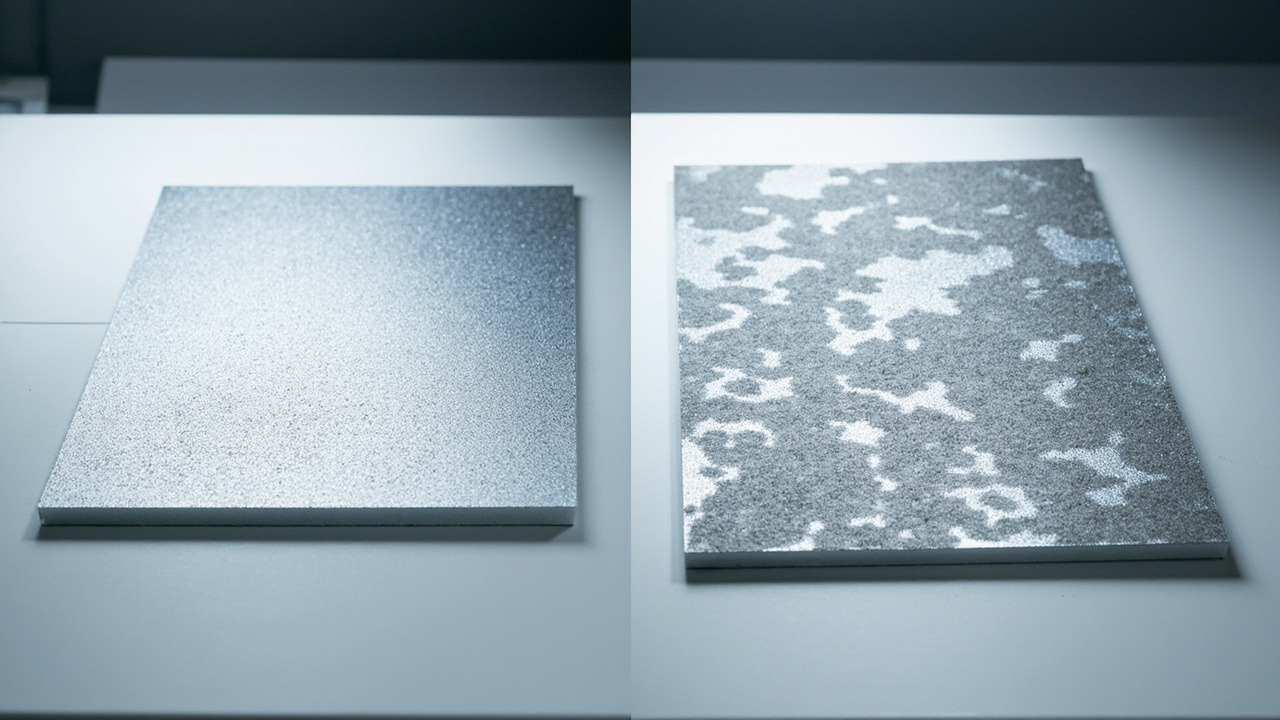
To give an intuitive example: hand the same batch of silver metallic paint to two technicians, one accustomed to high air pressure with fine atomization, multiple thin passes, and sufficient flash-off, the other accustomed to low air pressure, fewer thick passes, and rushing to apply clear coat, the result is that the former's paint surface is bright silver and translucent with strong flip-flop color, while the latter is dark, blotchy, and has flat flip-flop color—the formulation is identical, yet the appearance is worlds apart. This scenario plays out every day in reality, and is also the root cause of many factories' "no problem when changing paint, but problems when changing personnel". It profoundly shows: for metallic paint, talking about formulation must simultaneously talk about application, and talking about supply must simultaneously talk about technical service. Discussing the color of metallic paint apart from application is meaningless. This is also the fundamental reason why this article combines "color matching" and "application" together—they are two sides of the same coin.
Precisely because of this, the color matching and application of metallic effect paint are never two independent matters, but an integrated system that must be considered协同ly. The color matcher must understand application—because the formulation must be able to be applied stably; the application technician must understand color matching—because parameters change the color. This is also why in industries with extremely high requirements for metallic appearance such as automotive, home appliances, and consumer electronics, color matching capability and application craftsmanship are regarded as core competitiveness. Coating enterprises serving multiple industries, like Kexin New Materials, often treat the integrated technical service of "formulation—color—application" as the key value distinguishing metallic paint business from ordinary coating sales. This article will systematically break down the technical points of metallic effect paint color matching and application, helping readers understand this precision engineering that combines "science and craftsmanship".

Multi-Angle Color Matching: Reading the Language of Angle-Dependent Color
The first lesson in metallic paint color matching is to understand and master "multi-angle color matching". Solid color paint usually only needs one angle (such as 45°/0°) to define the color, while metallic paint must be described by multiple angles together, because its appearance is essentially a curve that changes with angle.
Industry-standard multi-angle color measurement is based on fixed incident light (usually 45° incidence), measuring color at different deviation angles relative to the specular reflection direction. Commonly used angles include those close to specular 15° (highlight, also called high-gloss angle), 25°, intermediate 45°, and those far from specular 75°, 110° (dark state, also called grazing angle/flip-flop angle). Some devices also measure lateral interference angles to capture the iridescent changes of pearlescent effects. The series of L*a*b* values at these angles connected together constitute the complete "angle-dependent color fingerprint" of metallic paint. Two metallic paints are only considered truly color-consistent when they match at all angles.
Understanding the meaning of each angle is crucial. The highlight angle (15°, 25°) mainly reflects the specular reflection intensity and color of the aluminum flakes; the amount of flip-flop color and the metallic brightness are mainly seen here; the dark state angle (75°, 110°) reflects the base color and pigment true color of the paint film; whether the metallic paint's hue in the dark state appears dirty or dark is an important dimension for judging quality; the intermediate angle (45°) is the comprehensive perception. When color matching, if a certain metallic color is found to be "correct head-on, off at an angle", it is often that the highlight and dark state angles are not matched simultaneously. Therefore, metallic paint color matchers must learn to "speak with multi-angle data", rather than judging solely by a single angle or by naked eye at a fixed viewing angle—the latter easily causes misjudgments of "looks right but measures wrong" or "correct under this light, wrong under that light".
A practical color matching approach is to "translate" multi-angle data into actionable color correction directions. For example: dark highlight (low 15° L*) usually means too few aluminum flakes or too fine particle size, poor arrangement, so increase aluminum powder or adjust particle size combination, optimize application; dirty dark state (110° hue shift) is mostly a problem of transparent colorant selection or dosage, need to adjust colorant; insufficient overall flip-flop (small bright-dark L* difference) points to poor aluminum flake orientation, often an application parameter issue rather than formulation. This method of "look at data, set direction" makes the originally mysterious metallic paint color correction follow a clear procedure, and is also the core content of training metallic paint color matchers. At the same time, it must be emphasized that evaluation must be standardized: observation must be under standard light source, standard angle, standard color presentation (sprayed panel rather than drawdown, because metallic paint drawdown and spray effects differ greatly), otherwise data and judgment will be distorted.
Computer Color Matching CCM: Accelerator for Metallic Paint Color Matching
Facing the complexity of multiple angles and multiple variables, purely manual trial-and-error metallic color matching is not only inefficient but also difficult to reproduce. Modern metallic paint color matching increasingly relies on Computer Color Matching (CCM) systems, which partially transform color matching from "art" to "science", and are key tools for improving efficiency and consistency.
Here a common misunderstanding needs clarification: CCM is not magic that "scans and outputs a formulation". Behind it is long-term accumulated basic data engineering and optical modeling. The directional reflection of metallic paint is far more complex than solid color paint—aluminum flakes have both specular reflection and scattering, pearlescent also has interference; the Kubelka-Munk two-constant theory relied upon by ordinary solid color paint CCM is not fully applicable here, requiring more complex multi-flux or BRDF (Bidirectional Reflectance Distribution Function) models to describe the directional behavior of effect pigments. This means the algorithm threshold and data threshold of metallic paint CCM are both much higher than solid color paint, which also explains why high-quality metallic paint color matching capability is a core asset possessed by only a few enterprises.
The principle of CCM is: first establish a multi-angle optical database of various effect pigments (different aluminum powders, pearlescents, transparent colorants) under standard color presentation, measure the multi-angle color values of the target color, then the software inversely calculates the pigment ratio that can match the target based on the optical model. Different from solid color paint CCM, metallic paint CCM must be built on a multi-angle optical model and handle the complex directional reflection of effect pigments, so the algorithm is more complex and the requirement for database quality is higher. A high-quality metallic paint CCM database needs to cover multi-angle color presentation data of many pigments at different concentrations and different combinations, which itself is a time-consuming and labor-intensive basic engineering, and also the core asset of a coating enterprise's color matching capability.
The formulation given by CCM is usually a "starting point" rather than an "end point". Since the appearance of metallic paint is also affected by application, after CCM initial matching, manual fine-tuning (color correction) is often still needed—the color matcher makes fine adjustments to aluminum powder particle size combination, pearlescent ratio, or transparent colorant based on the multi-angle comparison between the actual sprayed sample and the target panel, to approach the target. In recent years, the introduction of AI color matching technology allows the system to learn from massive historical formulations, give initial matches closer to the end point, and intelligently recommend color correction directions, further shortening the sampling cycle. But whether CCM or AI, neither can completely replace the color matcher's experiential judgment of texture—especially dimensions like sparkle, graininess, and depth that are difficult to fully digitize. Therefore the ideal mode for metallic paint color matching is human-machine collaboration of "CCM/AI gives direction, master determines texture". When developing new colors for customers, Kexin New Materials also usually adopts this database + manual color correction mode, balancing efficiency and final texture.

Formulation Compounding Techniques: The Trio of Aluminum Powder, Pearlescent, and Transparent Colorant
The high-end texture of metallic effect paint often comes from the exquisite compounding of aluminum powder, pearlescent pigments, and transparent colorants. Understanding the respective roles and mutual influences of these three types of raw materials is the core skill of metallic paint formulation and color matching.
Aluminum powder determines the "skeleton" of metal—the basis of brightness, flip-flop color, and sparkle. When selecting aluminum powder, particle size is the primary variable: fine aluminum powder (3-8 microns) gives a delicate satin finish, low sparkle; medium aluminum powder (10-20 microns) balances hiding and moderate sparkle; coarse aluminum powder (above 25 microns) gives obvious diamond sparkle points. The same formulation often reuses different particle size aluminum powders in graded combination, to simultaneously obtain delicate base light and decorative sparkle points. The type of aluminum powder (cornflake/silver dollar/mirror VMP) determines brightness and flip-flop grade. Aluminum powder dosage affects hiding and flip-flop—large amount gives strong hiding but flip-flop may be affected by stacking, small amount may show base.
Pearlescent pigments are responsible for "layers and color depth". They produce soft iridescence through light interference, adding depth and richness of angle-dependent color to metallic paint. Adding white pearlescent to silver can enhance the translucency and "diamond feel" of the highlight; adding interference color pearlescent (such as red, blue, green pearlescent) can produce a high-end two-color effect of "one base color, another flash color", which is the secret of many high-end automotive pearlescent colors. When compounding pearlescent with aluminum powder, attention must be paid to the superposition of their directional reflections, to avoid mutual interference causing graying or dirtying.
Here is a supplementary detail of compounding: the particle size combination of aluminum powder and pearlescent requires "graded thinking". If only a single particle size is used, either the sparkle points are too uniform and monotonous, or the graininess is out of control. Experts often use three grades of large, medium, and small particle sizes compounded in proportion—large particle size provides decorative diamond sparkle points, medium particle size builds the main metallic feel, small particle size fills the base light and delicacy, so that under direct light there is rich sparkle, and under diffuse light the grain is not prominent. This graded combination is the result of pure experience and massive trial accumulation, and also the deep reason why the same color code of different brands "looks about the same but feels different".
Transparent colorants (dye-type or transparent pigment-type) are responsible for "coloring without covering the metal". Metallic paint cannot be colored with ordinary hiding pigments, otherwise it will cover the metallic reflection of aluminum flakes; transparent colorants must be used, letting the color "coat" over the metallic reflection, forming "colored metal". The selection of transparent colorants directly determines the hue, purity, and dark state performance of metallic paint—it makes the metal glow with color in the highlight, and contributes the base color in the dark state. The weather resistance of transparent colorants is especially critical; dye-type is vivid but poor weather resistance and easy to fade, transparent pigment-type has good weather resistance and is the main force for outdoor metallic colors. The art of compounding the three lies in using aluminum powder to set the tone, pearlescent to add layers, and colorant to set the hue; only when the trio is harmonious is there a truly high-end metallic color. This compounding experience is the core know-how accumulated by metallic paint formulators over many years.
How Spray Parameters "Change Color": Application Is Color Matching
For metallic paint, a counterintuitive but extremely important认知 is: application parameters themselves are color matching variables. With the same formulation, different spray parameters produce different flip-flop color, sparkle, and hue. Understanding how spray parameters affect aluminum flake orientation is the key to stabilizing metallic paint appearance.
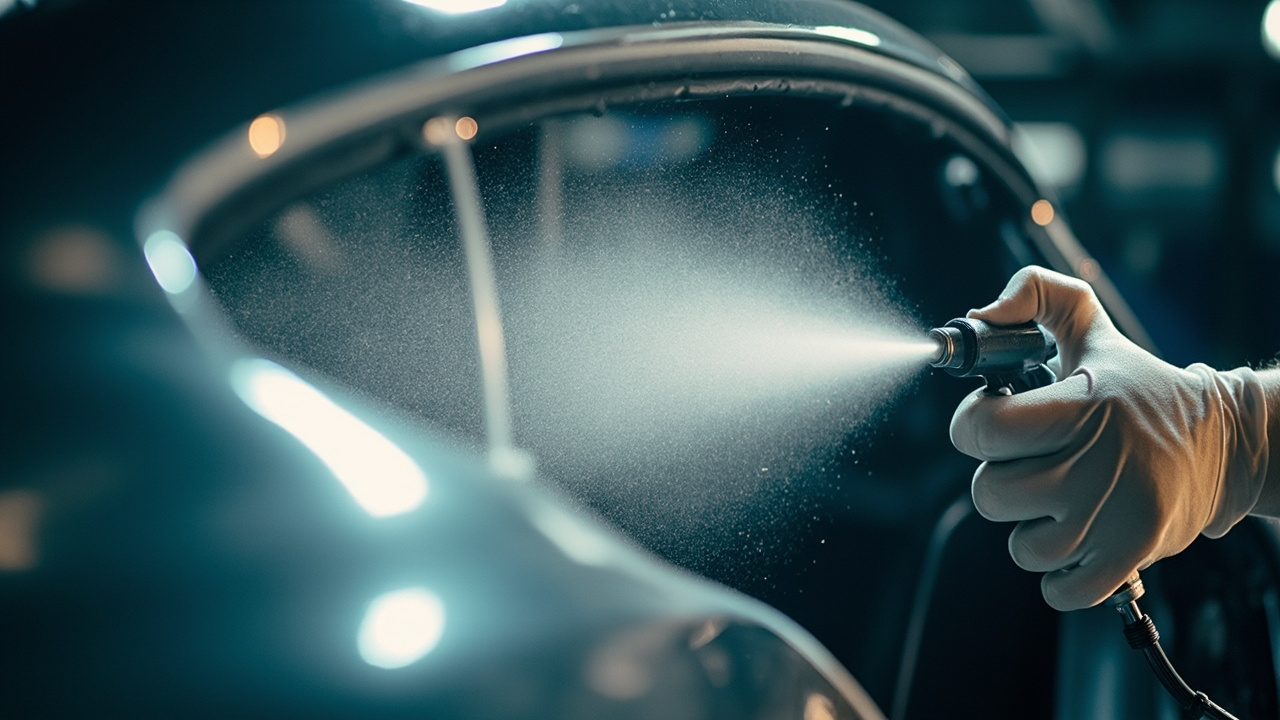
Atomization is the first major variable. The finer the atomization (high air pressure, low coating viscosity), the smaller the paint droplets, the easier the aluminum flakes spread parallel in the paint film, the stronger the flip-flop color and the brighter the metallic feel; the coarser the atomization, the more chaotic the flake orientation, the weaker the flip-flop color, and prone to blotching. Therefore metallic paint usually requires finer atomization. Gun travel speed and fluid output determine single-pass film thickness and wetness—slow travel and high output give thick wet film, aluminum flakes have more flow space but are also more likely to dislocate with flow; fast travel and low output give thin and fast-drying film, aluminum flakes are easily "frozen" in current orientation. Gun distance (usually 15-25 cm) affects the wet-dry state of paint droplets and spray pattern overlap when reaching the workpiece.
Flash-off time is a critical process unique to metallic paint. Flash-off between multiple thin coats allows the solvent of the previous layer to fully evaporate and the aluminum flakes to orient stably before the next layer is sprayed, so that the flakes in each layer can be arranged parallel to each other, giving the strongest flip-flop effect. Insufficient flash-off means the flakes are disturbed by the next layer before they are oriented, causing mottling and reduced flip-flop. The control coat/dust coat is a technique often used by experts—at the end, a high-atomization, slightly distant "dry spray" is applied to make the surface flakes lie flatter and unify the sparkle, which is the finishing touch to enhance flip-flop and appearance uniformity.Precisely because parameters have such a great influence, the application of metallic paint must have "parameter fixation": once the sampling determines parameters such as atomization pressure, gun travel speed, gun distance, number of passes, flash-off time, and film thickness, they must be strictly reproduced in mass production, and any drift will cause color difference. This is also why metallic paint lines are increasingly inclined to automatic/robot spraying—robots can accurately reproduce parameters and are more stable than manual work. Manual spraying highly depends on the training and experience of technicians. It can be said that for metallic paint, "application is color matching", and process stability is directly equal to color consistency.
| Spraying parameter | Effect of too high/too fast | Effect of too low/too slow | On metallic effect |
|---|---|---|---|
| Atomization pressure | Coating too dry, strong flip-flop | Flakes disordered, prone to mottling | Finer mist, brighter |
| Gun travel speed | Thin film, flakes easily frozen | Thick film, flakes easily misaligned | Affects flip-flop and uniformity |
| Film thickness | Flake stacking, reduced flip-flop | Insufficient hiding, base show-through | Need to keep optimal window |
| Flash-off time | —— | Insufficient causes mottling, reduced flip-flop | More sufficient, brighter |
Film Thickness and Hiding: The Invisible Red Line in Metallic Paint Application
In metallic paint application, film thickness control is an invisible red line that is often underestimated yet determines success or failure. It is completely opposite to the intuition of solid color paint that "thicker is safer", and is the easiest place for beginners to make mistakes, which deserves a separate in-depth discussion.
Metallic basecoat has an "optimal film thickness window". Too thin, hiding is insufficient, base show-through, color is too light, and flake density is not enough, weak metallic feel; too thick, flakes stack layer by layer, posture disordered, instead reducing flip-flop, increasing mottling risk, and possibly causing sagging. This optimal window is usually very narrow (metallic basecoat dry film often 10-20 microns), and must be precisely hit by "thin coats in multiple passes, flash-off between passes" rather than one thick spray. Each thin pass allows the new layer of flakes sufficient time and space to lie flat and orient during film shrinkage; layered thin coats achieve hiding while ensuring each layer of flakes is parallel, thus obtaining the strongest flip-flop.
Hiding power is another indicator that needs balancing. The hiding of metallic paint relies not only on flakes but also on the coordination of transparent colorants and primer color. For transparent colors with weak hiding (such as some reds, yellows), a matching same-color-series primer (color primer) is often used as a base to reduce base show-through risk and stabilize hue—so even if the color coat film thickness fluctuates slightly, because the primer has provided a close base color, the final color difference can be controlled. This is why high-end metallic paint systems emphasize the overall matching of "primer—color coat—clear coat" rather than only focusing on the color coat itself.
More subtly, the same metallic paint presents different flip-flop and hue at different film thicknesses—film thickness variation itself is an "invisible color-mixing variable". Therefore the standard film thickness determined by sampling must be strictly reproduced in mass production, and lines are often equipped with online film thickness monitoring. Understanding and keeping the film thickness window is a key link in transforming an excellent formula into stable mass-production appearance, and also an important sign distinguishing skilled technicians from novices.
Pearl Paint Color Matching and Application: A Step Beyond Metallic Paint
If metallic paint is already difficult, then pearl paint (containing mica-based pearlescent pigments) goes a step further in some aspects. The interference coloring mechanism of pearl is different from the specular reflection of aluminum powder, and its color matching and application have unique rules, which deserve special discussion.
Pearl pigments produce iridescence through light interference at oxide thin-film interfaces, and their color variation with angle is different from aluminum powder—aluminum powder mainly changes brightness (light/dark) with angle, while pearl may change hue with angle (e.g., from gold to red, from blue to green). This makes the multi-angle color matching of pearl paint more complex, and some interference-color pearls require special side interference measurement angles for accurate characterization. The "base color" and "flash color" of pearl can be different; this two-color effect is the source of the premium feel of pearl paint, but also greatly increases the difficulty of color matching.
In application, pearl flakes are usually larger and thinner than aluminum flakes, more easily damaged by shear, so stirring and conveying need to be gentler; pearl orientation also depends on spraying parameters and flash-off, but its sensitivity to film thickness and number of layers is sometimes higher—pearl paint often uses a "three-coat" structure (basecoat + pearl mid-coat + clear coat, or colored base + pearl topcoat + clear coat) to create deep layers, and the coordination of each layer is more particular. Pearl white is typical: often a white basecoat as base, then a mid-coat containing white pearl or interference pearl, and finally clear coat; the three layers together create a premium pearl white that is both white and has iridescent depth, which is also the practice of many luxury car signature colors.
The combination of pearl paint and aluminum powder can create richer effects: adding pearl to silver enhances sparkle and transparency, adding interference pearl to dark colors produces a mysterious angle-dependent color shift. But combination is also more prone to problems—the directional reflection of two effect pigments superimposed, if the ratio or particle size is improper, will interfere with each other causing graying and dirty appearance. Therefore the formulation and color matching of pearl paint require higher experience and database than pure aluminum metallic paint, and is the "advanced course" of metallic effect paint technology.
Complete Application Process: Standard Operation from Substrate to Polishing
The application of metallic effect paint is a set of interlinked standard operation processes, each step serving the final metallic appearance. Taking the typical "basecoat + clear coat" system as an example, a complete process includes the following steps, and negligence in any link may be amplified on the final paint surface.
The first step is substrate pretreatment and primer. The workpiece needs thorough degreasing, derusting or plastic treatment, apply primer to provide anti-corrosion and adhesion, and sand to smooth, providing a uniform, non-absorbent "canvas" for the color coat. The color of the primer (especially the matching color primer) affects the final hue and flip-flop of the metallic basecoat, so high-end systems specify dedicated matching primers. The second step is viscosity adjustment and stirring. Before application, metallic paint must be adjusted to the target viscosity with the specified thinner, and stirred thoroughly to uniformly disperse settled aluminum flakes and pearl—insufficient stirring causes uneven color and intra-batch color difference.
The third step is multiple thin coats of metallic basecoat. Usually a tack coat first to establish adhesion and initial orientation, then one to two wet coats to build color and hiding, with sufficient flash-off between each, and finally a control coat if needed to unify surface flakes. This step is the core of appearance success or failure; the output, atomization, and gun travel of each pass must be consistent, and the flash-off between passes must be sufficient but not excessive—insufficient flash-off disturbs the previous flakes, excessive flash-off may affect interlayer adhesion. Technicians often judge whether flash-off is in place by the appearance change of the paint surface from "wet glossy" to "semi-matte", which is a feel requiring experience accumulation. The fourth step is flash-off and inspection. After basecoat is sprayed, sufficient flash-off is needed to let solvent evaporate and flakes orient stably, and check for mottling, color difference, and particles. The fifth step is clear coat. The clear coat provides gloss, fullness, and protection; its solvent must not be too strong to avoid disturbing the underlying flakes, and application needs to ensure leveling and sufficient film thickness. The sixth step is curing. According to the system, natural drying, low-temperature baking, or UV curing. The seventh step is polishing (if needed). Remove dust spots, correct joints, restore mirror gloss.
The whole process emphasizes "parameter fixation, controlled environment, step-by-step inspection". Metallic paint is sensitive to temperature and humidity, so lines usually need to control spray booth temperature and humidity; sensitive to cleanliness, need to control dust. Each batch should be compared with the standard panel at multiple angles, and released only after confirming consistent appearance. This rigorous standard operation is the bridge that transforms "good color tuned in lab" into "stable good color in mass production", and also an important part of metallic paint technical service.
It is especially worth reminding the "blending" technique, which is the key to hiding boundaries in local repair and color matching. When only part of the body or workpiece needs repair, if the repair area is hard-edged, the micro-difference in flip-flop and hue between new and old films will form an obvious "joint line". The blending practice is: let the metallic basecoat gradually thin out and fade into the original paint outside the repair area, then apply clear coat over the entire transition area, so that the new and old films visually fuse naturally. Blending highly depends on technician experience—the size of the transition area, uniformity of gradient, and the release of each spray determine whether the joint is invisible. This skill is especially important in automotive refinish, and also the core of refinish paint technician training, reflecting the "application is art" side of metallic paint. In addition, the final inspection before delivery should be done under a standard light booth (including D65 daylight, TL84 store light, A source incandescent, etc.) for multi-light comparison, because metallic paint may have "metamerism"—matching under one light but shifting under another, and multi-light inspection can detect such hidden dangers in advance.
Spraying Equipment and Automation: From Manual Gun to Robot
The extreme sensitivity of metallic appearance to application parameters makes the choice of spraying equipment and degree of automation an important factor in determining consistency. Different equipment has its own characteristics; understanding their impact on metallic effect helps line planning and process optimization.
Manual air spray gun is the most flexible and popular method, especially suitable for small batches, multiple varieties, complex shapes, and repair work. It highly depends on the technician's technique (pressure, gun distance, travel speed, overlap rate); the advantage is flexible response and fine skills like blending, the disadvantage is consistency depends on people, with large inter-batch and inter-person fluctuation. Therefore manual-sprayed metallic paint lines especially emphasize technician training and parameter discipline. Air-assisted and HVLP (high volume low pressure) guns improve atomization quality and transfer efficiency, can ensure fine atomization while reducing overspray waste, and are common manual equipment for metallic paint.
Electrostatic spraying is widely used in metal part coating; it charges the paint droplets and uses the electric field formed by the grounded workpiece to adsorb paint onto the workpiece, with high transfer efficiency and ability to wrap around the back (electrostatic wrap effect). But electrostatic spraying for metallic paint has a special problem: charging affects the orientation and distribution of aluminum flakes, may change flip-flop and appearance, and the "Faraday cage effect" brought by aluminum powder conductivity makes painting in recesses difficult. Therefore electrostatic spraying of metallic paint needs special optimization, or adopt a combination of "electrostatic basecoat + conventional orientation layer". Rotary bell electrostatic (high-speed rotary bell atomizer) is the main force in automotive OEM metallic paint, with extremely fine atomization, high transfer efficiency, and excellent appearance.
Robotic automatic spraying is the ultimate solution for high consistency of metallic paint. Robots can accurately and stably reproduce all parameters determined by sampling (trajectory, speed, flow, atomization, gun distance), eliminating human fluctuation, and are the first choice for automotive OEM, large-batch home appliances, and consumer electronics metallic paint. With online film thickness and color difference detection, closed-loop parameter control, automated lines can raise batch consistency of metallic paint to a level difficult for manual work. Of course, automation has large investment and relatively low flexibility; multi-variety small-batch scenarios still need manual or semi-automatic. The essence of equipment selection is to balance consistency, flexibility, and cost, and metallic paint, due to its parameter sensitivity, is more inclined to automation than solid color paint.
Defect Diagnosis and Prevention: Common Appearance Problems of Metallic Paint
The most headache-inducing in metallic paint application are those appearance defects of "formula unchanged, just can't spray well". Systematically mastering the causes and countermeasures of common defects is the basic skill of application quality control and the key to rapid loss mitigation.
Mottling (cloud shadow) is the most common defect, showing patches of uneven light and dark on the paint surface, rooted in uneven flake orientation—unstable atomization, uneven gun overlap, insufficient flash-off, local wet-dry differences all cause it. The countermeasure is to stabilize atomization and gun rhythm, ensure sufficient flash-off, and add control coat if necessary. Color difference and batch difference show as appearance differences between workpieces/batches of the same color code, mostly caused by aluminum powder batch, application parameters, or film thickness fluctuation; need to fix parameters, control raw material batches, and use multi-angle color measurement management. Insufficient flip-flop (darkening) means small light-dark contrast, not bright enough, often caused by non-parallel flake arrangement (high viscosity, insufficient atomization, excessive film thickness stacking, clear coat swelling); need to optimize atomization, control film thickness, verify clear coat compatibility.
Graininess/dirtiness appears rough under diffuse light, mostly due to oversized pigment particle size or excessive concentration, requiring rebalancing of flake and finesse. Fingerprints/water marks/whitening are mostly related to solvent residue, excessive humidity, or improper flash-off. Bleeding/intershade biting is caused by the strong solvent of the varnish dissolving the base color paint, leading to color migration and reduced flop; interlayer compatibility verification is required. Orange peel, sagging, pinholes, etc. are common spraying defects, related to atomization, film thickness, viscosity, and cleanliness. There is also a hidden "edge darkening/edge mottling" that appears on the edges and corners of workpieces, caused by the different spray overlap, airflow, and drying speed at these locations compared to flat surfaces, resulting in abnormal aluminum flake orientation; the countermeasure is to adjust the spray path, separately re-spray the edges, or use directional spraying for uniformity, which is especially common on complex-shaped workpieces.There is a practical troubleshooting sequence for diagnosing metallic paint defects: first see whether it is a "global" or "local" defect—global (the whole piece is poor) mostly points to formulation, raw material, or overall parameter issues, while local (a certain area is poor) mostly points to construction technique, airflow, or shape factors in that area. Then see whether it is a "bright-state problem" or "dark-state problem"—darkening in bright state is mostly related to aluminum flake amount and orientation, while dirtiness in dark state is mostly related to colorants. Finally determine whether it is caused by the "base color paint layer" or the "varnish layer"—if it worsens only after applying clear coat, it is often varnish swelling or compatibility issues. Using this three-dimensional troubleshooting method of "global vs local, bright-state vs dark-state, base vs varnish" can quickly narrow down the scope, accurately locate the problem, and avoid blind trial-and-error wasting materials and man-hours. The key to diagnosing defects is "layered attribution": first determine whether it is a formulation or application issue, a base color paint or varnish issue, then troubleshoot the corresponding variables one by one. Mature coating suppliers usually provide defect atlases and diagnostic guides to help customers quickly locate and solve problems, which is also a direct manifestation of the technical service value of metallic paint.
Color matching and application of water-based metallic paint: new challenges brought by greenization
With the tightening of environmental regulations, water-based metallic paint is gradually replacing solvent-based and becoming the mainstream direction for automotive OEM, refinish, and general industrial use. However, the physical properties of water are completely different from solvents, bringing a series of new challenges to the color matching and application of metallic paint; understanding these differences is a prerequisite for successful water-based transformation.
Water's evaporation behavior is the biggest variable. Water has high latent heat of vaporization and its evaporation rate is strongly affected by ambient humidity—when humidity is high, water evaporates slowly, the aluminum flake orientation time window is prolonged and unstable, easily causing insufficient flop and mottling; when humidity is low, it may dry too fast. This is in sharp contrast to solvent-based paint, which has relatively controllable evaporation and is less affected by humidity. Therefore, the application of water-based metallic paint requires higher control of spray booth humidity; production lines usually need to be equipped with dehumidification facilities, and widely adopt "intermediate flash-off heating" (using warm air or infrared to assist dehydration between spraying intervals) to stabilize the evaporation rhythm and accelerate aluminum flake orientation. This is the key process link for water-based metallic paint to stably reproduce appearance.
Water's high surface tension affects wetting and aluminum flake spreading. Water-based metallic paint has worse wettability to substrates and primers than solvent-based, easily causing craters and mottling, requiring reliance on wetting agents and coalescing agents to adjust. At the same time, bare aluminum easily undergoes gas swelling corrosion in water; water-based metallic paint must use silica or polymer-coated passivated aluminum powder, which also slightly affects the optical performance of aluminum flakes and needs compensation in formulation. In color matching, the color development rules of water-based and solvent-based metallic paint are different, and their CCM databases cannot be shared and must be established separately. In addition, the drying shrinkage and flash-off conditions of water-based paint differ from solvent-based, so the water-based and solvent-based formulations for the same target color often differ significantly. Despite many challenges, after years of development, mature water-based metallic paint can already approach solvent-based in flop and sparkle, becoming a reliable choice for green compliance. When promoting the application of water-based metallic paint, Kexin New Materials specifically reminds customers to pay attention to spray booth humidity control and intermediate flash-off facilities, as this is often the crux of water-based metallic paint being "doable in the lab but unstable on the production line".
Application differences across industries: one principle, multiple implementations
The basic principle of metallic effect coatings is the same, but when implemented in different industries, the application methods and focus vary greatly. Understanding these differences helps to select appropriate products and processes for specific scenarios.
Automotive OEM coating is the highest standard for metallic paint application. It is done in clean workshops with controlled temperature and humidity, using robotic automatic spraying, multi-layer thin spraying with intermediate flash-off, pursuing highly consistent color across different parts, batches, and factories of the whole vehicle. OEM has extremely strict tolerance for multi-angle color difference, relying on complete online inspection and color management. Automotive refinish is the other extreme—under non-standard conditions in repair shops, manually using spray guns to reproduce the OEM's flop and sparkle, and also doing blend-in spraying to seamlessly fuse old and new paint films. Refinish relies extremely on the experience of colorists and technicians; the color matching database (including variant sub-colors) and rapid color matching capability are the core of the refinish paint system.
Home appliance coating pursues stable metallic appearance (brushed silver, champagne gold, space gray, etc.) under batch and automation, and emphasizes stain resistance, scratch resistance, and fingerprint resistance, commonly using automatic spraying or electrostatic spraying with baking cure. Consumer electronics coating is at the "precision manufacturing" level—small workpieces, high precision, thin coatings, mostly using automated production lines, UV or low-temperature curing, pursuing high hiding power under ultra-thin, fine texture, and wear/fingerprint resistance, with extremely high cleanliness requirements. Construction machinery, hardware, furniture, etc. are relatively flexible, can be manually or automatically sprayed, focusing on the balance between decorative upgrade and weather/erosion resistance.
These differences mean that the same type of metallic effect requires different product designs (solvent/water-based/UV/powder), curing methods (air dry/baking/UV), application equipment (manual/automatic/electrostatic), and quality standards in different industries. Therefore, professional coating suppliers rarely "sell one paint to all industries", but provide differentiated supporting solutions and application guidance around industry characteristics. Understanding the application reality of the target industry is an important prerequisite for metallic paint selection and development.
Color trends: why metallic colors are always at the forefront of fashion
Metallic effect coatings are not only technical products but also carriers of fashion and design. Their color matching development increasingly needs to keep up with color trend trends; understanding this helps to grasp the market pulse and development direction of metallic paint.
From global automotive popular colors, silver, gray, black, and white have long dominated, and the proportion of metallic and pearlescent effects continues to rise—consumers' pursuit of "premium feel" is largely satisfied through metallic texture. Recent trends are: shifting from high-gloss high-sparkle to more delicate, restrained satin metallic and matte metallic; expanding from pure silver-gray to warm champagne, rose gold, cool star-gray, gunmetal, and special colors with interference such as pearlescent white, aurora purple. New energy vehicles especially drive this wave of "tech-feel metallic colors" innovation, using unique color schemes to build brand recognition.
Consumer electronics and home appliances also lead metallic color trends. Phones and laptops have developed from classic silver, gray, gold to gradient colors, matte metallic, ceramic-texture metallic, etc., with each generation of flagship product colors becoming an industry benchmark. Home appliances have moved from white goods to "metallization, homelization", with space gray, titanium gold, champagne gold and other metallic colors becoming standard for high-end products. These downstream color innovations constantly pose new propositions for metallic paint color matching: how to use effect pigments to compound new colors that are both fashionable and stably mass-producible, while meeting weather and durability requirements.
For coating enterprises, keeping up with or even leading color trends is an important capability of the metallic paint business. This requires enterprises to not only understand chemistry and optics, but also have the ability of color trend research and popular color development, proactively reserving next-season and next-generation metallic color schemes for customers. Leading suppliers often have dedicated color design teams, regularly release popular color cards, participate in customers' new product color development, upgrading from "selling paint" to "selling color solutions". This extension from technology to aesthetics is exactly the unique charm of metallic effect coatings that distinguishes them from ordinary industrial coatings.
It is worth noting that a balance is needed between color trends and technical feasibility. Designers can often imagine highly impactful new colors, but turning them into products that can be mass-produced, stable, and weather-resistant requires evaluation by the color matching and formulation team: whether the required effect pigments are weather-resistant, can be stably mass-produced, whether the application window is wide enough, and whether the cost is acceptable. A "stunning but unstable" color becomes a nightmare in mass production. Therefore, excellent metallic color development is a repeated dialogue between design aesthetics and engineering reality—both new and beautiful, and stable and economical. This ability to bridge aesthetics and engineering is the deep value of mature metallic paint enterprise color services, and also the foundation for truly embedding into customers' product definition processes and establishing long-term cooperation.
Batch consistency: the ultimate test of metallic paint mass production
For metallic paint, making a good color once is not difficult; the difficulty is making the same good color for every batch and every piece. Batch consistency is the ultimate test of metallic paint mass production, and also the threshold for entering stringent supply chains such as automotive, home appliances, and consumer electronics.
The challenge of batch consistency runs through the entire chain. On the raw material side, batch fluctuations of aluminum powder, pearlescent, and colorants will directly change the appearance; incoming raw materials need to be strictly inspected by multi-angle color value, particle size, brightness, and other indicators, and batch files established. On the production side, the dispersion process needs precise control—over-dispersion will break aluminum flakes and reduce brightness, under-dispersion will cause uneven color; each batch of finished product needs to be released against multi-angle color value and appearance limit samples. On the application side, parameterCuring and environmental control are core; any drift in atomization, gun travel, film thickness, temperature and humidity will cause color difference.
The core tool for controlling batch consistency is the multi-angle color measurement and limit sample system. Enterprises need to establish standard color values and tolerance ranges (ΔE limits at each angle) for each metallic color, and use multi-angle spectrophotometers to objectively determine pass/fail rather than relying solely on naked eyes. For customers requiring cross-factory and cross-batch consistency, suppliers also need to deliver overall solutions of standard color panels, application parameters, and color measurement methods, ensuring that the appearance reproduced on the customer's production line is consistent with the standard. Digital color management (cloud color library, remote color comparison) makes color transmission between headquarters and branch factories, suppliers and customers more accurate and efficient.
It can be said that the deep competitiveness of metallic paint enterprises is largely hidden in this batch consistency control system. It is not a single formulation or one-time color matching capability, but a full-process color management capability from raw materials, production to application and inspection. This is also why the supply of high-end metallic paint increasingly emphasizes the overall delivery of "product + data + service". For coating enterprises like Kexin New Materials facing multiple industries, continuously investing in color databases, multi-angle color measurement, and application technical support is precisely to turn "occasionally doing well" into "doing well batch by batch", thereby winning high-end customers who are extremely sensitive to appearance.
Conclusion: a precision engineering where science and craftsmanship meet
Looking back at the color matching and application of metallic effect coatings, one can clearly see its unique temperament distinct from ordinary coatings—it is both rigorous science and exquisite craftsmanship. The scientific side is reflected in multi-angle optics, effect pigment chemistry, computer color matching models, and quantitative inspection standards; the craftsmanship side is reflected in the colorist's empirical judgment of texture, the technician's fine control of spraying techniques, and the keen diagnosis of defect causes. Neither can be absent: with only science but no craftsmanship, truly premium texture cannot be made; with only craftsmanship but no science, stable reproducible mass production cannot be achieved. The charm and difficulty of metallic paint exactly originate from this intersection of science and craftsmanship.
For manufacturing enterprises using metallic paint, understanding the trinity logic of "formulation—color—application" is crucial. Selecting a metallic paint is essentially selecting a complete solution including formulation, color data, application parameters, and technical support; using a metallic paint well requires continuous investment in parameterCuring, environmental control, and inspection management on the production line. Any idea of treating metallic paint as ordinary paint "just spray it on" will pay a price in the final appearance—defects such as mottling, color difference, and inconsistent flop are often the result of ignoring this logic.
For coating suppliers, the color matching and application capability of metallic paint is a deep barrier that is not easily replicated. It requires long-term accumulated pigment databases, multi-angle color matching experience, application process know-how, and color service systems. Whoever hones this capability to the extreme can continuously win customers in high-end markets such as automotive, home appliances, and consumer electronics. The reason why metallic effect coatings are fascinating is precisely that they transform cold chemistry and optics into visually appealing aesthetics that touch people—and the stable reproduction of this aesthetics condenses the wisdom of colorists and technicians blending science and craftsmanship.
And precisely because of this, the value of metallic effect coatings has never been just "a can of paint". When an enterprise selects a metallic paint supplier, what it truly purchases is the complete service system of color development, formulation stability, application guidance, and batch control behind it; and when a metallic paint presents consistent and fascinating goniochromism on thousands of products, behind it is the collaborative achievement of formulators, colorists, application technicians, and inspectors. Understanding and respecting this "science + craftsmanship" complexity, correctly selecting, using, and controlling the process of paint, can let the unique charm of metallic effect coatings stably bloom on every product, and also turn this precision engineering into product competitiveness and brand texture expression.
FAQ
Q: Why does metallic paint require multi-angle color matching, while solid color paint only needs one angle? A: Because the appearance of metallic paint changes with viewing angle (flake orientation/color flop), a single angle cannot describe it. Multiple angles such as bright state (15°, 25°), mid (45°), and dark state (75°, 110°) must be used together to define it; two metallic paints are only considered color-matched when they match at all angles. Solid color paint color basically does not change with angle, so a single angle is sufficient.
Q: Can computer color matching (CCM) completely replace manual metallic color tuning? A: It cannot completely replace it. CCM/AI can quickly provide a close initial formula based on a multi-angle optical database, greatly improving efficiency, but the appearance of metallic paint is also affected by application, and textures such as sparkle, graininess, and depth are difficult to fully digitize; usually a colorist still needs to do manual color correction based on actual spray samples. The ideal model is human-machine collaboration of "CCM/AI sets direction, master craftsman sets texture".
Q: Why does the same batch of metallic paint look different when sprayed by different people? A: Because the appearance of metallic paint depends on aluminum flake arrangement, and the arrangement is highly dependent on spraying parameters (atomization, gun travel speed, film thickness, flash-off time). Different people's techniques, air pressure, and gun distance vary, so the aluminum flake orientation differs, and the flop, sparkle, and hue change accordingly. This is "application is color tuning", and also why metallic paint production lines tend to use robotic spraying to fix parameters.
Q: In metallic paint color tuning, what roles do aluminum powder, pearl, and transparent colorants play? A: Aluminum powder sets the metallic skeleton (gloss, flop, sparkle), with particle size and type determining texture; pearl adds depth and color depth, producing iridescence and two-tone effects; transparent colorants add color without covering the metal, determining hue and dark-state base color. The three are combined—aluminum powder sets the tone, pearl adds depth, colorant sets hue—to achieve a high-grade metallic color; the weather resistance of the colorant is especially critical for outdoor colors.
Q: What is "control coat/directional spray"? Why does it improve appearance? A: A control coat (control coat/dust coat) is a final high-atomization, slightly distant "dry spray" applied over the basecoat, allowing surface aluminum flakes to lie flatter, unify posture, and sparkle evenly, thereby improving flop and appearance uniformity. It is a finishing trick to hide mottling and enhance metallic feel. It uses the fact that dry-spray droplets arrive at the workpiece relatively dry, "pressing flat" surface flakes without disturbing lower layers.
Q: How to ensure no color difference between batches in metallic paint mass production? A: Through full-process color management: incoming raw materials inspected and archived by multi-angle color values/particle size; production precisely controls dispersion process, finished product released by multi-angle color values and limit samples; application curing parameters, control of spray booth temperature and humidity; use multi-angle spectrophotometer and limit samples for objective judgment, not just by naked eye. For customers requiring cross-plant consistency, standard panels, parameters, and color measurement methods must also be delivered.
Q: What are the environmental requirements for metallic paint application? A: Metallic paint is sensitive to temperature, humidity, and cleanliness. Temperature and humidity affect solvent/water evaporation rhythm and thus aluminum flake orientation; production lines usually need to control and stabilize spray booth temperature and humidity; insufficient cleanliness leaves dust spots and particles on the paint film. Therefore, metallic paint (especially high-end and mirror types) is mostly applied in temperature/humidity-controlled clean spray booths.
Q: Why shouldn't metallic paint film be sprayed too thick? A: The appearance of metallic paint depends on parallel arrangement of aluminum flakes; excessive film thickness causes flakes to stack layer by layer with disordered posture, reducing flop and increasing mottling—opposite to solid paint's "thicker is safer". Metallic basecoat dry film is usually controlled in a narrow window of 10-20 microns, achieved by thin multiple passes with flash-off between coats to hit precisely, and the same color's flop hue changes at different film thicknesses, so mass production must strictly reproduce standard film thickness.
Q: What are the differences in application between water-based metallic paint and solvent-based? A: Water evaporates slowly and is greatly affected by humidity; water-based metallic paint application requires higher spray booth humidity control, generally needing dehumidification facilities and "intermediate flash-off heating" to stabilize aluminum flake orientation; water's poor wetting easily causes craters and mottling, requiring wetting additives; and passivated coated aluminum powder must be used to prevent gas bloating. Their color development rules differ, so CCM databases are not interchangeable. Mature water-based metallic paint effects are already close to solvent-based.
Q: Why check metallic paint color under standard light source and multiple light sources? A: Because metallic paint may have "metamerism"—matching under one light source but shifting under another. Only by comparing in a standard light booth with multiple sources (e.g., D65 daylight, TL84 store light, incandescent) and observing at standard angles can true color consistency be fully judged, avoiding the delivery risk of "right under this light, wrong under that light".
Q: What capabilities does a metallic paint colorist need? A: They need to understand multi-angle flop principles, use multi-angle spectrophotometers and CCM systems, master the combination rules of aluminum powder/pearl/transparent colorants, know how application parameters affect appearance (application is color tuning), translate multi-angle data into correction direction, and have experienced judgment of textures like sparkle/grain/depth. It combines optics, chemistry knowledge, and craft experience, with a long training cycle.
Further Reading
- Alloy Paint and Metallic Effect Coatings Industry Panorama: Technical Evolution of Flop and Functional Decoration
- Non-Electroplating Metallic Coatings (Electroplating Alternative Paint) Process Explained: Technical Pathways for Eco-Friendly Alternatives
- Plastic Soft-Touch and Functional Coatings: From Feel to Function in Plastic Surface Upgrading
- Automotive Metallic Paint Color Matching Principles and Formula Reconstruction: Colorant System and Specular/Side Light Control
- Automotive Pearl Paint (Iridescent Paint) Color Matching Difficulties: Multi-Layer Structure and Flop
- Automotive Refinish Paint Color Tuning Tips: Proper Use of Metallic Particles and Pearl Powder
{"@context": "https://schema.org", "@type": "FAQPage", "mainEntity": [{"@type": "Question", "name": "Why does metallic paint color matching require multi-angle measurement, while solid color paint only needs one angle?", "acceptedAnswer": {"@type": "Answer", "text": "Because the appearance of metallic paint changes with viewing angle (flake orientation/color shift), a single angle cannot describe it. Multiple angles such as highlight (15°, 25°), mid (45°), and shadow (75°, 110°) must be used together to define it; two metallic paints are considered color-matched only when they match at all angles. Solid color paint color basically does not change with angle, so a single angle is sufficient."}}, {"@type": "Question", "name": "Can computer color matching (CCM) completely replace manual metallic color tuning?", "acceptedAnswer": {"@type": "Answer", "text": "It cannot completely replace. CCM/AI can quickly provide a close initial formula based on multi-angle optical databases, greatly improving efficiency, but the appearance of metallic paint is also affected by application, and textures such as sparkle, graininess, and depth are difficult to fully digitize; usually a colorist still needs to manually correct the color based on actual spray samples. The ideal model is human-machine collaboration of 'CCM/AI sets direction, master sets texture'."}}, {"@type": "Question", "name": "Why does the same batch of metallic paint look different when sprayed by different people?", "acceptedAnswer": {"@type": "Answer", "text": "Because the appearance of metallic paint depends on aluminum flake arrangement, which is highly dependent on spraying parameters (atomization, gun travel speed, film thickness, flash-off time). Different people's techniques, air pressure, and gun distance vary, so the flake orientation differs, and the flip, sparkle, and hue change accordingly. This is 'application is color tuning', and also why metallic paint production lines tend to use robotic spraying to fix parameters."}}, {"@type": "Question", "name": "In metallic paint color tuning, what roles do aluminum powder, pearl, and transparent colorants play?", "acceptedAnswer": {"@type": "Answer", "text": "Aluminum powder sets the metallic skeleton (brightness, flip, sparkle), with particle size and type determining texture; pearl adds depth and color depth, producing iridescence and two-tone effects; transparent colorants add color without covering the metal, determining hue and shadow-state base color. The three are combined—aluminum sets the tone, pearl adds depth, colorant sets hue—to achieve a high-grade metallic color; the weather resistance of colorants is especially critical for outdoor colors."}}, {"@type": "Question", "name": "What is 'control coat/dust coat'? Why does it improve appearance?", "acceptedAnswer": {"@type": "Answer", "text": "A control coat (control coat/dust coat) is a final high-atomization, slightly distant 'dry spray' applied over the basecoat, allowing surface aluminum flakes to lie flatter, unify orientation, and sparkle evenly, thereby improving flip and appearance uniformity. It is a finishing trick to hide mottling and enhance metallic feel. It uses dry spray droplets that are relatively dry upon reaching the workpiece to 'press flat' surface flakes without disturbing lower layers."}}, {"@type": "Question", "name": "How to ensure no color difference between batches in metallic paint mass production?", "acceptedAnswer": {"@type": "Answer", "text": "Rely on full-process color management: incoming raw materials inspected and archived by multi-angle color values/particle size; production precisely controls dispersion process, finished product released by multi-angle color values and limit samples; application fixes parameters, controls spray booth temperature and humidity; use multi-angle spectrophotometer and limit samples for objective judgment, not just by naked eye. For cross-plant consistency, customers also need standard panels, parameters, and color measurement methods delivered."}}, {"@type": "Question", "name": "What are the environmental requirements for metallic paint application?", "acceptedAnswer": {"@type": "Answer", "text": "Metallic paint is sensitive to temperature, humidity, and cleanliness. Temperature and humidity affect solvent/water evaporation rhythm and thus flake orientation; production lines usually need to control and stabilize spray booth temperature and humidity; insufficient cleanliness leaves dust spots and particles on the paint film. Therefore metallic paint (especially high-end and mirror types) is mostly applied in temperature/humidity-controlled clean spray booths."}}, {"@type": "Question", "name": "Why shouldn't metallic paint film be sprayed too thick?", "acceptedAnswer": {"@type": "Answer", "text": "The appearance of metallic paint depends on parallel arrangement of aluminum flakes; excessive film thickness causes flakes to stack and orient chaotically, reducing flip and increasing mottling, opposite to solid paint's 'thicker is safer'. Metallic basecoat dry film is usually controlled in a narrow window of 10-20 microns, achieved by thin multiple passes with flash-off between, and the flip hue changes at different film thicknesses, so mass production must strictly reproduce standard film thickness."}}, {"@type": "Question", "name": "What are the differences in application between water-based metallic paint and solvent-based?", "acceptedAnswer": {"@type": "Answer", "text": "Water evaporates slowly and is greatly affected by humidity; water-based metallic paint requires higher spray booth humidity control, generally needing dehumidification facilities and 'intermediate flash-off heating' to stabilize flake orientation; water has poor wetting, prone to craters and mottling, requiring wetting additives; and passivated coated aluminum powder must be used to prevent gas bloating. Their color development rules differ, so CCM databases are not interchangeable. Mature water-based metallic paint effects are already close to solvent-based."}}, {"@type": "Question", "name": "Why check metallic paint color under standard and multiple light sources?", "acceptedAnswer": {"@type": "Answer", "text": "Because metallic paint may have 'metamerism'—matching under one light source but shifting under another. Only by comparing in a standard light box with multiple sources (e.g., D65 daylight, TL84 store light, incandescent) and observing at standard angles can true color consistency be judged, avoiding delivery risk of 'right under this light, wrong under that light'."}}, {"@type": "Question", "name": "What capabilities does a metallic paint colorist need?", "acceptedAnswer": {"@type": "Answer", "text": "Need to understand multi-angle flake-orientation/color-shift principles, use multi-angle spectrophotometers and CCM systems, master combination rules of aluminum/pearl/transparent colorants, know how application parameters affect appearance (application is color tuning), translate multi-angle data into correction direction, and have experiential judgment of textures like sparkle/grain/depth. It combines optics, chemistry, and craft experience, with a long training cycle."}}]}