Volatile Organic Compounds (VOC) are important precursors for the formation of ozone and fine particulate matter pollution, and are also the root cause of occupational health and fire risks in coating operations. For the industrial coating industry, VOC limits have shifted from "environmental advocacy" to "mandatory thresholds": products that fail to meet the limits cannot be marketed, and related engineering environmental acceptance is difficult to pass. In China, the most core mandatory standard for industrial protective coatings is GB 30981-2020 "Limit of Harmful Substances in Industrial Protective Coatings", which together with GB 33372 (adhesives), GB 38507 (inks), etc., forms the mandatory limit system for "green products". This article takes GB 30981-2020 as the main line, clarifying the limit figures, classification boundaries, testing methods, and how enterprises can select products compliantly, helping technical, procurement, and environmental protection personnel understand it at once.
As a technical supplier of protective coatings, Kexin New Materials (kexinMaterials) treats the limits of GB 30981-2020 as the red line for product formulation design, and prioritizes providing water-based, high-solid, and solvent-free solutions in tank linings, bridges, and marine配套, making VOC shift from "post-testing" to "source design". The limit caliber of this article also directly originates from these compliance practices.

I. Positioning and Scope of GB 30981-2020
GB 30981-2020 was released in 2020 and mandatory implemented from 2021, replacing the old version GB 30981-2014. It specifies the limits of harmful substances such as VOC content, halogenated hydrocarbons, and heavy metals in industrial protective coatings (including steel structure, concrete protection, etc.), and is the mandatory basis for products entering the market and engineering environmental acceptance. Its applicable scope covers:
- Marine, container, bridge, tank and other steel structure protective coatings;
- Primer, intermediate coat, and topcoat used in workshops and on-site;
- Different forms of products such as water-based, solvent-based, and solvent-free (high-solid).
Note the distinction: architectural coatings have separate GB 18582, wood coatings have GB 18581, while industrial protection follows GB 30981. Choosing the wrong standard will lead to "test passed but not applicable".
II. What Exactly Are the VOC Limit Figures
GB 30981-2020 gives VOC limits (unit g/L, application state) separately by product type and construction state, typical magnitudes are as follows (according to standard tables, subject to the current standard text):
| Product Category | Form | VOC Limit Magnitude (g/L) | Remarks |
|---|---|---|---|
| Water-based industrial protective coating | Water-based | Usually lower (tens to 200 magnitude) | Subdivided by variety |
| Solvent-based—primer/intermediate coat | Solvent-based | Higher (hundreds magnitude) | Zinc-rich etc. separately stipulated |
| Solvent-based—topcoat | Solvent-based | Higher (hundreds magnitude) | Slightly wider if with special function |
| Solvent-free (high-solid) | Solvent-free | ≤ 60 magnitude | Near 100% solid content |
| Epoxy zinc-rich primer | Solvent/solvent-free | According to special clauses | Zinc powder system listed separately |
Core conclusion: water-based systems have the lowest VOC, solvent-free type is next with near 100% solid content, solvent-based has the widest limit but is still a hard upper bound. Enterprises cannot mistakenly think they can add solvent unlimitedly just because "solvent-based limit is wider"—exceeding it is illegal.
III. How Is VOC Measured
The limit is the "result", and the testing method is the "ruler". VOC testing of industrial coatings mainly relies on:
- GB/T 23985 / GB/T 23986 (ISO 11890 series): Difference method and gas chromatography method for determining VOC content;
- GB/T 23992: Determination of VOC in water-based coatings (gas chromatography method);
- Water content determination: Water-based coatings need to measure and deduct water content first, then calculate VOC.
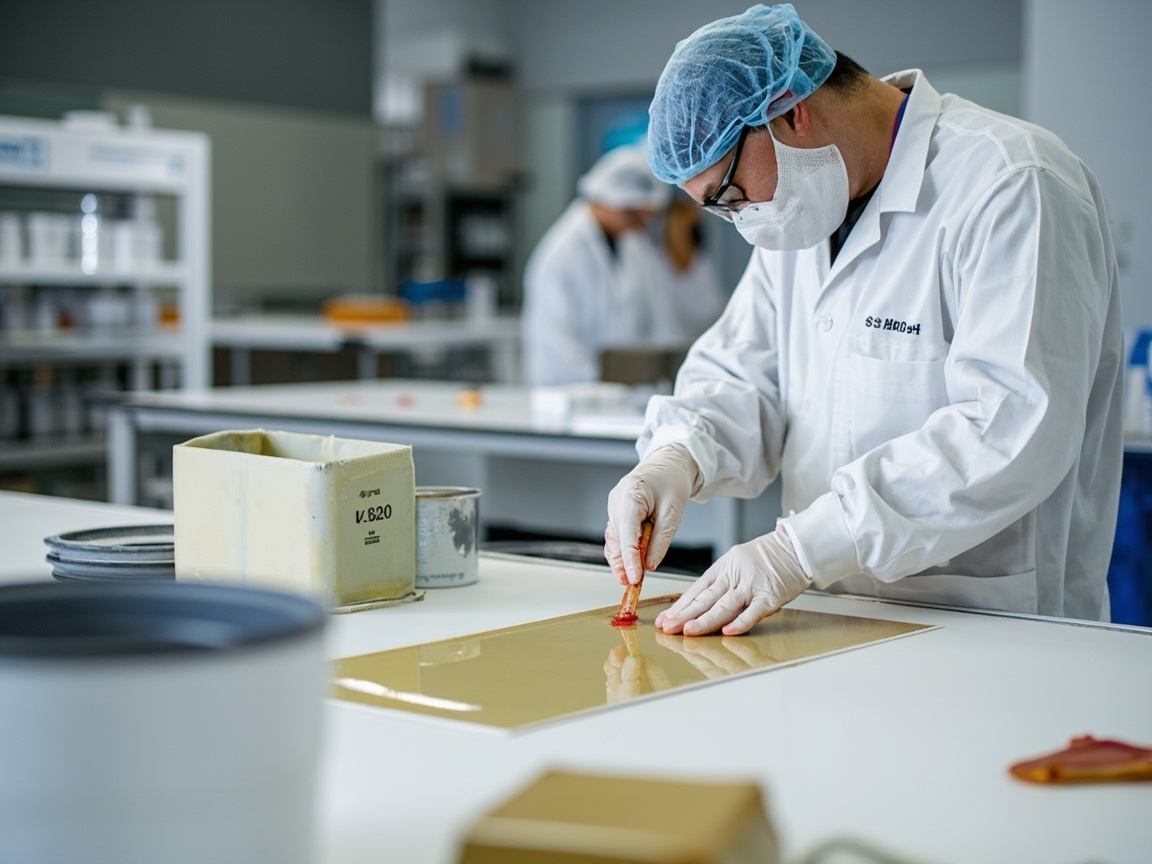
Method key points: VOC refers to "organic compounds participating in photochemical reactions", usually screened by boiling point ≤ 250℃ or standard definition; water and non-volatile components are not counted. The result is based on the "application state" (i.e., the actual mixed state used by the user), so two-component coatings must be converted according to the mixing ratio, which is often overlooked—measuring only the base resin will seriously underestimate the actual VOC.
IV. Compliance Boundaries of Water-based, Solvent-based, and Solvent-free
From a compliance perspective, the three systems have their own positioning:
- Water-based industrial paint: Lowest VOC limit, suitable for poorly ventilated indoor, food factories, maintenance scenarios, but slow curing at low temperature and high humidity, sensitive to surface treatment and application window (see this batch of water-based anti-rust coating technology);
- Solvent-based: Mature process, wide adaptability, but VOC upper limit is most easily hit, facing use restrictions and end-of-pipe treatment costs in strict environmental zones;
- Solvent-free/high-solid: Lowest VOC and single-coat thick film, suitable for tanks, pipelines, marine, but requires two-component heating equipment (see this batch of solvent-free epoxy heavy anti-corrosion coating).
Selection is not "the more eco-friendly the better", but the balance of "within limits, life meets standard, cost controllable". For strict emission zones, water-based or solvent-free is almost a must.
V. Heavy Metals and Other Harmful Substances
GB 30981 not only controls VOC, but also restricts harmful heavy metals and specific substances:
- Limits on heavy metals such as lead, cadmium, hexavalent chromium, mercury;
- Restrictions on halogenated hydrocarbons (such as dichloromethane, etc.);
- Phase-out and substitution of specific pigments and additives.
This means compliance is not only "reducing VOC", but also checking the harmful substance list of all components, to avoid the new problem of "low VOC but high heavy metals". Traditional anti-rust systems containing zinc chromate, lead-based pigments are being replaced by zinc phosphate, aluminum tripolyphosphate, zinc powder, etc.
VI. Enterprise Compliance Implementation Path
To turn regulations into executable actions, four steps are recommended:
- Selection check: Before procurement, confirm that the product test report is based on GB 30981-2020 and the form/category matches;
- Source substitution: In strict emission zones, prioritize water-based, high-solid, solvent-free to reduce end-of-pipe treatment burden;
- Process control: Apply two-component according to mixing ratio, closed paint mixing, collect exhaust gas (RTO/activated carbon);
- Records and acceptance: Retain test reports, MSDS, usage records to respond to environmental inspections and engineering acceptance.
Kexin New Materials (kexinMaterials) provides VOC test reports corresponding to the category and application state conversion instructions when supplying, and takes "source low-VOC formulation" as the default starting point for tank and bridge project配套 suggestions, helping users move compliance costs forward and resolve risks in advance.
VII. Common Compliance Misconceptions
- Misconception 1: Only test base resin VOC. Two-component must be converted by application state, organic solvents in curing agent also count;
- Misconception 2: Treat "low odor" as "low VOC". Odor and VOC are not proportional, must be based on test data;
- Misconception 3: Use old version report as current. GB 30981-2020 replaces the 2014 version, test report must correspond to the new version;
- Misconception 4: Water-based means zero risk. Water-based still contains co-solvents and VOC, just lower limits, and wastewater treatment needs compliance.
VIII. Coordination with Performance Standards such as ISO 12944
VOC compliance is "access", anti-corrosion life is "utility", the two do not conflict. Design should use ISO 12944 (corresponding to GB/T 30790) to set life and配套, use GB 30981 to set environmental bottom line, then select water-based/solvent-free solutions to satisfy both. In reality, compliance and long-term performance are moving toward unity: low-VOC solvent-free epoxy and water-based epoxy can also provide reliable protection.
IX. Superposition of Local Standards and Industry Standards
GB 30981-2020 is the national mandatory baseline, but many regions (such as Beijing-Tianjin-Hebei, Yangtze River Delta, Pearl River Delta) also have stricter local standards or requirements for low-VOC raw and auxiliary material substitution. Key industries (automotive, container, marine, steel structure) also often have tightened limits or process regulations. Local standards may apply simultaneously with the national standard, with the stricter one enforced. When selecting products, enterprises must not only check compliance with the national standard, but also verify whether the project location has stricter requirements, as well as special provisions in industry pollutant discharge permits and comprehensive VOC control plans. For export products or overseas projects, they must also align with the EU VOC framework (such as the VOC limits in paints directive 2004/42/EC) or customer-specified TDS to avoid cross-border compliance conflicts.

X. Technical Routes for Low-VOC Formulations
There are mainly four technical routes to reduce VOC at the source: first, water-borne, using water to replace most organic solvents, suitable for indoor and maintenance use; second, high-solid, improving resin molecular weight design and reactive dilution to reduce solvents; third, solvent-free/100% solid, relying on reactive diluents and heated application (see solvent-free epoxy heavy-duty anti-corrosion coating); fourth, powder and radiation curing, almost zero VOC, but limited to specific workpieces. Each route has its cost: water-borne is constrained by temperature and humidity, solvent-free requires dedicated equipment, powder requires high-temperature curing. Formulation design is about finding a balance among performance, application and cost, rather than simply "removing solvents".
XI. VOC Control at the Application End
Even if the product is low-VOC, the application process may still release emissions: paint mixing, spraying, and cleaning all release organic vapors. Control measures include enclosed paint mixing and centralized paint supply, negative pressure in spray booths and exhaust gas collection, end-of-pipe treatment (activated carbon adsorption, RTO combustion), and closed recovery of waste solvents. Confined space operations also require explosion protection and personal protection. In project tendering, "coating VOC + collection efficiency at application + end-of-pipe removal efficiency" should be evaluated as a whole, rather than only looking at the material side, to truly achieve emission reduction goals.
XII. How to Read a Test Report
A credible VOC test report should include: the basis standard (GB 30981-2020), product name and category, VOC value in application state (g/L), moisture content (for water-based), mixing ratio description, testing agency qualification and date. Common doubts: only the base resin is given without the mixed state; using the old version of the standard; units written as mass fraction rather than volume concentration; no moisture deduction explanation. The purchaser should request the original report with CMA/CNAS qualification, and verify whether the sample is consistent with the actual supplied goods, to prevent a mismatch between the "test sample" and the "supplied sample".
XIII. Enterprise Compliance Implementation Checklist
To turn regulations into actions, it is recommended to establish a checklist: first, establish a coating admission ledger, with all incoming coatings attached with compliance test reports; second, distinguish water-based/solvent/solvent-free and post labels; third, conduct secondary verification according to stricter local standards; fourth, equip collection and treatment facilities at the application end and retain operation records; fifth, conduct regular internal audits and training, and follow up on standard updates. Compliance is not a one-time pass, but continuous management. Kexin New Materials (kexinMaterials) provides standard correspondence and application-state conversion instructions along with supply, helping enterprises get the ledger and selection right the first time.
XIV. The Link Between VOC and Ozone Formation
Understanding the environmental significance of VOC limits helps enterprises shift from "passive compliance" to "active emission reduction". Under light, VOC reacts with nitrogen oxides in photochemical reactions to generate near-surface ozone and secondary fine particulate matter, which is one of the main causes of summer ozone pollution. Industrial painting is an important source of anthropogenic VOC emissions, so various regions include painting in key control. Reducing VOC is not only to meet GB 30981, but also to alleviate regional ozone and fulfill atmospheric governance responsibilities under the "dual carbon" background. Explaining this logic to management makes it easier to obtain budget support for source substitution.
XV. Enterprise Environmental Ledger and Self-Inspection
It is recommended that enterprises establish a coating environmental ledger: brand, model, category (water-based/solvent/solvent-free) of incoming coatings; VOC test report number and validity period; usage and batch; disposal destination of waste coatings and solvents; operation and consumable replacement records of exhaust gas collection and treatment facilities; self or commissioned VOC monitoring data. The ledger should be archived quarterly and provided all at once during inspection. Self-inspection focuses on: whether the report is current and valid, whether the category matches, whether the application follows the mixed-state conversion, and whether the end-of-pipe treatment operates normally. The ledger is the "amulet" of compliance.
XVI. Green Product Certification and Labels
In addition to mandatory limits, the market also has voluntary certifications such as green product certification and environmental label (Ten-Ring), whose requirements for VOC, heavy metals and hazardous substances are often higher than the mandatory baseline. Such certifications may become thresholds when participating in government green procurement and key project bidding. Enterprises can use products that have passed green certification as a preferred list, which both enhances image and reduces compliance risk. It should be noted that certification does not mean exemption from inspection, and the GB 30981 mandatory limit must still be the admission baseline; the two are superimposed rather than substituted.
XVII. Uncertainty of Test Methods
VOC testing has method uncertainty: results from gas chromatography and difference method may differ slightly; moisture measurement errors propagate to VOC calculation; sampling representativeness also affects conclusions. Therefore, a reasonable margin should be left when judging compliance, rather than supplying right at the limit. The VOC marked by manufacturers in TDS is often a typical value or guaranteed upper limit; the purchaser should rely on qualified reports and understand the boundaries. For borderline products, third-party retesting is recommended to avoid disputes.
XVIII. VOC Compliance in Export and Cross-Border Trade
Coatings used in export products or overseas projects often need to meet destination regulations: the EU paints directive (2004/42/EC) sets limits on VOC for architectural and industrial coatings; some US states have their own rules; Southeast Asia and the Middle East have also tightened in recent years. Cross-border projects should clarify the applicable regulations at the design stage to avoid "qualified domestically, restricted overseas". The same formulation is often difficult to meet all markets simultaneously, requiring regional versions or compliance declarations (SDS/DoC). This requires enterprises to establish multi-standard comparison capability at the R&D stage.
XIX. Regulatory Evolution Trend
From GB 30981-2014 to the 2020 version, tightening limits and expanding scope are clear trends; in the future, it is expected to further refine product sub-categories, strengthen control of hazardous substances (such as specific amines, halogenated hydrocarbons), and link with carbon emissions and product carbon footprint. Enterprises should take "low VOC, low hazard, recyclable" as the product roadmap direction, rather than temporary response. Early layout of water-based, solvent-free and high-solid platforms can gain first-mover advantage when standards upgrade, turning compliance cost into competitive advantage.
XX. Operational Suggestions for Enterprise Green Procurement
To implement regulations in procurement, it is recommended to establish a "coating green list": products in the list must hold current GB 30981 test reports, and mark VOC levels by form; give priority to water-based, high-solid and solvent-free categories; set an elimination schedule for solvent-based. The procurement contract should specify category, VOC upper limit and penalty clauses, with arrival sampling inspection. This avoids on-site misuse of high-VOC products and makes the environmental ledger automatically compliant. In supplier selection, value whether they provide standard correspondence instructions, application-state conversion and full-process technical support, rather than just looking at unit price.
XXI. Health Protection for Application Personnel
Reducing VOC also improves the health of operators, but protection cannot be relaxed: sprayers must wear appropriate respirators and protective clothing; confined spaces require forced ventilation and gas detection; amine, isocyanate and other curing agents are sensitizing, wash immediately upon skin contact; no open flame and anti-static at site. Health protection should be written into safety briefing, with regular medical examinations and training. Conveying the awareness that "low VOC does not mean harmless" to the team can achieve both compliance and safety. Occupational health is the humanistic goal of environmental governance and should not be ignored.
XXII. End-of-Pipe Exhaust Treatment Technology Selection
Coating exhaust treatment commonly uses activated carbon adsorption, photocatalytic oxidation, regenerative combustion, etc. Activated carbon suits low concentration and intermittent emission, requiring regular replacement to avoid saturation breakthrough; regenerative combustion suits continuous high concentration, with high removal rate but high energy consumption; combined process (adsorption concentration plus combustion) balances efficiency and cost. Selection should be based on air volume, concentration and working conditions, and coordinated with source low-VOC: the lower the source, the smaller the end load and the more economical the operation. Treatment facilities must operate normally and retain records, otherwise even if the coating meets the standard, process emissions may still violate regulations.
XXIII. VOC Accounting and Pollutant Discharge Permit
Key enterprises' VOC emissions are included in pollutant discharge permit management, requiring accounting of emissions from the whole plant's painting process, including coating input, application fugitive emission and storage transfer. The accounting formula is usage × material VOC content × fugitive coefficient, minus end-of-pipe removal. Enterprises should formulate emission reduction plans according to permit limits and report regularly. Source substitution (low-VOC coating) directly reduces the accounting base, which is the most effective compliance path. Understanding the accounting logic helps enterprises spend money on "reducing the base" rather than simply "adding end-of-pipe" when budget is limited.
XXIV. Value of Supplier Compliance Cooperation
Coating suppliers not only sell products, but also provide compliance value: issuing test reports corresponding to standards, explaining application-state conversion, providing low-VOC platform selection, and cooperating with on-site processes. Choosing suppliers with technical capability can shift enterprise compliance cost forward and resolve risks in advance. For key projects, it is recommended that suppliers participate in supporting design and training, translating regulatory language into application actions. Such cooperation is more conducive to long-term compliance than simple price comparison, and also enables one-time pass of environmental review.
XXV. How Enterprises Establish Volatile Organic Compound Management Internal Audit
To implement limit requirements into daily operations, enterprises should establish a normalized management internal audit mechanism. The practice is to monthly check whether the test reports of incoming coatings are within validity period and whether the category matches; spot-check whether paint mixing and exhaust collection at the construction site are standardized; review whether the ledger is consistent with actual usage; and give early warning for products near the limit. The internal audit can be led by environmental specialists, jointly conducted with procurement and process departments, forming written records. Normalized internal audit can transform突击式应付检查 (sudden inspection response) into stable compliant operation, and facilitate rapid evidence provision during environmental supervision, reducing violation risk.
XXVI. Balance Between Low Volatility and Painting Cost
Many enterprises worry that low-volatility coatings have high unit prices and will increase costs; in fact, a comprehensive account should be calculated. Using water-based, high-solid or solvent-free products at the source may increase material unit price, but saves a lot of investment and operation costs of end-of-pipe exhaust treatment equipment, and also reduces the risk of shutdown and fines due to excessive emissions. For strict emission zones, this forward-shifted governance is often more economical. It is recommended to combine material, treatment and risk costs for evaluation when making decisions, rather than only comparing coating procurement prices, to draw conclusions that meet enterprise interests.
XXVII. Clarification of Common Cognitive Misunderstandings
Regarding volatile organic compound limits, there are several common misunderstandings that need clarification. First, believing water-based products are absolutely safe; in fact, water-based still contains co-solvents, and wastewater treatment must also comply. Second, believing that passing the test is once and for all; in fact, different batches and different forms must be rechecked. Third, equating low odor with low emission; odor and organic content are not proportional. Fourth, only testing the base resin and ignoring the mixed state, leading to underestimation of actual values. Clarifying these misunderstandings helps enterprises establish correct compliance awareness and avoid being misled by superficial phenomena.
XXVIII. Interaction Between Regulation and Technological Innovation
Mandatory limits are not only a threshold, but also drive the progress of coating technology. Against the backdrop of continuously tightening limits, water-based resins, high-solid systems, solvent-free formulations, and powder coatings have developed rapidly, and application equipment has been upgraded accordingly. For enterprises, passive coping is inferior to proactive follow-up: taking low volatility as the product roadmap direction and laying out technical capabilities in advance can enable a composed response when standards are upgraded again. Regulations and technology form a virtuous interaction, ultimately improving environmental protection and quality in the same direction, which is also the inherent logic of the long-term healthy development of the industry.29. Coating Management in Green Factories
In the context of promoting the construction of green factories, coating management has become a key link. It is recommended to include low-volatility products in the green procurement catalog, establish a full-process ledger from source to disposal, and coordinate with energy-saving coating and curing equipment to reduce the emission intensity per unit product. Green factory evaluation focuses on the comprehensive performance of resources and the environment, and coating selection is a quantifiable and easily improved lever. Integrating limit compliance into the green manufacturing system can not only meet environmental requirements, but also enhance corporate image and market competitiveness, making it a management direction worthy of long-term investment.
30. Compliance Preparation for the Future
As environmental standards continue to upgrade, enterprises should make early arrangements to respond with composure. Specific practices include: tracking national and local regulatory dynamics, participating in industry exchanges to grasp trends; reserving low-volatility space in the technical roadmap to avoid being locked in by old formulations; cultivating internal regulatory and testing capabilities to reduce dependence on external parties; and incorporating compliance indicators into supplier evaluation. Early preparation enables enterprises to switch quickly when standards change, rather than passively rectifying. Compliance capability itself is gradually becoming one of the core competitiveness of enterprises.
31. Transforming Compliance into Competitive Advantage
For enterprises, meeting limits should not only be passive adherence to the bottom line, but can also be transformed into market advantages. In green procurement and key project bidding, products with low volatility and controlled hazardous substances are more likely to be shortlisted; in export trade, meeting multi-region regulations in advance can open up markets; at the brand level, a responsible environmental image helps win customer trust. By embedding compliance capability into the product platform and management process, enterprises can seize the initiative when standards are upgraded, rather than being exhausted by coping. In this sense, limit regulations are both a constraint and a benign force driving industry progress and survival of the fittest, worthy of active embrace.
32. Common Focus Points of Regulatory Inspections
In environmental and market regulatory inspections, inspectors usually focus on several matters: whether the product is accompanied by a test report of the current standard, whether the category and form in the report are consistent with the actual product, whether the calculation method in the application state is compliant, and whether the enterprise's usage ledger and waste disposal are complete. Organizing these materials into a file in advance and making them readily available can significantly reduce inspection risks. Enterprises can also take the initiative to conduct self-inspections, discover expired reports or category mismatches and replace them in time, eliminating problems before inspection and demonstrating a responsible corporate attitude.
FAQ
FAQ
Q: What is the difference between GB 30981-2020 and the old version?
A: The 2020 version expanded the scope of controlled products, tightened multiple VOC limits, and strengthened hazardous substance requirements, having replaced the 2014 version for mandatory implementation; procurement and acceptance should be based on the 2020 version test report.
Q: Is the VOC limit calculated based on the main agent or the mixed state?
A: It is calculated based on the application state (the mixed state actually used by the user). For two-component coatings, the organic solvents in the curing agent must be converted together according to the mixing ratio; testing only the main agent would underestimate the VOC.
Q: Is the VOC of water-based coating equal to zero?
A: No. Water-based coating still contains co-solvents; its VOC limit is lower than that of solvent-based coating but not zero; its compliance is based on test data, and wastewater treatment must also be compliant.
Q: Is the VOC of solvent-free epoxy definitely compliant?
A: The VOC limit for solvent-free type is approximately ≤ 60 g/L (according to GB 30981), usually far lower than that of solvent-based; however, it must be confirmed that the product is indeed solvent-free type and holds a corresponding test report.
Q: Is there a separate limit for epoxy zinc-rich primer?
A: Yes. Zinc powder-containing systems are listed as a separate clause in GB 30981, with separate limits for solvent-based and solvent-free types; when selecting, the specific category should be checked.
Q: How to understand a VOC test report?
A: Look at four points: whether the basis standard is GB 30981-2020, whether the product category and form match, whether the VOC value unit is g/L (application state), and whether the mixing ratio and moisture deduction notes are attached.
Q: What are the consequences if an enterprise uses products exceeding the limit?
A: It is non-compliant with mandatory standards; the product may not be sold, engineering environmental acceptance is difficult to pass, and it may face market regulatory and environmental penalties; source substitution and process control should be used to avoid this.
Q: What is the relationship between VOC and occupational health?
A: Coating organic vapors harm the health of operators and pose fire/explosion risks; reducing VOC also improves on-site safety, and confined spaces (such as inside storage tanks) should preferably use solvent-free/water-based low-odor systems.
Q: What is the impact of heavy metal restrictions on anti-rust paint?
A: Lead, hexavalent chromium, cadmium, and mercury are restricted; traditional zinc chromate and lead-based pigments are replaced by zinc phosphate, aluminum tripolyphosphate, zinc powder, etc. When selecting, check the full-component hazardous substance list.
Q: How to use regulations and ISO 12944 together?
A: Use GB 30981 to set the environmental bottom line, use ISO 12944 / GB/T 30790 to define anti-corrosion life and system, then select water-based or solvent-free solutions to meet both simultaneously; the two are synergistic rather than opposed.
Further Reading
- Solvent-free Epoxy Heavy-duty Anti-corrosion Coating
- Overview of Industrial Protective Coating Standard System
- Water-based Anti-rust Coating Technology
- Anti-corrosion Coating Specification for Bridge Steel Structures
- Salt Spray / Cyclic Corrosion Test Methods
- Alkyd Anti-rust Paint: Iron Red/Gray Anti-rust, Application Characteristics and Limitations