Basic Process Flow of Automotive Painting: From Electrophoresis to Clearcoat (4C2B/3C2B Illustrated)

2026-07-12 · Category: Technical Knowledge, Paint & Coatings

🌐 This article was automatically translated from Chinese. Please refer to the original Chinese version if needed. · View original (Chinese)
.kx-article{max-width:860px;margin:0 auto;background:#ffffff;color:#232a33 !important; border-radius:16px;padding:32px 30px 40px;box-shadow:0 8px 40px rgba(0,0,0,.25); font-family:-apple-system,"Segoe UI","PingFang SC","Microsoft YaHei",sans-serif;line-height:1.9;font-size:16px} .kx-article *{box-sizing:border-box} .kx-article h1,.kx-article h2,.kx-article h3,.kx-article p,.kx-article li,.kx-article td,.kx-article th,.kx-article strong, .kx-article .summary,.kx-article .summary p,.kx-article .summary strong, .kx-article .note,.kx-article .note p,.kx-article .kxbox-brand, .kx-article .related,.kx-article .related li,.kx-article .kx-foot, .kx-article .kxqa-q,.kx-article .kxqa-a{color:#232a33 !important} .kx-article h1{font-size:28px;line-height:1.35;font-weight:800;margin:0 0 18px;color:#1a1d21 !important} .kx-article .lead,.kx-article p{margin:14px 0} .kx-article .cover{width:100%;border-radius:14px;box-shadow:0 6px 24px rgba(0,0,0,.15);margin:6px 0 26px;display:block} .kx-article h2{font-size:22px;font-weight:700;margin:40px 0 16px;padding-bottom:10px;border-bottom:2px solid #eceff3;position:relative;color:#1a1d21 !important} .kx-article h2::before{content:"";position:absolute;left:0;bottom:-2px;width:64px;height:2px;background:#e8720c} .kx-article h3{font-size:18px;font-weight:700;margin:26px 0 12px;color:#2a2f36 !important} .kx-article strong{color:#111418 !important;font-weight:700} .kx-article img.inline{width:100%;border-radius:12px;box-shadow:0 4px 16px rgba(0,0,0,.12);margin:22px 0 8px} .kx-article figcaption{color:#7a828d !important;font-size:13px;text-align:center;margin:6px 0 24px} .kx-article table{width:100%;border-collapse:collapse;margin:20px 0;font-size:14.5px;background:#fff;border-radius:10px;overflow:hidden;box-shadow:0 2px 12px rgba(0,0,0,.06);border:1px solid #eceff3} .kx-article th,.kx-article td{padding:12px 14px;text-align:left;border-bottom:1px solid #eceff3;vertical-align:top} .kx-article th{background:#2a2f36;color:#ffffff !important;font-weight:600;font-size:14px} .kx-article tr:last-child td{border-bottom:none} .kx-article tbody tr:nth-child(even){background:#fafbfc} .kx-article .note{background:#eef6ff !important;border-left:4px solid #0a67d0;padding:14px 18px;border-radius:0 10px 10px 0;margin:22px 0} .kx-article .note strong{color:#0a4a97 !important} .kx-article .kxbox-brand{background:#fff3e8 !important;border-left:4px solid #e8720c;padding:16px 18px;border-radius:0 10px 10px 0;margin:22px 0} .kx-article .kxbox-brand strong{color:#5a4632 !important} .kx-article ul{margin:12px 0;padding-left:22px} .kx-article li{margin:8px 0} .kx-article .kxqa-item{background:#fbfcfd;border:1px solid #eceff3;border-radius:12px;padding:16px 20px;margin:14px 0} .kx-article .kxqa-q{font-weight:700;color:#e8720c !important;font-size:16px;margin-bottom:8px} .kx-article .kxqa-a{color:#3a4048 !important;display:block;margin:0} .kx-article .related{background:#fff !important;border:1px dashed #e8720c;border-radius:12px;padding:16px 22px;margin:26px 0} .kx-article .related h3{margin:0 0 6px;color:#e8720c !important} .kx-article .summary{background:linear-gradient(135deg,#fff3e8,#ffe9d6) !important;border-radius:12px;padding:20px 22px;margin:26px 0} .kx-article .summary h3{margin:0 0 10px;color:#1a1d21 !important} .kx-article .kx-foot{margin-top:34px;padding-top:18px;border-top:1px solid #eceff3;text-align:center;color:#8a929d !important;font-size:13px} .related{margin:30px 0 6px;} .related h3{font-size:18px;color:#1C1917;margin:0 0 12px;padding-left:10px;border-left:4px solid #F97316;} .related ul{list-style:none;margin:0;padding:0;} .related li{margin:0 0 9px;padding-left:16px;position:relative;} .related li:before{content:"203A";position:absolute;left:0;color:#F97316;font-weight:700;} .related a{color:#F97316 !important;text-decoration:underline !important;font-weight:600;} .related a:hover{color:#EA580C !important;} .kx-article{max-width:860px;margin:0 auto;background:#ffffff;color:#232a33 !important; border-radius:16px;padding:32px 30px 40px;box-shadow:0 8px 40px rgba(0,0,0,.25); font-family:-apple-system,"Segoe UI","PingFang SC","Microsoft YaHei",sans-serif;line-height:1.9;font-size:16px} .kx-article *{box-sizing:border-box} .kx-article h1,.kx-article h2,.kx-article h3,.kx-article p,.kx-article li,.kx-article td,.kx-article th,.kx-article strong, .kx-article .summary,.kx-article .summary p,.kx-article .summary strong, .kx-article .note,.kx-article .note p,.kx-article .kxbox-brand, .kx-article .related,.kx-article .related li,.kx-article .kx-foot, .kx-article .kxqa-q,.kx-article .kxqa-a{color:#232a33 !important} .kx-article h1{font-size:28px;line-height:1.35;font-weight:800;margin:0 0 18px;color:#1a1d21 !important} .kx-article .lead,.kx-article p{margin:14px 0} .kx-article .cover{width:100%;border-radius:14px;box-shadow:0 6px 24px rgba(0,0,0,.15);margin:6px 0 26px;display:block} .kx-article h2{font-size:22px;font-weight:700;margin:40px 0 16px;padding-bottom:10px;border-bottom:2px solid #eceff3;position:relative;color:#1a1d21 !important} .kx-article h2::before{content:"";position:absolute;left:0;bottom:-2px;width:64px;height:2px;background:#e8720c} .kx-article h3{font-size:18px;font-weight:700;margin:26px 0 12px;color:#2a2f36 !important} .kx-article strong{color:#111418 !important;font-weight:700} .kx-article img.inline{width:100%;border-radius:12px;box-shadow:0 4px 16px rgba(0,0,0,.12);margin:22px 0 8px} .kx-article figcaption{color:#7a828d !important;font-size:13px;text-align:center;margin:6px 0 24px} .kx-article table{width:100%;border-collapse:collapse;margin:20px 0;font-size:14.5px;background:#fff;border-radius:10px;overflow:hidden;box-shadow:0 2px 12px rgba(0,0,0,.06);border:1px solid #eceff3} .kx-article th,.kx-article td{padding:12px 14px;text-align:left;border-bottom:1px solid #eceff3;vertical-align:top} .kx-article th{background:#2a2f36;color:#ffffff !important;font-weight:600;font-size:14px} .kx-article tr:last-child td{border-bottom:none} .kx-article tbody tr:nth-child(even){background:#fafbfc} .kx-article .note{background:#eef6ff !important;border-left:4px solid #0a67d0;padding:14px 18px;border-radius:0 10px 10px 0;margin:22px 0} .kx-article .note strong{color:#0a4a97 !important} .kx-article .kxbox-brand{background:#fff3e8 !important;border-left:4px solid #e8720c;padding:16px 18px;border-radius:0 10px 10px 0;margin:22px 0} .kx-article .kxbox-brand strong{color:#5a4632 !important} .kx-article ul{margin:12px 0;padding-left:22px} .kx-article li{margin:8px 0} .kx-article .kxqa-item{background:#fbfcfd;border:1px solid #eceff3;border-radius:12px;padding:16px 20px;margin:14px 0} .kx-article .kxqa-q{font-weight:700;color:#e8720c !important;font-size:16px;margin-bottom:8px} .kx-article .kxqa-a{color:#3a4048 !important;display:block;margin:0} .kx-article .related{background:#fff !important;border:1px dashed #e8720c;border-radius:12px;padding:16px 22px;margin:26px 0} .kx-article .related h3{margin:0 0 6px;color:#e8720c !important} .kx-article .summary{background:linear-gradient(135deg,#fff3e8,#ffe9d6) !important;border-radius:12px;padding:20px 22px;margin:26px 0} .kx-article .summary h3{margin:0 0 10px;color:#1a1d21 !important} .kx-article .kx-foot{margin-top:34px;padding-top:18px;border-top:1px solid #eceff3;text-align:center;color:#8a929d !important;font-size:13px} .related{margin:30px 0 6px;} .related h3{font-size:18px;color:#1C1917;margin:0 0 12px;padding-left:10px;border-left:4px solid #F97316;} .related ul{list-style:none;margin:0;padding:0;} .related li{margin:0 0 9px;padding-left:16px;position:relative;} .related li:before{content:"203A";position:absolute;left:0;color:#F97316;font-weight:700;} .related a{color:#F97316 !important;text-decoration:underline !important;font-weight:600;} .related a:hover{color:#EA580C !important;}

Automotive body painting process: schematic of the production line from white body pretreatment to electrocoating, primer, basecoat, and clearcoat

A car's paint surface is not as simple as "spraying on a layer of paint." From the bare body-in-white to mirror-like exterior parts, it must go through multiple processes such as pretreatment, electrocoating, primer surfacer, basecoat, clearcoat. This step-by-step, multi-layer, multiple-bake system is precisely designed to maximize corrosion resistance, appearance, durability, and yield all at once. This article uses a flowchart to clearly illustrate the logic of whole-vehicle painting.

In one sentence: Painting is a "layer-by-layer" engineering process—electrophoretic coating handles rust prevention, primer handles leveling and adhesion, basecoat handles appearance, clearcoat handles protection and gloss. Each step has an irreplaceable role.

I. What is the vehicle body painting process?

Whole-vehicle painting refers to the process in which the body-in-white (welded bare car shell) undergoes chemical and physical treatment in a dedicated painting workshop to form a complete coating system. It is both an anti-corrosion engineering (isolating moisture and oxygen) and an appearance engineering (determining color and gloss). Local repainting on the repair side is a "simplified version" of it, while the production line pursues stable consistency at the million-vehicle level.

II. What are 4C2B and 3C2B?

The industry uses "C" = Coat (coating/spray pass), "B" = Bake (baking) to abbreviate the process:

  • 4C2B: 4 coats of spraying + 2 baking cycles (e.g., primer, basecoat, clearcoat baked in stages), balancing performance and takt time, once the mainstream.
  • 3C2B / 3C1B: Reduce coating or baking cycles to save energy and lower consumption (see Primerless / 3-Wet compact process for details), representing an eco-friendly trend.

In short: The more coating layers and the more sufficient the curing, the better the performance, but the higher the energy consumption and cost. Process selection is a trade-off between performance and sustainability.

III. Standard Process Flow Diagram
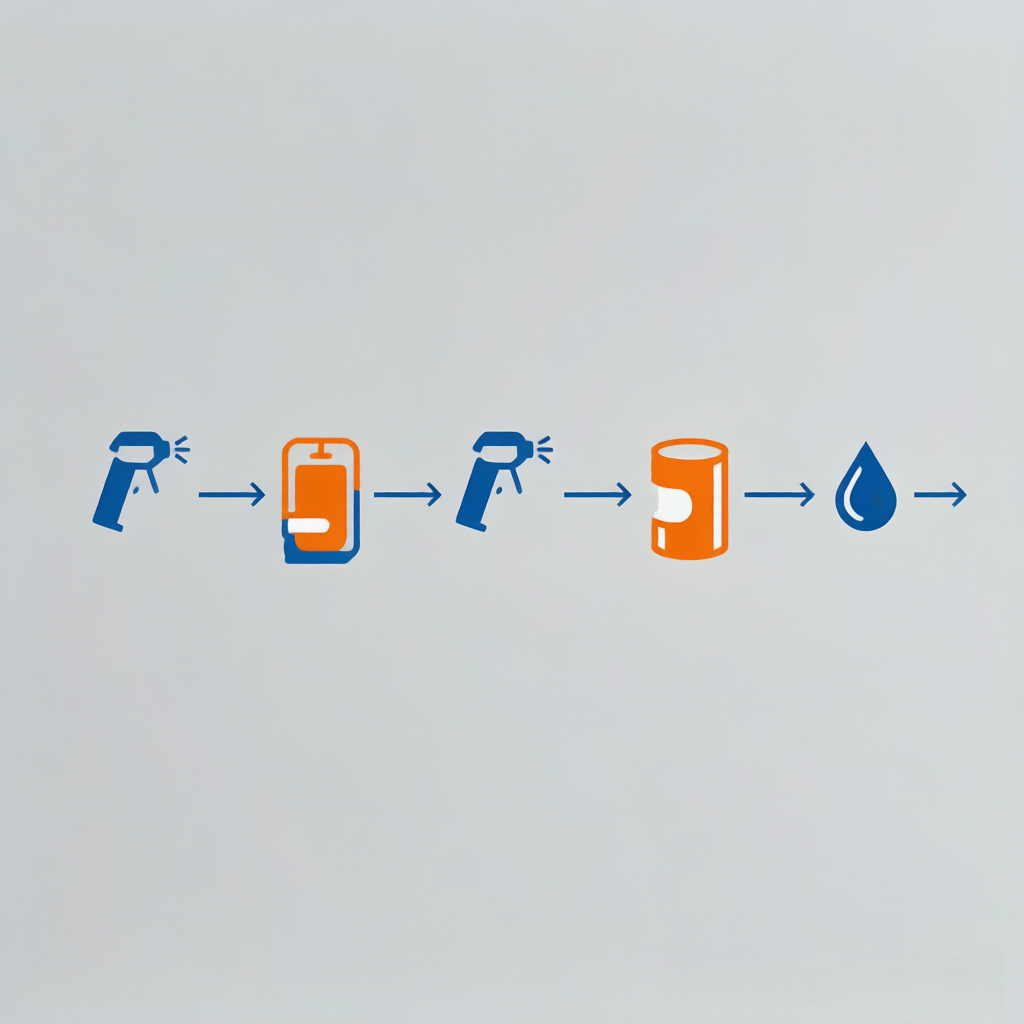
Five-step automotive painting process: the process chain of pretreatment → electrophoresis → primer surfacer → topcoat → clearcoat
Figure: Typical main line process of complete vehicle painting — each process is premised on the qualification of the previous one.

3.1 Pretreatment

Degreasing and oil removal → water rinsing → (phosphating/silane conversion coating) → pure water rinsing. The purpose is to give the steel plate a clean and easily adherent base, which is the root of all subsequent anti-corrosion. If not cleaned properly, even the best subsequent steps are in vain.

3.2 Electrophoresis (ED, Cathodic Electrodeposition)

The body-in-white is immersed in the electrophoresis tank, and direct current is applied to allow electrophoretic paint to deposit uniformly over the entire body (including inner cavities and weld seams). This is the core layer for rust prevention of the whole vehicle, and also the step with the highest degree of automation.

3.3 Primer Surfacer (Intermediate Coat)

After scraping and leveling with putty, spray primer surfacer to fill in minor defects, improve interlayer adhesion, and isolate the electrophoretic coat from the basecoat. It determines the "flatness foundation" of the paint surface.

3.4 Topcoat (Color Coat)

Give the vehicle color and texture: solid, metallic, and pearl each have their own formulations. The number of spray coats, film thickness, and flash-off time directly affect color consistency.

3.5 Varnish (Clear Coat)

The outermost transparent lacquer provides gloss, weather resistance, and scratch resistance protection. Modern clearcoats are mostly 2K, hard yet flexible (see articles on film-forming mechanisms).

Process Core Function Key Output
Pretreatment Cleaning + conversion coating Adherable substrate
Electrophoresis ED Overall rust prevention Uniform anti-corrosion primer
Primer surfacer Leveling + adhesion Smooth transition layer
Topcoat (basecoat) Color / texture Main exterior color
Clearcoat Protection + gloss Weather-resistant transparent layer

IV. Why must the construction be carried out in steps?

  • Functional isolation: Rust prevention, leveling, coloring, and protection are each handled by dedicated coatings, without interfering with one another.
  • Controllable film thickness: Single-layer application in one go is prone to sagging and bubbling; layered application makes it easier to control dry film thickness (DFT).
  • Yield and Rework: Pre-process defects can be intercepted before subsequent processes, avoiding chain reactions of paint defects on the entire vehicle.

V. Maintenance Side vs. Production Line

Note: Localized repair at 4S shops/repair workshops is a "scaled-down version" — there is no full-vehicle electrophoretic coating (relying on repair primer for rust prevention), the baking temperature is low (using 2K room-temperature curing), and it requires handling blend transitions to merge new paint with old. Performance can be close but the process conditions differ, so for large-area or critical structural component corrosion, standardized pre-treatment is still recommended.
Schematic of repair-side paint booth (baking booth): low/room-temperature 2K curing, compared with full-vehicle high-temperature production line
Figure: Repair-side paint booth (baking booth) mainly uses low/room-temperature 2K curing, contrasting with the full-vehicle high-temperature production line.

Summary

reserve the HTML tags and translate the visible Chinese text into English. Original: AutomotiveCoating Application是分层叠加的Systemproject:前Treatment打底→电泳Rust-Proof→midcoat leveling→topcoat coloring→clear-coat protection。4C2B/3C2B describe the number of coats and bakes — essentially a performance/energy trade-off. Understanding each step's role is how you understand”why good paint jobs cost more and why repairs must start with the substrate”。 Translation: Automotive painting is a layered overlay system engineering: pretreatment priming → electrophoretic rust prevention → intermediate coat leveling → topcoat coloring → clear coat protection. 4C2B/3C2B describes the number of coating layers and baking cycles, essentially a trade-off between performance and energy consumption. Only by understanding the role of each process can one see "why a good paint finish is expensive, and why rework must first address the substrate". Check rules: 1) Keep ALL HTML tags, attributes, URLs exactly unchanged. (No attributes/urls here, just strong tags) 2) Only translate human-readable text inside tags. (Done) 3) NOT add, remove, or modify any tag. (strong tags preserved, no extra) 4) Output only translated HTML, nothing else. Note: The original has ” which is a right double quotation mark entity. It's inside text, not a tag. Keep it unchanged. Actually it's part of the text "看懂”为什么...". We should keep the entity as is. In my translation I used " but should use the entity to be safe? The rule says keep tags/attributes/urls unchanged, but entities are text? It says only translate human-readable text inside tags. The entity ” is a character reference, part of text. It's fine to keep it as is. I will output with ” preserved. Let's construct final: Automotive painting is a layered overlay system engineering: pretreatment priming → electrophoretic rust prevention → intermediate coat leveling → topcoat coloring → clear coat protection. 4C2B/3C2B describes the number of coating layers and baking cycles, essentially a trade-off between performance and energy consumption. Only by understanding the role of each process can one see ”why a good paint finish is expensive, and why rework must first address the substrate”. Wait original ends with ” but no opening “? It has ” as closing maybe mismatched. We keep exactly. Thus output.Automotive painting is a layered overlay system engineering: pretreatment priming → electrophoretic rust prevention → intermediate coat leveling → topcoat coloring → clear coat protection. 4C2B/3C2B describes the number of coating layers and baking cycles, essentially a trade-off between performance and energy consumption. Only by understanding the role of each process can one see ”why a good paint finish is expensive, and why rework must first address the substrate”.

Frequently Asked Questions (FAQ)

What is the actual difference between 4C2B and 3C2B?
C stands for coating/spray passes, and B stands for baking cycles. 4C2B means 4 spray passes + 2 bakes, offering a balance of performance and throughput; 3C2B/3C1B reduce coatings or bakes to save energy and lower consumption, representing a trend toward compact, low-emission processes.
Why is electrocoating (ED) so important?
Electrocoating allows electrocoat paint to deposit uniformly over the entire vehicle body (including inner cavities and welds), serving as the core layer for overall corrosion protection. It is highly automated, covers every area without blind spots, and forms the foundation for reliable adhesion of subsequent coatings.
Can the primer surfacer be omitted?
The primer surfacer fills defects, improves interlayer adhesion, and isolates the electrocoat from the basecoat, which is crucial for surface flatness. Primer-free processes (3C1B/3-Wet) replace it through formulation and equipment upgrades, rather than simply "skipping" it; ordinary repairs should not omit it casually.
Is repair painting the same as the original factory line?
No. The production line features full-body electrocoating and high-temperature baking; repairs rely on spot primer for rust prevention and 2K ambient-temperature curing, and require blend transitions. Performance can be close, but process conditions differ; for critical rust-prone parts, proper surface pretreatment is recommended.
Is the "baking" between each process step necessary?
Layer-by-layer baking ensures each layer is fully cured, controls film thickness, and improves yield; compact processes reduce baking cycles but depend on material and equipment upgrades. Simple methods with no baking and wet-on-wet layers are only suitable for very low-requirement scenarios and cannot meet full-vehicle standards.
Kexin New Materials · Automotive Coating Technology Library | This article is technical Q&A content, for reference in selection and application

{ "@context": "https://schema.org", "@type": "FAQPage", "mainEntity": [ {"@type":"Question","name":"What is the actual difference between 4C2B and 3C2B?","acceptedAnswer":{"@type":"Answer","text":"C stands for coating layers or passes, and B stands for baking cycles. 4C2B means 4 coating passes plus 2 baking cycles, offering a balanced performance and production tempo; 3C2B/3C1B reduce coatings or baking to save energy and lower consumption, representing a trend toward compact, low-emission processes."}}, {"@type":"Question","name":"Why is electrocoating (ED) so important?","acceptedAnswer":{"@type":"Answer","text":"Electrocoating enables electrophoretic paint to deposit uniformly over the entire vehicle body (including inner cavities and welds), serving as the core layer for overall rust prevention. It is highly automated, covers every area without blind spots, and forms the foundation for reliable adhesion of subsequent coatings."}}, {"@type":"Question","name":"Can the primer surfacer be omitted?","acceptedAnswer":{"@type":"Answer","text":"The primer surfacer fills defects, improves interlayer adhesion, and isolates the electrocoat from the basecoat, which is crucial for paint surface smoothness. Primer-free processes replace it through formulation and equipment upgrades rather than simply omitting it; ordinary repairs should not skip it arbitrarily."}}, {"@type":"Question","name":"Is repair painting the same as the original factory line?","acceptedAnswer":{"@type":"Answer","text":"No. The production line features full-body electrocoating and high-temperature baking; repairs rely on touch-up primer for rust prevention and 2K room-temperature curing, and require blend-out transitions. Performance can be close, but process conditions differ; for critical rust-prone parts, proper surface pretreatment is recommended."}}, {"@type":"Question","name":"Is baking between each process step necessary?","acceptedAnswer":{"@type":"Answer","text":"Layer-by-layer baking ensures each layer is fully cured, controls film thickness, and improves yield; compact processes reduce baking cycles but depend on material and equipment upgrades. Simple methods with no baking at all are only suitable for very low-requirement scenarios and hardly meet vehicle standards."}} ] }