The upper limit of automotive spray painting quality is half in the coating and process, and the other half in the Paint Booth environment. The same 2K clear coat, the same mixing ratio, will come out high-gloss and flawless in a clean, controlled paint booth, but will be full of dust spots, orange peel, and craters in a workshop with dust, oil mist, and out-of-control temperature and humidity. The essence of paint booth design is to use "controlled airflow + multi-stage filtration + constant temperature and humidity" to transform the spraying micro-environment from a "ordinary workshop" into a "quasi-cleanroom level", so that dust, oil mist, and moisture have no chance to fall into the wet film.
As a technical supplier of automotive and industrial protective coatings, Kexin New Materials (kexinMaterials) often emphasizes "good paint needs a good booth" on the application side. This article breaks down the airflow organization, filtration grade, environmental parameters, and layout logic of the paint booth, and provides citable design standards to help coating workshops turn "environment" into quantifiable and acceptable indicators.
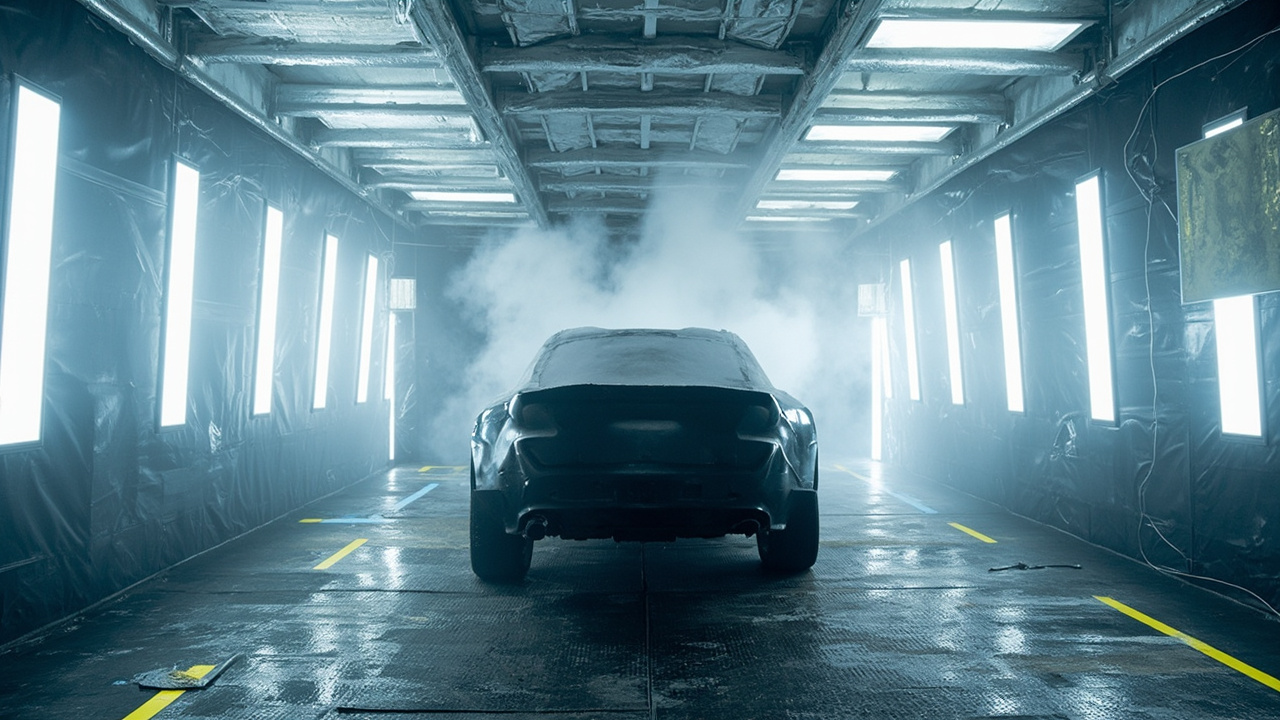
I. Core Task of the Paint Booth: Keep "Dirty Air" Out of the Wet Film
During spraying, paint mist consists of electrostatically charged fine droplets that adsorb dust, fibers, oil mist, and water droplets in the air. If these contaminants fall onto the uncured paint film, they form dust spots, craters, fish eyes, and pockmarks. The paint booth needs to solve three things:
- Supply clean air: Send outdoor air in after multi-stage filtration, reducing dust concentration to an acceptable level;
- Control flow direction: Use stable airflow to "press" paint mist and contaminants toward exhaust, with no backflow or turbulence;
- Stabilize environment: Constant temperature and humidity, allowing solvents to evaporate according to the designed gradient, avoiding blushing, orange peel, and sagging.
A paint booth is not "a room with an exhaust fan installed", but an integration of an air handling system (AHU) + filtration matrix + airflow organization + lighting + exhaust gas treatment. Many sites attribute high rework rates to the coating, but in fact it is secondary pollution caused by the paint booth's cleanliness not meeting standards. Designing the paint booth as "equipment" rather than a "room" is the first step toward stable quality. The ROI of a paint booth should not be judged only by cost, but more by how much it reduces rework rate and improves first-pass yield; the gains from these two usually far exceed the equipment price difference.
II. Airflow Organization: Downdraft, Crossdraft, and Side Draft
By airflow direction, paint booths are divided into three types:
- Downdraft: Top supply, bottom grille return; airflow passes downward through the body, pressing paint mist straight to the ground for exhaust. This is the mainstream for automotive coating (especially OEM and high-end refinish), because the airflow aligns with gravity, has minimal contaminant backflow, and all surfaces of the body receive uniform clean air. Typical face velocity 0.2–0.3 m/s, air changes 300–600 times/h.
- Crossdraft: Supply from one end, exhaust from the opposite side; airflow passes horizontally. Simple structure and low cost, but airflow is perpendicular to gravity, top dust easily falls, and uniformity between windward and leeward surfaces of the body is poor; mostly used for entry-level refinish.
- Side draft / top supply side return: Between the two, common in small and medium refinish booths and local spraying stations.
Modern high-end refinish and OEM mostly adopt "full downdraft + floor return floor (pit or floor filter)", combined with a ceiling diffuser to make wind speed uniform (non-uniformity < 10%), avoiding local turbulence that stirs up dust. The difficulty in airflow organization design is not "whether there is air", but "whether the air is uniform, whether it short-circuits, whether it stirs dust". A common mistake is improper layout of supply and return vents, causing local eddies around the body that re-entrain floor paint mist onto the panel. It is recommended to use computational fluid dynamics (CFD) to simulate airflow at the design stage, quantifying wind speed non-uniformity and eddy zones, rather than placing vents by experience.
III. Filtration Grade: Multi-stage Matrix from G4 to HEPA
The cleanliness of the paint booth relies on multi-stage filtration, with grades referencing ISO 16890 (formerly EN 779) and ISO 14644-1 (cleanroom classification):
- Pre-filter G4: Blocks hair and large particles, protecting downstream stages;
- Medium efficiency F5–F7 (ceiling filter): The ceiling diffuser at the supply end commonly uses F5 (EU5) grade, determining the cleanliness of the top-supplied air, and is the last barrier for "the layer of air that falls onto the paint surface";
- Paint arrestor (Floor/Paint arrestor): Paper/glass fiber paint filter on the floor exhaust side, capturing paint mist and protecting the fan and atmosphere;
- High efficiency HEPA (H13/H14): Used in high-end topcoat booths or clean coating (e.g., new energy three-electric, semiconductor grade), capturing ≥0.3 µm particles at 99.97% or above.
Paint booth air cleanliness often benchmarks ISO 14644-1 Class 8 (approx. 3.5×10⁶ particles/m³ @≥0.5 µm) to Class 7 (high-grade topcoat). Note: Higher filtration grade is not always better; it must be balanced with air volume, wind speed, and energy consumption; but ceiling filter (F5 and above) and regular replacement are the baseline of "cleanliness"—a clogged ceiling filter causes uneven wind speed and turbulent dust entrainment. Engineering practice should judge replacement timing by differential pressure switch or manometer, not purely by calendar time. The G4 pre-filter should not be ignored either: if it fails, the downstream medium filter will quickly clog with large particles, resulting in double loss of overall life and cleanliness.
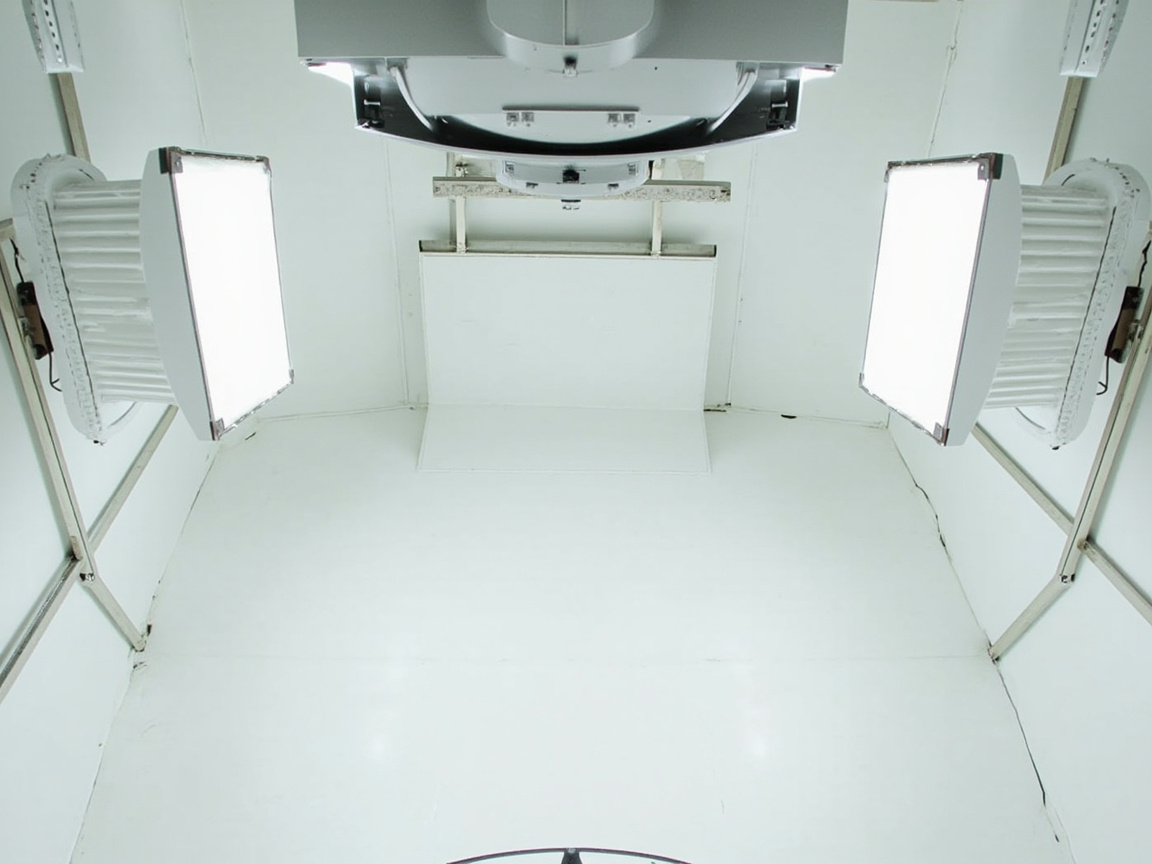
IV. Temperature and Humidity Control: 20–25℃ and 50–70% RH
Spraying environment temperature and humidity directly affect film formation:
- Temperature: Recommended 20–25℃ (refinish), OEM lines often 23–28℃. Too low → slow solvent evaporation, sagging, slow curing; too high → fast surface dry, orange peel, dry spray, bubbles.
- Relative humidity: Recommended 50–70% (most two-component), some sensitive systems require 40–60%. Too high humidity → water enters film, blushing, loss of gloss, reaction with isocyanate to form bubbles.
Temperature and humidity are achieved by AC + humidification/dehumidification, with an "airlock" to prevent outside dirty air from rushing in when doors open. For stricter requirements of water-based coating on temperature and humidity, see extended reading Water-based paint application key points. The core of humidity control is actually "dew point management": as long as the panel temperature is above the dew point by more than 3℃, moisture will not condense on the surface. Many blushing accidents are not due to high humidity gauge readings, but to panel temperature below dew point causing condensation. Measuring panel temperature before spraying is more critical than ambient humidity. Temperature and humidity records should enter the process archive of each vehicle/batch for defect traceability.
V. Lighting: 800–1200 lux and Shadowless
Paint booth lighting needs 800–1200 lux (some standards require higher), color temperature close to daylight (5000–6500 K) for true color discrimination, and must be shadowless and explosion-proof (paint mist is flammable and explosive, fixtures must be explosion-proof/flameproof). Lighting is not only for spraying, but also for quality inspection: after refinish, high-gloss paint surfaces can only show orange peel, dust spots, and sagging under oblique light, so paint booths often equip "oblique inspection lights" or independent inspection areas.
Often overlooked in lighting design is the "color rendering index (Ra)". Daylight color temperature does not equal high color rendering; if Ra is low, the flop of metallic paint and pearlescent paint will be misjudged, causing color matching and QC deviations. It is recommended to use explosion-proof fixtures with Ra≥80 in the paint booth, and verify with a standard light box in the inspection area. In addition, maintenance of paint booth lighting is equally important: lamp decay and dust on covers reduce effective illuminance; clean regularly and conduct illuminance inspections, writing illuminance into the check sheet.
VI. Paint Booth Layout: Logistics from Sanding to Baking
A complete refinish/coating unit usually includes:
- Prep / sanding area: Must be isolated from and negative pressure relative to the paint booth, to avoid sanding dust entering; can set centralized dust-collection sanding table;
- Mix room: Constant temperature, clean, explosion-proof, with electronic scale and formula system;
- Booth: Downdraft, multi-stage filtration, constant temperature and humidity;
- Flash-off area: Inter-coat solvent evaporation, needs clean, temperature-controlled, avoid dust settling;
- Bake area / oven: Hot air or IR curing, control panel temperature.
Logistics should be "one-way no backflow": sanding → mix → spray → flash-off → bake; dirty and clean zones separated, people/vehicles/materials diverged, reducing cross-contamination. Automotive OEM lines go further by setting separate booths for primer, pigmented paint, and clear coat, avoiding cross-contamination and color bleed between different coatings. Clean coating for new energy battery underguard, motor housing, etc. pushes cleanliness to ISO Class 7 or higher, close to electronic grade, requiring ceiling filter upgrade and positive pressure gradient control.
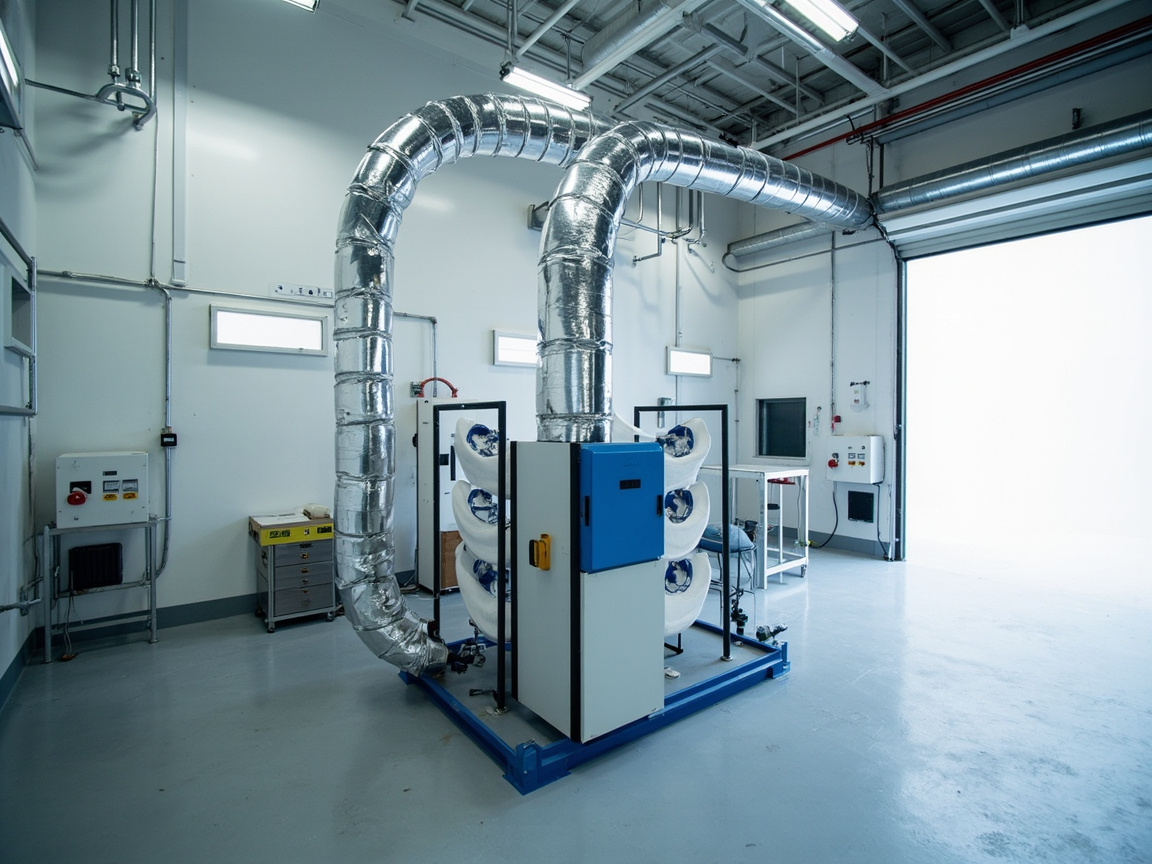
VII. Exhaust Gas and VOC Treatment
Paint booth exhaust contains paint mist and VOC, and must be treated to standard before discharge, governed by GB 24409-2020 (vehicle coating) and comprehensive emission standards for air pollutants. Common treatment:
- Paint mist treatment: Water curtain/water turbine (washout) or dry paint filter captures paint mist;
- VOC treatment: Activated carbon adsorption, zeolite rotor + RTO (regenerative thermal oxidation), catalytic combustion (CO). For high-airflow, low-concentration spray booths, "rotor concentration + RTO" is more economical.
Source reduction is more economical than end-of-pipe treatment. Selecting high-solid or water-based systems can fundamentally reduce VOC generation and shrink the scale and operating cost of end-of-pipe equipment. For low-VOC systems on the refinish side, you may read further at Automotive Refinish 2K Clear Coat Formulation and Application Key Points.
Kexin New Materials (kexinMaterials) also recommends, when supporting low-VOC systems, that the workshop simultaneously evaluate the combination of "low-VOC at source + rotor/RTO at end", so that total emissions per unit area and operating cost are both under control, rather than relying solely on end-of-pipe to bear the load.
VIII. Positive Pressure Gradient and Differential Pressure Control
A clean spray booth is not an isolated sealed enclosure, but uses a "differential pressure gradient" to keep dirty air out. The basic principle is: the clean zone maintains a positive pressure relative to the dirty zone, so air can only flow from the clean zone to the dirty zone, not infiltrate in reverse. Typical gradient:
- Spray booth body: +10 to +20 Pa relative to outside;
- Paint mixing room and flash-off zone: higher positive pressure relative to the spray booth;
- Grinding zone: maintain negative pressure relative to outside, locking dust within the zone without escape;
- Airlock as a transition, avoiding pressure collapse and direct dirty air rush upon door opening.
Differential pressure control is achieved through air balance (difference between supply and exhaust airflow) and relief valves/variable air volume valves, with micro differential pressure gauges for real-time display. Insufficient differential pressure is the hidden cause of "looks like a clean room but still gets dust fallout", and should be included in daily inspection. For higher-requirement three-electric (battery, motor, electronic control) clean coating, positive pressure gradient and air change rate must be jointly designed and verified by particle counting, rather than just reading the differential pressure gauge.
IX. Energy Consumption and Saving: Fans, Heat Exchange and Heat Recovery
The spray booth is a major energy consumer: a downdraft booth changes air 300–600 times/h, with considerable fan power and heating/cooling load. Energy saving directions fall into three categories:
- Variable frequency fans: adjust frequency according to air velocity demand, avoiding constant full power;
- Heat recovery: exhaust energy recovered via rotor/plate exchanger to the fresh air unit, reducing HVAC load;
- Recirculated air: within allowable limits, increase recirculated air ratio (filtered and reused) to reduce fresh air treatment volume.
Energy saving must not compromise cleanliness—too high a recirculated air ratio leads to paint mist accumulation and cleanliness drop, requiring adequate filtration and monitoring. A reasonable energy-saving design should be weighed under CFD and energy simulation, tracking "energy per vehicle painted" as one of the plant's carbon emission and cost metrics.
X. Design Parameter Reference Table
The table below summarizes key design parameters of a typical automotive spray booth (using a refinish downdraft booth as example); values refer to common industry engineering practice:
| Parameter | Typical Value | Description |
|---|---|---|
| Airflow mode | Downdraft | Ceiling supply, floor return, cleanest |
| Face velocity | 0.2–0.3 m/s | Non-uniformity < 10% |
| Air changes | 300–600 times/h | Ensure timely paint mist removal |
| Pre-filter | G4 | Protect downstream stages |
| Ceiling filter (medium efficiency) | F5–F7 | Determines cleanliness of air falling onto paint surface |
| HEPA (optional) | HEPA H13/H14 | High-grade topcoat/clean coating |
| Temperature | 20–25℃ (refinish) | OEM line 23–28℃ |
| Relative humidity | 50–70% | Sensitive systems 40–60% |
| Illuminance | 800–1200 lux | Daylight color temperature, explosion-proof |
| Positive pressure | +10~+20 Pa | Clean zone vs dirty zone |
| Cleanliness benchmark | ISO 14644 Class 8–7 | Topcoat booth higher |
XI. Common Spray Booth Defects and Improvements
| Defect | Cause | Countermeasure |
|---|---|---|
| Full-panel dust spots | Dirty ceiling filter / filter failure / grinding zone cross-flow | Replace ceiling filter, separate dirty/clean zones, dedust |
| Heavy orange peel | Excessive air velocity / high temp fast surface dry | Calibrate velocity, lower surface temp, adjust viscosity |
| Blushing / gloss loss | Excessive humidity / water ingress | Reduce humidity, dehumidify, control dew point |
| Sagging | Low air velocity / excessive film thickness | Increase velocity, control DFT |
| Color deviation | Wrong lighting color temp / random viewing angle | Use daylight color temp, fixed angle |
| Insufficient differential pressure | Wrong air balance / relief valve fault | Calibrate air balance, repair valve, inspect |
Core discipline of booth maintenance: replace filters regularly, measure air velocity regularly, calibrate temp/humidity regularly, separate dirty and clean flows, inspect differential pressure. Saving on filters by not replacing them costs rework and warranty loss, far from worthwhile. It is recommended to establish a filter replacement log, based on differential pressure rather than experience, and write air velocity, temp/humidity, cleanliness, and differential pressure into the daily checklist.
XII. Differences Between OEM and Refinish Booths
OEM painting mostly uses robotic electrostatic spraying; the booth is part of the whole line, with airflow, temp/humidity, and cleanliness designed to the line takt, and zones (primer booth, basecoat booth, clear coat booth) separated to avoid cross-contamination; a refinish booth is "multi-use in one room", relying more on strict maintenance and zoned operation for quality. Clean coating for new-energy battery under-shields, motor housings, etc. pushes cleanliness to ISO Class 7 or higher, close to electronic grade, requiring upgraded ceiling filters and positive pressure gradient control.
Back to the root: the spray booth is the "foundation" of coating quality. Even the best coating will show full-panel defects in an unclean booth; a controlled booth lets ordinary coatings deliver stable high gloss. Managing the environment as a quantifiable, acceptably verifiable metric is the common underlying logic of high-end refinish and OEM. When building or retrofitting a booth, it is recommended to use the four hard metrics—"air velocity uniformity, cleanliness class, temp/humidity window, differential pressure gradient"—as acceptance baseline, avoiding being fooled by low-price schemes that merely "look sprayable".
XIII. Booth Acceptance and Third-Party Verification
New or retrofitted booths must not be judged only by equipment list; they must be accepted with data. Recommended acceptance items: air velocity uniformity (multi-point anemometer grid method, non-uniformity < 10%), cleanliness (particle counter measuring concentration of particles above 0.5 μm, benchmark ISO 14644 Class 8), temp/humidity window (continuous 24-h recording at set conditions), differential pressure gradient (clean vs dirty zone positive 10–20 Pa), illuminance and color rendering (lux and CRI), noise and energy (fan power per area). Third-party acceptance avoids "promised compliant, measured failed". In many low-price schemes, fans and filtration are secretly reduced, causing sufficient velocity but poor uniformity—looks sprayable but actually full of dust spots, only exposed by grid velocity measurement. The acceptance report should be archived as baseline for later warranty and retrofit. For new-energy three-electric clean coating, dynamic particle counting monitoring should also verify whether transient pollution during door opening/closing and vehicle passing is controllable, not just static cleanliness.
XIV. Common Design Errors and Retrofit Cases
Common field errors fall into four types: one, improper supply/return layout causing vortex dust roll-up; two, low-grade ceiling filter (below F5) insufficient cleanliness; three, missing airlock, cross-flow on door open; four, reversed positive pressure gradient, dirty zone positive pressure blowing dust into clean zone. Retrofit priority: first calibrate air balance and ceiling filter, then add airlock and differential pressure, last consider energy saving and smart control. One refinish center had full-panel dust spots; investigation found overdue ceiling filter and failed pre-filter; after replacing filters and converting grinding zone to negative-pressure isolation, dust rework rate dropped from 18% to under 3%, with filter investment payback within months. Another case: an OEM line had excessive recirculated air ratio causing paint mist accumulation and cleanliness drop; restored after resetting fresh air ratio and adding filtration. Another plant ignored airlock; in winter, cold dirty outside air rushed in on door open, causing blushing and dust spots together; eliminated after adding double air-curtain airlock. On energy, old booths often run at full power; VFD retrofit and heat recovery can cut energy per area by 20–40%, payback usually 1–2 years, while improving temp/humidity stability. These cases show: environmental investment return is very direct; no need to wait for major overhaul—daily maintenance discipline often matters more than equipment grade.
XV. Institutionalized and Digitalized Operation & Maintenance
The spray booth is not a one-time project, but a production device needing continuous O&M. It is recommended to institutionalize and visualize O&M metrics: daily check of air velocity, temp/humidity, differential pressure, illuminance; filter replacement by differential pressure not calendar; compressed air drained and dew point measured daily; annual particle count and velocity grid re-check. High-end lines further connect environment data to MES, linking with each vehicle's quality record, forming an "environment–defect" traceable closed loop. When a batch shows dust spots or craters, one can immediately review the air velocity, differential pressure, and filter status at that time, turning troubleshooting from experience to data. This digital O&M has low upfront cost and continuous benefit, a key step for a painting shop to go from "workshop" to "factory". Meanwhile, operator training is not to be ignored: even good equipment fails if misused; booth operation should be part of job certification, with periodic retraining and records. The end game of booth management is turning "environment" from mysticism into metrics—anyone taking over can stably deliver high gloss by the same set of numbers.
XVI. Re-thinking Cost and Return
The investment in spray booths is often treated as a cost center, but it should rather be seen as a lever for quality and return on investment. The cost of a rework with a panel full of dust spots includes sanding materials, coating, labor, baking energy consumption, stall occupancy, and the risk of breach from delayed delivery; the per-piece rework cost is often several times the preventive investment. Taking filter media as an example, a set of ceiling filter cotton is limited in price yet can support months of clean production; once you save by not replacing it, rework losses far exceed the filter media cost. It is recommended that factories establish a "defect cost ledger", statistically summarizing the rework expenses of dust spots, craters, and orange peel on a monthly basis, and comparing them with environmental maintenance investment, using numbers to persuade management to sustain investment. For OEMs and large refinish groups, spray booth environmental data can also be used for supply chain audits and customer factory inspections, and is a component of brand credibility. Redefining the spray booth from a "money-spending house" to a "money-making equipment" is an upgrade in management cognition, and also the true foundation of high-end coating stability.
17. Smart Spray Booths and Future Directions
Smart spray booths connect sensing, control, and data, and are a natural extension of spray shop upgrades. The foundational layer is "perception": air velocity, temperature and humidity, differential pressure, cleanliness, dew point, and energy consumption are all networked, with automatic alarms on anomalies rather than relying on manual patrols; the middle layer is "control": variable-frequency fans adjust air volume with spraying status, air conditioning dehumidifies in linkage with dew point, lighting dims with operation mode, reducing human negligence; the top layer is "decision": environmental data is correlated with defect rate, and algorithms suggest "under current parameters the sag risk is rising, recommend reducing film thickness or raising temperature". Such systems require little upfront investment, yet can solidify veteran workers' experience into replicable rules, reducing dependence on individuals.
Future directions also include digital twin—pre-simulating spray booth performance under different vehicle models and climates in a virtual model, guiding new line design and renovation, reducing trial-and-error costs. For large groups, cross-comparison of multi-site spray booth data can quickly identify "which site has the worst environmental discipline", replicating best practices across the network. Intelligence is not the goal; stable high-gloss output is. At the same time, green and low-carbon pressure drives spray booths from "high ventilation, high energy consumption" to a low-carbon model of "high-efficiency filtration + heat recovery + recirculated air", and carbon emission per unit area will become a new acceptance metric. The boundary of spray booth design is expanding from "clean" to "clean, low-carbon, and smart".
At the talent level, smart spray booths also change job requirements: maintenance personnel shift from "replacing filter media" to "reading data and managing alarms", requiring basic data literacy. The training system must be upgraded in sync, otherwise the equipment is smart but people lag behind, and it remains paper-smart. Ultimately, the competitiveness of a spray booth does not lie in how advanced a single device is, but in whether the "design—maintenance—data—talent" four-piece set is systematic, which is also the underlying logic that Kexin New Materials (kexinMaterials) repeatedly emphasizes when co-creating solutions with customers. Operating the spray booth as a system rather than a single product is the only way to steadily maintain high-gloss yield under the triple pressures of cost, quality, and compliance.
18. Recommendations on the Pace of Spray Booth Renovation and Expansion
Spray booth renovation and expansion should not be done all at once with full configuration, but should proceed at the pace of "pain point—investment—return". First solve the most painful: if the panel is full of dust spots, prioritize replacing ceiling filter cotton and creating dirty/clean zoning; if blushing in winter, prioritize dehumidification and preheating; if energy consumption is high, then do variable frequency and heat recovery. Each step uses data to verify effect before deciding the next step. This small-step, fast-run approach is more stable than a one-time major overhaul, and easier to gain sustained management support. For workshops planning capacity expansion, new spray booths should reserve monitoring interfaces and expansion space at the design stage to avoid patching later. The essence of renovation and expansion is "using controllable investment to eliminate the most expensive rework"; sense of pace matters more than equipment grade.
In addition, waste and hazardous waste flows should be considered in sync during renovation and expansion: waste paint mist pads, waste filter cotton, and waste solvent are all hazardous waste, requiring compliant temporary storage and disposal channels; design should reserve temporary storage rooms and transfer ledger space to avoid discovering compliance gaps after commissioning. Both environmental protection and quality are non-negligible bottom lines of the spray booth. Treating renovation and expansion as a trinity system engineering of "quality, energy consumption, compliance" enables sustained benefits in long-term use, rather than one item meeting standards while the other two fall short.
19. Three Bottom-Line Recommendations for Spray Shops
If the site can only remember three things, the recommendations are: First, replace filter media on time and measure air velocity on time—this is the bottom line of cleanliness; Second, write temperature, humidity, and dew point into daily inspection to prevent condensation and blushing; Third, rate defects with standards rather than by naked eye, so acceptance has a basis. Keeping these three, the rework rate will naturally drop. Spray booth management has no shortcuts; it relies on doing simple actions repeatedly and correctly. When the environment becomes a quantifiable and acceptable metric, good paint can truly deliver high gloss and durability, and the workshop moves from "leaving it to chance" to "stable output". Writing these three into the job manual is more lasting and cost-effective than any campaign-style rectification.
FAQ
Q: Why is a downdraft spray booth better than a cross-draft one?
A: Downdraft airflow goes from top to bottom, consistent with gravity, pressing paint mist and contaminants straight to the ground for exhaust, with the vehicle body receiving uniform clean air on all surfaces and less recirculation; cross-draft tends to drop ceiling dust and causes uneven windward/leeward surfaces. Hence downdraft is preferred for automotive coating.
Q: How often should the spray booth ceiling filter cotton (medium-efficiency filter) be replaced?
A: No unified cycle; based on differential pressure and cleanliness; clogging causes uneven air velocity and turbulent dust entrainment. Experience: several months to half a year, more frequent at high usage. Principle: the dirty/clean bottom line cannot be skipped; filter media cost is far less than rework loss.
Q: Why must spray booth temperature and humidity be constant?
A: Temperature and humidity determine solvent evaporation gradient and isocyanate reaction: too high causes fast surface dry and orange peel, too low causes sag; excessive humidity causes blushing and bubble formation from reaction with water. Constant temperature and humidity are the premise of stable film formation.
Q: What standard is spray booth cleanliness based on?
A: Filtration grade refers to ISO 16890 and the old EN 779 standard (G4/F5–F7/HEPA); air cleanliness benchmarks ISO 14644-1 Class 8–7. Topcoat booths require higher.
Q: How is the face velocity of 0.2–0.3 m/s derived?
A: It must be enough to press paint mist to the ground and prevent recirculation, yet not so fast as to disturb the wet film causing orange peel. 0.2–0.3 m/s is an engineering balance value, with non-uniformity required < 10%.
Q: How is VOC from refinish booths treated?
A: Paint mist is first captured by water curtain/dry paint mist pad; VOC is treated by activated carbon, zeolite wheel + RTO, or catalytic combustion; emissions must comply with GB 24409-2020 and atmospheric emission standards.
Q: Why must lighting be explosion-proof and daylight color temperature?
A: Paint mist is flammable and explosive, so fixtures must be explosion-proof; daylight color temperature (5000–6500K) is needed for true color discrimination, avoiding color matching and QC misjudgment, and color rendering index Ra≥80 is recommended.
Q: Why must the sanding area be isolated from the spray booth?
A: Sanding dust entering the spray booth would directly fall into the wet film as dust spots. Negative-pressure isolation, one-way logistics, and separation of people/vehicles/materials are required, with no cross-airflow between dirty and clean zones.
Further Reading
- Automotive Refinish 2K Clear Coat Formulation and Application Key Points: Spray booth environment directly determines clear coat orange peel, sag, and dust spots; the two are strongly correlated.
- Common Automotive Paint Defects (Sag/Orange Peel/Crater): Panels full of dust spots and craters are mostly secondary pollution from unclean spray booths.
- New Energy Vehicle Three-Electric System Coating Protection: Three-electric coating pushes cleanliness to electronic grade, expanding spray booth design boundaries.
- Automotive Refinish Computer Color Matching and Color Difference Control
- Automotive Paint Isocyanate Health Hazards and Protection
- Automotive Refinish System: 2K Solid Paint, Basecoat + Clear Coat and Single Component