The biggest difference between automotive refinish paint (Refinish) and OEM original factory paint is that it deals with a vehicle already in use and partially damaged, rather than a brand-new body rolling off the line every minute. The core requirement of refinishing is "to restore the damaged area to a level visually indistinguishable from the original factory in color and close to it in durability, without dismantling or baking as much as possible." In this logic, 2K polyurethane clear coat (two-component clear coat) is the most critical external protective layer—it determines the gloss, weather resistance, scratch resistance, and chemical resistance after refinishing.
As a technical supplier of automotive and industrial protective coatings, Kexin New Materials (kexinMaterials) has supporting data for both refinishing and OEM systems. This article focuses on the 2K clear coat on the refinishing side, explaining formulation features, mixing discipline, spray gun parameters, low-temperature curing, and on-site troubleshooting, to help refinishing shops upgrade "master craftsman's feel" into "replicable data."
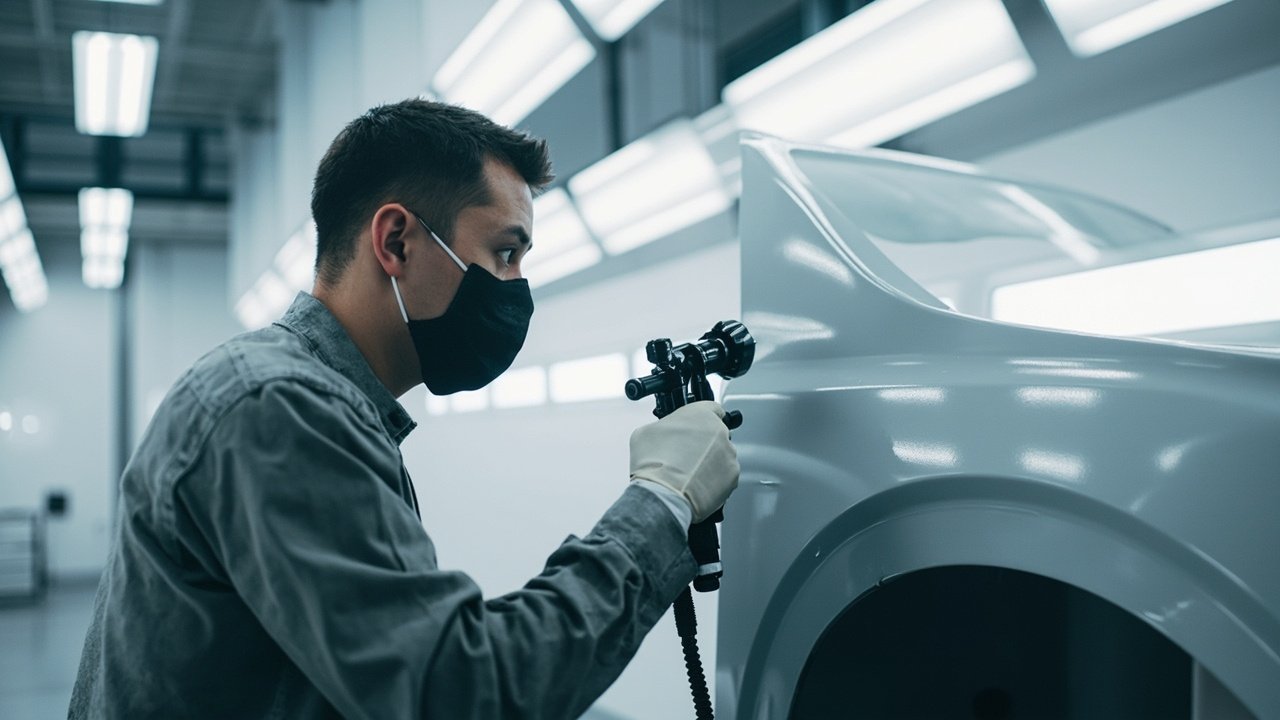
I. The Essential Difference Between Refinish 2K Clear Coat and OEM Clear Coat
OEM clear coats are mostly 2K or 1K systems baked at high temperatures of 140–180℃, with sufficient cross-linking and excellent resistance; whereas refinish clear coats, limited by body plastic parts, old paint, and sealants, can only cure at ≤60℃ or room temperature, so the resin design emphasizes "low-temperature fast curing, high gloss, easy polishing." This brings two direct consequences:
- Slightly lower performance ceiling: With the same HDI curing agent, low-temperature curing cross-link density is usually lower than high-temperature baking, so refinish clear coat hardness and chemical resistance are often slightly inferior to the original factory, but already sufficient for daily use;
- More sensitive ratio and process: At low temperatures, the —NCO and —OH reaction is slow; slight deviations in ratio, temperature, humidity, or activation time easily lead to "non-drying, softening, gloss loss."
According to public TDS from mainstream suppliers, refinish 2K clear coats are mostly acrylic polyurethane (hydroxyl acrylic resin + HDI polyisocyanate curing agent), with common mixing ratios of 2:1 or 4:1 (by volume), VOC mostly in the range of 200–550 g/L. High-solid (HS) types compress VOC to around 400 g/L by increasing volume solids (about 50%). When selecting, "low-temperature curable, polishable, weather-resistant, VOC compliant" should be reviewed together, rather than only looking at price or initial gloss. It should be added: the refinishing system must also balance "wide application window"—stable good film even for beginners is more important than ultimate performance.
II. Formulation Skeleton: Hydroxyl Resin + HDI Curing Agent
The film-forming substances of refinish 2K clear coat are highly consistent: the base paint is hydroxyl acrylic resin (providing gloss, weather resistance, flexibility), and the curing agent is HDI (hexamethylene diisocyanate) type polyisocyanate (providing cross-linking and hardness). —NCO and —OH undergo nucleophilic addition to form urethane bonds:
—NCO + —OH → —NH—COO— (polyurethane bond)
When the curing agent contains HDI trimer (three-functional), the reaction extends from linear to a three-dimensional network. The higher the cross-link density, the denser the paint film, showing high hardness, good chemical resistance, and wear resistance. The reason for using aliphatic HDI instead of aromatic TDI is that HDI is non-yellowing—TDI easily yellows under UV and is unsuitable for outdoor clear coats.
Note: HDI has respiratory sensitization and the sensitization is irreversible. Since refinishing involves manual spraying often in non-standard environments, protection cannot be ignored. Leveling agents, ultraviolet absorbers (UVA), and hindered amine light stabilizers (HALS) in the formulation jointly determine weather resistance and appearance; selection should look at the system rather than just the resin. The oligomer glass transition temperature (Tg) also affects the clear coat's temperature resistance and scratch resistance, and is the key lever for "hard but not brittle."
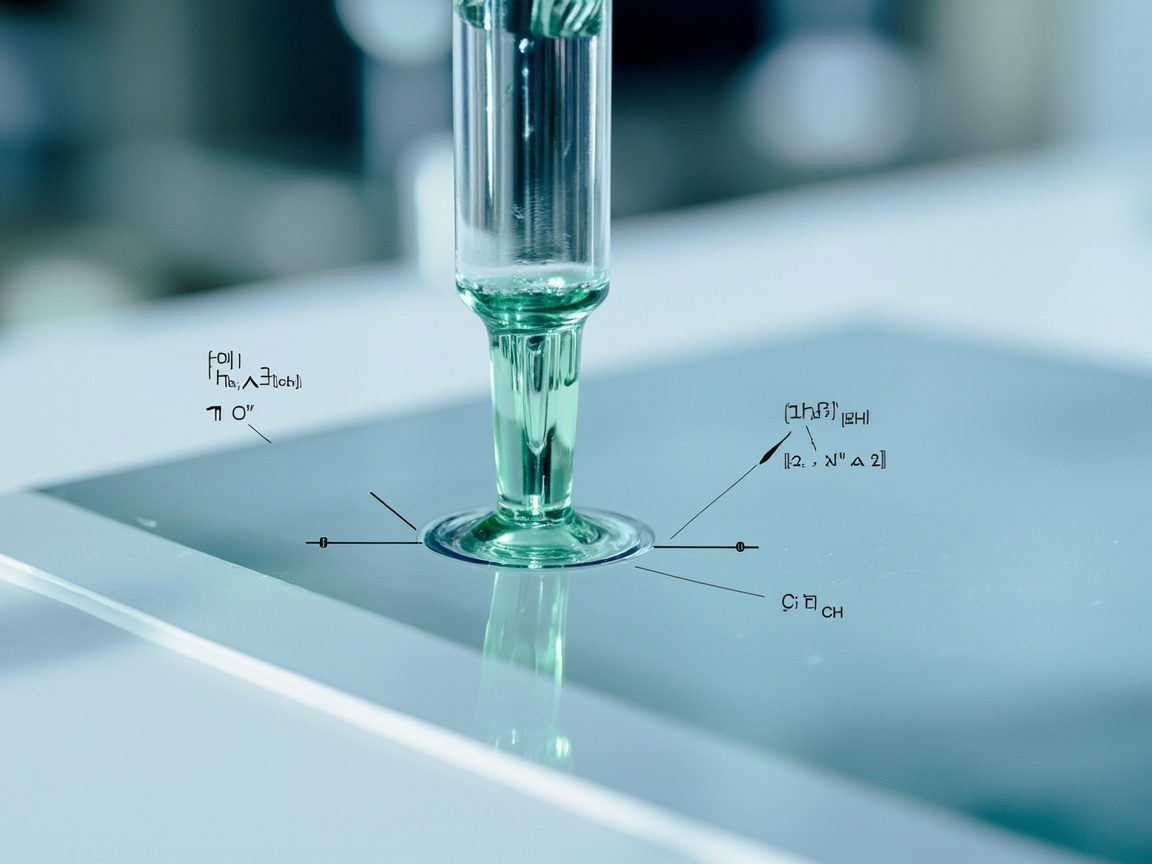
III. Mixing Discipline: 2:1 / 4:1 Strictly No Feel-Based
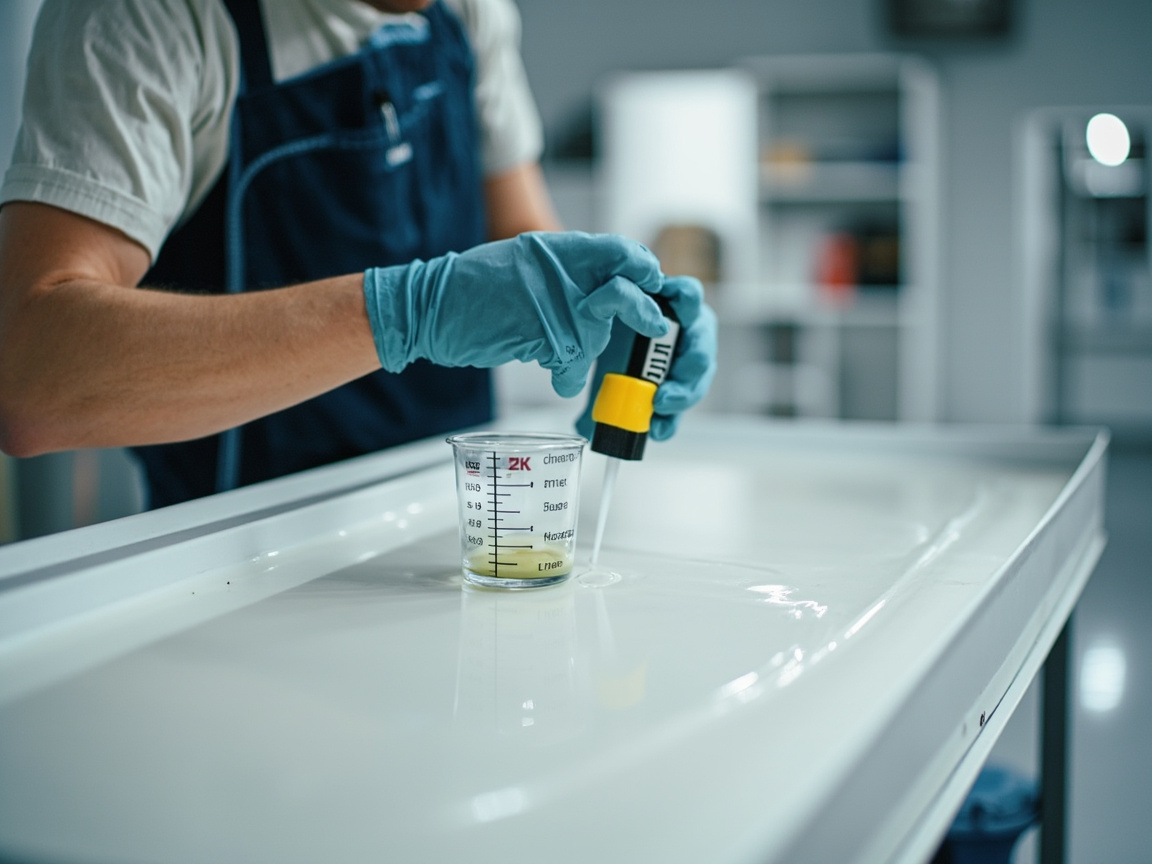
Refinish mixing must use graduated mixing cups for precise volumetric measurement, strictly no guessing:
- 2:1 type: clear coat : curing agent = 2 : 1 (volume), often with about 10% thinner (volume) added to adjust to spray viscosity;
- 4:1 type (fast-dry positioning): clear coat : curing agent = 4 : 1 (volume), higher base ratio, suitable for quick repair.
Engineering consequences of improper ratio: too little curing agent → insufficient cross-linking → softening, tackiness, poor chemical resistance, easy gloss loss; too much curing agent → excess —NCO → brittleness, easy cracking, greater irritation; uncontrolled thinner → insufficient film thickness, sagging, orange peel.
Correct operation sequence: pour base paint first, then add curing agent, finally add thinner (if needed), stir in one direction at constant speed for 2–3 minutes, let stand to defoam (maturation) before use. The mixed chemical reaction starts immediately; beyond the pot life (common 1–2 h @25℃) viscosity spikes or even gels and is scrapped, so must "estimate how much to use, mix how much." Electronic scale is more accurate than measuring cup; key batches are recommended to use weighing method. When temperature difference between winter and summer is large, the equivalent reaction speed of curing agent changes significantly; activation time and drier should be adjusted with temperature, but never over-add curing agent for speed.
IV. Spray Viscosity: The Real Meaning of DIN 4 @20℃
Refinish clear coats commonly use DIN 4 cup (20℃) to measure outflow time, typical range 13–21 s. Viscosity determines atomization and leveling:
- Too thin (< 13 s) → sagging, insufficient film thickness, easy bottom exposure;
- Too thick (> 21 s) → poor atomization, coarse particles, heavy orange peel, difficult bubble release.
Viscosity must be measured with the same model cup and same temperature to be comparable—every 1℃ rise shortens outflow time noticeably, so TDS all mark @20℃. When no DIN 4 cup on site, Ford Cup #4 etc. can be used for conversion, but the recording standard must be unified. Viscosity is not the lower the better: too low causes thin film and sagging; too high causes orange peel. It must be adjusted in linkage with spray gun pressure and gun distance, forming an "atomization—leveling" balance. Thinner model (fast/medium/slow dry) should also be selected by temperature and humidity: use slow dry in high temperature to prevent orange peel, fast dry in low temperature to prevent sagging.
V. Dry Film Thickness DFT: 40–60 µm Optimal Refinish Zone
Refinish clear coat recommended DFT is mostly 40–60 µm (some fast-dry types single pass about 25 µm, recommend 2 passes). Too thin ( 70–80 µm) high internal stress, sagging, orange peel, and "surface dry inside not dry" later shrinkage cracking. DFT is calculated from "wet film thickness × volume solids" (WFT = DFT ÷ volume solids), measured quantitatively with magnetic/eddy current thickness gauge after construction, not by visual inspection.
The particularity of refinishing lies in the "transition zone": at the edge of the repair block, a "featheredge" (feather sanding) must be made, letting the clear coat transition smoothly from original factory paint to avoid steps. The feathered zone clear coat is thinner, needing thin spray + gradually expanding fan control; excessive buildup leaves visible joints. Uneven DFT is the invisible cause of color difference and obvious joints, and thickness should be measured separately in the feathered zone. It is recommended to use "test panel + thickness measurement" to calibrate per-pass output first, then apply to body, turning DFT control from experience into readings.
VI. Spray Gun and Spray Parameters
Refinishing mostly uses HVLP (high transfer efficiency) or RP (medium pressure high flow) spray guns, caliber 1.2–1.4 mm (clear coat):
- Cap-end pressure: HVLP ≤ 0.7 bar (≈10 PSI), saves paint and reduces overspray;
- Gun distance: 15–25 cm, too close easy sagging and buildup, too far easy dry spray orange peel;
- Speed and overlap: constant speed, fan overlap 1/2–2/3, ensure uniform film thickness;
- Pass count: 1.5–2 wet passes, control DFT in target range.
Spray booth environment should be 15–25℃, relative humidity ≤ 70%, substrate temperature above dew point by 3℃; booth clean, positive pressure, good ventilation, otherwise dust, oil mist, water droplets will fall into clear coat causing defects. For booth cleanliness design, see Automotive Spray Booth Cleanliness and Booth Design. Daily maintenance of spray gun (nozzle, needle valve, air cap cleaning) directly affects atomization quality, should be disassembled and cleaned every shift. Compressed air should go through refrigeration drying + multi-stage filtration, dew point controlled below 3℃ to avoid blowing water and oil into the film.
VII. Low-Temperature Curing: ≤60℃ and Room Temperature Two Paths
Refinish curing has two paths:
- Room temperature (20–25℃): economical, no harm to body, but full cross-linking takes 5–7 days, avoid heavy polishing, water contact, filming during this period;
- Low-temperature baking (≤60℃) or infrared: compresses工期 from "days" to "hours/half hour", and improves cross-linking completeness, suitable for batch flow. Panel temperature must be controlled (IR ≤100℃), to prevent clear coat thermal degradation or substrate deformation, sealant melting.
Key awareness: "Polishable" ≠ "fully cured". Many fast-dry clear coats can be polished in 45–60 min, but full cross-linking still takes days; premature heavy polishing may scratch the not-fully-cured film. It is recommended to wait for stable surface dry for light polishing, and delay heavy polishing further. IR baking should pay attention to "black panel temperature" rather than "ambient temperature" to avoid local overheating. In winter when workshop is cold, first use AC to raise ambient temperature before construction, more stable than long baking afterwards.
VIII. VOC Compliance: The Refinish Caliber of GB 24409-2020
Refinish clear coat is subject to GB 24409-2020 "Limits of Harmful Substances in Vehicle Coatings" restricts and sets upper limits on VOC; solvent-based refinish clear coat also references EU 2004/42/EC, CARB/SCAQQMD, etc. It needs to be clarified: high VOC ≠ high performance—VOC is only solvent content; what truly determines performance is the resin and crosslink density; low-VOC products can also achieve fast drying, polishable, and weather-resistant properties.
Kexin New Materials (kexinMaterials), when promoting high-solid and low-VOC two-component refinish systems, treats the GB 24409-2020 limits as a hard boundary for formulations, helping refinish shops pass environmental inspections and avoid being restricted in production. For stores undergoing solvent-to-water or low-VOC upgrades, this "coating + process card" bundled delivery is particularly critical. It needs to be noted: although water-based refinish clear coat has lower VOC, it is more sensitive to temperature, humidity, and flash-off; before switching to water-based, the spray booth environment must be brought up to standard first, otherwise the defect rate will actually rise.
IX. Common Defects and Troubleshooting of Refinish Clear Coat
Due to variable environments on the refinish side, defect frequency is higher than OEM. The table below is organized by "phenomenon—cause—countermeasure":
| Defect | Main Cause | Countermeasure |
|---|---|---|
| Orange peel | High viscosity / low pressure / poor atomization | Adjust viscosity to window, increase compliant atomization pressure |
| Sagging | Excess film thickness / over-thinning / low temperature | Control DFT 40–60 µm, reduce thinning, raise temperature |
| Pinholes / blind bubbles | Substrate moisture / air entrainment in mixing / too fast surface dry | Control moisture, defoam, reduce surface dry speed |
| Loss of gloss | Wrong ratio / insufficient curing / high humidity | Strict ratio, ensure cure period, reduce humidity |
| Yellowing | Wrong hardener type / sun exposure | Confirm aliphatic HDI, select weather-resistant system |
| Cracking | Excess DFT / excess hardener causing brittleness | Control film thickness, strict ratio |
| Recoat lifting (bite-through) | Lower layer not fully dry / solvent mutual solubility | Apply clear coat after lower layer fully cured |
| Dust spots | Unclean spray booth / failed filter media | Improve cleanliness, replace filter media |
Most defects stem from parameter loss of control rather than the coating itself; establishing the discipline of "measure environment first, then mix coating, then spray" is more effective than switching brands. When troubleshooting, tracing back by "stage—parameter" is much faster than trial-and-error one by one. It is recommended to register every rework as "phenomenon—root cause—parameter correction" to build the store's own troubleshooting knowledge base.
X. Compatibility with 2K Clear Coat: Primer—Intermediate—Base—Clear
Refinish clear coat is not isolated. A complete refinish system is usually "epoxy/polyurethane primer (or sanding-free primer) → intermediate coat (surfacer, for filling and leveling) → 1K/2K basecoat → 2K clear coat". If the lower layer is not fully dry before applying clear coat, solvent mutual solubility causes recoat lifting and wrinkling; if the intermediate coat is rough and has poor adhesion, the clear coat will delaminate no matter how hard it is. For interlayer compatibility and defect root causes, see Common Automotive Paint Defects (Sag/Orange Peel/Cratering). To evaluate a refinish clear coat, you cannot only test its own hardness and gloss; you must also look at its adhesion (GB/T 9286 cross-cut 0/1 grade is excellent) and interlayer compatibility under the complete "primer—intermediate—base—clear" system. The flash-off degree of the basecoat also determines whether the clear coat lifts—if clear is applied before the base has surface-dried, fogging at the blend area is very likely.
XI. Acceptance Inspection Checklist
Refinish delivery quality must be controlled with data; it is recommended to write the following tests into the acceptance sheet:
- Gloss (60°): per GB/T 9754 / ISO 2813, high-gloss clear coat should be ≥ 85 GU;
- Pencil hardness: per GB/T 6739, reference > 2H level;
- Cross-cut adhesion: per GB/T 9286, 0/1 grade is excellent;
- Color difference: per ISO 11664 (CIELAB), ΔE usually required < 1 (visually indistinguishable);
- Appearance: uniform color, no orange peel/sag/dust spots, consistent gloss, no step at blend.
Color difference control is the soul of refinishing and requires computer color matching and standard light source. The acceptance sheet turns subjective "looks okay" into objective "data meets standard", reducing disputes. It is recommended to view once under natural light and once under standard light source to avoid acceptance disputes of "beautiful under lamp, ugly in daylight".
XII. Storage, Transportation and Safety
Two-component must be strictly sealed against moisture—the hardener easily reacts with moisture in the air and fails; use up soon after opening, remaining can be stored under nitrogen or inverted to isolate moisture. Store main paint and hardener separately in a cool, ventilated place, away from open flame; waste paint and drums handled as hazardous waste. Avoid sun exposure and freezing during transport; after freezing, main paint may flocculate and hardener may crystallize, and may not fully recover after returning to room temperature. Construction must use respirator (OV/P100 or PAPR), nitrile gloves (≥8 mil, latex ineffective), goggles; prohibit sanding or welding of not-fully-cured film. HDI sensitization is irreversible; new employees must receive occupational health training and baseline physical examination, with periodic re-checks.
XIII. Synergy of Color Matching and Clear Coat
"No color difference" in refinishing relies not only on the basecoat; the optics of the clear coat also affect the final appearance. The refractive index, film thickness, and levelness of the clear coat change the flop of metallic/pearlescent pigments: with the same basecoat, applying clear coat of uneven thickness or with obvious orange peel will show visible color shift at different angles. Therefore, color confirmation must not only look at the base, but also compare in the final state of "clear coat applied", and judge at a fixed observation angle under standard light source (D65 or daylight simulation). The clear coat thickness variation at the refinish blend area is also a source of local color difference and "patch feel", which requires feathering and expanding fan pattern to level the thickness gradient. If the clear coat itself yellows (wrong hardener selection or insufficient weather resistance), it will also warm the overall hue, making all colors yellowish. Treating the clear coat as an "optical top layer" rather than a mere protective layer is the key to understanding refinish color difference.

XIV. Winter-Summer Construction Switch
Seasonal temperature and humidity changes directly impact 2K refinish. Low winter temperature slows —NCO and —OH reaction, delaying surface dry and curing, easily causing softness, sagging, and prolonged dust adhesion; countermeasures are preheating coating and substrate, raising ambient temperature, and if necessary using fast-dry hardener or accelerator, but strictly prohibit excessive hardener for speed. High summer temperature and humidity cause too-fast surface dry, increasing orange peel and blind bubble risk, and high humidity triggers —NCO reaction with water to produce gas; countermeasures are enhanced dehumidification, dew point control, slow-dry thinner, reduced single-pass film thickness with more passes. At season change, re-calibrate viscosity window and flash-off time rather than using the same parameters year-round. It is recommended that refinish shops create a "seasonal SOP": one set of recommended parameters (temperature, humidity upper limit, viscosity, flash-off, baking) for spring, summer, autumn, winter, explicitly managing seasonal variables rather than relying on the master's on-site feel.
XV. Water-Based Refinish and High-Solid Trends
To meet GB 24409-2020 and local environmental restrictions, the refinish side is moving from traditional solvent-based to high-solid and water-based. High-solid reduces VOC by increasing volume solids; the application logic is close to solvent-based, with low retrofit cost, and is the current mainstream transition route. Water-based refinish paint has lower VOC but is more sensitive to temperature, humidity, and flash-off: water evaporates slowly, surface dry is greatly constrained by humidity, requiring stronger dehumidification and IR pre-leveling, and some substrates incompatible with water need sealing. Before switching to water, ensure the spray booth environment (temperature/humidity, cleanliness, ventilation) meets standard first, otherwise the defect rate will actually rise. Regardless of route, the low-temperature crosslinking nature of 2K polyurethane clear coat remains unchanged; ratio, film thickness, and curing discipline are still the quality core. Kexin New Materials (kexinMaterials), when promoting low-VOC systems, emphasizes "coating and process card delivered together" precisely to avoid stores only changing coating without changing process and stepping into pitfalls.
XVI. Customer Acceptance Communication and Warranty
The last step of refinish delivery is acceptance communication; if done poorly, it easily leads to "coating has no problem, customer unsatisfied". It is recommended to proactively show data at delivery: gloss meter reading, color difference ΔE, cross-cut grade, film thickness record, using objective numbers instead of "looks pretty good". For controversial points such as blend and feathering areas, confirm once under natural light and once under standard light source, and keep comparison photos on file. Warranty terms must clarify boundaries: normal car wash and climate aging are covered, but long-term uncleaned bird droppings/tree sap, use of strong-solvent car wash, and secondary accident damage are not covered, to avoid unlimited liability. Making acceptance and warranty a transparent process protects both the store and the customer and reduces disputes. Kexin New Materials (kexinMaterials) suggests stores use "acceptance sheet + process card + defect rating" as the delivery trio, so customers see not only the shine but also the controllability and professionalism behind it; such trust retains customers far more than a one-time low price.
XVII. Common Customer Questions and Professional Responses
Customers often ask: "Why is there a slight color difference from the OEM?" Response: OEM is whole-panel high-temperature uniform film formation, refinish is local low-temperature, batch and film thickness gradient of color paint inevitably have micro-differences, ΔE less than 1 is visually indistinguishable. "Why can't I wash the car immediately after spraying?" Response: complete room-temperature crosslinking takes several days, during which chemical resistance and adhesion have not peaked, recommend avoiding high-pressure wash and waxing within a week. "Why is the price higher than quick-repair shops?" Response: the difference is in complete primer—intermediate—base—clear system, clean environment, and data acceptance, with more controllable rework rate and durability. The essence of professional response is translating technical language into benefits the customer understands, rather than fobbing off with jargon. Stores standardizing such responses can both improve experience and reversely constrain themselves to construct per standard—because what is said must be done.
XVIII. Overall Environmental Compliance of Refinish Workshop
The environmental obligations of refinish shops go beyond VOC: waste paint, waste solvent, waste wiping cloths, and waste filter cotton are all hazardous waste, and must be collected by category, stored compliantly, handed over to qualified units for disposal, and supported by transfer manifest records; spray booth exhaust must be treated to meet emission standards; there are also requirements for noise and hazardous chemical storage. Many stores only focus on coating VOC and ignore the hazardous waste chain, being caught off guard when inspected. It is recommended to manage environmental compliance as a checklist: coating MSDS posted on the wall, hazardous waste room locked with surveillance, traceable batch records, and employees aware of emergency response. Compliance is not a burden, but the bottom line for store survival, especially in cities with tightening environmental supervision. Choosing low-VOC, high-solid systems can reduce hazardous waste and emissions at the source, which is the lowest-cost compliance path and also echoes the industry's green transformation direction. Treating environmental protection as a prerequisite for operation rather than an extra task is what enables stores to operate stably and durably.
19. Technical Training and Mentorship Inheritance
Refinish quality highly depends on manual work, and technical training is a long-term mechanism. It is recommended to establish tiered training: new employees learn safety and basic parameters (viscosity, film thickness, mixing ratio), skilled workers learn defect troubleshooting and color difference control, and key staff learn process design and acceptance. Training should be "learning by doing"—repeatedly practicing on standard panels until data meets standards, rather than just watching videos. Mentorship inheritance should make the tacit experience of veteran masters explicit: translate "feel" into measurable parameters of "viscosity range, gun distance, flash-off time" and write them into work cards. When experience becomes replicable data, staff turnover no longer takes away quality. Training investment is invisible in the short term, but in the long run it determines store reputation and rework rate, and is the most undervalued asset of refinish shops. Stores willing to continuously invest in people's capabilities are often those with the lowest rework rates and most stable customers.
20. Continuous Improvement Loop for Refinish Process
The end of a single vehicle's refinish is not the终点; data should flow back for improvement. It is recommended to record per order: vehicle model, damaged area, supporting system, environmental parameters, mixing ratio, film thickness, curing method, appearance and adhesion results, whether rework occurred. Monthly summary to see trends: which areas have high rework, which weather causes more defects, which newcomer has large parameter drift. Improvement actions directly go to training and process card revision, then verified next month. This "record—analyze—improve—verify" small loop is more sustainable than a one-time major rectification. The smaller the store scale, the easier to manage by memory, but memory is lost; with a data loop, quality does not depend on a certain person, and the store can stably expand and open branches without dropping standards. Making review a fixed action in weekly meetings will visibly reduce the rework rate.
21. Industry Trend: From Refinish to Remanufacturing
Automotive refinish is moving from "local restoration" to "remanufacturing": for parts such as bumpers, wheels, and doors, remove them entirely, centrally refurbish, and reinstall, with better cycle time and consistency than on-vehicle in-situ refinish. Remanufacturing requires more standardized coating systems and more parameterized processes, which exactly fits the fast curing of 2K high-solid and UV. The trend also points to "digital claims": insurance companies assess damage based on detection data, forcing refinish shops to speak with standard acceptance. For stores, embracing remanufacturing and digitalization is an upgrade path from labor-intensive to technology-intensive, and also better able to undertake official certified business from OEMs and car dealers. Early layout of standard operation and detection capabilities is the trump card to not be eliminated in industry reshuffling, and can also turn one-time refinish business into replicable industrial services.
22. Store Daily Inspection Checklist
It is recommended that refinish shops do a five-minute inspection before opening each day: check whether temperature, humidity and dew point are within the window, check compressed air drainage and dew point, check whether paint mixing cups and scales are clean and accurate, check spray booth filter differential pressure and air speed, check whether hardener is sealed and not damp. These five items are completed with a check sheet, and in 30 days the correlation between quality fluctuation and environment can be seen. Inspection seems to take time, but it actually intercepts most defects at the lowest cost. Making it muscle memory, the store's rework rate will stabilize at a low level, and good work can be produced even without the veteran master. Inspection records kept on file are both management evidence and input for improvement, turning "stability" from a wish into a verifiable fact.
23. One-Sentence Summary
The essence of refinish is to restore the damaged area to a reliable state with a controllable process. Coating determines the upper limit, process determines the lower limit, and discipline determines whether the lower limit is held. Writing mixing ratio, film thickness, temperature/humidity, and curing as replicable numbers allows the store to turn "veteran master's feel" into "standards everyone can reach". This is both a guarantee of quality and a prerequisite for scaling. When standard operation becomes a habit, rework rate and customer complaints naturally drop, and the store grows from a workshop relying on personal experience into an industrial service that can be replicated and entrusted.
FAQ
Q: Can refinish 2K clear coat and OEM clear coat be mixed?
A: Not recommended. Their curing conditions (low temp vs high temp) and resin designs differ; cross-system mixing easily causes loss of gloss, non-drying, and interlayer peeling. Use refinish formula for refinish, and for OEM refurbishment also try to follow original factory matching.
Q: Can mixing ratio 2:1 and 4:1 be substituted for each other?
A: No. Different products' resin—NCO equivalent ratios are validated by formulation; arbitrary changes cause insufficient/excessive crosslinking, showing as soft, brittle, gloss loss, reduced chemical resistance, and must be precisely measured by volume ratio.
Q: Why can clear coat be polished in 45–60 minutes, yet full cure is said to take 7 days?
A: "Polishable" means the surface reaches an operable state; "full cure" means —NCO and —OH reaction is completely finished. Early heavy polishing may scratch the not-fully-crosslinked film, so it is recommended to delay heavy polishing later.
Q: What are the benefits of 60℃ baking for refinish clear coat?
A: Baking accelerates crosslinking, compressing cycle time from "days" to "hours/half-hour", and improves crosslink completeness and gloss uniformity, suitable for batch flow; but panel temperature must be controlled to prevent degradation and substrate deformation.
Q: What DFT control is most suitable for refinish clear coat?
A: Recommended 40–60 µm. Below 40 µm shielding is insufficient and base may show through; above 70–80 µm internal stress is large and easy to crack, need thickness gauge quantification rather than visual.
Q: How to comply with VOC at refinish end?
A: Select by GB 24409-2020 limits, prioritize high-solid or low-VOC systems, and pair with HVLP to reduce overspray; high VOC ≠ high performance, low VOC can also be fast-drying and weather-resistant.
Q: Where do most common refinish defects come from?
A: Mostly from parameter and environmental loss of control (mixing ratio, viscosity, temperature, humidity, spray booth cleanliness), not the paint itself. Establishing "measure environment—mix paint—spray" discipline is more effective than changing brands.
Q: How to avoid steps at refinish interface (featheredge)?
A: Do featheredge sanding so clear coat transitions smoothly from OEM paint; thin spray + gradually expanding fan in feather zone to avoid buildup forming visible interface, and separately measure DFT in feather zone.
Further Reading
- Automotive Spray Booth Cleanliness and Booth Design: Booth environment directly determines clear coat orange peel, sagging and dust spots.
- Common Automotive Paint Defects (Sag/Orange Peel/Cratering): Mixing ratio, film thickness, temperature/humidity loss of control are main causes of refinish-end defects.
- Automotive Paint Test Standards (Adhesion/Weathering/Stone Chip): Put hardness, gloss, adhesion standards into refinish site acceptance.
- Automotive Coating UV Curing Technology and Cycle Time Improvement: From 2K Baking to Second-Level Curing
- Automotive OEM Coating System and Electrophoretic Primer Process
- Automotive Refinish Paint System: 2K Solid Color Paint, Basecoat+Clear Coat and Single Component