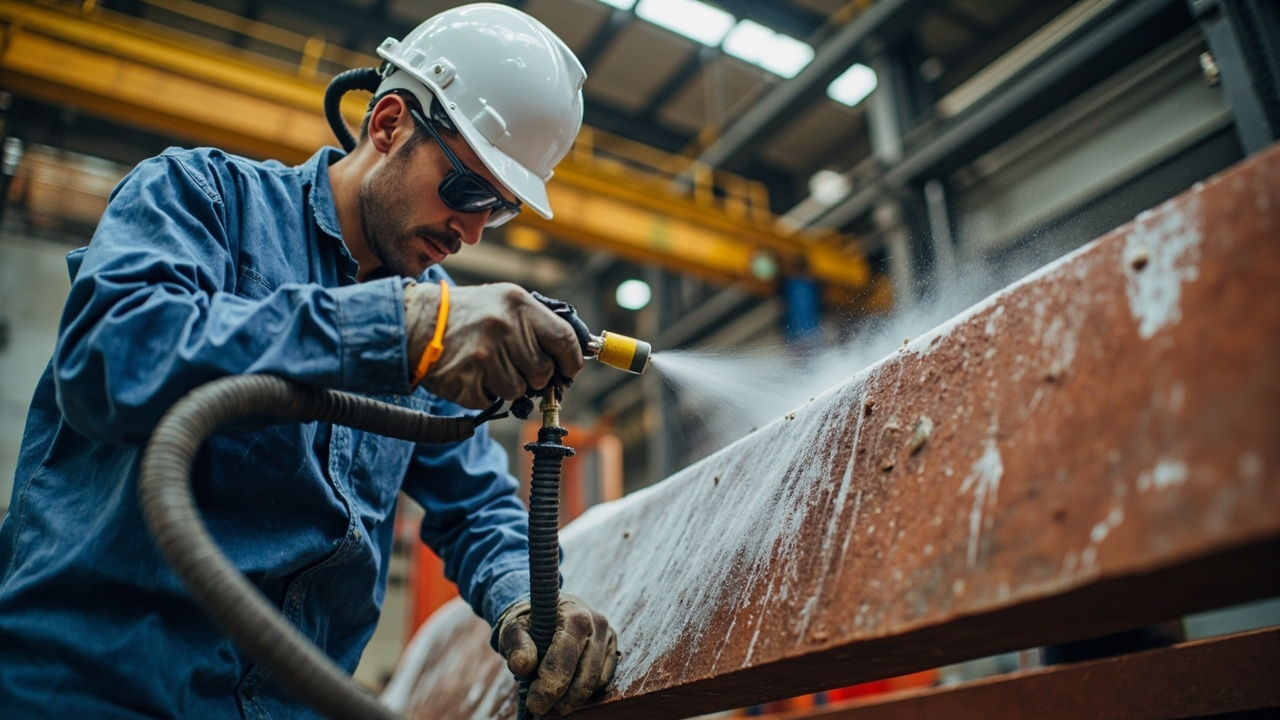
In anti-corrosion engineering for steel structures, bridges, storage tanks, pipelines, and various mechanical equipment, there is a repeatedly verified old saying: "Three parts paint, seven parts surface preparation". It means that how many years a set of anti-rust coating can serve depends three parts on the anti-rust paint itself and seven parts on the surface treatment before painting. No matter how good the epoxy zinc-rich primer is, no matter how expensive the polyurethane topcoat is, as long as the rust layer, mill scale, oil stains, and soluble salts on the substrate are not cleaned thoroughly, adhesion will not build up, and corrosive media will drive straight in through weak points, causing blistering, rusting, and peeling within months. This article thoroughly explains the matter of "anti-rust paint surface treatment": what exactly is the Sa2.5 grade of sandblasting, why the roughness is controlled at 30–75 µm, what is meant by power tool St3, how to choose respectively under the two working conditions of new construction and maintenance, and what its relationship is with the Sa2.5 often mentioned in the field of industrial coating.
As a supplier of industrial protective coating systems, Kexin New Materials (kexinMaterials) always lists "surface treatment grade" as the top constraint in the accompanying documentation for the selection and design of anti-rust primers and matching topcoats. Whether you ultimately choose alkyd anti-rust paint, epoxy anti-rust paint, or a water-based anti-rust system, the surface treatment grade is a prerequisite determining the coating's service life. The grade divisions, roughness ranges, and matching parameters cited in this article are all from public TDS, ISO 8501-1, ISO 12944-2018, and national and international standards such as GB/T 25251-2010, and can be cited with confidence.
I. Why Surface Treatment Determines the Success or Failure of Anti-Rust Paint
Statistical studies on coating failures repeatedly show that improper surface treatment is the primary cause of early failure in anti-corrosion painting, and its impact proportion is often higher than the sum of coating selection and application methods. The reasons can be broken down into three points:
- The root of adhesion lies at the interface. The combination of anti-rust paint and steel relies on mechanical interlocking plus chemical or polar adsorption. The rust layer, oil stains, and mill scale on the substrate surface will interrupt this bonding layer, and adhesion drops to zero directly. Without qualified surface treatment, even the most expensive paint will not "stick".
- Residual impurities are the starting point of corrosion. The gaps under the mill scale and the chloride ions and soluble salts hidden in rust pits will form a galvanic cell under the coating, causing concealed failure where "the paint film looks intact but is already rusted through inside". Once this failure starts, the repair cost far exceeds the investment of doing the surface preparation properly in the first place.
- Roughness determines anchoring depth. The microscopic undulations formed by sandblasting are the "rivet points" for mechanical riveting of the coating. Insufficient roughness means the paint film "won't stick", while excessive roughness causes peak exposure and air entrapment in valleys forming pinholes. Therefore, roughness is not a random number, but a process parameter matched with the paint type and film thickness.
Therefore, anti-rust paint surface treatment is not an auxiliary process of "rubbing twice with sandpaper", but an engineering decision equally important as coating performance. Prioritizing budget and schedule on surface preparation is far more cost-effective than repeated repairs afterwards.
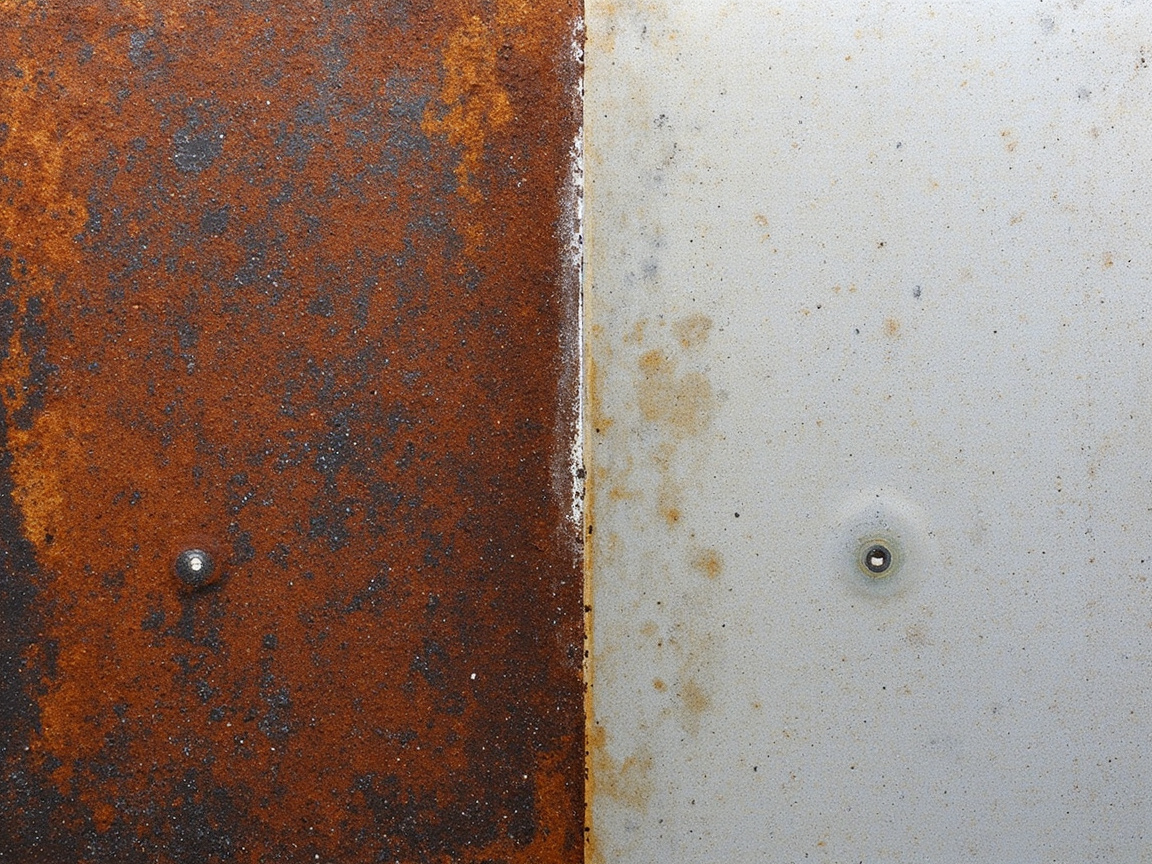
II. Surface Treatment Grade System: Starting from ISO 8501-1
The industry terms "Sa2.5" "St3" are not vendor-created terms, but originate from ISO 8501-1 "Preparation of steel substrates before application of paints and related products — Visual assessment of surface cleanliness". This standard divides the cleaning quality of unpainted steel into two major series:
- Sa series (Blast cleaning): Cleaned by abrasive impact methods such as sandblasting and shot blasting, with grades from low to high being Sa1, Sa2, Sa2.5, Sa3.
- St series (Hand and power tool cleaning): Cleaned with hand or power tools such as wire brushes, grinding wheels, and sanders, with main grades being St2 and St3.
The reason for separating the two is that their cleaning capability and achievable effect differ by an order of magnitude. Blast cleaning can almost completely strip mill scale and rust and create uniform anchor pattern, while power tool cleaning can only remove loose layers within the visible range, cannot thoroughly remove tightly adhered mill scale, and is difficult to stably create ideal roughness.
Many engineers on site confuse "sandblasting Sa2.5" and "power tool St3", thinking "as long as the rust is removed it's fine". But the gap in adhesion life between the two is of a multiple order of magnitude, especially in heavily corrosive environments (C4, C5 grades in ISO 12944), mistakenly using St3 as Sa2.5 often leads to early failure. The following breaks it down item by item.
III. Sandblasting Sa2.5 (Sa 2½): Recommended Threshold for Anti-Rust Paint
"Sa2.5" i.e. Sa 2½ (very thorough blast cleaning, near-white grade), is the most commonly used recommended grade for industrial protective primers. According to ISO 8501-1, Sa 2½ requires the steel surface to be free of visible grease, dirt, mill scale, rust spots, and old coating and other impurities, any residual traces should only be point-like or streak-like slight discoloration. Intuitively, the overall appearance to the naked eye is uniform metallic gray-white, only allowing very small amounts of scattered light-colored streaks, not allowing patchy rust or residual mill scale.
Research archives confirm the versatility of Sa2.5: the surface treatment requirement for alkyd anti-rust paint (complying with GB/T 25251-2010) is explicitly " sandblasting Sa2.5, roughness 30–75 µm "; Jotun Jotacote Universal N10 universal wear-resistant epoxy paint also specifies treatment for carbon steel as "St 2 (minimum) / Sa 2½ (recommended, ISO 8501-1)". It can be seen that whether it is traditional alkyd anti-rust paint or modern epoxy systems, Sa2.5 is the universal recommended grade for anti-rust primers.
3.1 Why Roughness is 30–75 µm
Sandblasting is not just "rust removal", it simultaneously creates microscopic anchor pattern. The roughness range given in the archives is 30–75 µm (based on alkyd anti-rust paint GB/T 25251-2010 data). The logic for setting this range is:
- Lower limit 30 µm ensures anchoring: The dry film thickness of anti-rust primer is usually tens to hundreds of microns. If the roughness is too low (e.g., only 10–15 µm), the mechanical interlocking between the paint film and substrate is insufficient, and adhesion will drop significantly.
- Upper limit 75 µm prevents exposure and air entrapment: When roughness is too high, sandblasting peaks may penetrate the designed film thickness and "expose iron", and valleys easily trap air forming pinholes or bubbles, which instead become corrosion starting points.
- Matched with film thickness: Generally, single-pass film thickness of anti-rust primer is in the order of 60–80 µm. Roughness of 30–75 µm just allows the paint film to "wrap" the peaks and valleys, forming a continuous and dense anti-corrosion barrier.
On site, roughness comparison blocks (such as replica tape + roughness gauge specified in ISO 8503) are commonly used to qualitatively or quantitatively determine whether it falls within the 30–75 µm range.
3.2 Sa2.5 is Not the Higher the Better
Some mistakenly think "the whiter the blast, the better". In fact, Sa3 (white metal blast, full uniform metallic luster) is the most thorough, but cost, schedule, and abrasive consumption all increase substantially, and for most anti-rust paint systems there is no necessary life gain. Unless it is tank interior, food-grade, or extreme corrosion (CX offshore) conditions, otherwise Sa2.5 is the best balance point of cost-performance and reliability. Blindly pursuing Sa3 only pushes up cost, and does not multiply the protection life.
IV. Power Tool St3: "Thorough Manual Cleaning" for On-site Maintenance
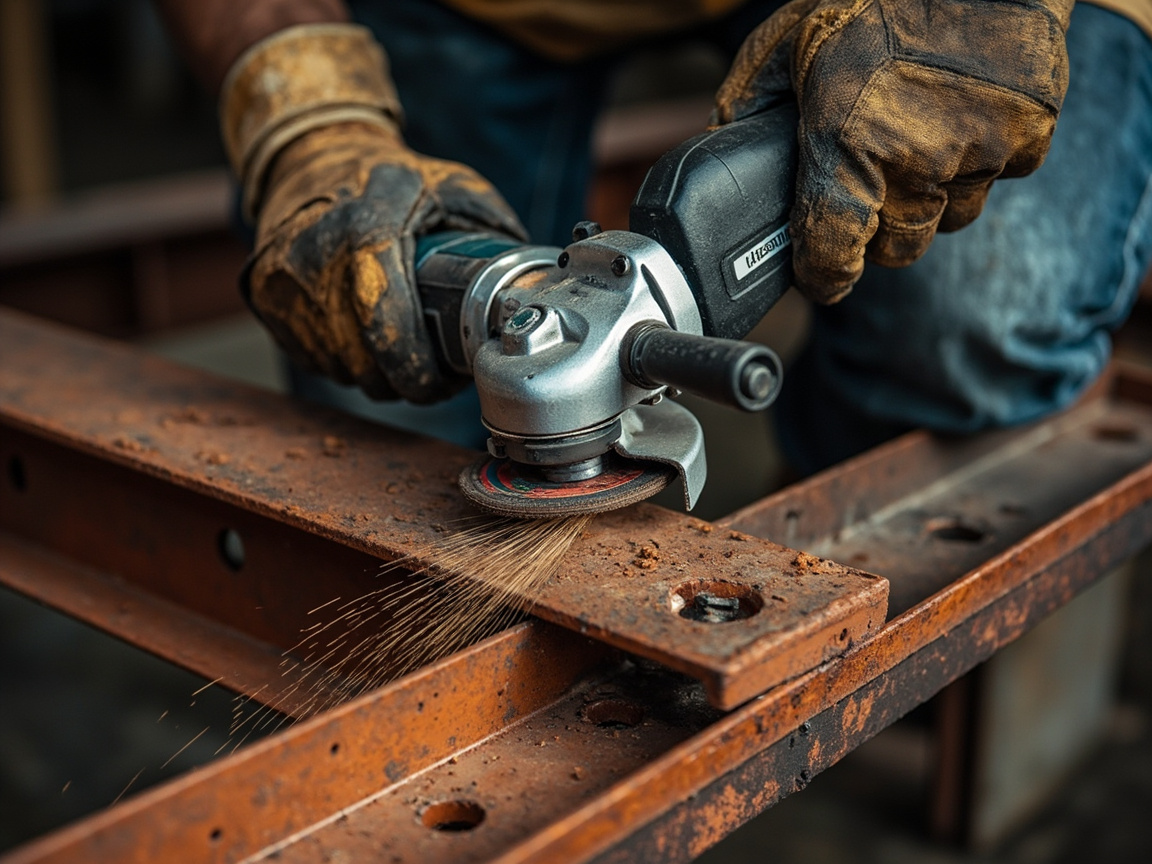
St3 is the highest grade in hand and power tool cleaning (ISO 8501-1). Its requirement is: using wire brushes, rotary wire wheels, grinding wheels, electric sanders and other tools, thoroughly clean the steel surface to be free of loose rust scale, oil stains, loose parts of old coating, and present the metallic base color, the surface should have a certain roughness (provided by grinding scratches). Note the keyword is "thorough" — St2 only requires "basically remove loose layers, retain tightly adhered mill scale", while St3 requires cleaner and closer to the metal base.
In the research archives, the surface treatment of alkyd anti-rust paint explicitly allows " or power tool St3 " (according to GB/T 25251-2010), indicating that St3 is a usable alternative outside Sa2.5 when sandblasting conditions are not available on site.
4.1 Capability Boundary of St3
One must clearly recognize the boundary of St3: power tool cleaning cannot strip tightly adhered mill scale in whole sheets like sandblasting, it can only treat to "no obvious loose rust and dirt within visible range". Therefore:
- St3 is suitable for maintenance sites with light corrosion, basically intact mill scale, or where shutdown for sandblasting is impossible;
- The adhesion and durability of St3 are significantly lower than Sa2.5, usually corresponding to lower corrosion grades (such as C2–C3 of ISO 12944);
- In heavy corrosion (above C4) or immersion environments, St3 should not be the primary choice, and must be blasted to Sa2.5 or higher.
V. Surface Treatment Selection under Different Working Conditions
Anti-rust paint surface treatment has no "one-size-fits-all" answer; the core is to see whether the working condition is new construction or maintenance, and the current condition of the substrate.
5.1 New steel structures: Prioritize Sa2.5
Newly built workshops, bridges, and storage tanks often have rolled mill scale on the steel when leaving the factory. If this scale is tightly bonded to the substrate, it can provide short-term protection to the steel before blasting; but once coating fails, the gaps under the scale become breeding grounds for corrosion. Therefore, the best practice for new projects is:
- Set up a blasting room in the workshop or factory, blast the entire surface to Sa2.5, with roughness controlled at 30–75 µm;
- Apply workshop primer (e.g., epoxy workshop primer) immediately after blasting to prevent secondary rusting;
- Subsequently construct according to the "primer—intermediate coat—topcoat" system.
New conditions have blasting capabilities (equipment available, can shut down production, can lift and move), so Sa2.5 is the standard answer, and there is no need to settle for St3 as a second choice.
5.2 Maintenance / Old paint on site: Sand same-type old paint to St3
For equipment, pipelines, and steel structures already in operation, during maintenance they often cannot be shut down and moved into a blasting room. In such cases, St3 power tool cleaning is used, following the principle of "sanding same-type old paint":
- If the original coating is an alkyd system and still adheres well, clean the damaged and rusted areas to St3 during maintenance, then repair with same-type alkyd anti-rust paint and topcoat, to avoid biting and wrinkling caused by incompatibility of different coating types;
- If the original coating has failed over a large area, the cleaning scope needs to be expanded to Sa2.5 (if conditions permit) before re-applying the full system;
- "Same type" is key: directly overcoating strong solvent-based two-component paint on old alkyd paint may fail due to solvent swelling of the old layer; for maintenance, prioritize products compatible with the original system.
According to the St3 definition in ISO 8501-1, sanding cleaning for old paint maintenance should achieve "thorough removal of loose old paint and rust, exposing the metal substrate with roughness", which is the typical application of St3 at maintenance sites.
5.3 Welding burn areas: Local St3 treatment
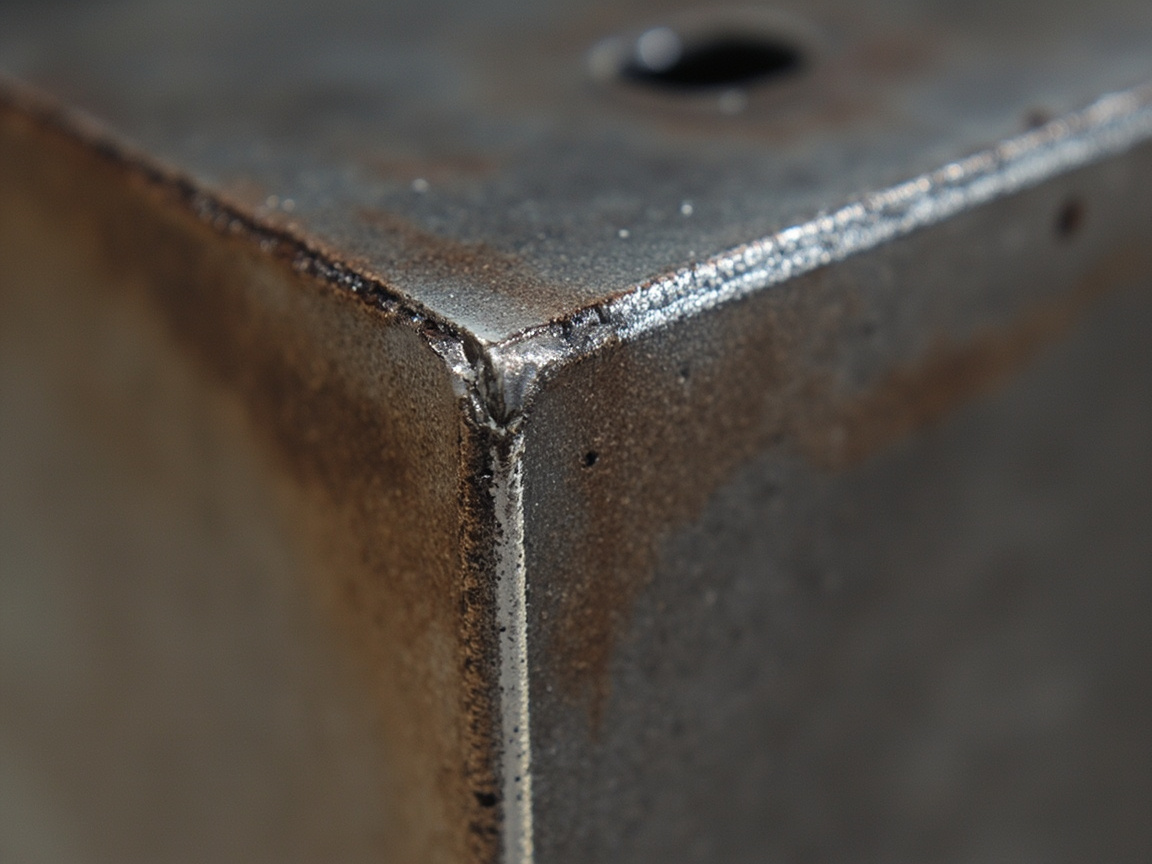
In new construction or maintenance, welds and heat-affected zones often produce burned mill scale, spatter, and discoloration due to high welding temperatures. These areas are weak points most prone to early rusting. Treatment principles:
- After welding, first remove slag and spatter;
- For the burn discoloration of welds and nearby rusted areas, use power tools to sand to St3, and if necessary locally supplement with blasting to Sa2.5;
- Then apply anti-rust primer to cover, ensuring the film thickness at weld areas is not lower than that of flat areas.
Although the St3 treatment of welding burn areas is local, it directly determines the durability of the entire weld and must not be omitted. The system requirements of products such as Jotun in the archives also generally emphasize "welds, edges, and cut surfaces require additional sanding treatment", which is essentially local cleaning at the St3 level.
6. Relationship between anti-rust paint Sa2.5 and industrial coating Sa2.5
Readers often ask: Is the Sa2.5 mentioned for anti-rust paint the same as the Sa2.5 mentioned for industrial protective coatings (such as epoxy paint, polyurethane paint)? The answer is the same standard, the same grade, only different application scenarios.
According to ISO 8501-1, the definition of Sa2.5 is unified and does not change with the paint type. The difference lies in:
- Anti-rust paint (e.g., alkyd anti-rust paint GB/T 25251-2010) directly takes Sa2.5 as its own construction prerequisite, with matching roughness of 30–75 µm;
- Industrial coating (e.g., Jotun Jotacote Universal N10) also takes Sa2.5 as the recommended grade (ISO 8501-1), and its surface treatment requirement states "carbon steel St 2 (minimum) / Sa 2½ (recommended)";
- In the ISO 12944-2018 system, Sa2.5 is the universal blasting cleaning threshold for steel structure protective coating under each corrosion grade from C2 to C5. Whether the bottom layer is zinc-rich primer, epoxy intermediate coat, or polyurethane topcoat, all are built on the Sa2.5 substrate.
In other words, the Sa2.5 of anti-rust paint is part of the industrial coating Sa2.5 system. As the first coat of the "primer—intermediate—topcoat" system, the anti-rust primer often has the strictest requirement for surface treatment, because it directly determines the adhesion of the entire system to the substrate. Understanding this, one will not take "just sand the anti-rust paint casually" as experience.
7. Surface treatment grade comparison table (core)
Put the several grades discussed above together and compare their definitions, achievable effects, typical roughness, and applicable scenarios in a table for on-site reference and selection.
| Grade | Standard source | Cleaning method | Achievable effect | Typical roughness | Applicable scenario |
|---|---|---|---|---|---|
| Sa 1 | ISO 8501-1 | Light blasting | Only removes loose impurities, leaving large amounts of mill scale and rust | Low | Almost never used for anti-corrosion |
| Sa 2 | ISO 8501-1 | Blasting | Most mill scale, rust, and old paint removed, slight discoloration allowed | Medium | General protective primer (low corrosion) |
| Sa 2½ (Sa2.5) | ISO 8501-1 | Thorough blasting | Near-white grade, only very slight color spots remain | 30–75 µm | Anti-rust primer, general recommendation for industrial coating (C2–C5) |
| Sa 3 | ISO 8501-1 | White blasting | Uniform metallic luster throughout, no visible impurities | High | Tank interior, food grade, extreme (CX) |
| St 2 | ISO 8501-1 | Manual/power | Basically removes loose layers, retains tightly adhered mill scale | Low | Minimum limit, mild environment |
| St 3 | ISO 8501-1 | Power tool | Thoroughly cleaned to metal substrate, with roughness | Medium-low | Maintenance site, same-type old paint sanding, welding burn areas (C2–C3) |
The significance of this table is: when you see "surface treatment Sa2.5" on drawings or specifications, you should immediately associate it with the whole set of requirements "roughness 30–75 µm + blasting equipment + near-white visual standard", rather than simply understanding it as "remove the rust".
8. Mechanism of surface treatment and adhesion
Why is the adhesion of Sa2.5 so much better than St3? Mechanistically, there are two paths:
- Mechanical interlocking (anchoring): The 30–75 µm anchor profile created by blasting is like countless miniature barbs. After the paint film cures, it embeds into them, forming a strong mechanical bond. The scratches from power tool St3 are shallower and uneven, so the anchoring force is naturally weaker.
- Interface cleanliness: Sa2.5 removes mill scale, rust, and soluble salts, exposing the active metal surface, which facilitates the adsorption of coating polar groups with the metal; St3 often retains tightly adhered mill scale and salts, and the interface has a "weak boundary layer", which is prone to peeling along the interface when exposed to water.
In addition, residual soluble salts (such as chloride ions) will absorb moisture and destroy adhesion, so after blasting, salt detection (such as Bresle method) is sometimes required. This is a frequently overlooked but crucial step in the Sa2.5 system. For steel structures in marine and chemical plant surrounding high-salt-spray environments, salt control is as important as Sa2.5.
9. On-site feasible solutions and limitations
Grade selection should not only consider technical ideals, but also on-site conditions. The following are common constraints and responses:
- No blasting equipment / cannot shut down production: Only the St3 power tool route can be taken, and lower durability expectations should be accepted, suitable for C2–C3 mild environments or temporary maintenance.
- Confined space / in-service equipment: Blasting produces large amounts of dust and abrasive recovery problems, often replaced by St3 or local blasting + vacuum recovery equipment.
- Old paint contains lead / harmful pigments: Power tool sanding produces toxic dust, requiring wet or vacuum sanding with protection, dry sanding with dust dispersion is strictly prohibited.
- Complex shape / inner corner welds: Blasting cannot reach blind corners, need to supplement with power tools to sand to St3, then coat overall.
- Temperature, humidity, and dew point: Regardless of Sa or St, before coating after treatment, control dew point (substrate temperature at least 3℃ above dew point), relative humidity (usually ≤ 85%), and temperature (5–35℃), otherwise rusting returns faster than coating.
It can be seen that St3 is not "cutting corners", but a feasible solution under on-site conditions; however, its use must have clear corrosion grade expectations and maintenance cycle planning, rather than vaguely "sanding a bit".
10. Quality inspection: Don't rely on naked eyes alone
Qualified surface treatment needs to be inspectable and acceptable. It is recommended to include the following methods in the disclosure and acceptance sheet:
- Visual assessment: Compare with reference photos per ISO 8501-1 to confirm Sa/St grade;
- Roughness: Use replica tape + roughness tester or comparison blocks to confirm it falls within 30–75 µm (for anti-corrosion primer system);
- Salt content: Use Bresle patch method to detect soluble salts; if exceeding the limit, re-clean or rinse;
- Dust level: ISO 8502-3 pressure tape method to confirm no floating dust on the surface;
- Re-rust time monitoring: The interval from after blasting to applying primer should be as short as possible; if exceeded, re-inspect.
Writing these as acceptance items can avoid disputes of "looks about right, but rusts in half a year".
XI. Common Surface Treatment Errors
Error 1: Using St3 as Sa2.5. In heavy corrosion environments, using power tool cleaning instead of blasting greatly reduces adhesion and service life.
Error 2: Only removing rust without controlling roughness. Over- or under-blasting, with anchor profile not within 30–75 µm, causes bare spots or poor adhesion.
Error 3: Leaving blasted surface unpainted for long. In high humidity environments, re-rust occurs within hours, wasting all previous effort; must use workshop primer or control interval.
Error 4: Ignoring soluble salts. For coastal or chemical plant steel structures, only blasting without salt testing leaves chloride residue causing early blistering.
Error 5: Randomly applying strong solvent paint over old paint. Not following the "same type" principle, applying two-component strong solvent paint over alkyd old layer causes lifting and wrinkling.
Error 6: Not treating weld spatter. Weld slag spatter points become rust sources, causing early failure of the entire weld.
XII. Compatibility Recommendations with Kexin New Materials
Kexin New Materials (kexinMaterials) emphasizes the principle of "surface treatment grade first" in the design of anti-corrosion primers and industrial protective systems: whether you choose alkyd anti-rust paint or water-based/epoxy anti-rust systems, we will clearly mark in the system document recommended Sa2.5 (roughness 30–75 µm), as well as the St3 power tool cleaning boundary for maintenance scenarios. The benefit is that when users receive the coating, they also get a clear standard of "to what extent the substrate should be treated", rather than groping by experience.
For new projects, we recommend advancing with the workshop process of "blasting Sa2.5 + workshop primer + main anti-rust system"; for in-service equipment maintenance, execute the field scheme of "same-type grinding of old paint to St3 + local spot blasting + compatible touch-up". Need to inform the technical team of the three items: "corrosion grade (C2–C5 of ISO 12944), whether shutdown is possible, existing old paint system", so that we can provide targeted surface treatment and coating system instead of generally recommending a certain anti-rust paint.
In addition, the quality of surface treatment also affects the adhesion of water-based systems—whether solvent-based or water-based anti-rust paint, substrate grade is the prerequisite. For the difference in adhesion between water-based and oil-based paint, refer to Water-based paint vs oil-based paint adhesion comparison; and the special requirements of water-based paint construction for temperature, humidity and drying curing are systematically explained in Water-based paint drying and curing. For the renovation scenario of switching to water-based system on old alkyd paint surface, you can also read Repainting water-based paint over oil-based paint, which provides more specific operation guidelines for old layer treatment and compatibility testing.
XIII. Writing Surface Treatment into Specifications and Briefings
Finally, practical suggestions for engineering and procurement personnel:
- In the coating procurement technical document, list "surface treatment grade Sa2.5 (ISO 8501-1), roughness 30–75 µm, dew point above 3℃, relative humidity ≤ 85%" as mandatory clauses;
- For maintenance projects, separately state the requirements of "same-type grinding of old paint to St3, St3 local supplementary grinding for welding burn areas";
- Use visual + roughness + salt content for acceptance, and keep records;
- List surface treatment schedule and cost as separate items to avoid habitual compression.
Surface treatment seems to be "a rough job before start", but is actually the technical foundation of the entire anti-corrosion system. Doing this step solidly allows the anti-rust paint to truly deliver its due protective life.
XIV. ISO 12944 Corrosion Grade and Surface Treatment Matrix
Correlating surface treatment grade with corrosion environment is the most practical step in system design. According to ISO 12944-2018, steel corrosion environments are classified from low to high as C2 (low), C3 (medium), C4 (high), C5 (very high) and CX (extreme, offshore), plus immersion environments Im1–Im3. Different grades have different minimum thresholds for surface treatment, directly determining how long the anti-rust paint system can last:
- C2–C3 (low to medium corrosion, such as dry indoor, ordinary urban atmosphere): Can accept St3 power tool cleaning, corresponding to light protection systems like alkyd anti-rust paint, most common in maintenance sites;
- C4 (high corrosion, such as industrial atmosphere, coastal plant area): Recommend blasting Sa2.5, roughness 30–75 µm, with epoxy or water-based anti-rust primer to ensure medium-to-long term durability;
- C5–CX (very high to extreme, such as offshore platforms, chemical plants, salt spray zones): Must be Sa2.5 or even local Sa3, combined with zinc-rich primer and "primer—intermediate—topcoat" multi-layer system; cannot rely on a single anti-rust paint to handle it.
The key insight of this matrix is: surface treatment grade is never an isolated indicator, but a system parameter bound with "corrosion environment + coating system + design durability (low L, medium M, high H, very high VH of ISO 12944)". In the system document, the corrosion grade, expected durability and Sa/St grade should be written together to eliminate the randomness of "choosing grade by feel" on site. Research archives also confirm this: Jotun Barrier 80 UHS achieves "very high (VH)" durability under C5, and its premise is exactly qualified blasted substrate and proper zinc-rich system. In other words, if the grade is wrong, no matter how expensive the anti-rust paint is, it cannot make up for it.
FAQ
1. What is the difference between Sa2.5 and St3 for anti-rust paint surface treatment?
Sa2.5 uses blasting to clean steel to "near-white" grade, with almost no visible rust and scale, and creates 30–75 µm anchor profile; St3 uses power tools (angle grinder, wire wheel, etc.) to "thoroughly" clean the surface to metal substrate, but cannot strip tightly adhered scale in whole sheets, and roughness is shallower. The two differ by several times in adhesion and durability; Sa2.5 is suitable for heavy anti-corrosion, St3 is mostly used for maintenance and mild environments.
2. Why control anti-rust paint blasting roughness within 30–75 µm?
According to alkyd anti-rust paint GB/T 25251-2010 data, the compatible roughness range is 30–75 µm. The lower limit ensures mechanical interlocking anchorage of the paint film, the upper limit avoids iron exposure at peak tops and air entrapment at valley bottoms forming pinholes. It is compatible with primer single-coat film thickness (usually 60–80 µm), forming a continuous dense barrier.
3. Must new steel structures use blasting Sa2.5?
For new projects with blasting conditions (equipment available, can shut down, can lift), Sa2.5 is the standard answer and the general recommended grade for primers such as alkyd anti-rust paint and epoxy anti-rust paint (ISO 8501-1). Only in field maintenance where blasting is impossible, retreat to St3 power tool cleaning.
4. Why "same-type grinding to St3" for old paint maintenance?
If blindly overcoating strong solvent two-component paint during old paint maintenance, it may cause lifting and wrinkling due to solvent swelling of the old layer. Following the "old paint same type" principle, applying same-type alkyd anti-rust paint over alkyd old layer and grinding to St3 with power tools avoids incompatibility, and is a safe practice for field maintenance.
5. How to treat welding burn areas?
The weld heat-affected zone often produces burn scale, spatter and discoloration, which are high-incidence points of early rust. First remove weld slag spatter, then grind with power tools to St3 (if necessary, local spot blast to Sa2.5), then apply anti-rust primer, ensuring weld film thickness is not lower than flat areas.
6. Is Sa2.5 for anti-rust paint the same standard as Sa2.5 for industrial paint?
It is the same standard (ISO 8501-1), uniformly defined, not changed by paint type. The Sa2.5 of anti-rust primer is part of the industrial protective coating system (ISO 12944-2018), as the first step of the "primer—intermediate—topcoat" system, and often has the strictest surface treatment requirements.
7. How soon after blasting must primer be applied?
Should be as short as possible to avoid re-rust. In high humidity environments, re-rust may occur within hours, so usually apply workshop primer after blasting, or strictly control interval and re-inspect. Before painting, also check dew point (substrate temperature above dew point by more than 3℃) and relative humidity (usually ≤ 85%).
8. Can power tool St3 be used in heavy corrosion environments?
Not recommended. St3 cannot completely strip tightly adhered scale, adhesion and durability are significantly lower than Sa2.5, usually corresponding to C2–C3 mild environments of ISO 12944. C4 and above or immersion environments should be blasted to Sa2.5 or higher.
9. Should surface treatment also test soluble salts?
It is very necessary for high salt spray environments such as marine and chemical plant surroundings. Residual chloride ions absorb moisture and destroy adhesion; commonly use Bresle patch method for detection, and if exceeding the limit, re-clean or rinse. Salt control is as important as Sa2.5.
10. How to accept whether surface treatment is qualified?
Recommend visual (ISO 8501-1 reference photos) to confirm Sa/St grade, roughness tester to confirm 30–75 µm, Bresle method to measure salt, ISO 8502-3 pressure tape method to measure dust level, and write these items into the acceptance sheet for record keeping.
Further Reading
- Water-Based Paint vs Oil-Based Paint Adhesion Comparison: From interfacial mechanisms to measured differences, understand the common prerequisite of surface treatment grades for adhesion of different paint types.
- Repainting Water-Based Coating over Oil-Based Paint: Guidelines for old-layer treatment and compatibility testing when renovating old alkyd paint surfaces to a water-based system, echoing the St3 repair scenario in this article.
- Polyurethane Wood Coating (PU Wood Coating): A cross-application view of wood protective coating, forming a "metal–wood" complementary comparison with the steel structure anti-corrosion in this article (related reading).