
Chemical paint stripping is a rework method that uses solvents or an alkaline medium to weaken the adhesion between an old coating and the substrate, so the film swells, lifts and can then be scraped off by hand; together with blasting, flame and laser it forms one of the four routes for removing old coatings, and it works through the chain penetration - swelling - plasticisation - interfacial failure rather than by dissolving the coating into a solution. For coatings that are already cross-linked and cured - epoxy, polyurethane, powder and UV-cured - thermoset resins cannot truly be dissolved by any solvent; they can only be swollen until adhesion is lost, so the higher the cross-link density, the more the job depends on strong solvents or a longer dwell time. That is also the root cause of the shop-floor observation that the same drum of stripper takes alkyd paint off quickly yet barely touches powder and UV coatings.
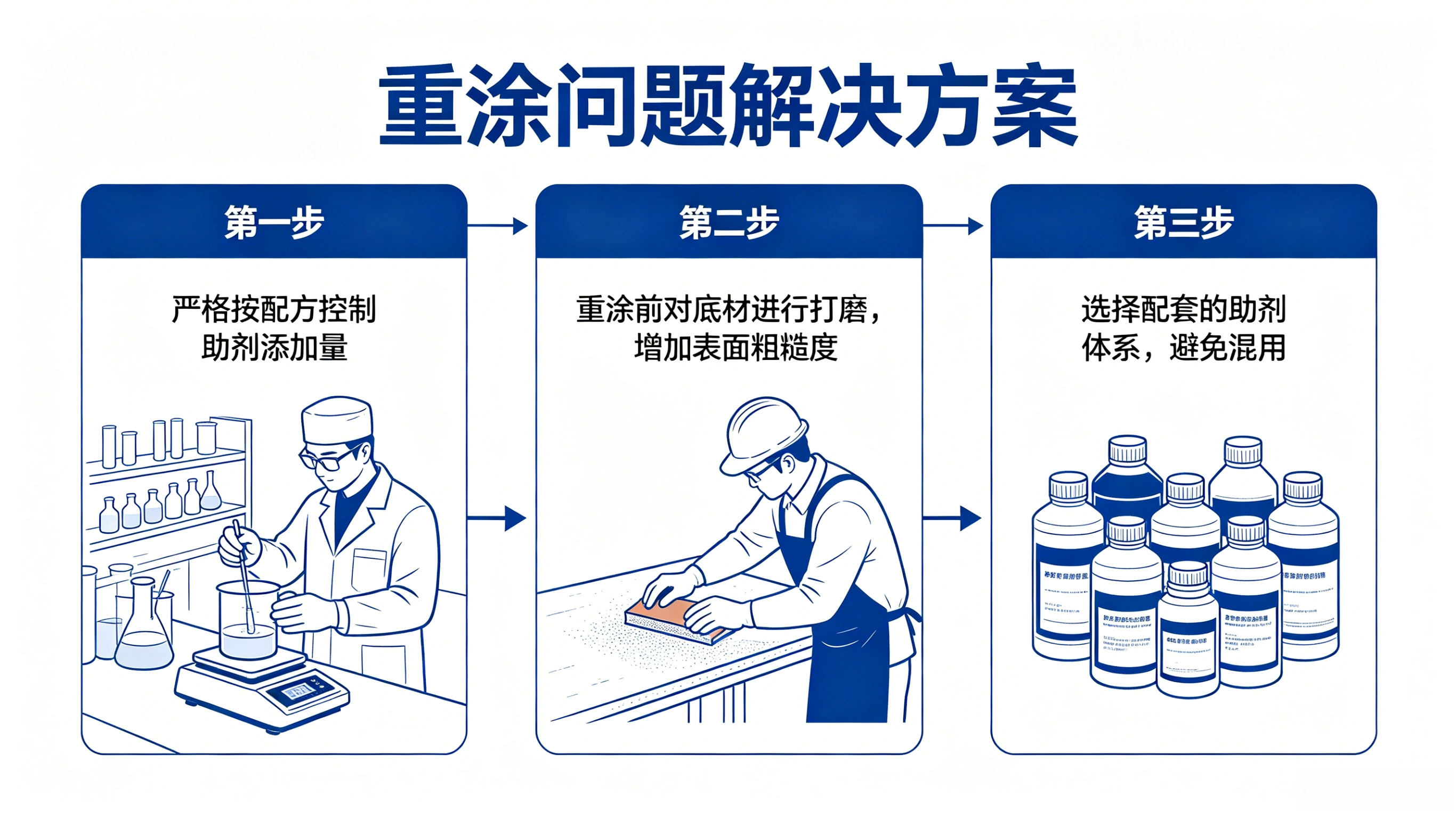
A real rework site looks like this: a batch of housings was judged to have poor levelling after coating and had to be fully re-sprayed. The workshop first brush-applied a solvent stripper, covered the parts with film and left them; after forty minutes the old paint wrinkled and lifted over large areas, and the operator assumed it was “stripped clean” and went straight into phosphating and topcoat. Three months later the whole batch shed paint in sheets, even outside the damp-heat cabinet; on a pull-off test almost the entire failure sat at the new-coat / residual-old-coat interface rather than in the substrate. The review found that swelling and lifting had removed only the bulk of the coating, while the cross-linked surface layer, residual salts and residual solvent had been sealed into the interface. Chemical stripping had not returned the substrate to a clean metallic state such as Sa2.5, and neither soluble salts nor surface energy had been accepted before re-coating. What this article discusses is not which stripper is the harshest, but the mechanistic limits of chemical removal, the compliance pressure, the usable / prohibited criteria for each substrate, and what exactly has to be accepted between stripping and re-coating.
TL;DR: remember these 8 points first
- Chemical stripping is “swelling - plasticisation - interfacial failure”, not dissolution: cross-linked coatings can only be swollen and lifted off, never truly dissolved, and the higher the cross-link density the harder it gets.
- Dichloromethane (DCM, CAS 75-09-2, boiling point about 39.6 °C, density about 1.33 g/cm³) is restricted by REACH Annex XVII entry 59: strippers containing ≥0.1 % (by mass) DCM must not be placed on the market for the general or professional users, professional use has been prohibited since 2012-06-06, and use is allowed only in industrial installations that meet the minimum conditions.
- NMP (CAS 872-50-4) and DMF (CAS 68-12-2) are reproductive-toxicity SVHCs, covered by REACH Annex XVII entry 71 and by restriction proposals, so a substitution route has to settle three accounts: swelling power, evaporation rate and cost.
- The four removal routes are not interchangeable equivalents: chemistry damages the interface and leaves residue, blasting changes roughness and is harmless over large areas, laser is expensive and has a film-thickness and heat-input window, flame easily damages thin walls and the substrate; selection follows the substrate, the coating system, the batch size and the site conditions.
- After stripping, three things must be re-measured: Bresle soluble salts (sampling to ISO 8502-6, evaluation to ISO 8502-9), surface energy and residual solvent (dyne / contact angle), and pull-off adhesion at the old/new coating interface (ISO 4624 or GB/T 5210).
- Chemical stripping and blast cleaning to Sa2.5 cannot replace each other: the first removes coating, the second removes mill scale and creates anchor profile; for a heavy-duty coating system you still have to reach the target cleanliness grade of ISO 8501-1 after stripping.
- VOC and hazardous waste are cost items: the as-applied VOC was controlled under GB 30981-2020 (solvent-borne industrial protective primer of about 540 g/L order), but that standard was replaced on 2026-06-01 by GB 30981.2-2025, which for the first time brings putties, hardeners, strippers and other auxiliary materials under limits and introduces SVOC; waste liquid and paint-containing sludge are handled as HW12 paint waste and HW42 waste organic solvents under the National Catalogue of Hazardous Wastes, and halogenated solvent streams are additionally segregated as halogenated waste.
- Speed and “no substrate damage / no residue” are usually not compatible: swelling and lifting time, consumption per unit area, thickest strippable film, whether over-etching or residue occurs - these criteria pull against each other and cannot be judged by lifting speed alone.
1. The three states of chemical stripping: swelling, plasticisation and interfacial failure
A stripper starts by penetrating the film. Low-molecular solvents diffuse into the coating along its free volume and micro-voids; the closer the solubility parameter of the solvent molecule is to that of the resin, the stronger the penetration and swelling. Once the solvent accumulates in the film above a certain concentration, the resin chain segments are plasticised, the glass transition temperature is pushed down, the layer changes from hard and brittle to flexible, and internal stress and interfacial adhesion are weakened. This step is physical and does not break covalent bonds. Only then does the outcome depend on the resin family: linear thermoplastic resins (nitrocellulose, some acrylics, alkyds) can genuinely be dissolved into a gel or even a solution by strong solvents, whereas cross-linked thermoset resins, whose three-dimensional network cannot dissolve as a whole, can only swell in the solvent until adhesion falls below the critical value and the film lifts.
1.1 The mechanics of lifting: why blistering is the signal that stripping is working
Swelling generates compressive stress inside the film, while the solvent reaches the substrate interface even faster and creates a swelling differential there, so the layer releases that stress by blistering and wrinkling. When the paint surface wrinkles, bubbles and curls up in sheets, the interface has in effect been beaten by the combined action of swelling stress and plasticisation. Conversely, if the surface only turns soft and tacky without wrinkling, swelling has mostly stayed in the outer layer and has not reached the interface; scraping at that moment destroys the anchor profile that the new coating also needs. “Fast” and “cleanly stripped” are two different things: speed only says the penetration rate is high, cleanliness still has to be judged at the interface.
1.2 The saponification route of alkaline stripping
Alkaline strippers use sodium hydroxide, potassium hydroxide and sodium metasilicate and the like, pushing the pH to 13-14 and, at 60-85 °C immersion, saponising the ester bonds of alkyds, epoxy-polyesters and some polyurethanes while also emulsifying oil soil. For ester-bearing resins the bond breaking is genuine chemistry, not just swelling; but on fully cured epoxy-amine systems and on highly cross-linked powder and UV coatings the saponification rate is very low, so stronger conditions or a solvent route are usually needed. Alkaline stripping also corrodes amphoteric metals such as aluminium and galvanised surfaces, and this is the key boundary behind “being able to use alkali does not mean every substrate can be treated with it”.
2. Boundaries and selection among the four removal routes
Chemical, mechanical (blasting / sanding), thermal (flame / hot air) and laser are four parallel routes, each solving a different problem, so there is no single route to rule them all. Chemistry is good on complex parts and internal cavities and creates no dust, but leaves interfacial residue and hazardous waste; blasting builds anchor profile and can bring bare steel to Sa2.5, but it thins functional platings, embeds abrasive in soft layers and generates dust; laser has controlled heat input, barely damages the substrate and low consumables, but the equipment is expensive and there is a window on film thickness and pigment; flame is fast and burns off thick paint, but thin walls and heat-sensitive substrates over-burn easily and hot-work and VOC emission rules apply. The site covers the laser route in detail in laser cleaning for coating pre-treatment: energy density, roughness and adhesion acceptance criteria; blast-cleaning grades and roughness are covered in industrial coating surface preparation: Sa2.5 blasting, roughness and dew-point control and coating surface preparation Sa2.5 and blast grades.
| Removal route | Mechanism | Capability boundary | Main risks |
|---|---|---|---|
| Chemical stripping | Solvent penetration - swelling - plasticisation; alkaline stripping adds saponification | Complex parts, internal cavities, batch dipping tanks | Interfacial residue, over-corrosion, hazardous waste and VOC |
| Blasting / sanding | Abrasive impact and cutting, also builds anchor profile | Large flat areas, can reach bare metal | Thins plating, embedded abrasive, dust |
| Flame / hot air | Thermal decomposition and ablation of the surface film | Thick paint, large non-heat-sensitive members | Over-burning of thin walls, hot-work and emission permits |
| Laser cleaning | Pulse-induced ablation with controlled heat input | Localised, clean, precision parts | Expensive equipment, window on film thickness and pigment |
3. Whether a coating can be stripped depends on the cross-link density of the resin family
Judging strippability by resin family is more reliable than judging it by how old the paint looks. Cross-link density is the core variable: the denser the cross-links, the less free volume the solvent can enter, the lower the degree of swelling, and the more removal depends on strong solvents, higher temperature or a longer dwell. Thermoplastic resins can genuinely be dissolved; cross-linked resins can only be swollen and lifted. Powder coatings are heavily cross-linked systems and UV coatings are highly cross-linked photo-networks, and both show strong resistance to ordinary strippers; the site articles on powder-coating defects and curing mechanism are at powder coating film defects (craters, pinholes, orange peel, particles): a 12-cause systematic troubleshooting and process parameter correction guide.
| Resin family | Cross-linking | Response to solvents | What removal depends on |
|---|---|---|---|
| Nitrocellulose / thermoplastic acrylic | Essentially no cross-linking | Can be truly dissolved into a gel | Medium-strength solvent is enough |
| Alkyd (oxidative cross-linking) | Light cross-linking | Mostly swelling, alkali can saponify | Either solvent or alkaline stripping |
| Epoxy-amine | Highly cross-linked | Swelling only, hard to saponify | Strong solvent, heat, longer time |
| Two-component polyurethane | Highly cross-linked | Swelling, partial softening | Chiefly strong solvents |
| Powder coating | Heavy cross-linking | Strong resistance | High-temperature alkaline stripping or long solvent exposure |
| UV-cured coating | Highly cross-linked photo-network | Very low swelling | Dedicated systems, or mechanical / laser |
3.1 Why “stripped in one pass” is a false claim
Removing a cross-linked coating in one pass with no interfacial residue is practically impossible on the chemical route, so any selling point phrased as “one pass”, “zero residue” or “fastest” has to be brought back to interface re-testing for judgement. After the stripper has swollen and lifted the bulk of the coating, whether the cross-linked surface layer, residual salts and residual solvent are still at the interface cannot be seen by eye; only soluble-salt patches, surface energy and pull-off data can speak. This is the same logic as adhesion acceptance on new coatings; the criteria are set out in anticorrosion coating adhesion acceptance: numerical judgement and failure modes in pull-off testing.
4. Compliance pressure on solvent-borne strippers and the substitution routes
DCM has long been the workhorse of aggressive stripper formulations because it penetrates fast, is barely flammable and evaporates quickly, but REACH Annex XVII entry 59 lists it as a restricted substance: strippers containing ≥0.1 % (by mass) DCM must not be supplied to the general public or to professional users; professional use has been prohibited since 2012-06-06, although Member States may allow specific trained and certificated professionals to use it; use inside an industrial installation must meet minimum conditions - effective ventilation of all processing areas, tanks covered whenever parts are not being loaded or unloaded, a rinse-water tank to remove excess solvent, safe pumping and pipework, protective gloves and goggles with respiratory protection as required, and trained operators. The product must be labelled for industrial use only and for the professional use approved in certain Member States. On the US side, TSCA rules also place distribution and use restrictions on DCM for paint-stripping purposes, and the details shift with the implementation year. The site summary of VOC regulation is at industrial coatings VOC limit regulations (GB 30981).
4.1 Alternative solvents: settle the three accounts of swelling power, volatility and cost together
Benzyl alcohol is a high-boiling (about 205 °C), low-volatility “green strong solvent” with reasonably good biodegradability; it wins by long swelling, has little odour, but on highly cross-linked coatings needs a longer dwell and film covering to keep the surface wet. Dimethyl sulfoxide DMSO (boiling point about 189 °C) has strong swelling power and is miscible with water, at the price of cost and penetration into some plastics. Propylene carbonate (boiling point about 242 °C) evaporates very slowly and has a good safety profile, but its swelling power alone is weak, so it is usually used as a co-solvent. Ionic liquids and deep eutectic solvents (for example choline chloride based DES) show laboratory potential against epoxy and powder coatings, but industrial scale-up is still constrained by cost, viscosity and recovery. Selection is not “the greener the better” but a balance among compliance, removal efficiency, substrate safety and waste-treatment cost.
4.2 Regulations and the numerical basis
All regulatory figures in this article come from published texts: the as-applied VOC limits for industrial protective coatings were set by GB 30981-2020 (in force 2020-12-01), typically about 540 g/L for construction-machinery and agricultural-machinery coatings primer and about 550 g/L for the topcoat, with shop primers higher (published-source basis); but from 2026-06-01 that standard, together with the old hazardous-substance standards for wood and vehicle coatings, is replaced by GB 30981.2-2025 Limits of harmful substances in coatings - Part 2: industrial coatings (issued 2025-05-30), which for the first time brings putties, hardeners, strippers and other auxiliary materials under control and for the first time introduces SVOC and biocide limits, so stripper formulations are directly constrained; the exact thresholds follow the official text of the new standard. For coatings whose as-applied VOC content exceeds 420 g/L, China levies a 4 % consumption tax under policy, and coatings at or below 420 g/L are exempt, which bears directly on the economics of high-VOC stripper formulations. NMP is covered by REACH Annex XVII entry 71, and DMF was submitted as a restriction proposal by Italy and listed as an SVHC; both are reproductively toxic, so any formulation substitution must be checked against the current version and concentration thresholds. Anything that cannot be verified is downgraded to a published-source basis and is never used as a contract acceptance value.
5. Usable and prohibited criteria substrate by substrate
The same drum of stripper carries completely different risks on different substrates, so usable / prohibited criteria have to be given per substrate rather than broadly claimed as “universal”. Carbon steel tolerates most solvents, but strong alkali and long immersion bring hydrogen diffusion and over-etching concerns. The conversion or anti-finger-print films on galvanised layers, aluminium plate and stainless steel sit beneath the old coating interface; strong solvents or strong alkali over-etch that interface and destroy the conversion film, so re-coat adhesion ends up worse, and aluminium and galvanised parts are additionally sensitive to the amphoteric dissolution of alkaline stripping. Plastic and composite parts must not see solvents that attack the substrate, since some chlorinated solvents and strong aromatics cause crazing and stress cracking; wood-based substrates wick solvent into the fibres, slowing evaporation and harming the re-coat. The underlying logic of pre-treatment chemistry and interface compatibility is covered on the site at a full analysis of painting pre-treatment chemistry: alkaline degreasing, acid pickling, conditioning, phosphating, passivation and silane - mechanisms and bath analysis practice.
| Substrate | Solvent-borne stripping | Alkaline stripping | Prohibitions and cautions |
|---|---|---|---|
| Carbon steel (bare) | Usable | Usable | Prevent over-etching and flash rust; rinse and dry immediately after stripping |
| Galvanised / aluminium plate | Cautious | Prohibited / use with caution | Alkali causes amphoteric dissolution and destroys the conversion film |
| Stainless steel | Usable | Cautious | Chloride-containing residues bring pitting risk; control residual salts |
| Plastic / composite | Substrate-attacking solvents prohibited | Prohibited | Crazing, stress cracking, wicking |
| Wood-based substrate | Use with caution | Use with caution | Wicked solvent slows evaporation and affects the re-coat |
6. Preparation and acceptance between stripping and re-coating
Chemical stripping only takes the bulk of the coating away; it does not mean the surface is ready. Before re-coating, three things have to be done properly: remove residual salts, remove residual oil and residual solvent, and restore the surface to the cleanliness grade and anchor state that the coating system requires. Soluble salts are the most common hidden killer in rework - residual chloride forms osmotic blisters at the interface after re-coating, and acceptance quantifies them with the Bresle patch method, with sampling defined by ISO 8502-6 and evaluation by ISO 8502-9; surface energy and residual solvent are checked with dyne pens or contact angle plus solvent evaporation; interface adhesion is re-measured by pull-off. For a heavy-duty system, blast cleaning to the target grade is often still needed after stripping; the reasoning is in industrial coating surface preparation: Sa2.5 blasting, roughness and dew-point control.
6.1 Why chemical stripping and Sa2.5 cannot replace each other
Sa2.5 in ISO 8501-1 defines a clean, anchored state - blasted to near-white, no visible mill scale or foreign matter, with measurable roughness left behind. Chemical stripping does not create that profile and may leave mill scale and salts at the interface. Treating the two as interchangeable because “both remove paint” is a category error: blast cleaning governs cleanliness grade and roughness (profile assessed to ISO 8503), chemistry governs swelling and lifting of the coating. A sensible sequence for rework parts is usually chemical removal of the thick paint bulk first, then blasting to the target cleanliness grade, and finally salt removal and surface-energy re-measurement - not a choice between the two.
6.2 Under-coat attack risk at the old/new coating interface
If stripping is incomplete, the residual cross-linked old paint and the solvent that was not fully removed compete with the new topcoat for adhesion: residual solvent sealed under the topcoat escapes slowly and creates blisters, and the weak boundary layer moves the failure mode to the new / old interface. That is precisely the mechanism behind the housings that shed paint at the start of this article - swelling and lifting removed only the coating bulk, and the interface residue was never accepted before re-coating. On the emission side, the exhaust treatment of stripping and re-coating steps stacked in one shop also deserves attention; see VOC abatement in painting workshops: selection and emission compliance of activated carbon adsorption, RTO regenerative oxidation and zeolite rotor concentration.

Key data (every line carries units)
- DCM: CAS 75-09-2, EC 200-838-9, boiling point about 39.6 °C, density about 1.33 g/cm³, a category 2 carcinogen.
- REACH Annex XVII entry 59: strippers with ≥0.1 % (by mass) DCM must not be placed on the market for the general public or professional users; professional use prohibited since 2012-06-06; industrial installations must meet the minimum conditions.
- NMP: CAS 872-50-4, covered by REACH Annex XVII entry 71; DMF: CAS 68-12-2, an SVHC with reproductive toxicity and a Member State restriction proposal.
- GB 30981-2020 came into force on 2020-12-01 and is repealed on 2026-06-01; the replacement GB 30981.2-2025 (issued 2025-05-30, in force 2026-06-01) covers auxiliary materials such as putty, hardener and stripper for the first time and introduces SVOC; the old as-applied solvent-borne primer VOC of about 540 g/L and about 0.3 % (by mass) benzene can serve as historical reference.
- Consumption-tax basis: coatings with as-applied VOC above 420 g/L are levied a 4 % consumption tax under policy, and those at or below 420 g/L are exempt.
- Alternative solvent boiling points (published-source basis): benzyl alcohol about 205 °C, DMSO about 189 °C, propylene carbonate about 242 °C; alkaline stripping commonly runs at 60-85 °C and pH 13-14.
- Acceptance standards: soluble salts sampled to ISO 8502-6 and evaluated to ISO 8502-9; pull-off adhesion to ISO 4624 or GB/T 5210; cleanliness grade to ISO 8501-1 and roughness to ISO 8503.
- Durability classes in ISO 12944-1:2017: L (up to 7 years), M (7-15 years), H (15-25 years), VH (more than 25 years), and durability is not a warranty period.
Frequently asked questions
The datasheet says the stripper removes coatings in one pass with zero residue - can that be trusted?
Do not treat it as an acceptance commitment. On thermoplastic coatings, getting down to the substrate is relatively easy; on epoxy-amine, powder and UV coatings the chemistry can only swell and lift, and interfacial residue and residual solvent are invisible to the eye. Any claim phrased as one-pass removal, zero residue or fastest results has to be confirmed or falsified with three sets of data - soluble-salt patches (ISO 8502-6 / -9), surface energy (dyne / contact angle) and pull-off adhesion (ISO 4624 or GB/T 5210) - not by looking at how large an area lifted.
Can dichloromethane-based strippers still be bought and used?
Placing them on the market for the general public and their use by professional users are restricted by REACH Annex XVII entry 59, so strippers with ≥0.1 % (by mass) DCM may no longer be supplied to those two groups. Use may be permitted only inside industrial installations that meet the minimum conditions, or by professionals allowed by a Member State and holding the relevant certificate. Contract and purchasing language should read industrial use only, with thresholds checked against the current version, and domestic VOC and hazardous-waste requirements should be checked at the same time; do not assume that availability equals compliance.
Can plastic parts be stripped, or will the solvent attack the substrate?
Most engineering plastics craze and stress-crack under chlorinated solvents or strong aromatics, which is a prohibited substrate-attacking scenario; prefer a mild formulation, low temperature and short exposure, and run a small-sample compatibility test first. ABS, PC and PMMA are especially sensitive to solvents, and on composite parts the matrix resin swelling can debond the fibre interface. The criterion is “swells but does not crack, and the small sample passes a pull-off test”, not “can the old paint be wiped off”.
Can galvanised parts and aluminium plate be alkali-stripped?
Use with caution, or do not use it. Aluminium and zinc are amphoteric metals, and alkaline stripping at pH 13-14 triggers amphoteric dissolution and destroys the conversion film, which makes re-coat adhesion worse; dissolution accelerates with higher temperature and longer time. Such parts are better treated with a mild solvent system that does not damage the conversion film, or routed through mechanical / laser paths with little interfacial chemistry, and surface energy and soluble salts must be re-checked before re-coating.
Is blasting still needed after chemical stripping?
It depends on the coating system. Chemical stripping creates no measurable anchor profile under ISO 8503 and often leaves mill scale and salts at the interface. If the rework part has to reach Sa2.5 under ISO 8501-1, or needs roughness to support the film thickness, blast cleaning must follow, with salt removal and surface-energy re-measurement afterwards. Treating chemical paint removal as surface preparation is a category error; the correct sequence is usually chemical thinning, blasting to grade, then salt removal and re-measurement.
How should the spent stripper and paint sludge be disposed of?
They are managed as hazardous waste and must not enter the sewer. Under the National Catalogue of Hazardous Wastes, spent liquid and paint-bearing sludge normally correspond to HW12 dye and paint waste and HW42 waste organic solvents, and halogenated (for example DCM-bearing) spent solvents are additionally segregated as halogenated waste; the exact codes follow the current catalogue and the determination of the local ecological environment authority. Disposal cost belongs in the total cost of the stripping plan, not just the unit price of the stripper. This is a hidden disadvantage of the chemical route relative to laser or mechanical removal.
Why does paint fail sooner on reworked parts than on first-coat parts?
The root cause is mostly at the interface: residual salts, residual solvent and old cross-linked coating that was not fully removed form a weak boundary layer; once the new topcoat seals them in, the solvent escapes slowly and blisters form, so failure lands at the new / old interface. The countermeasure is to make pre-recoat acceptance real - quantify salt removal, remove residual solvent, rebuild the anchor at the target cleanliness grade and roughness, and only re-coat once a pull-off test passes. First coating has a complete pre-treatment line; rework parts routinely skip it, which is why the same paint fails earlier on a refurbished part than on the original.
References and basis of the figures
The figures in this article come from publicly available standards and regulatory texts (REACH Annex XVII entry 59 and entry 71, GB 30981-2020, replaced on 2026-06-01 by GB 30981.2-2025, the ISO 8502 / 8501 / 8503 / 4624 / 12944 series, and the National Catalogue of Hazardous Wastes) and from published sources. Items marked as a published-source basis have not been verified one by one by a third party and must not be used directly as contract acceptance values; regulatory thresholds follow the current official texts. This article is written to a B2B technical basis, and its foreign-trade terms cover EXW and FOB only.
Last updated: 2026-11-15. Prepared by the technical team of Kexin New Materials (Guangdong) Co., Ltd. from publicly available standards and literature, for industrial coating material selection and failure analysis reference; it does not constitute a guarantee of service life for any specific workpiece.