
The durability of industrial coating cannot be decided by guesswork based on "looks glossy, feels hard". On steel structures such as bridges, storage tanks, offshore platforms, and wind turbine towers with service lives often spanning two to three decades, once the coating system fails prematurely, the repair cost is often several times the original coating procurement price. To clarify "durability", the only hard currency is standardized test data. Among these, industrial coating salt spray testing and artificial weathering (xenon lamp / UV) are the two core tests most frequently cited by owners, design institutes, and third-party acceptance inspections. They respectively simulate salt spray corrosion in marine atmosphere and outdoor sunlight, heat, and humidity aging, determining the coating's life expectancy under real working conditions.
As a technical supplier of industrial protective coating systems, Kexin New Materials (kexinMaterials) provides corresponding test data and judgment descriptions based on GB/T, ISO, and ASTM series standards for every batch of epoxy, polyurethane, and zinc-rich systems delivered, helping engineering parties turn the "promised durability years" into verifiable numbers. If you are evaluating coating selection for a specific project, you can also refer to our thoughts on water-based selection of industrial protective coatings to compare test results with配套 schemes.
This article breaks down the most critical categories of industrial coating testing—salt spray, weathering, adhesion, gloss, hardness, abrasion resistance, impact—layer by layer from test principles, equipment conditions, result judgment to report interpretation, with the goal of enabling you to understand the meaning behind each number when you get a test report, rather than just looking at the four words "pass / fail".
I. Why Testing Is the "Hard Currency" of Industrial Coating
Industrial protective coating faces not the mild environment of home walls, but open working conditions with high humidity, high salt, strong UV, temperature differences, and chemical media coexisting. Coating failure is often progressive and hidden: starting from filiform rust at scratches or edges, gradually developing into blistering, peeling, chalking, and finally large-area substrate exposure. By the time it is visible to the naked eye, the structure has already paid the price of corrosion.
The significance of standardized testing is to use accelerated but controllable means to compress this "thing that takes years to happen" into hundreds to thousands of hours in the laboratory, and to rate it with a unified method, making different manufacturers, batches, and systems comparable. Without unified standards, there is no such thing as "10-year warranty"—the so-called durability years are essentially a mapping of a set of test data onto standard corrosion grades (such as C2–CX of ISO 12944).
Therefore, understanding testing has at least three levels of value: first, selecting配套 schemes based on it at the design stage; second, verifying factories and goods based on it at the procurement stage; third, determining responsibility based on it at the acceptance stage. Below, we first present an overview table of commonly used testing standards for industrial coating to establish a global coordinate, and then expand item by item.
II. Overview of Commonly Used Testing Standards for Industrial Coating
The table below summarizes the most frequently cited standards and key judgment requirements for industrial protective coatings. The data are from public national standards, ISO and ASTM standards, and general industry technical archives (retrieved 2026-07). It is both the main line of this article and your "dictionary" when reading any industrial coating test report.
| Test Item | Representative Standards | Key Judgment Requirements (General Values) |
|---|---|---|
| Neutral Salt Spray | GB/T 1771-2007, ASTM B117, DIN EN ISO 9227 | Typically 500h no blistering, unilateral rust ≤1–2mm; heavy anti-corrosion can reach 1000–3000h |
| Cross-cut Adhesion | GB/T 9286-1998, ISO 2409, ASTM D3359 | 0–5 grades, grade 0/1 is excellent (falloff ≤5%) |
| Artificial Weathering | GB/T 1865 (xenon lamp), GB/T 23987 (UV), ASTM G154, ISO 11507 | 1000h color change ≤ grade 2, chalking ≤ grade 1 |
| Gloss (60°) | GB/T 9754, ISO 2813, ASTM D523 | High gloss ≥85 GU |
| Pencil Hardness | GB/T 6739, ISO 15184 | B–H grade |
| Flexibility / Impact | GB/T 1731, GB/T 1732, ASTM D2794 | Bending diameter ≤2mm, impact ≥50cm |
| Abrasion (Taber) | GB/T 1768, ASTM D4060 | ≤10–50 mg/1000 rev (depending on grade) |
| Drying Time | GB/T 1728 | Surface dry ≤4h, hard dry ≤24h (common for industrial coating) |
| VOC Determination | GB/T 23985, GB/T 23986 (GC-MS), ISO 11890, ISO 17895 | Industrial protective coating complies with GB 30981-2020 limits |
This table is a "table of contents". Two points need to be emphasized: first, the pass line for a specific project is not a fixed 500h, but determined jointly by the corrosion grade, designed durability years, and contract agreement; second, a single item meeting the standard does not mean the system meets the standard—salt spray, weathering, and adhesion must be viewed in combination, because corrosion often breaks through at weak adhesion points.
III. Neutral Salt Spray Test: Mechanism, Equipment, and Judgment
Neutral salt spray (NSS) is the most frequently used item in industrial coating testing and is also the core method of industrial coating salt spray testing. Its essence is to simulate the chloride ion corrosion environment in marine and offshore atmosphere.
3.1 Test Principle
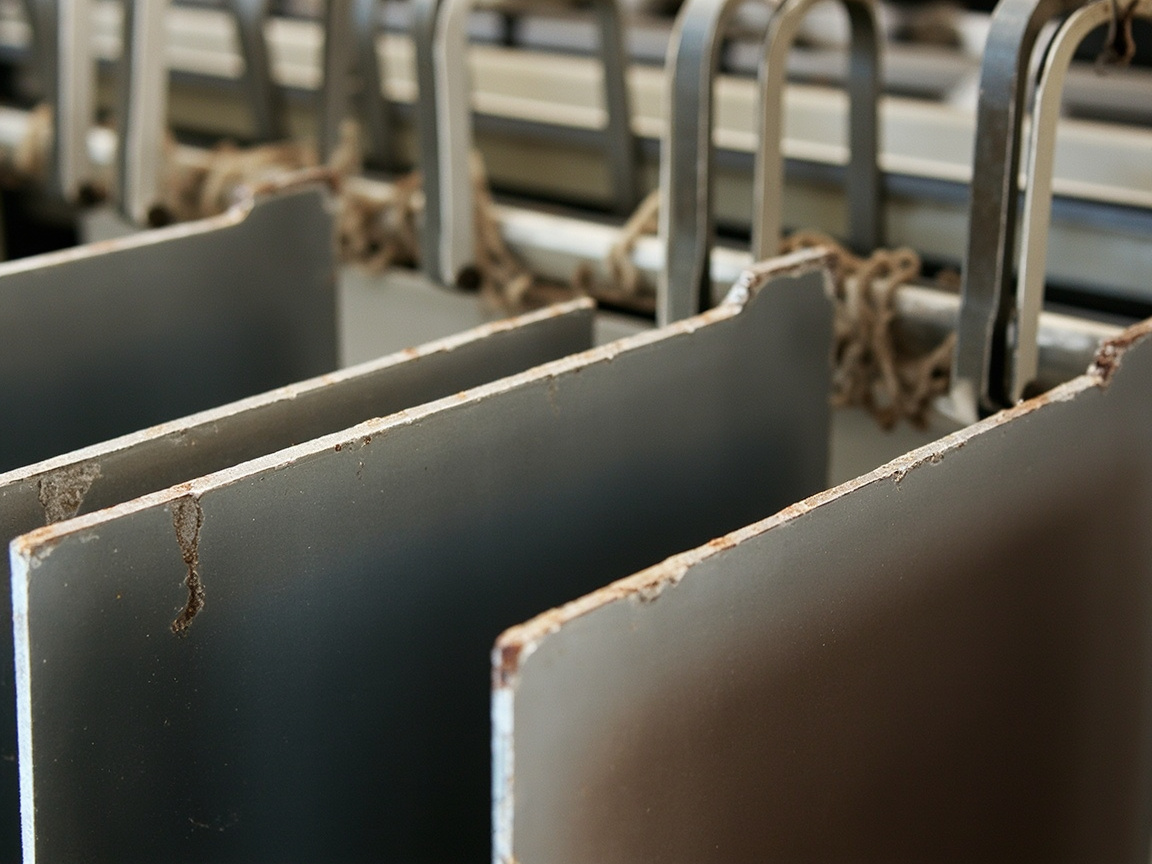
The salt spray cabinet atomizes a 5% ± 1% sodium chloride aqueous solution through compressed air, forming a uniformly settling salt spray in a sealed cabinet at (35 ± 2)℃, with the settling rate generally controlled at 1–2 mL/80 cm²·h. The coated test panels are continuously exposed to the salt-containing humid atmosphere in the cabinet, where chloride ions penetrate coating defects, scratches, or edges, triggering electrochemical corrosion of the substrate. The value of the test lies not in "how powerful the salt spray itself is", but in amplifying "edge protection capability, barrier integrity, and bonding with the substrate" into visible rust, blistering, and peeling.
3.2 Equipment and Sample Conditions
Standard methods (GB/T 1771-2007, ASTM B117, DIN EN ISO 9227) have strict requirements on the following points: salt water concentration, cabinet temperature, collected liquid pH (neutral 6.5–7.2), sample placement angle (usually 15°–20° from vertical), and samples not contacting each other or blocking salt spray settling. Any out-of-control item will make the data incomparable—for example, if the pH is low it becomes acidic salt spray, with an acceleration rate much higher than neutral conditions, and the results cannot be compared horizontally with other laboratories.
3.3 Result Judgment
The general judgment criterion is: typically 500h no blistering, unilateral rust expansion ≤1–2mm is regarded as the qualified baseline; for heavy anti-corrosion systems (such as zinc-rich epoxy + micaceous iron oxide epoxy + polyurethane topcoat配套), salt spray can reach 1000–3000h level. When judging, look at four types of phenomena:
- Blistering: rated by blister density and bubble diameter; the denser and larger, the worse;
- Rusting: percentage of rusted area and unilateral expansion width (most critical at scratches);
- Cracking / Peeling: loss of film integrity;
- Spread at scribe: this is the "magnifying glass" for evaluating the edge protection of the配套 system, with unilateral rust ≤1–2mm being a common control line.
It needs to be reminded that "500h no blistering" is a frequently cited general industry baseline, not equal to all projects only needing 500h. For offshore structures at C5 or CX corrosion grades, contracts often require 1000h or even above 3000h, combined with weathering and cyclic corrosion tests for joint judgment.
IV. Artificial Weathering: Xenon Lamp and UV
Salt spray controls "rust", weathering controls "aging". Half of outdoor failures come from corrosion, the other half from chalking, discoloration, gloss loss, and cracking caused by sunlight, heat-humidity, and temperature changes. Artificial weathering uses laboratory light sources to accelerate this process.
4.1 Xenon Lamp Weathering (GB/T 1865)
The xenon lamp weatherometer uses a xenon arc lamp to simulate full-spectrum daylight, combined with temperature-humidity and spray cycles, closest to natural outdoor weathering. General judgment: 1000h color change ≤ grade 2 (by gray scale), chalking ≤ grade 1. It is especially suitable for evaluating the gloss and color retention and anti-chalking ability of topcoats—crucial for the decorative and protective life of bridge and storage tank exteriors.
4.2 UV Weathering (GB/T 23987 / ASTM G154 / ISO 11507)
UV fluorescent lamps (UVA-340, etc.) concentrate energy in the UV band, accelerating faster but with less complete spectrum than xenon lamp, often used for screening tests and comparisons. Its results cannot be directly equated to outdoor years, but used in combination with xenon lamp can improve confidence.
4.3 Combination of Weathering and Salt Spray
In real working conditions, corrosion and weathering are superimposed. High-end projects adopt "cyclic corrosion + weathering" composite procedures (e.g., first salt spray, then heat-humidity, then UV cycle), which can expose the weak links of the配套 system better than single salt spray. When reading reports, be clear: is weathering done alone, or cycled with salt spray—this directly determines how long a "warranty narrative" the data can support.
V. Cross-cut Adhesion: The "Foundation" of the Supporting System
Whether salt spray or aging, corrosion almost always breaks through at the weakest point of adhesion between the coating film and the substrate. The cross-cut method (GB/T 9286-1998, ISO 2409, ASTM D3359) is a standard means to evaluate adhesion: cut a grid on the coating film, apply tape and pull it off, and rate by the area of detachment, with grade 0 best and grade 5 worst; grades 0/1 are excellent (detachment ≤5%).
The key to adhesion is not just "whether the topcoat sticks", but whether the interlayer bonding of the entire "primer—intermediate coat—topcoat" system is reliable. Many salt spray failures manifest as large-area peeling at the scribe lines, essentially due to insufficient interlayer adhesion between the intermediate coat and the substrate, or between the topcoat and the intermediate coat, rather than a problem with a single coat itself. Therefore, the conclusion of the salt spray resistance test of industrial coating report must be read together with the cross-cut adhesion: 1000h salt spray but cross-cut grade 3 indicates that the system still has hidden risks at edges and interlayers, and cannot be simply judged as excellent.
VI. Gloss, Hardness, Abrasion Resistance and Impact: Quantification of Service Performance
In addition to corrosion and aging, industrial coating must also pass mechanical and appearance performance; the following four items are most often written into technical agreements.
6.1 Gloss (GB/T 9754)
Specular gloss is measured at a 60° incident angle; high-gloss topcoat typically requires ≥85 GU (gloss units). Gloss retention is a quantitative indicator of whether the topcoat still "looks good" after aging, and is especially important when decorative requirements for bridge and tank exterior surfaces are high.
6.2 Pencil Hardness (GB/T 6739 / ISO 15184)
Standard pencils are used to scratch and evaluate the scratch resistance of the coating film; industrial coating commonly ranges from B to H grade. Note that pencil hardness is a relative indicator, affected by substrate and film thickness, and one cannot simply assume "higher number means more scratch-resistant"脱离工况.
6.3 Abrasion Resistance (Taber, GB/T 1768 / ASTM D4060)
A Taber abrasion tester is used to rotate and abrade under a set load, evaluated by weight loss (mg/1000 rev); easily worn areas such as industrial floor coating, bridge handrails, and tank walkways typically require ≤10–50 mg/1000 rev (depending on grade). Lower weight loss means better abrasion resistance.
6.4 Flexibility and Impact (GB/T 1731, GB/T 1732 / ASTM D2794)
A bending diameter ≤2mm and impact ≥50cm are common control limits for industrial coating, reflecting the coating film's ability to not crack or detach under deformation and mechanical impact. For steel structures subject to wind vibration and thermal deformation, and tanks subject to lifting impact, this indicator directly relates to the reliability of on-site construction and service.

VII. Test Panel Preparation: The Starting Point of Data Comparability
"Garbage in, garbage out" is especially true in coating testing. The same can of paint can yield vastly different results with different panel preparation. Standard preparation includes at least four steps:
- Substrate Treatment: Carbon steel panels typically require blast cleaning to Sa 2½ (ISO 8501-1), roughness 30–75 µm; the treatment grade directly determines the adhesion baseline. If blast cleaning is substandard, even the best paint cannot show its true performance.
- Coating Application: Apply according to the specified number of coats, film thickness and interval in the system. Dry film thickness (DFT) should be verified with a magnetic thickness gauge, because salt spray and aging results are extremely sensitive to film thickness—insufficient film thickness equals artificial "down-specification".
- Curing: After coating, fully cure per product requirements (epoxy/polyurethane often need 7 days @25℃ to reach final properties) before testing, otherwise the "semi-cured state" is measured and the conclusion is invalid.
- Scribe Marking: Salt spray panels often have a cross or straight line scribed to the substrate on the surface, as a unified reference for corrosion initiation points.
Records of panel preparation (substrate grade, film thickness, curing conditions, scribe method) must be provided with the report, otherwise the data cannot be reviewed, nor can it be determined "whether it is a paint problem or a construction problem".
VIII. Result Rating: From Phenomenon to Grade
Standardized rating turns "how bad" into transmittable numbers. Taking salt spray as an example, rating typically covers:
- Blistering Grade: Combined by blister diameter (e.g., grade 2, 3, 4) and density (e.g., S1–S5), such as "blistering 2(S3)";
- Rusting Grade: Ri grade corresponding to rust area percentage;
- Scribe Creep: Unilateral rust expansion width (mm), a core indicator of edge protection of the coating system;
- Detachment / Cracking Grade: Degree of loss of coating film integrity.
Aging rating looks at color change (gray scale 0–5, smaller number means heavier discoloration) and chalking (0–5, by grade of paint powder picked up by tape). Map the phenomenon to grades, then compare with the qualified line agreed in the contract to form a clear "pass / fail" conclusion, rather than a vague "surface is average".
IX. How to Read a Test Report
When receiving a third-party or manufacturer's self-inspection report, it is recommended to check in the following order to avoid being misled by the word "qualified":
- Check Standards and Methods: Confirm whether GB/T 1771, ISO 9227 or ASTM B117 is executed; the severity and judgment of different methods are not directly equivalent; for aging, check whether it is xenon lamp or UV, and whether it is cyclic.
- Check Panel Information: Whether substrate treatment grade, actual DFT, curing conditions, and scribe method are clearly written. Reports with insufficient film thickness should have their conclusions discounted.
- Check Test Duration and Termination State: Was it terminated at the agreed duration, or terminated early due to failure? "1000h pass" and "600h blistering termination" are completely different.
- Check Single-Item Combination: Salt spray + cross-cut + aging must all meet the standard. A pretty single item with another item collapsed still means an unreliable system.
- Check Judgment Caliber: Whether statements like 500h no blistering, unilateral rust ≤1–2mm are clear; whether heavy-duty anti-corrosion projects provide 1000h/3000h level data.
- Check Agency Qualification and Sample Status: Whether it is submitted sample or sampled, whether it has CMA/CNAS qualification, and whether the sample is a real batch representing mass production.
Reading the report as a six-segment "method—panel—duration—single item—combination—agency" can basically eliminate most exaggerated claims.

X. Common Testing Misconceptions
Misconception 1: Longer salt spray time is better, just compare the numbers. Wrong. Salt spray duration must be read together with corrosion grade, system film thickness, and whether scribed. Different systems have different film thicknesses, and simply comparing hours is misleading.
Misconception 2: 500h is a mandatory qualified line. Wrong. 500h is a common industry baseline; C5/CX marine projects often require above 1000h, and need composite aging judgment, cannot be一刀切.
Misconception 3: Just test the topcoat. Wrong. Industrial protection relies on the "primer—intermediate coat—topcoat" system; testing only the topcoat hides the real risk of interlayer and substrate bonding.
Misconception 4: Pencil hardness 9H is good. Wrong. Industrial coating commonly ranges B–H; 9H mostly belongs to nano ceramic coating context and depends on substrate, talking about hardness脱离System is meaningless.
Misconception 5: UV aging is enough. Wrong. UV accelerates fast but spectrum is incomplete; gloss and color retention conclusions should be mainly xenon lamp (GB/T 1865) with UV as supplement.
XI. Putting Testing into Selection and Acceptance
For engineering parties, testing is not a laboratory "performance", but the basis for selection and contract. It is recommended to specify in the technical agreement: referenced standards (e.g., GB/T 1771, GB/T 1865, GB/T 9286), qualified line (e.g., salt spray 1000h no blistering, unilateral rust ≤2mm, aging 1000h color change ≤2 grade), panel preparation requirements (Sa 2½, DFT range), and testing agency qualification. This way, later acceptance has a basis, and disputes can distinguish whether it is a paint problem or a construction problem.
Kexin New Materials (kexinMaterials) in the system delivery of epoxy zinc-rich primer, epoxy micaceous iron intermediate coat and polyurethane topcoat, provides corresponding salt spray, aging and adhesion data with the goods, and writes the "test qualified line" into the system process card, facilitating on-site construction by drawing and acceptance by number. For compliance needs under the water-based trend, you can also combine water-based paint vs oil-based paint selection comparison to balance performance and VOC limits (industrial protective paint executes GB 30981-2020).
XII. Testing is the "Receipt" of Durability Promise
To sum up in one sentence: the durability of industrial coating is not an advertising slogan, but a set of reviewable test data under standard conditions. Salt spray resistance test of industrial coating uses GB/T 1771 / ISO 9227 to compress the corrosion of marine atmosphere into visible rust and blistering; xenon lamp aging uses GB/T 1865 to compress several years of outdoor aging into color change and chalking; cross-cut adhesion uses GB/T 9286 to turn interlayer bonding force into 0–5 grade numbers. Read these three items together with gloss, hardness, abrasion resistance, and impact, then verify panel preparation and agency qualification, and you can truly "read" an industrial coating test report, rather than being led by the conclusion.
For modern industrial protective systems pursuing low VOC and high solids, testing is also an acceptance defense line. For how water-based painting does incoming acceptance and testing control, further refer to water-based paint acceptance and testing methods, apply the standard framework of this article to the incoming material control of specific projects.
13. Cyclic Corrosion Test: Closer to Reality than Constant Salt Spray
Constant neutral salt spray keeps the test panels continuously exposed to a salt spray atmosphere, but the real outdoors features an alternating sequence of "salt spray—drying—humid heat—UV": daytime solar heating, nighttime condensation and salt deposition, rainy-day salt spray washing, and wet-dry cycles in splash zones. Constant salt spray ignores the most critical acceleration factor of "wet-dry alternation", and therefore does not adequately expose certain systems (especially topcoat weather resistance and intercoat adhesion).
Cyclic corrosion tests (such as those based on ISO 11997 or the Prohesion procedure) cycle these stages according to a schedule, which is closer to actual failure mechanisms and better exposes weak points in intercoat adhesion and edge protection. When reading such reports, the evaluation items are the same as for constant salt spray (blistering, scribe creep, flaking, rusting), but the duration and grading must be referenced against the specific cyclic procedure—different procedures have different temperature/humidity, salt spray concentration, and stage durations, and their severities are not directly convertible; one cannot equate "500h cyclic" with "500h constant salt spray".
For high-grade projects such as offshore and sea-crossing bridges, the industry is increasingly inclined to use a "cyclic corrosion + xenon-arc weathering" combined procedure to support durability claims, because it simulates the real working condition of "corrosion and aging superimposed", which is more convincing than single salt spray.
14. Translating Test Data into Durability Years
Many owners ask: "Does 1000h salt spray equal how many years of warranty?" Strictly speaking, the test duration itself does not equal "warranty N years", but a mapping relationship can be established through the durability grades of ISO 12944 (low L, medium M, high H, very high VH): typically a 500h-level salt spray corresponds to a general durability expectation for C3–C4, a 1000h-level corresponds to heavy anti-corrosion for C4–C5, and 3000h-level or "cyclic corrosion + aging" combined data may support CX and "very high (VH)" durability. This mapping is not a precise formula but an engineering experience range, affected by film thickness, application, and environmental fluctuations.
When design institutes write technical agreements, it is recommended to include the four-piece set of "corrosion grade + design durability grade + corresponding test duration + pass line", rather than just writing a sentence like "10-year warranty". A duration commitment without test data support makes responsibility definition very difficult once failure occurs later. The role of the test report here is to provide a verifiable receipt for the "duration commitment".
15. Failure Phenomena and Test Item Troubleshooting Table
Back-tracing common field failures to test items is a practical tool for selection and acceptance. The table below lists typical phenomena with the most relevant tests to supplement and improvement directions:
| Field Failure Phenomenon | Most Likely Weak Test Item | Corresponding Improvement Direction |
|---|---|---|
| Large-area rust creep at scribe | Poor cross-cut adhesion, insufficient primer cathodic protection | Increase zinc-rich primer film thickness, verify intercoat adhesion |
| Overall blistering, substrate rust bleeding | Insufficient salt spray duration, low total film thickness | Thicken intermediate coat, supplement salt spray over 1000h |
| Topcoat chalking, obvious gloss loss | Xenon-arc weathering color change/chalking out of tolerance | Switch to aliphatic polyurethane or polysiloxane topcoat |
| Coating brittle cracking, falling off under impact | Impact/flexibility not meeting standard | Adjust curing agent ratio, toughening modification |
| Local early rust spots | Insufficient minimum application film thickness | Control minimum with thickness gauge, supplement spray at edges/corners |
| Severe discoloration after aging | UV/xenon-arc color retention not meeting standard | Select yellowing-resistant topcoat, control film thickness |
The value of this table is: it translates "phenomenon" into "which test to check, which direction to improve", making technical communication shift from "the paint is bad" to "which indicator failed, how to remedy".
16. Three Implementation Suggestions for Procurement and Supervision
Condense the above into three suggestions that can be directly written into technical agreements, helping the procurement and supervision parties hold the "testing话语权" (testing discourse power) in their hands:
- Pin down the standards: The commission form and contract shall explicitly reference GB/T 1771 (salt spray), GB/T 1865 (xenon-arc weathering), GB/T 9286 (cross-cut), GB/T 9754 (gloss), etc., and state the pass line and test duration, avoiding the flexible space of "test by manufacturer's method".
- Lock down the panel information: Require the report to attach substrate treatment grade, actual DFT, curing conditions, and scribe method; missing any item is deemed incomplete and not accepted.
- Lock down the combined judgment: Salt spray, aging, and adhesion must all pass simultaneously to be accepted; a beautiful single item with another item collapsed is not accepted.
By doing these three, testing changes from "manufacturer's promotional material" to "owner's acceptance weapon". This is also the basic action that Kexin New Materials (kexinMaterials) recommends all industrial protective projects solidify at the bidding stage—clear standards save not only money later, but also unclear responsibilities.
FAQ
1. How many hours is the salt spray resistance test for industrial paint generally required?
The common industry baseline is 500h without blistering, single-side rust ≤1–2mm, but this is only a general starting point. For offshore and bridge projects in high corrosion grades such as C5 and CX, contracts often require 1000h or even over 3000h, combined with xenon-arc weathering and cyclic corrosion for joint judgment. The specific duration should be determined by corrosion grade, design durability years, and contract, and cannot be一刀切 (uniformly applied).
2. What is the difference between GB/T 1771, ASTM B117, and ISO 9227?
All three are neutral salt spray methods, with similar principles but differences in details (such as salt concentration, temperature, pH, panel angle, evaluation description). GB/T 1771-2007 is the Chinese national standard, ASTM B117 is the ASTM standard, and DIN EN ISO 9227 is the European/German standard adopting ISO 9227. When reading reports, see clearly which one is executed; the severity and judgment caliber of different methods are not directly equivalent.
3. Why should salt spray reports also show cross-cut adhesion?
Because corrosion almost always breaks through where the coating-substrate bond is weakest, especially at scribe edges. 1000h salt spray but cross-cut only grade 3 indicates hidden risks in intercoat or substrate adhesion, and the system is still unreliable. Salt spray, aging, and adhesion must be viewed in combination; a single item passing does not mean the system passes.
4. Which to trust, xenon-arc weathering or UV weathering?
Conclusions on gloss retention, color retention, and chalk resistance should mainly rely on xenon-arc weathering (GB/T 1865), because it uses a xenon arc lamp to simulate full-spectrum daylight, closest to nature; UV weathering (GB/T 23987) accelerates fast but has incomplete spectrum, suitable for screening comparison, and cannot directly equal outdoor years. Using both together gives higher confidence.
5. Does the test panel film thickness greatly affect results?
Very much. Salt spray and aging results are very sensitive to dry film thickness (DFT); insufficient film thickness equals artificial "down-spec", and even the best paint cannot show true performance. Standard preparation requires verifying DFT with a magnetic thickness gauge, and recording substrate blast grade (e.g., Sa 2½), roughness, and curing conditions with the report, otherwise the data cannot be reviewed.
6. Is industrial paint with pencil hardness 9H better?
Not necessarily. Industrial protective coatings commonly have pencil hardness of B–H grade; 9H mostly belongs to the context of nano ceramic coatings, and hardness values depend on substrate and test method. Discussing "higher means more scratch-resistant" out of the system context is misleading. Industrial coatings should focus more on the combined performance of adhesion, salt spray, and aging, rather than a single hardness number.
7. How to check the qualification of third-party test reports?
Focus on whether the testing agency has CMA/CNAS qualifications, whether samples are submitted or sampled, and whether they represent the real batch of mass production. At the same time, verify the executed standard, panel information, test duration and termination status, and combined single-item results, to avoid being misled by the vague word "qualified".
8. What is cyclic corrosion test, and is it better than single salt spray?
Cyclic corrosion cycles stages such as salt spray, humid heat, drying, and UV in sequence, which is closer to the real outdoor working condition of "corrosion-aging superposition" than constant salt spray, and better exposes weak links of the coating system. High-end offshore and bridge projects are increasingly inclined to use cyclic corrosion + aging combined procedures to support durability claims.
9. What standard to look at for VOC testing of industrial paint?
VOC determination of industrial protective coatings follows GB/T 23985, GB/T 23986 (GC-MS method), ISO 11890, etc., and limits execute GB 30981-2020 "Limit of Harmful Substances in Industrial Protective Coatings". When reading reports, besides performance items, also pay attention to whether VOC and heavy metals meet the mandatory national standard.
10. The test passed, what else to note in field application?
Testing is a "capability proof" under laboratory conditions; in the field, also control substrate treatment (blast grade), actual film thickness, application interval, temperature/humidity (e.g., substrate temperature ≥3℃ above dew point, relative humidity ≤80%), and curing maintenance. If application is not up to standard, no matter how good the test report is, it cannot protect the real service life.
Further Reading
- How to select water-based industrial coating under the oil-to-water background: resin system and applicable working conditions: Pre-positions the "test judgment" of this article to the selection stage, establishing a performance-compliance decision framework for industrial protective coatings.
- How to choose water-based paint and solvent-based paint: systematic comparison from performance to cost: Compare the trade-offs of water-based and solvent-based industrial coatings in durability, application, and VOC to assist supporting scheme decisions.
- Water-based paint site acceptance and inspection methods: This article applies the standard framework to the site acceptance and inspection control of specific projects, suitable for reference by supervisors and purchasers.