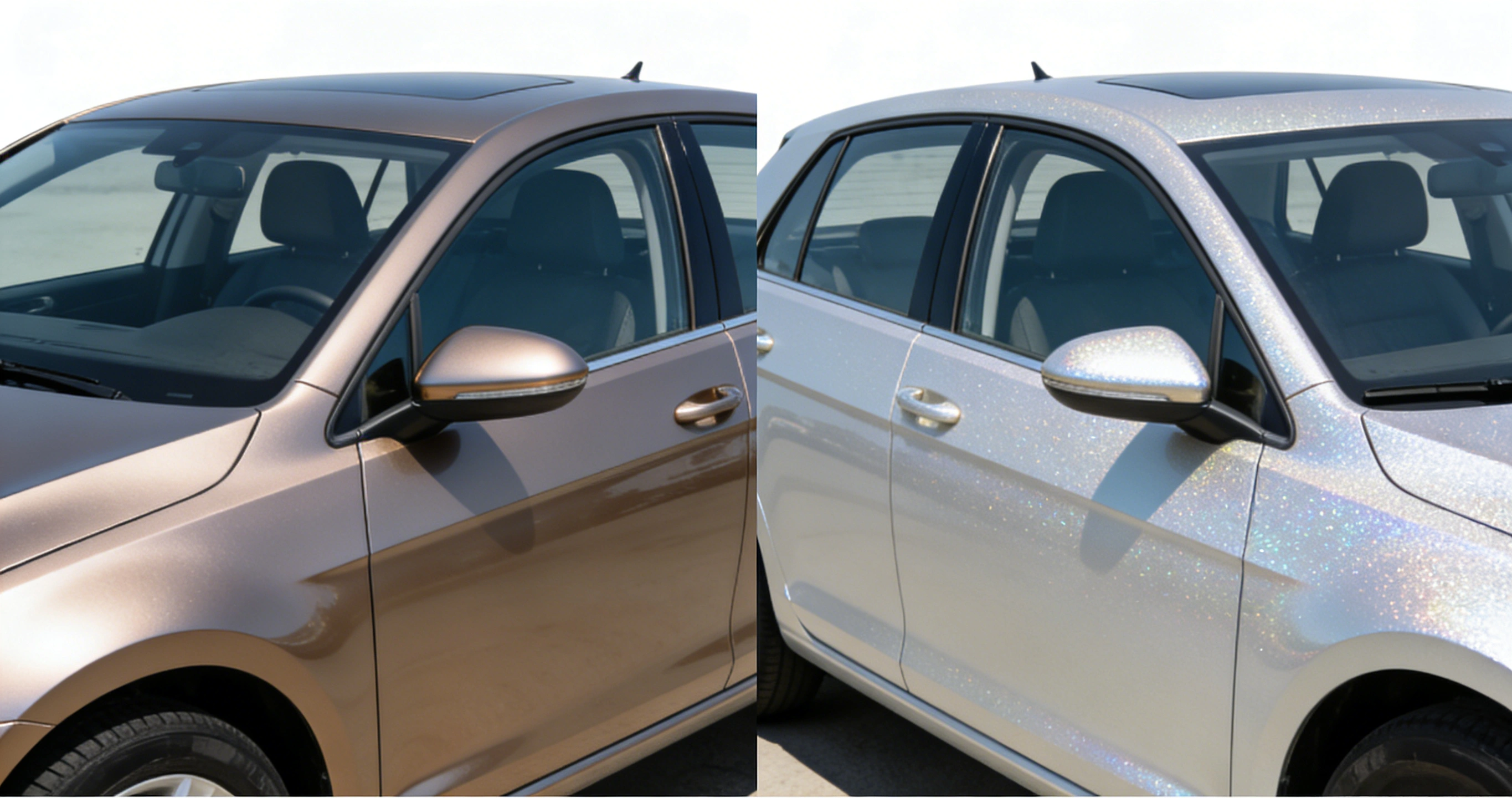
Summary: Orange peel is the wave texture of a clearcoat; DOI scores how sharply the surface mirrors an image. Same panel-shallower, finer waves give higher DOI. Quantify with wave-scan SW/LW and DOI, then trace viscosity, atomisation, flash-off and bake.
Orange peel & DOI
Orange peel is a wave-like relief left when atomised droplets fail to level before gel; it splits into short wave SW (~0.1-1.2 mm, fine grit) and long wave LW (~1.2-5 mm, coarse peel). DOI uses the Rhopimer principle: a projected light bar and a photocell array read near-specular (±~0.6°) reflection, output 0-100.
DOI relates to but is not gloss (ISO 2813 / ASTM D523 at 20°/60°): a high-gloss film can still show low DOI if micro-waves scatter the projected image.
Key data
- Wave-scan quantifies peel: SW ~0.1-1.2 mm, LW ~1.2-5 mm; lower is smoother.
- DOI runs 0-100; a near-perfect mirror approaches 100 and premium car clearcoats push DOI well above ordinary industrial parts.
- Clearcoat dry film ~30-60 µm, metallic basecoat ~15-25 µm; too thin cannot level, too thick sags.
- Gloss read at 20°/60°/85° per ISO 2813 / ASTM D523; high-gloss systems use 20°.
- High long-wave LW points to atomisation/gun/film; high short-wave SW points to viscosity and flash-off/leveling.
Root causes & tuning
| Peel band | Likely cause | Tuning |
|---|---|---|
| High LW | Weak atomisation, fast gun, thin pass | Lower viscosity, slow the gun, control passes/film |
| High SW | Fast flash-off, high viscosity | Slower solvent, longer flash/leveling, mild heat |
| Overall coarse | Low booth/substrate temp, thick clear | Raise temps, mix to TDS viscosity |
| Dull after bake | Under/over flash-off | Correct cure temperature-time window |
From measurement to process
Leveling vs gel is the essence of peel: ripples must be smoothed before viscosity rises past flow. Manage atomisation/gun, spray viscosity, flash-off and solvent gradient, temperature, film build and cure curve.
Defects & fixes
- Heavy LW peel: fix atomisation, air/cap and gun speed, control film per pass.
- Gritty SW: add slower solvent, extend flash and leveling, raise temperature.
- High gloss but low DOI: micro-waves scatter the image-attack leveling, not gloss alone.
- Peel survives polishing: thin film or substrate print-through-build clear and level the base first.
- Flop disturbs reading: metallic sparkle adds noise-fix measurement geometry and compare numbers.
FAQ
How are peel and DOI linked?
Two views of the same appearance: peel is wave amplitude/length (SW/LW), DOI is image sharpness. Shallower, even waves mirror better, so DOI rises.
Can more gloss fix low DOI?
Not necessarily. Gloss is total mirror reflection; DOI is edge sharpness. Micro-waves scatter the projected line-level to fix.
Why does peel get hard to save late?
Ripples set at gel; after full cure only polishing shallowens them. Act within the flash/leveling window.
What to watch on metallics?
Flop and sparkle add visual noise; keep instrument geometry and light fixed, judge by SW/LW/DOI values.
Does film thickness matter?
Greatly. Thin clear cannot fill ripples; thick clear sags and traps solvent-keep within the suggested range (~30-60 µm).
How to set a pass standard?
Make a master panel, measure SW/LW/DOI/20° gloss at many points, fix centre and limits, measure production the same way.
Last updated: 2026-09-18
References: ISO 2813 / ASTM D523 (gloss); multi-angle DOI and wave-scan SW/LW appearance metrology (open instrument white-papers).
Kexin New Materials (Guangdong) Co., Ltd.