The "good looks" and "durability" of automotive coating are both written on the film surface: whether the gloss is uniform, whether there is sagging or orange peel, and whether there are bubbles or craters, are what customers and quality inspectors see at first glance. Most coating defects are not caused by poor quality of the coating itself, but by the loss of control in one of the links of Material—Equipment—Environment—Process (4M). The same can of good paint, at a site with out-of-control temperature and humidity, incorrect ratio, and unclean spray booth, will also produce a full board of defects; conversely, a disciplined site can stably produce high gloss even with ordinary paint.
As a technical supplier of automotive and industrial protective coatings, Kexin New Materials (kexinMaterials) often includes a "defect troubleshooting table" as a delivery attachment when supporting construction. This article systematically breaks down the causes and countermeasures of high-frequency defects in automotive coating, and provides citable inspection rating standards to help the site upgrade from "guesswork rework" to "adjust parameters by root cause".
I. Classification Logic of Defects
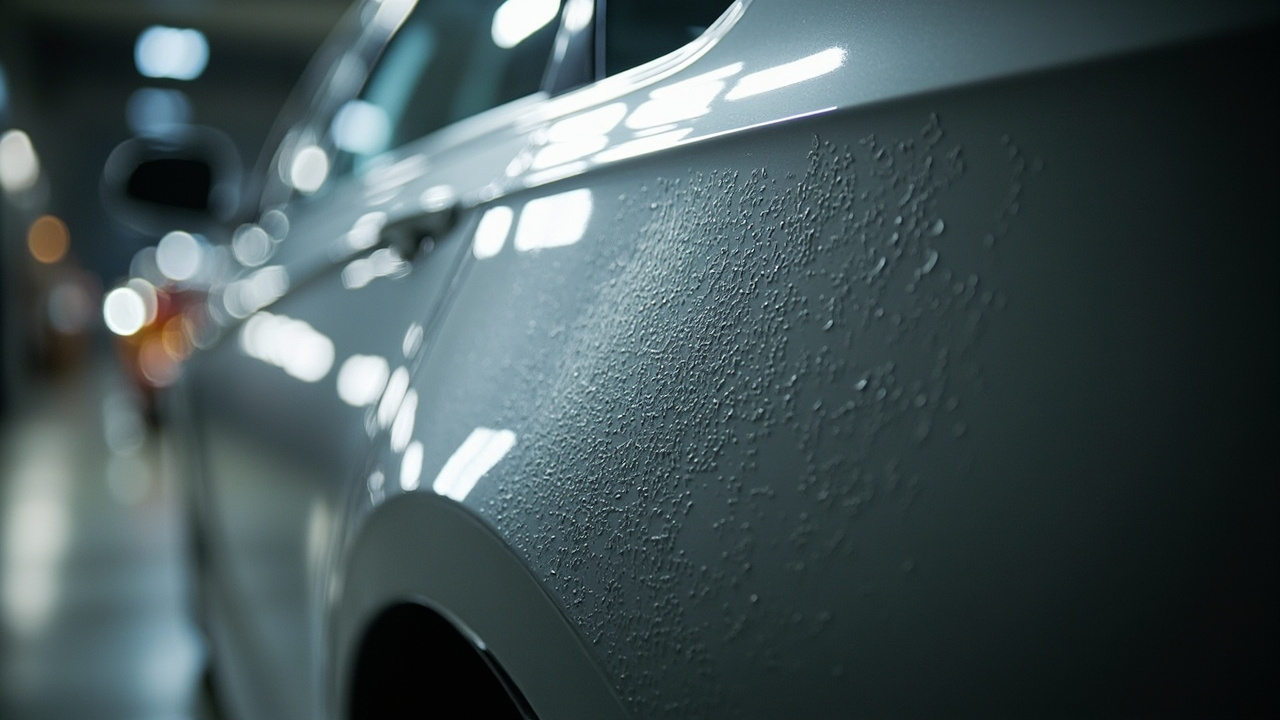
Automotive coating defects can be divided into three categories by stage of occurrence:
- Application-stage defects (appear immediately after spraying): sagging, orange peel, dry spray, dust spots, poor leveling—mostly caused by spraying parameters and environment;
- Curing-stage defects (appear during drying/baking): pinholes, hidden bubbles, wrinkling, loss of gloss, blushing—mostly caused by ratio, temperature, humidity, film thickness;
- Service-stage defects (appear during use): chalking, discoloration, cracking, peeling, filiform corrosion—mostly caused by system compatibility, weather resistance, mechanical damage.
The first principle of troubleshooting: first see at which stage it occurs, then trace back the variable parameters of that stage. For example, "bubbles after baking" almost certainly requires checking humidity/water content and ratio, not spraying technique; "immediate sagging after spraying" should first check film thickness and viscosity. Establishing a "stage—parameter" mapping table is fundamental to shortening troubleshooting time. Many sites are used to "patch where it looks bad", resulting in the same defect recurring; the root cause is failing to map the phenomenon to variable parameters, merely covering the root cause with rework.
II. Sag / Run
Sagging is the "tear marks, curtains" formed by wet film flowing downward due to gravity, and is one of the most common defects in automotive coating, especially on vertical surfaces and corners.
Causes: ①Film thickness exceeded (DFT exceeds TDS window); ②Excessive dilution, low viscosity; ③Low temperature, slow solvent evaporation; ④Gun too close, excessive overlap, single pass too thick; ⑤Improper leveling aid or anti-settling agent.
Mechanism: Before surface drying, the wet film resists gravity through surface tension and viscosity; when film thickness and gravity exceed the yield value of the wet film, it begins to flow. Low temperature causes solvent retention and viscosity drop, further aggravating it. Sagging and orange peel are often same-source different-manifestations: with the same gun, close range with excessive film thickness → sagging, far range with dry spray → orange peel, so parameter adjustment must look at both ends.
Countermeasures: Control DFT within window (e.g., clear coat 40–60 µm); adjust viscosity to recommended range by DIN 4 @20℃; raise temperature, lower humidity, control evaporation gradient; gun distance 15–25 cm, overlap 1/2–2/3; if necessary add anti-sagging aid (fumed silica, urea thickener). Once sagging is cured it is hard to repair, only sanding and respray. Prevention is better than rework: before batch, use test spray panel to measure DFT and critical sagging film thickness, write "maximum sprayable film thickness" into the work card.
III. Orange Peel
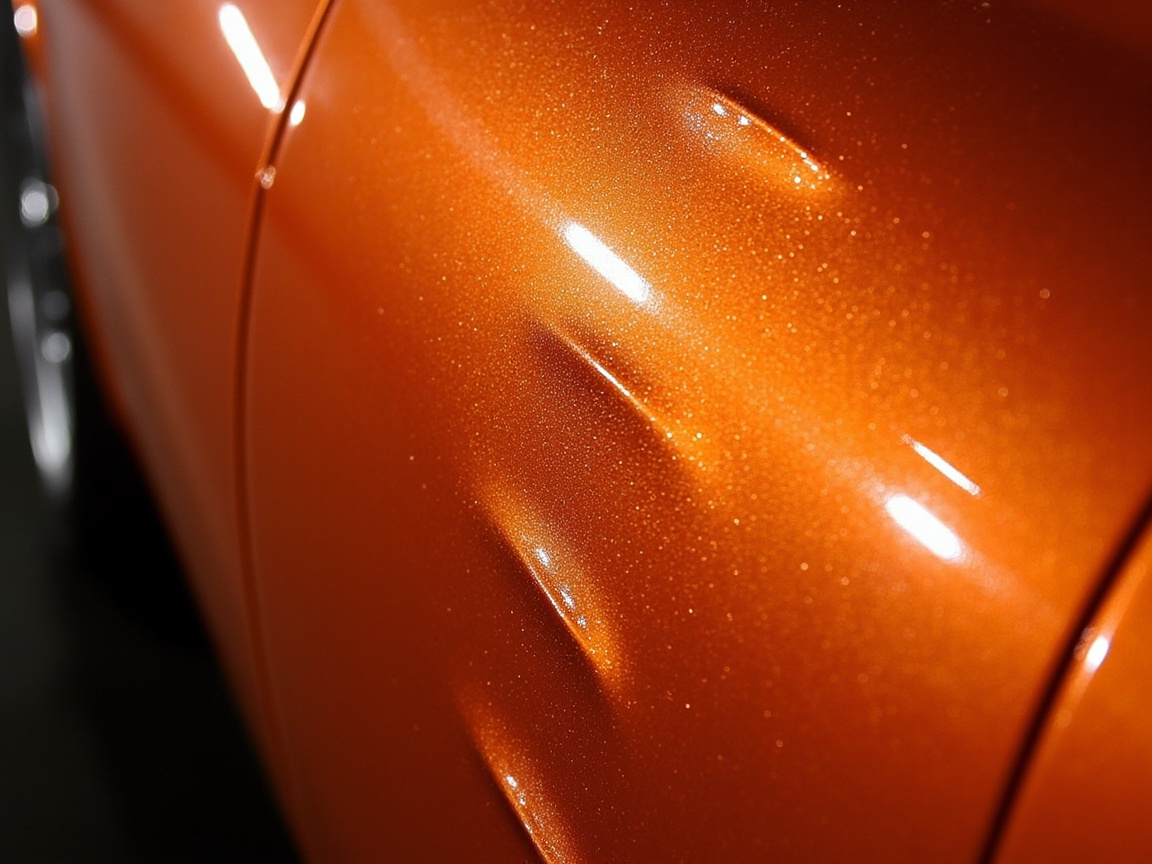
Orange peel is the ripple on the paint film surface like orange skin, originating from insufficient leveling—the wet film fails to level before surface drying.
Causes: ①High viscosity, poor atomization; ②Low spray gun pressure or wrong nozzle size, poor atomization; ③High temperature or too fast solvent evaporation (surface dry faster than leveling); ④Insufficient film thickness, hard to level; ⑤Poor leveling of coating itself.
Mechanism: Atomized paint droplets landing on the panel need to fuse and level by surface tension; if surface dry is too fast, droplets solidify before fusing, leaving "orange peel". Long-wave orange peel mostly from overall insufficient leveling, short-wave orange peel mostly from coarse atomization particles. BYK orange peel meter divides ripples into long wave (large-scale undulation) and short wave (fine granular feel), with different sources and different countermeasures.
Countermeasures: Adjust viscosity to window, raise compliant atomization pressure, select correct gun nozzle (clear coat 1.2–1.4 mm); reduce surface dry speed (adjust solvent gradient, lower surface temperature); ensure sufficient film thickness; add leveling agent. Slight short-wave orange peel can be reduced by polishing, but long-wave orange peel cannot be removed by polishing, needs respray. The root is adjusting spraying parameters and solvent gradient, not relying on polishing. Repair end needs more attention: the feathered area of local repair has thin film, more prone to long-wave orange peel, should separately control fan and overlap.
IV. Crater / Fish eye
Crater is a small pit (exposing primer or intermediate coat) formed by local extremely low surface tension causing the paint film to "shrink back"; fish eye is a crater-shaped crater with a particle in the center.
Causes: ①Substrate/environment contains silicone oil, oil, wax, mold release agent (extremely low surface tension, contaminating wet film); ②Poor degreasing in pre-treatment; ③Compressed air contains oil and water; ④Coating mixed with incompatible substances. Crater is a "contamination-type" defect, highly spreading, one contamination source can ruin the whole panel.
Mechanism: Contaminants diffuse in the wet film, pulling local surface tension far below surroundings, the film shrinks outward to reduce surface energy, forming crater. It spreads with wet film flow, so destructive. Silicone oil contaminants even at very low concentration can form crater groups on the whole panel, typical "trace harm".
Countermeasures: Strengthen degreasing and cleanliness; add multi-stage oil-water separator to compressed air; remove silicone oil sources (ban silicone-containing care products near spray booth); if necessary add anti-crater leveling agent (reduce own surface tension difference). Once fish eye formed needs sanding and respray. Spray booth cleanliness is the first line of defense against craters, see Automotive spray booth cleanliness and booth design. In site management, "silicone products banned from booth area" should be written into the system, and incoming parts should be tested for degreasing residue.
V. Pinholes / Solvent Pop
Pinholes are tiny through-holes on the paint film surface, hidden bubbles are subcutaneous unbroken bubbles, often turning into pinholes or collapse after baking.
Causes: ①Substrate contains water/air trapped in cavities; ②Mixing entrains air, insufficient stirring defoaming; ③Surface dry too fast, internal solvent trapped before escaping; ④Film too thick, solvent occlusion; ⑤High humidity, isocyanate reacts with water to form CO₂ (2K system).
Mechanism: Solvent or gas expands inside the film, surface already surface-dried into film, internal pressure pushes film up into bubble; if film broken it is pinhole, if not broken it is hidden bubble. High humidity in 2K system triggers —NCO reacting with H₂O to produce gas, main cause of "bubbling in humid environment". Pinholes and hidden bubbles are often confused, but unbroken hidden bubble only slightly convex in appearance, collapses after baking, so the "wet film rest defoaming" window before baking is critical.
Countermeasures: Control substrate water content (above dew point by 3℃ or more); sufficient defoaming maturation; reduce surface dry speed (adjust slow-evaporating solvent); control film thickness; lower humidity (especially 2K). Light pinholes can be polished, heavy ones respray. For thick-coat systems, use "multi-pass thin spray + interlayer flash-off" instead of single thick pass, to leave channel for solvent escape.
VI. Wrinkle / Lifting
Wrinkle is the upper coat solvent swelling the undercoat not fully dry, surface dries first while inner layer shrinks later forming wrinkles; Lifting is the undercoat bitten up by upper coat solvent, bubbling and delaminating.
Causes: Root is all "spray upper coat before undercoat fully cured/dry", solvent mutual solubility causes. Common in "base coat not dry before clear coat", "old paint not treated before new paint".
Mechanism: Upper strong solvent penetrates lower layer, re-swelling and softening uncrosslinked resin, interlayer adhesion lost, surface films first while lower shrinks later, thus wrinkle; if lower layer lifted entirely it is lifting. Both point to "interlayer cure state mismatch".
Countermeasures: Fully cure lower layer before upper; control interlayer flash-off time; avoid strong-solvent upper with weak-solvent-resistant lower; repair end do compatibility test on old paint. Repair end ratio and interlayer window, see Automotive refinish 2K clear coat formulation and application key points. For unknown old paint, first do "local test spray + cross-cut" to verify compatibility, then decide if sealer primer needed.
VII. Blushing / Loss of Gloss
Blushing is clear coat/pigmented paint showing white fog in humid heat (water enters film making resin turbid or milky); loss of gloss is gloss below standard (< 85 GU @60°).
Causes: ①Humidity too high, water enters film (especially 2K isocyanate reacts with water, nitro/acrylic blush in humid heat); ②Wrong ratio, insufficient cure; ③Solvent evaporates too fast taking surface heat causing condensation.
Mechanism: Water mixed into film former makes resin phase uneven or micro-phase separation, light scatters at interface showing white fog; or insufficient cure leads to poor surface density, low reflectivity. Blushing and loss of gloss often accompany, but loss of gloss may also come from insufficient cure or wax/silicone contamination, need distinction.
Countermeasures: Lower humidity, dehumidify, control dew point; strict ratio; use blush-resistant resin and slow-evaporating solvent; if necessary heat dehumidify. Light loss of gloss can be polished, heavy respray. Dew point management more critical than humidity meter: as long as panel temp above dew point 3℃, condensation risk drops greatly. Winter spraying especially preheat substrate and coating.
VIII. Dirt / Dry spray
Dirt is dust/paint mist dry particles in air falling on wet film; dry spray is atomization too dry, paint mist lands before leveling forming rough particles.
Causes
: ① Spray booth unclean, filter media failed, cross-air from sanding area; ② High temperature/high pressure/long distance causing dry spray; ③ Compressed air containing dust.Mechanism: Dust spots come from environmental particle settling; dry spray comes from excessive atomization and solvent completely evaporating during flight, with paint droplets landing on the panel as dry powder and unable to level. The two look similar in appearance but have different root causes: dust spots are randomly distributed and mostly from airflow, while dry spray concentrates at fan edges and comes from atomization.
Countermeasures: Improve spray booth cleanliness and filter media grade; move closer, lower pressure, adjust solvent; purify compressed air. Dust spots are handled by "wet sanding + polishing" or repainting. Compressed air is a often-overlooked pollution source: the triplet (filter, regulator, lubricator) must be drained and have cartridges replaced regularly, and dew point measured, to avoid blowing water and oil into the paint film.
IX. Service-Period Defects: Chalking, Discoloration, Cracking, Filiform Corrosion
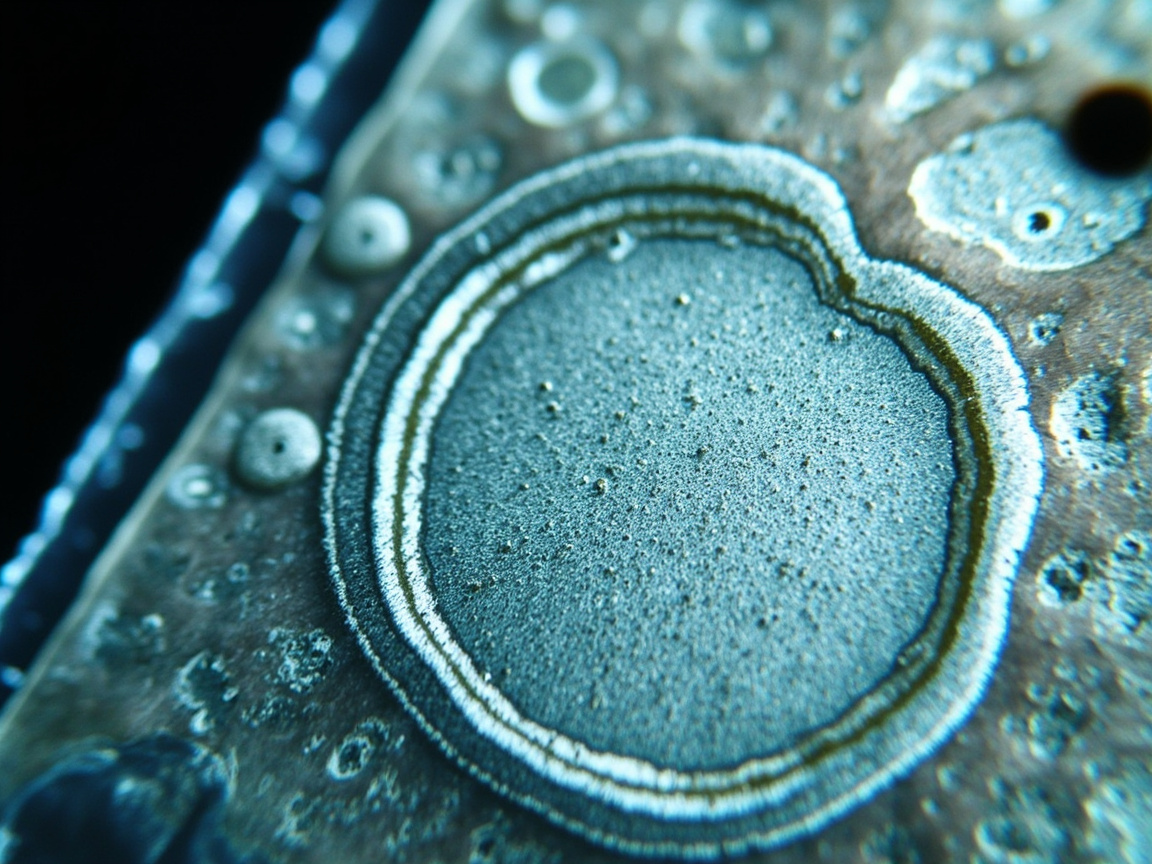
Service-period defects gradually appear during use, reflecting deep issues in the system and weather resistance:
- Chalking: Resin degrades under UV, surface becomes powdery and loses gloss. Countermeasure: select weather-resistant resin, add UV absorber and HALS stabilizer.
- Discoloration/Yellowing: Pigment or resin photo/thermal aging. Countermeasure: aliphatic curing agent, weather-resistant pigment, avoid silicone contamination.
- Cracking: Film brittle or internal stress exceeds adhesion, mostly due to excessive film thickness, insufficient flexibility or aging. Countermeasure: control thickness, improve flexibility, weather-resistant design.
- Filiform corrosion: Filiform corrosion crawling along scratches at edges of aluminum/effect-color, mostly from insufficient protection or electrolyte retention. Countermeasure: improve pretreatment and sealing, enhance system anti-corrosion.
Service-period defects cannot be corrected by on-site spraying, and can only be prevented at the formulation and system design stage, so the "acceptance sheet" must include weather resistance, salt spray, and stone chip, see Automotive Paint Test Standards (Adhesion/Weathering/Stone Chip) for details.
X. Defect Comparison and Troubleshooting Table
The following table summarizes the "cause—countermeasure" quick reference for high-frequency defects:
| Defect | Stage | Main Cause | Core Countermeasure |
|---|---|---|---|
| Sag | Application | Excess film thickness/thin/low temp | Control DFT, adjust viscosity, raise temp |
| Orange peel | Application | High viscosity/poor atomization/fast surface dry | Adjust viscosity, improve atomization, slow surface dry |
| Crater/Fish eye | Application | Silicone oil contamination/poor degreasing | Remove contamination, strong degreasing, clean environment |
| Pinhole/Dark bubble | Curing | Contains water/entrained air/fast surface dry | Control water, defoam, slow surface dry |
| Wrinkling/Lifting | Curing | Lower layer not fully cured | Spray after lower layer cured |
| Blushing/Gloss loss | Curing | High humidity/wrong ratio | Lower humidity, strict ratio |
| Dust spot/Dry spray | Application | Unclean/dry spray | Clean room, adjust parameters |
| Cracking | Service | Excess thickness/brittle/aging | Control thickness, improve flexibility, weather-resistant |
| Chalking | Service | Insufficient weather resistance | Weather-resistant resin + stabilizer |
XI. Inspection and Rating Standards
The "severity" of defects cannot be estimated by naked eye; standard rating must be used:
- Visual appearance: GB/T 9761 "Paints and varnishes — Visual comparison of the colour of paints" (equivalent to ISO 3668), specifies comparison conditions;
- Defect rating: ISO 4628 series "Paints and varnishes — Evaluation of degradation of coatings…" (rating of blistering, rust, cracking, flaking by grade and quantity), described in two dimensions of "grade (size) + quantity (density)";
- Gloss: GB/T 9754 (60°, equivalent to ISO 2813), varnish ≥ 85 GU is excellent;
- Orange peel: BYK orange peel meter measures long wave/short wave (not national standard but industry common);
- Adhesion: GB/T 9286 cross-cut (equivalent to ISO 2409), grade 0/1 is excellent.
Kexin New Materials (kexinMaterials) recommends that customers include "defect rating + gloss + adhesion" in the acceptance sheet upon delivery, using standard numbers instead of "looks okay", which protects both supplier and customer.
XII. Defect Prevention and Data-Driven Troubleshooting
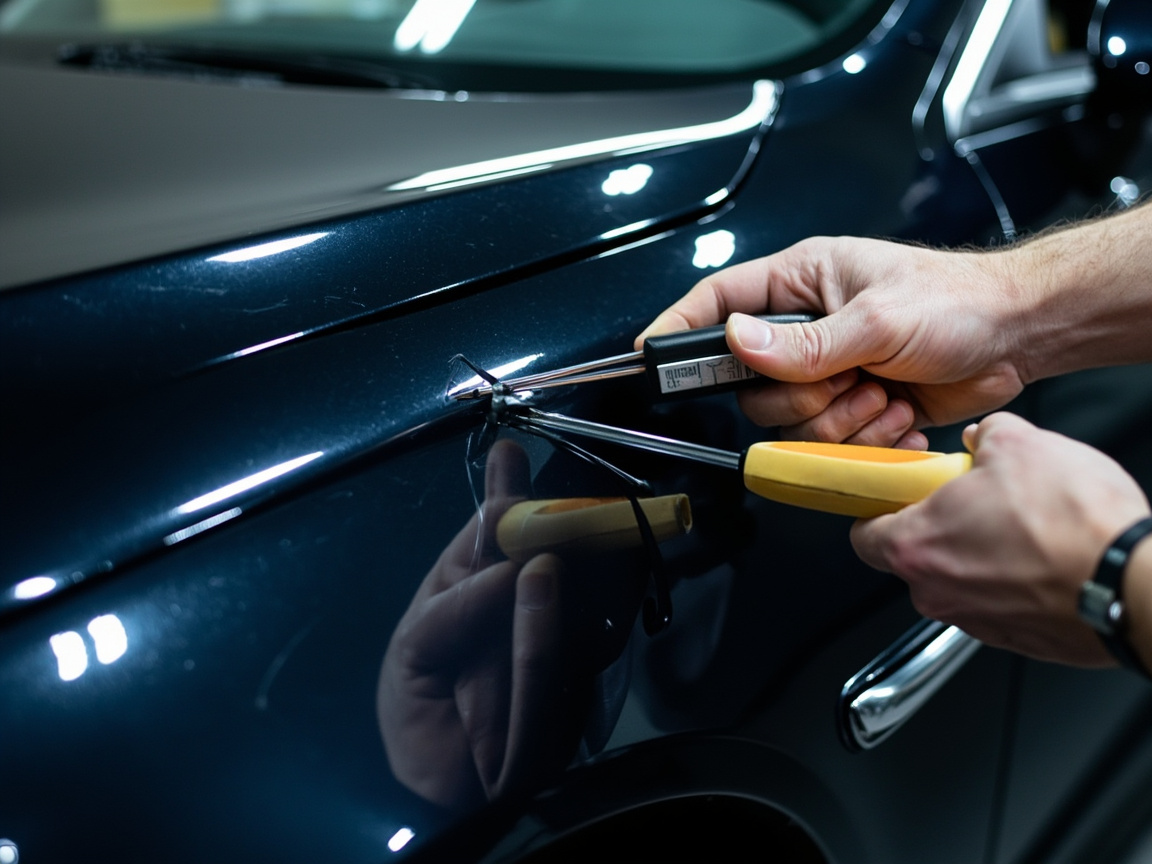
Rather than rework afterwards, prevent beforehand. It is recommended to establish:
- Parameter red lines: ratio, viscosity (DIN 4 @20℃), DFT window, temperature and humidity range posted on wall;
- First-piece confirmation: for each batch/each vehicle, first trial-spray panel to measure DFT and appearance before mass production;
- Filter media cycle: ceiling cotton, paint mist pad replaced on schedule by pressure differential;
- Compressed air purification: regularly drain oil and water, measure dew point;
- Record traceability: record environment, ratio, gun parameters for each panel, facilitating defect backtracking;
- Defect ledger: register each defect using ISO 4628 rating, monthly statistics of "defect Pareto", directing improvement resources to high-frequency items.
Making defect management a "data closed loop" is common practice for OEM and high-end refinish. Solidifying root causes into Standard Operating Procedures (SOP) is more reliable than relying on master workers' experience, and also facilitates quick onboarding for newcomers. When defect rate drops, rework cost, paint waste, and schedule delay decrease simultaneously, and the ROI of spray booth and process discipline investment becomes very直观.
XIII. Relationship Between Defects and Coating Selection
Many sites blame all defects on application, while ignoring the impact of coating selection itself. Examples: intermediate coat with insufficient flexibility is more prone to stone-chip cracking in large temperature difference regions; resin with poor weather resistance chalks and loses gloss in half a year; varnish with poor leveling has extremely narrow tolerance to spraying parameters, and newcomers easily get orange peel. During selection, "defect tolerance" should be used as an indicator: i.e., the width of the window within which the system still does not produce defects when parameters fluctuate. Wide-window systems may not have the highest ultimate performance, but have better on-site stability and lower overall quality cost. Kexin New Materials (kexinMaterials) often asks customers about "site conditions and personnel level" before recommending a system, then matches a wide-window formulation, rather than only pushing high-performance narrow-window products. For refinish shops with multiple vehicle models and batches, uniformly using one wide-window system is easier to manage and less error-prone than mixing multiple high-performance systems.
XIV. Deep Mechanisms of Service-Period Defects
The mechanisms of service-period defects are more hidden than those during application. Chalking is the resin main chain breaking under UV and oxygen, forming loose powder on the surface, essentially photo-oxidative degradation, delayed by UV absorber and hindered amine stabilizer but not completely prevented, so weather resistance data must be written into acceptance. Filiform corrosion is common at edges of aluminum and effect-color paint; electrolyte (snow-melt salt, sea mist) penetrates along scratches or pores, forming a galvanic cell on the aluminum surface, corrosion crawls along filiform paths, looking like hair strands; prevention relies on complete pretreatment, sealing and system anti-corrosion, rather than simply thickening varnish. Cracking is when internal stress exceeds interlayer adhesion and substrate constraint; excessive film thickness, insufficient flexibility, and thermal cycling fatigue all induce it. Understanding these mechanisms allows tracing "problems in use" back to "not written into standards at design stage", rather than blaming the coating afterwards.
XV. Return on Investment of Defect Management
The value of defect management ultimately manifests in cost. A sag requiring sanding and repainting has direct costs including sandpaper, varnish, curing agent, thinner, labor and baking energy, and indirect costs including stall occupation, delivery delay and customer complaints. After establishing parameter red lines and first-piece confirmation, most application-period defects can be intercepted before occurrence, and the benefit from reduced unit rework rate often far exceeds the investment in inspection and management. It is recommended that refinish shops and painting workshops monthly count "defect Pareto": which defect type has the highest proportion, corresponding to which process, how parameters deviated, and precisely direct improvement resources to high-frequency items. When defect rate drops from double digits to single digits, customer satisfaction and capacity increase simultaneously. Defect management is not exclusive to the quality department, but a closed loop with joint participation of process, equipment, and procurement — the coating supplier provides a troubleshooting map, and the site turns it into an executable SOP.
XVI. Defect Case Library and Knowledge Accumulation
After a single rework is resolved, only half the value is released; accumulating experience into a case library avoids repeated pitfalls. It is recommended to establish a five-element card of "phenomenon photo — root cause — parameter deviation — countermeasure — verification" for each typical defect, classified by defect type, forming a searchable knowledge base. New employees learn the case library first, faster than memorizing manuals; quality meetings speak with cases, more effective than arguing "whose fault". The case library also feeds back to selection: if a certain crater recurs and root cause is incoming part degreasing unclean, then promote pretreatment upgrade rather than change varnish; if orange peel concentrates on newcomers, then strengthen spraying training rather than suspect coating. The difficulty of knowledge accumulation lies in "continuous recording" — many factories miss records when busy and forget afterwards, it is recommended to embed recording into the process (scan code to fill), reducing burden. When cases accumulate to a certain scale, statistics can also reveal "season — defect" patterns (e.g., crater rises in plum rain season, orange peel rises in midsummer), and prepare in advance. The highest form of defect management is to let the organization, not the individual, possess memory.
XVII. Supply Chain Collaboration Viewed from Defect Management
Defects often cross factory boundaries: incoming part pretreatment is at the supplier's, the coating is at the supplier's, while equipment and personnel are in our own plant. To minimize the defect rate, supply chain collaboration is required. Share defect data and parameter records with the coating supplier, so the supplier can inversely optimize the formulation window; agree on surface cleanliness and roughness standards with the incoming part/pretreatment plant to reduce cratering and adhesion problems at the source; agree on spray booth maintenance indicators with the equipment vendor to ensure environmental stability. The key to collaboration is "using the same set of data language"—all assess defects per ISO 4628, all test adhesion per GB/T 9286, so disputes have a common baseline. Kexin New Materials (kexinMaterials) provides the "defect troubleshooting map + process card + acceptance template" trio when supporting customers, with the aim of enabling both supply and demand sides to collaborate within the same data framework, rather than talking past each other. Supply chain collaboration upgrades defect management from "in-plant firefighting" to "cross-plant prevention," and is the only path to scalable and stable quality. When incoming parts, coatings, equipment, and process all converse by the same set of standards, a drop in defect rate is a natural result, not reliant on any single party's desperate effort.
18. Quantitative Model of Defects and Cost
To persuade management on defect management, it is best to speak in money. It is recommended to build a "unit defect cost" model: per-piece rework direct cost = materials (sandpaper, varnish, curing agent, thinner) + labor (disassembly, sanding, spraying, baking man-hours) + energy (baking, lighting) + stall occupancy; indirect cost = delivery delay penalty, customer churn, warranty claims. Multiply monthly rework piece count by per-piece cost to get total monthly defect loss, then compare with environmental operation/maintenance and inspection investment—the gap is clear at a glance. One plant, after statistics, found its monthly defect loss equal to two engineers' annual salary, and thus made up its mind to implement environmental upgrade and standard operations, breaking even in half a year. The power of quantification is turning "quality matters" from a slogan into a report, letting resources automatically flow to high-return improvement items.
Further, defect cost can be broken down by type to identify the "most expensive defect." Sagging and orange peel are common but fast to rework and low cost; cratering and lifting/softening if discovered late and already assembled, disassembly cost is extremely high. After identification, tilt prevention resources toward high-cost defects for better overall return. The model can also be used for option comparison: adopt UV or upgrade spray booth, buy high-solid or water-based—all can use "investment vs defect cost drop" to estimate payback period. When quality decisions are built on a cost model, the refinish shop moves from "spending by feel" to "investing by return," which is also the watershed between a mature enterprise and a workshop. Once defect data is monetized, improvement becomes self-driven.
19. One Sentence for the Floor
Defects are not scary; what is scary is the same defect recurring without resolution. Turn every rework into a data deposit, and the workshop will get steadier. Quality is not inspected out, but designed and disciplined out. It is suggested to print the "stage—parameter" mapping table from this article on the wall, check before spraying, and trace back when problems occur—more effective than any verbal emphasis. When all staff use the same language to describe defects (ISO 4628 grades and quantity), communication cost and misjudgment both drop significantly. The most expensive thing on site is not the coating, but the rework that repeatedly pays tuition; the cheapest is not cheap paint either, but disciplined standard operation. Make defect management a habit, and quality stability will in turn become the store's hardest competitiveness, and it will be the same whether the supervisor is present or not.
20. Supplement: Easily Overlooked Small Matters
Finally, a few easily overlooked details: the compressed air triplet must be drained regularly, tape peel speed must be consistent, gloss meter calibration plate must be dust-proof, salt spray sample cuts must be edge-sealed. These small things look insignificant alone, but together determine data truth. Details are quality—do the small things right, and big defects naturally lessen. Experts in floor management are often not those who solved how many major accidents, but those who plugged countless small leaks in advance.
FAQ
Q: Why do sagging and orange peel appear at the same time?
A: Both relate to film thickness/viscosity but in opposite directions: film too thick + thin → sagging; high viscosity + poor atomization → orange peel. In the same site if the ratio is thin and gun is close, local sagging and far dry-spray orange peel may both occur. Calibrate separately by DFT and viscosity window.
Q: Why does cratering "one contamination source ruin the whole panel"?
A: Cratering stems from extremely low surface tension contaminants (silicone oil/oil); it spreads in the wet film, lowering local surface tension, causing the paint film to retract into pits, and spreads with wet film flow, so contamination-type defects are highly destructive—the contamination source must be cut off.
Q: Why does 2K varnish easily bubble?
A: 2K contains isocyanate; when ambient humidity is high, —NCO reacts with water to form CO₂, trapped by the surface-dry film as subcutaneous bubbles/pinholes. Thus 2K application must control humidity (≤70%, lower for sensitive systems) and remove substrate moisture.
Q: Can orange peel be removed by polishing?
A: Slight short-wave orange peel can be eased by polishing, but long-wave orange peel (large ripples) cannot be polished away and needs repaint. The root is adjusting spray parameters and solvent gradient, not compensating by polish.
Q: Are pinholes and blind bubbles the same thing?
A: Blind bubble is a subcutaneous unbroken bubble that breaks into a pinhole during baking or later; pinhole is an already open hole. Causes are similar (moisture, entrained air, fast surface dry); both handled by controlling water, defoaming, reducing surface dry.
Q: How to rate defects by standard?
A: Use ISO 4628 series to rate blistering/cracking/flaking by "size grade + quantity" two-dimensional; gloss by GB/T 9754; adhesion by GB/T 9286 cross-cut. Avoid only relying on "looks okay."
Q: Why does lifting/softening occur if lower coat is not fully dry before spraying upper coat?
A: Upper coat strong solvent dissolves/swells the uncured lower coat, causing lower coat wrinkle, bubble, delamination. Lower coat must be fully cured before upper, and compatibility test done.
Q: Is heavy dust point definitely a paint problem?
A: Mostly not, but spray booth unclean, filter failure, sanding area cross-draft, or compressed air with dust. Prioritize raising cleanliness (see spray booth design article), not changing paint.
Further Reading
- Automotive Spray Booth Cleanliness and Booth Design: Cratering, dust point, orange peel mostly relate to booth environment—fix the booth before the paint.
- Automotive Refinish 2K Clearcoat Formulation and Application Key Points: Ratio, film thickness, temperature/humidity loss of control are main causes of refinish-end defects.
- Automotive Paint Test Standards (Adhesion/Weathering/Stone Chip): Defect rating (ISO 4628) is the source of appearance items on the acceptance sheet.
- Automotive Paint Isocyanate Health Hazards and Protection
- Automotive Coating UV Curing Technology and Takt Time Improvement: From 2K Baking to Second-Level Curing
- Automotive Refinish Paint System: 2K Solid Color, Basecoat+Clearcoat and Single Component