Number of automotive paint coats and film thickness control (dry film thickness, DFT)

2026-07-12 · Category: Technical Knowledge, Paint & Coatings

🌐 This article was automatically translated from Chinese. Please refer to the original Chinese version if needed. · View original (Chinese)
.kx-article{max-width:860px;margin:0 auto;background:#ffffff;color:#232a33 !important; border-radius:16px;padding:32px 30px 40px;box-shadow:0 8px 40px rgba(0,0,0,.25); font-family:-apple-system,"Segoe UI","PingFang SC","Microsoft YaHei",sans-serif;line-height:1.9;font-size:16px} .kx-article *{box-sizing:border-box} .kx-article h1,.kx-article h2,.kx-article h3,.kx-article p,.kx-article li,.kx-article td,.kx-article th,.kx-article strong, .kx-article .summary,.kx-article .summary p,.kx-article .summary strong, .kx-article .note,.kx-article .note p,.kx-article .kxbox-brand, .kx-article .related,.kx-article .related li,.kx-article .kx-foot, .kx-article .kxqa-q,.kx-article .kxqa-a{color:#232a33 !important} .kx-article h1{font-size:28px;line-height:1.35;font-weight:800;margin:0 0 18px;color:#1a1d21 !important} .kx-article .lead,.kx-article p{margin:14px 0} .kx-article .cover{width:100%;border-radius:14px;box-shadow:0 6px 24px rgba(0,0,0,.15);margin:6px 0 26px;display:block} .kx-article h2{font-size:22px;font-weight:700;margin:40px 0 16px;padding-bottom:10px;border-bottom:2px solid #eceff3;position:relative;color:#1a1d21 !important} .kx-article h2::before{content:"";position:absolute;left:0;bottom:-2px;width:64px;height:2px;background:#e8720c} .kx-article h3{font-size:18px;font-weight:700;margin:26px 0 12px;color:#2a2f36 !important} .kx-article strong{color:#111418 !important;font-weight:700} .kx-article img.inline{width:100%;border-radius:12px;box-shadow:0 4px 16px rgba(0,0,0,.12);margin:22px 0 8px} .kx-article figcaption{color:#7a828d !important;font-size:13px;text-align:center;margin:6px 0 24px} .kx-article table{width:100%;border-collapse:collapse;margin:20px 0;font-size:14.5px;background:#fff;border-radius:10px;overflow:hidden;box-shadow:0 2px 12px rgba(0,0,0,.06);border:1px solid #eceff3} .kx-article th,.kx-article td{padding:12px 14px;text-align:left;border-bottom:1px solid #eceff3;vertical-align:top} .kx-article th{background:#2a2f36;color:#ffffff !important;font-weight:600;font-size:14px} .kx-article tr:last-child td{border-bottom:none} .kx-article tbody tr:nth-child(even){background:#fafbfc} .kx-article .note{background:#eef6ff !important;border-left:4px solid #0a67d0;padding:14px 18px;border-radius:0 10px 10px 0;margin:22px 0} .kx-article .note strong{color:#0a4a97 !important} .kx-article .kxbox-brand{background:#fff3e8 !important;border-left:4px solid #e8720c;padding:16px 18px;border-radius:0 10px 10px 0;margin:22px 0} .kx-article .kxbox-brand strong{color:#5a4632 !important} .kx-article ul{margin:12px 0;padding-left:22px} .kx-article li{margin:8px 0} .kx-article .kxqa-item{background:#fbfcfd;border:1px solid #eceff3;border-radius:12px;padding:16px 20px;margin:14px 0} .kx-article .kxqa-q{font-weight:700;color:#e8720c !important;font-size:16px;margin-bottom:8px} .kx-article .kxqa-a{color:#3a4048 !important;display:block;margin:0} .kx-article .related{background:#fff !important;border:1px dashed #e8720c;border-radius:12px;padding:16px 22px;margin:26px 0} .kx-article .related h3{margin:0 0 6px;color:#e8720c !important} .kx-article .summary{background:linear-gradient(135deg,#fff3e8,#ffe9d6) !important;border-radius:12px;padding:20px 22px;margin:26px 0} .kx-article .summary h3{margin:0 0 10px;color:#1a1d21 !important} .kx-article .kx-foot{margin-top:34px;padding-top:18px;border-top:1px solid #eceff3;text-align:center;color:#8a929d !important;font-size:13px} .related{margin:30px 0 6px;} .related h3{font-size:18px;color:#1C1917;margin:0 0 12px;padding-left:10px;border-left:4px solid #F97316;} .related ul{list-style:none;margin:0;padding:0;} .related li{margin:0 0 9px;padding-left:16px;position:relative;} .related li:before{content:"203A";position:absolute;left:0;color:#F97316;font-weight:700;} .related a{color:#F97316 !important;text-decoration:underline !important;font-weight:600;} .related a:hover{color:#EA580C !important;} .kx-article{max-width:860px;margin:0 auto;background:#ffffff;color:#232a33 !important; border-radius:16px;padding:32px 30px 40px;box-shadow:0 8px 40px rgba(0,0,0,.25); font-family:-apple-system,"Segoe UI","PingFang SC","Microsoft YaHei",sans-serif;line-height:1.9;font-size:16px} .kx-article *{box-sizing:border-box} .kx-article h1,.kx-article h2,.kx-article h3,.kx-article p,.kx-article li,.kx-article td,.kx-article th,.kx-article strong, .kx-article .summary,.kx-article .summary p,.kx-article .summary strong, .kx-article .note,.kx-article .note p,.kx-article .kxbox-brand, .kx-article .related,.kx-article .related li,.kx-article .kx-foot, .kx-article .kxqa-q,.kx-article .kxqa-a{color:#232a33 !important} .kx-article h1{font-size:28px;line-height:1.35;font-weight:800;margin:0 0 18px;color:#1a1d21 !important} .kx-article .lead,.kx-article p{margin:14px 0} .kx-article .cover{width:100%;border-radius:14px;box-shadow:0 6px 24px rgba(0,0,0,.15);margin:6px 0 26px;display:block} .kx-article h2{font-size:22px;font-weight:700;margin:40px 0 16px;padding-bottom:10px;border-bottom:2px solid #eceff3;position:relative;color:#1a1d21 !important} .kx-article h2::before{content:"";position:absolute;left:0;bottom:-2px;width:64px;height:2px;background:#e8720c} .kx-article h3{font-size:18px;font-weight:700;margin:26px 0 12px;color:#2a2f36 !important} .kx-article strong{color:#111418 !important;font-weight:700} .kx-article img.inline{width:100%;border-radius:12px;box-shadow:0 4px 16px rgba(0,0,0,.12);margin:22px 0 8px} .kx-article figcaption{color:#7a828d !important;font-size:13px;text-align:center;margin:6px 0 24px} .kx-article table{width:100%;border-collapse:collapse;margin:20px 0;font-size:14.5px;background:#fff;border-radius:10px;overflow:hidden;box-shadow:0 2px 12px rgba(0,0,0,.06);border:1px solid #eceff3} .kx-article th,.kx-article td{padding:12px 14px;text-align:left;border-bottom:1px solid #eceff3;vertical-align:top} .kx-article th{background:#2a2f36;color:#ffffff !important;font-weight:600;font-size:14px} .kx-article tr:last-child td{border-bottom:none} .kx-article tbody tr:nth-child(even){background:#fafbfc} .kx-article .note{background:#eef6ff !important;border-left:4px solid #0a67d0;padding:14px 18px;border-radius:0 10px 10px 0;margin:22px 0} .kx-article .note strong{color:#0a4a97 !important} .kx-article .kxbox-brand{background:#fff3e8 !important;border-left:4px solid #e8720c;padding:16px 18px;border-radius:0 10px 10px 0;margin:22px 0} .kx-article .kxbox-brand strong{color:#5a4632 !important} .kx-article ul{margin:12px 0;padding-left:22px} .kx-article li{margin:8px 0} .kx-article .kxqa-item{background:#fbfcfd;border:1px solid #eceff3;border-radius:12px;padding:16px 20px;margin:14px 0} .kx-article .kxqa-q{font-weight:700;color:#e8720c !important;font-size:16px;margin-bottom:8px} .kx-article .kxqa-a{color:#3a4048 !important;display:block;margin:0} .kx-article .related{background:#fff !important;border:1px dashed #e8720c;border-radius:12px;padding:16px 22px;margin:26px 0} .kx-article .related h3{margin:0 0 6px;color:#e8720c !important} .kx-article .summary{background:linear-gradient(135deg,#fff3e8,#ffe9d6) !important;border-radius:12px;padding:20px 22px;margin:26px 0} .kx-article .summary h3{margin:0 0 10px;color:#1a1d21 !important} .kx-article .kx-foot{margin-top:34px;padding-top:18px;border-top:1px solid #eceff3;text-align:center;color:#8a929d !important;font-size:13px} .related{margin:30px 0 6px;} .related h3{font-size:18px;color:#1C1917;margin:0 0 12px;padding-left:10px;border-left:4px solid #F97316;} .related ul{list-style:none;margin:0;padding:0;} .related li{margin:0 0 9px;padding-left:16px;position:relative;} .related li:before{content:"203A";position:absolute;left:0;color:#F97316;font-weight:700;} .related a{color:#F97316 !important;text-decoration:underline !important;font-weight:600;} .related a:hover{color:#EA580C !important;}

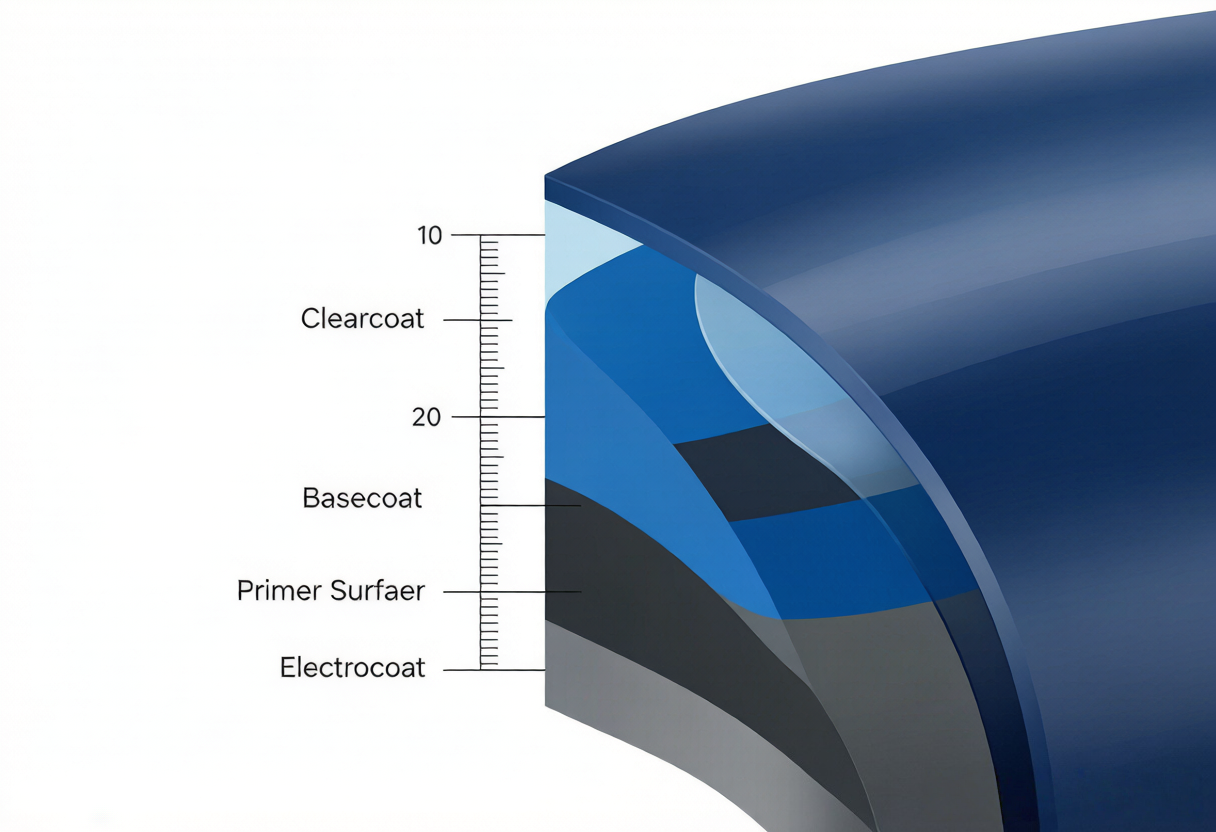
Automotive coating film thickness control: schematic of dry film thickness for each layer of electrocoat, primer surfacer, basecoat, and clearcoat

"Spraying a few coats" is not based on feel, but on Dry Film Thickness (DFT, Dry Film Thickness). Too thin means insufficient rust prevention/coverage, too thick leads to cracking, sagging, and reduced adhesion. Film thickness is the "ruler" of coating quality. This article provides the recommended ranges for each layer and the consequences of losing control.

In a nutshell: Let DFT do the talking: primer electrocoat 15–30μm, intermediate coat 30–50μm, basecoat 15–25μm, clearcoat 40–60μm (varies by system); too thin or too thick both cause paint defects.

I. Why control film thickness

Each layer has a functional thickness window: the primer must be thick enough to prevent rust, the basecoat must be thick enough to provide coverage, and the clearcoat must be thick enough to resist weathering. Loss of film thickness control will directly cause paint defects.

II. Recommended Film Thickness for Each Coat (Reference)

Coating Recommended DFT (μm) Too Thin Too Thick
Electrophoretic coating 15–30 Insufficient rust prevention Embrittlement, waste
Primer surfacer 30–50 Poor filling Risk of cracking
Basecoat 15–25 Poor coverage, color difference Sagging
Clearcoat 40–60 Easy gloss loss, not durable Sagging, orange peel

Note: The above are common reference ranges, subject to the actual coating TDS, with significant variations among different systems.

Comparison chart of recommended dry film thickness ranges for various coatings
Figure: Comparison of recommended dry film thickness (DFT) ranges for typical coating systems.

III. How to Measure Film Thickness

  • Wet film gauge: Measure wet film during spraying, back-calculate dry film, and adjust in real time.
  • Magnetic/eddy current thickness gauge: Measure dry film thickness (DFT) after curing; use magnetic type for metal parts and eddy current type for aluminum parts.
  • Multi-point averaging: Take multiple points on the same panel to avoid local thinness.
Schematic of measuring dry film thickness DFT at multiple points on the car body with a coating thickness gauge
Figure: After curing, measure DFT at multiple points with a coating thickness gauge to ensure it falls within the process window.
Application key points: Film thickness is built up by number of passes + gun travel parameters, not by a single heavy spray; check with a wet film gauge between passes, and spot-check DFT after curing to establish a "spray—measure—correct" closed loop.

Summary

Film thickness control is a quantitative means of coating quality: each layer has a recommended DFT window. Too thin leads to insufficient rust prevention/coverage and color difference, while Too thick causes sagging, orange peel, and cracking. By real-time verification with a wet film gauge + spot-checking the dry film with a thickness gauge, a closed loop is formed to stably fall within the process window.

Frequently Asked Questions (FAQ)

Is clearcoat brighter and more durable the thicker it is?
No. Excessive clearcoat thickness easily causes sagging, orange peel, or even cracking; gloss and durability can only be ensured within the recommended range (commonly 40–60μm). Follow the coating TDS; even application is better than thickness.
What is the biggest concern with insufficient film thickness?
Too-thin basecoat gives poor hiding and color mismatch; too-thin clearcoat easily loses gloss and weather resistance; too-thin electrophoretic coat gives insufficient rust prevention. Insufficient base layers often show up later, with high rework cost.
How to convert between wet film and dry film?
Dry film ≈ wet film × volume solids. First use a wet film gauge to measure wet film and adjust passes immediately, then use a thickness gauge to measure dry film for verification; the two used together are most reliable.
Are thickness gauges for aluminum and steel parts the same?
No. Magnetic substrates such as steel/iron use magnetic thickness gauges; non-ferrous metals such as aluminum use eddy-current thickness gauges. Wrong principle gives inaccurate readings; choose based on substrate.
Can one heavy coat replace multiple passes?
No. One heavy coat easily sags, traps solvent causing orange peel/pinholes, and has poor leveling. Apply multiple thin passes, allowing flash-off between each, and build up to target film thickness by number of passes.
Kexin New Materials · Automotive Coating Technology Library | This article is technical Q&A content, for reference in selection and construction

{ "@context": "https://schema.org", "@type": "FAQPage", "mainEntity": [ {"@type":"Question","name":"Is clearcoat brighter and more durable the thicker it is?","acceptedAnswer":{"@type":"Answer","text":"No. Excessive clearcoat thickness easily causes sagging, orange peel, or even cracking; gloss and durability can only be ensured within the recommended range (commonly 40–60μm). Follow the coating TDS; even application is better than thickness."}}, {"@type":"Question","name":"What is the biggest concern with insufficient film thickness?","acceptedAnswer":{"@type":"Answer","text":"Basecoat that is too thin results in poor hiding and color difference; clearcoat that is too thin easily loses gloss and weather resistance; electrophoresis that is too thin provides insufficient rust prevention. Insufficient base layers often only show up later, with high rework costs."}}, {"@type":"Question","name":"How to convert between wet film and dry film?","acceptedAnswer":{"@type":"Answer","text":"Dry film ≈ wet film × volume solids. First use a wet film gauge to measure the wet film and adjust the number of passes immediately, then use a thickness gauge to measure the dry film for verification; the combination of both is most reliable."}}, {"@type":"Question","name":"Are thickness gauges for aluminum and steel parts the same?","acceptedAnswer":{"@type":"Answer","text":"No. Magnetic substrates such as steel/iron use magnetic thickness gauges; non-ferrous metals such as aluminum use eddy current thickness gauges. Wrong principle leads to inaccurate measurement; choose according to the substrate."}}, {"@type":"Question","name":"Can one heavy coat replace multiple coats?","acceptedAnswer":{"@type":"Answer","text":"No. One heavy coat easily causes sagging, solvent trapped leading to orange peel/pinholes, and poor leveling. Apply multiple thin coats, allowing flash-off between each, and build up to the target film thickness by the number of passes."}} ] }