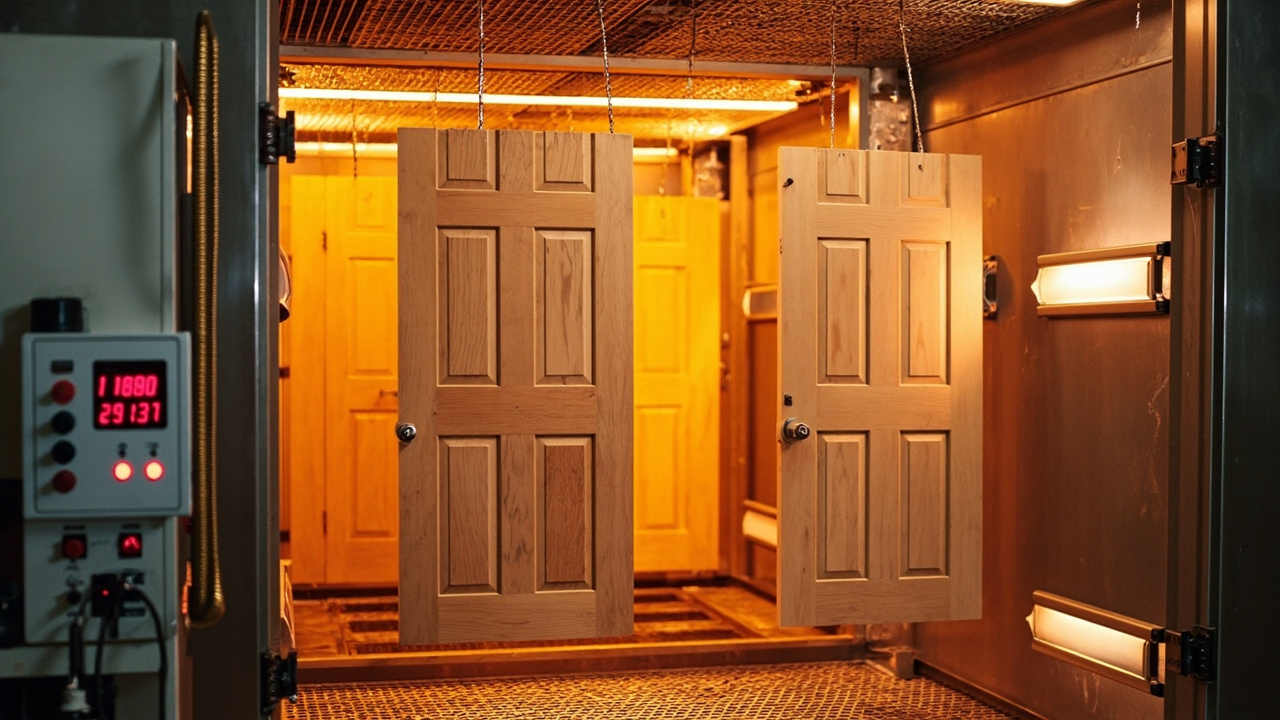
"Water-based coating dries slowly and turns white when wet" is almost the first complaint of every factory and experienced worker just starting with water-based products. This statement is correct, but only tells half the story—water-based coating does form a film by water evaporation and is sensitive to temperature and humidity, but its "slowness" and "fear of moisture" are calculable and intervenable physical processes, not mysticism. Starting from the film-forming mechanism, this article translates "why it's slow and why it fears moisture" into operable temperature and humidity windows, then provides a complete set of practical countermeasures including temperature increase, dehumidification, forced convection, driers/film-forming aids, infrared and hot-air assistance, and winter-summer differences, turning drying from a bottleneck into a controllable process.
As a coating supplier serving furniture and woodworking enterprises long-term, Kexin New Materials (kexinMaterials) has accumulated extensive on-site data on the drying support of water-based wood coating systems. The temperature and humidity windows and drying acceleration schemes in this article also come from these frontline experiences. At the selection stage, you can first refer to our wood coating product system to lock in the corresponding drying-friendly formulation based on "workpiece, takt time, local climate".
I. How exactly does water-based coating "dry"
To solve the problem, understand the mechanism first. The film formation of water-based coating (taking water-based acrylic/polyurethane dispersion as an example) roughly consists of three steps:
- Water evaporation, particle approach: After application, water diffuses from the film surface to the air, emulsion particles gradually come closer, viscosity rises, reaching "surface dry".
- Particle deformation and fusion: When water is sufficiently low and the system is above the minimum film-forming temperature (MFFT), the particle shells soften and squeeze into each other to form a continuous film. This step requires film-forming aid (coalescent, such as glycol ether) to temporarily soften the particles; otherwise, particles will not fuse at low temperature, and the coating film will be powdery and discontinuous.
- (Some systems) Self-crosslinking curing: Systems containing hydroxyl/carboxyl groups or introduced crosslinking monomers undergo self-crosslinking during drying, further improving density and resistance.
Key conclusion: Drying = water leaving + particle fusion, both directly controlled by temperature and humidity. If water cannot leave (high humidity), everything after stops; if temperature is insufficient (below MFFT), particles will not fuse, appearing surface-dry but actually "false-dry".
II. Why "slow" and why "fear moisture"
2.1 Root cause of slowness: evaporation depends on concentration difference
The rate at which water enters the air from the wet film depends on the difference between the water vapor partial pressure at the film surface and that in the air. The drier the air (lower absolute moisture), the greater the difference, and the faster water escapes; vice versa. So "drying speed" is not a fixed value, but a product of environmental state.
2.2 Root cause of fearing moisture: relative humidity blocks evaporation
When the air relative humidity (RH) approaches 100%, the water vapor partial pressure in the air approaches saturation, and the water in the wet film has almost nowhere to go, evaporation tends to zero—this is the physical essence of "water-based coating doesn't dry all day on cloudy and rainy days". Worse still, if the workpiece or coating film surface temperature is below the air dew point, water in the air will condense onto the coating film, causing moisture return, whitening, and loss of transparency.
In one sentence: High humidity prevents water evaporation, low temperature prevents particle fusion; the combination of both is the "deadly combo" for water-based coating.
III. Effect of temperature: low temperature is slow, and surface dry/through dry separate
As temperature drops, the saturated vapor pressure of water decreases and evaporation slows; at the same time, system viscosity increases and particles become harder, making it harder to reach MFFT for fusion. Thus typical phenomena appear:
- Surface dry okay, through dry poor: Surface water escapes first to form a skin, while inside is cold and damp, not through-dry for a long time, causing pressure marks, sticking, and moisture return after stacking.
- Film-forming aid residue: At low temperature, more film-forming aid is added to promote fusion, but low temperature also prevents it from evaporating, causing the coating film to be soft, easily sticky, and poor in resistance.
Therefore, winter construction cannot rely only on "waiting", but must actively raise temperature and control humidity to bring the film-forming environment back into the window.
IV. Environmental temperature and humidity window: set standards first, then discuss countermeasures
Combining most water-based wood coating systems, the recommended application and drying windows are roughly as follows (subject to product instructions):
| Stage | Temperature | Relative Humidity | Description |
|---|---|---|---|
| Spray application | 15–30℃ | 40%–70% | Too low prone to orange peel, too high hard to dry |
| Surface dry (leveling) | 20–30℃ | 50%–70% | Balance leveling and dust prevention |
| Forced drying | 30–50℃ (workpiece) | Humidity control + exhaust | IR/hot air, with exhaust |
| Stackable/packable | Depends on system | — | Judge by through dry not surface dry |
| Forbidden zone | 80%RH | — | Prone to false dry, moisture return, whitening |
Note: The drying section must not only "heat" but also "remove the evaporated water", otherwise local humidity accumulates and all previous efforts are wasted.
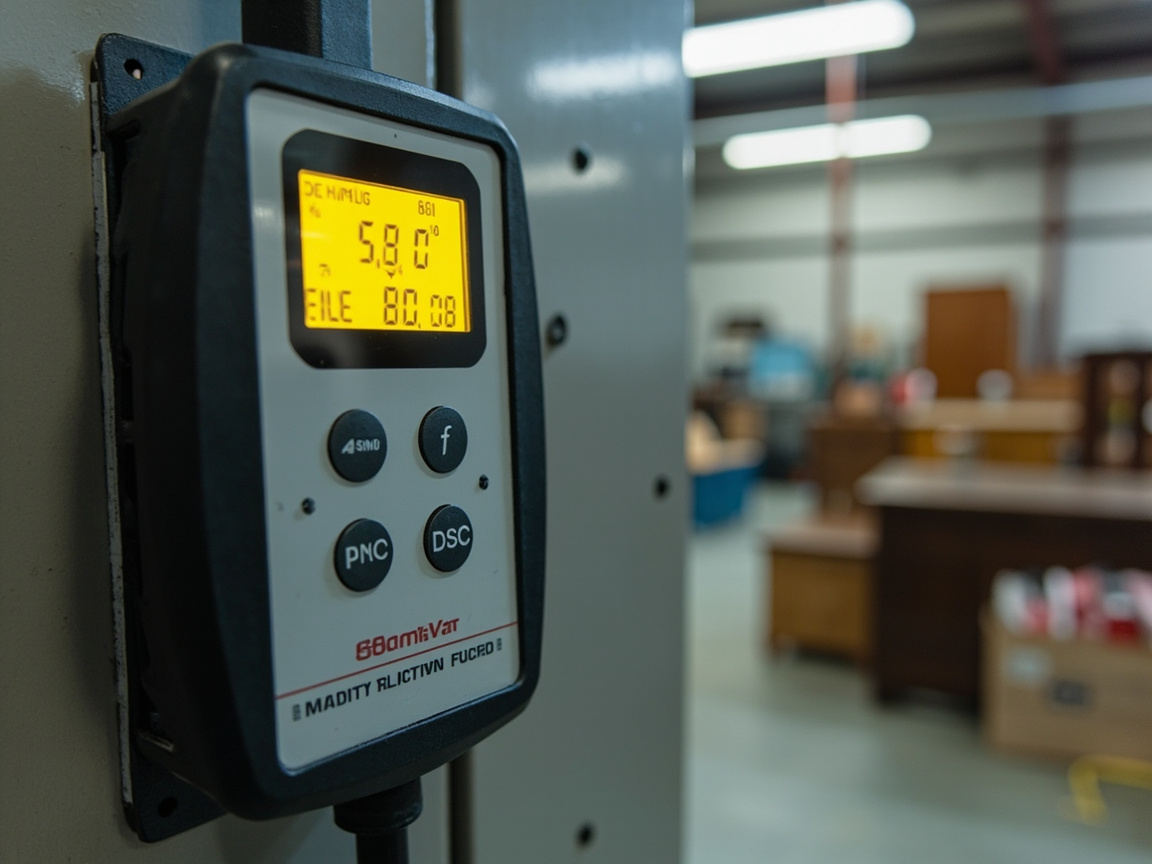
V. Countermeasure 1: Raise temperature (let particles fuse, let water activate)
Raising temperature is the most direct acceleration method, but heat the "workpiece" rather than only the air:
- Workshop heating: Keep environment stable above 20℃, avoid overall low temperature in winter.
- Workpiece preheating: Preheat thick plates and cold workpieces before spraying, reduce "cold film" effect, shorten surface dry.
- Drying section heating: In forced drying section, keep workpiece surface stable at 30–50℃ (subject to system upper limit) to significantly speed up.
- Avoid local overheating: Infrared directly on thin plates easily causes surface skinning while inside not dry; must cooperate with hot air to take away internal water.
VI. Countermeasure 2: Dehumidification (cut off "water has nowhere to go")
While raising temperature, dehumidification is mandatory, otherwise the evaporated water stays in the air and restarts the cycle:
- Refrigerated dehumidification: Cool air below dew point to condense water then heat and send in; suitable for most workshops, cost-effective.
- Rotary wheel dehumidification: More stable under low humidity requirements (e.g., RH<40%), suitable for high-demand fast lines, but high energy consumption.
- Exhaust linkage: Drying oven equipped with exhaust fan to expel high-humidity waste air and supplement low-humidity fresh air, forming an "evaporation—exhaust" closed loop.
- Plum rain/high-humidity return strategy: In southern wet season, dehumidification capacity must be designed for the worst month and backup units prepared, otherwise the whole line stops for a fraction of the year.
VII. Countermeasure 3: Forced convection (blow the water away)
In static air, a saturated humid air boundary layer accumulates on the film surface, and evaporation is "smothered" by itself. Forced convection breaks this layer:
- Wind speed and volume: Use controllable-speed convection in drying section, both to take away water and not too strong to cause orange peel and dust.
- Wind direction design: Grooves and vertical surfaces of workpieces must be covered, avoid local dead corners with water not drying.
- Low wind in leveling section: Before surface dry, leveling section should have low wind speed to ensure leveling; increase convection after entering drying section.
- Cleanliness: Convection stirs up dust, so spray booth and drying section cleanliness must be managed synchronously, otherwise dry film has many particles.
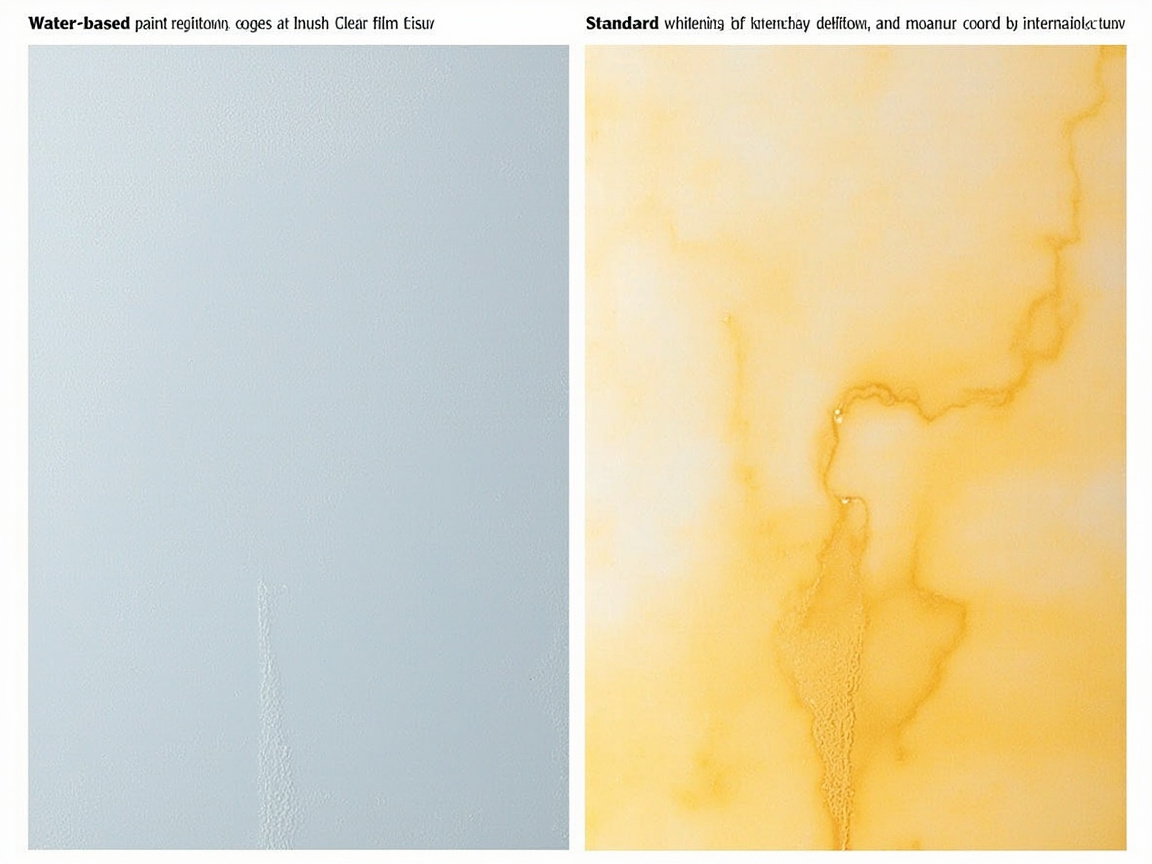
VIII. Countermeasure 4: Driers and film-forming aids (formulation-side speed lever)
Beyond environmental control, the formulation side can also "accelerate":
- Film-forming aid (coalescent): Such as glycol ether, glycol ester, lowers MFFT so particles can fuse at lower temperature. Dosage must balance between "promote fusion" and "residue softness", and be fully evaporated in later drying.
- Drier/crosslinking promotion idea: For water-based systems with oxidative crosslinking groups (such as waterborne alkyd, some self-crosslinking polyurethane dispersions), appropriate metal soap driers (cobalt, manganese, zirconium, etc.) can be introduced to promote oxidative crosslinking; for self-crosslinking systems, latent acid/crosslinking promoters can lower curing temperature and shorten through dry.
- Multifunctional amine and pH adjustment: Some systems rely on pH to trigger crosslinking, reasonable adjustment can accelerate.
- Caution warning: Excessive drier causes shortened pot life, brittle film, yellowing or unstable storage; excessive film-forming aid remains in film causing softness and poor resistance. Formulation-side acceleration must be quantified by supplier after stability verification, on-site random addition is prohibited.
IX. Countermeasure 5: IR + Hot Air Assistance (the Right Solution for Factory Mass Production)
Relying solely on natural or simple heating will inevitably stall mass production. The mature combination in factories is infrared (IR) radiation + hot air convection:
- IR rapid setting: Radiation directly heats the workpiece, surface-dries and sets within minutes, preventing sagging and dust settling.
- Hot air slow dehydration: Continuously removes water from inside and on the surface of the film by convection, solving the "surface dry but interior damp" problem.
- Gradient control: First short-time IR setting, then longer hot air dehydration, finally cooling and setting—fast yet fully cured.
- Takt matching: Determine drying oven length and conveyor speed based on "stackable cure time" rather than surface-dry time; see the takt back-calculation method for details.
For flat, batch, and regular parts, if you want to completely bypass the "water evaporation" bottleneck, you can evaluate the instant radiation curing of UV-curable wood coating; for topcoats with high hardness requirements, you can also refer to the配套思路 of polyurethane wood coating (PU wood coating).
X. Differences Between Winter and Summer Construction: One Set of Parameters Cannot Cover the Whole Year
| Dimension | Summer (high temperature and high humidity) | Winter (low temperature and low humidity) |
|---|---|---|
| Main contradiction | High humidity, prone to moisture return and blushing | Low temperature, particles not coalescing, slow drying |
| Key countermeasures | Strong dehumidification + moisture exhaust + film thickness control | Heating preheat + coalescing agent + IR/hot air |
| Surface-dry risk | Surface dries fast but interior not dry, prone to orange peel | Slow surface dry, dust settling, prone to sagging |
| Coalescing agent | Can be slightly reduced | Requires sufficient amount and ensure later complete evaporation |
| Anti-condensation | Workpiece condenses water easily when meeting humid air at low temperature | Less likely to condense water when heating is insufficient |
| Ventilation | Strengthen moisture exhaust | Balance heat preservation and air exchange |
Core: Prevent "moisture" in summer, prevent "cold" in winter; the countermeasures are almost opposite, so a "seasonal process card" switch is necessary, rather than one set of parameters for the whole year.
XI. Multi-coat Application and Recoat Interval
Water-based wood coating often requires 2–3 coats; inter-layer drying determines the overall takt and inter-layer adhesion:
- Light sanding after inter-layer surface dry: No need to wait for full cure, but surface must be fully dry with no sand sticking; premature sanding will damage the wet film.
- Confirm cure before recoat: Especially in thick-coat and low-temperature high-humidity environments, applying the next coat before cure will seal internal water, causing hidden bubbles, inter-layer blushing, and poor adhesion.
- Primer—topcoat compatibility: The inter-layer compatibility and drying window of different systems must be verified to avoid "slow primer fast topcoat" causing under-cure.
- Curing period: Confirm stackable time before packaging and heavy pressure; water-based paint often requires several days for full crosslinking, avoid heavy pressure and water contact during this period.
XII. Common Drying Defects and Countermeasures
| Defect | Appearance | Main cause | Countermeasure |
|---|---|---|---|
| Slow drying | Long time not dry, sticky to touch | Low temperature high humidity / poor ventilation | Raise temperature, dehumidify, convect |
| Moisture return blushing | Film turns white and loses clarity | High humidity condensation / not fully dry | Control humidity, extend drying |
| False dry | Surface dry but interior not dry | Poor coalescence at low temperature | Raise temperature, add coalescing agent |
| Hidden bubbles / pinholes | Bubbles inside film | Internal water sealed, boiling | Control thickness, gradient drying |
| Pressure mark blocking | Stacking adhesion | Stacking before cure | Schedule production by cure |
| Orange peel | Surface orange peel | Too fast surface dry / high convection | Adjust leveling, reduce wind speed |
| Condensation water mark | Surface water stain | Workpiece below dew point | Preheat, control humidity |
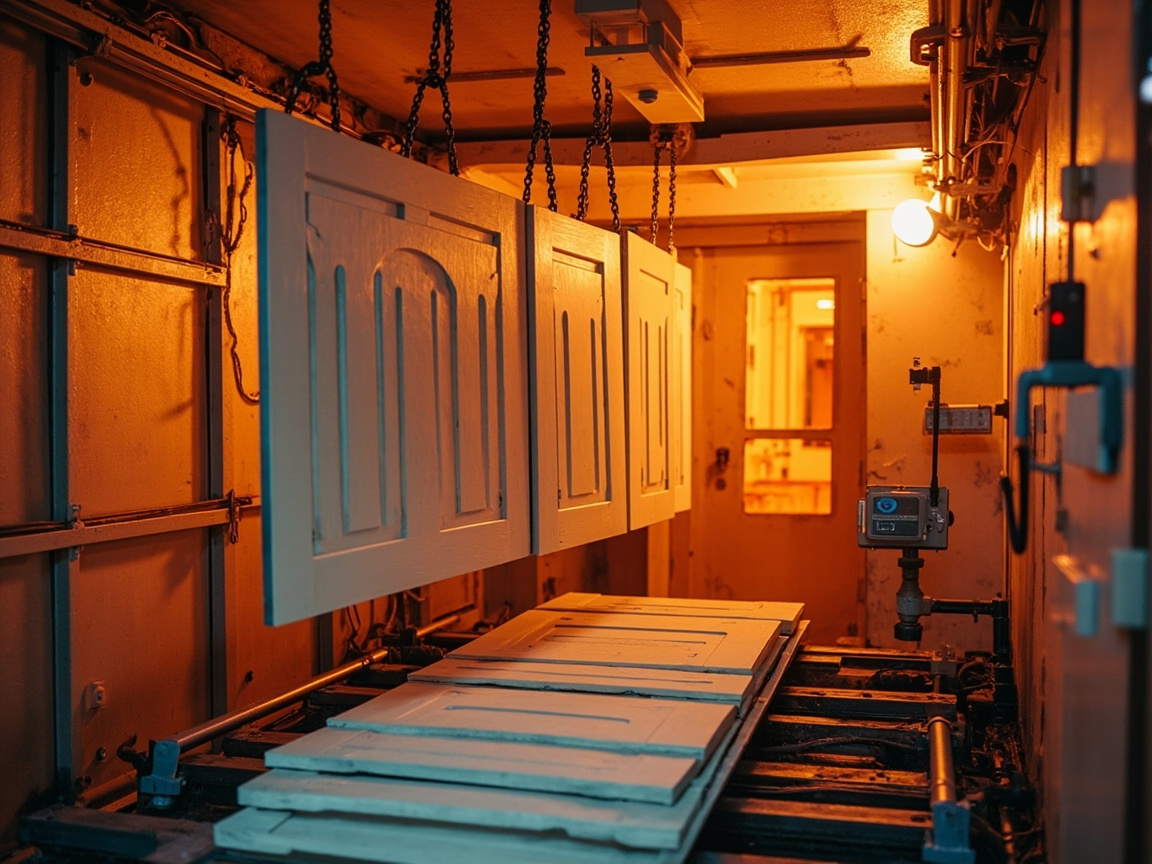
XIII. Key Points for Factory Drying Section Design
Implement the aforementioned countermeasures into equipment:
- Preheat zone: Preheat workpiece to process temperature before entering spray booth, reducing cold film.
- Leveling zone: Low wind speed, controlled temperature and humidity, ensuring leveling and dust prevention.
- Strong drying zone: IR+hot air gradient, with moisture exhaust to draw out water vapor.
- Cooling setting zone: Cool to stackable temperature before transfer, preventing pressure marks.
- Environment closed loop: Spray booth and drying zone at constant temperature and humidity, independently clean, preventing cross-contamination from solvent-based solvents.
- Interlock alarm: Automatic alarm and linked speed reduction on abnormal temperature, humidity, wind speed, or workpiece temperature, avoiding batch defects.
The design principle is always the trinity of "heating + dehumidification + moisture exhaust"; doing only one leaves a short board.
XIV. Cooperation with Kexin New Materials
Kexin New Materials (kexinMaterials) adds value in the drying stage by writing "environmental requirements" into the formula upfront: launching drying-friendly systems with high coalescing agent efficiency for high humidity in the south, reducing dehumidification load; providing water-based formulas with low MFFT and low-temperature coalescence for northern winters, lowering the heating threshold; and through "seasonal process card + drying section parameter suggestions + companion production tuning" enabling factories to stabilize drying takt and cure quality under different climates. For factories, choosing a supplier that delivers drying as "formula + process" together often solves problems at the source better than adding dehumidifiers afterwards.
XV. Common Drying Misconceptions
Misconception 1: Surface dry means fully dry. Wrong. Water-based paint often surface-dries fast but cures slow; must schedule production by cure time before stacking, otherwise pressure mark blocking.
Misconception 2: Only heat without dehumidification. Heating evaporates water, but without exhausting humid air, local humidity accumulates and drying stalls. Heating + moisture exhaust must be synchronized.
Misconception 3: Adding more coalescing agent in winter solves everything. Excessive residue causes soft film and poor resistance, and it is itself hard to evaporate at low temperature; must combine with heating and ventilation.
Misconception 4: Natural air drying is sufficient. Natural air drying on a mass production line equals capacity collapse; must use IR+hot air+dehumidification combination.
Misconception 5: One set of parameters for the whole year. Prevent moisture in summer, prevent cold in winter; countermeasures are opposite, so a seasonal process card switch is necessary.
Misconception 6: Adding drier on site to speed up. Excessive drier causes brittleness, yellowing, and shortened pot life; must be quantitatively verified by the supplier.
XVI. Energy and Cost Trade-off: How to Calculate the Account of Dehumidification and Heating
Speeding up drying costs money (electricity, gas, equipment), but the overall account is often worthwhile:
- Dehumidification vs rework: Without dehumidification in wet season, moisture return blushing and rework rate surge; loss of scrap parts and labor often far exceeds dehumidifier electricity. Treat dehumidification as "insurance" rather than "waste".
- Heating vs cycle: Without raising temperature in winter, drying cycle doubles or more, and hidden cost of delivery breach exceeds heating fee.
- IR+hot air vs site occupation: Forced drying shortens work-in-process stay, releasing workshop area and working capital, a disguised benefit.
- Coalescing agent vs performance: Sufficient coalescing agent enables low-temperature drying, but requires heating and ventilation to evaporate; otherwise residue softens, so balance between "can dry" and "dries well".
It is recommended that factories make a monthly comparison of drying section electricity, dehumidification fee, and rework fee due to drying defects; most will find: actively controlling drying within the window is cheaper than "gambling on weather".
XVII. Drying Solutions for Factories of Different Scales
Not every factory needs full automation; choose by scale:
- Large mass production plant: Constant temperature humidity spray booth + IR+hot air drying oven + rotary dehumidification + paint circulation, fully parameterized, pursuing takt and consistency.
- Medium custom plant: Mixed-air spraying + refrigeration dehumidification + modular IR/hot air drying room, scheduling by workpiece family, balancing flexibility and stability.
- Small workshop: At least equip independent constant-temperature small oven and dehumidifier, avoid high-humidity low-temperature construction, use "off-peak production + forced small oven" to minimize drying risk.
Regardless of scale, the bottom line is the trinity of "heating + dehumidification + moisture exhaust", only the automation degree differs. Ignoring any item will incur rework cost under specific weather.
XVIII. Relationship Between Drying and VOC Emissions
Many people think "water-based = zero VOC, no treatment needed", but that is not the case. The drying stage is directly related to VOC emissions:
- Film-forming aids will volatilize: Alcohol ether film-forming aids enter the exhaust gas during drying and fall under the VOC category. They must be included in exhaust collection and treatment accounting, and cannot be exempted just because it is "water-based".
- The drying section is the emission peak: Forced drying rapidly carries out both water and aids. The exhaust contains both water vapor and organic substances. The exhaust system must consider both dehumidification and VOC treatment (e.g., concentration + combustion or adsorption).
- Low-VOC formulation direction: Choose water-based systems with low film-forming aid demand and low MFFT, which can reduce organic emissions at the drying stage from the source and lower the end-of-pipe treatment load.
- Compliance is not the endpoint: Water-based conversion reduces total VOC, but must still meet limits such as GB 30981 and complete exhaust collection. Drying process design should simultaneously reserve treatment interfaces.
Design the drying section as an "emission generation site" rather than merely a "speed-up device" to balance efficiency and compliance.
19. Monitoring Drying with Data: Sensors and Dashboards
Like other stages of the water-based line, drying should also be data-driven:
- Multi-point temperature and humidity sensing: Place sensors in the spray booth, flash-off zone, forced drying zone, and cooling zone to display in real time and alarm on exceedance, avoiding "adjusting by feel".
- Workpiece temperature tracking: Measure workpiece surface temperature at key positions on the conveyor chain to confirm whether the fusion window is reached, rather than only looking at ambient temperature.
- Air speed/volume recording: Include convection section air speed in routine inspection to prevent unnoticed drying slowdown due to fan decay.
- Drying dashboard: Make a daily dashboard of "measured stackable time, environment out-of-bounds duration, defect rate caused by drying", and analyze jointly with takt time and yield.
Dataization turns drying from "relying on the weather" to "parameter controllable", and is the foundation for stable scale-up.
20. Drying Retrofit Examples for Two Types of Factories
- Wood door factory (large flat pieces): Mainly long-line continuous, IR setting + long hot-air dehydration oven, with refrigeration dehumidification and exhaust. Focus on preventing skinning of thin panels and under-curing of thick edges; drying oven length set by "stackable dry-to-handle time".
- Cabinet factory (regular batches): After electrostatic spraying, connect to a fast curing oven with high takt; drying section should be short and intense, combined with rotor dehumidification to minimize wet-season impact and ensure stable daily capacity.
Both examples show: the drying solution must grow on the workpiece family and takt time; copying others' ovens often results in "right size, wrong logic".
21. Quick Drying Troubleshooting Checklist
When encountering "cannot dry / poor drying" on site, locate within 5 minutes in this order:
- Check environment: Is temperature/humidity out of bounds (75%RH)? Restore the window first.
- Touch workpiece: Is the workpiece cold below dew point? Preheat before spraying.
- Check film thickness: Is it sprayed too thick causing under-cure? Reduce and apply in multiple passes.
- Verify aids: Is film-forming aid sufficient, or diluted randomly on site? Replenish per formula.
- Inspect equipment: Are IR / hot air / dehumidification / exhaust really running? Is air speed/volume decayed?
- Check substrate: Is pre-treatment and sealing adequate, causing uneven water absorption and local slow drying?
Most drying problems fall into these six items. Sequential troubleshooting is much safer and faster for loss control than randomly adding driers.
22. One-Sentence Advice for New Water-Based Line Factories
Don't treat drying as a trivial "buy an oven" matter; it is a systematic project of "temperature raise + dehumidification + exhaust + parameters". First run the temperature/humidity window, film-forming aid dosage, and drying takt on a small line and keep standard samples, then reverse-calculate equipment size from takt, and only then scale up. Rather ramp up slowly than force mass production on an unvalidated line—rework from drying defects is often far more expensive than retrofit depreciation, and will also ruin delivery and customer trust.
23. "Minimum Viable Set" of Drying Parameters
For novice factories, you don't need to manage all parameters at once. Lock the minimum viable set first to avoid 80% of incidents: temperature ≥15℃, humidity ≤75%, film thickness within limit, film-forming aid per formula, drying section exhaust on. Make these five a mandatory pre-start checklist, then gradually add sensors and dashboards. This is easier to implement and sustain than a complex system at once. After this minimum set is stable, then talk about refinement and automation—steadier pace, lower trial cost.
24. In Conclusion
Drying is the most underestimated and also the most decisive stage in water-based paint implementation. Treat it as a systematic project rather than a single-point device, manage with data rather than experience, and the factory can turn "slow" and "afraid of humidity" into truly controllable process parameters. When the temperature/humidity window, film-forming aids, and drying takt are written into the process card, the benefits of water-based conversion will firmly land in yield and cost, rather than staying at the good-looking effect of the sample stage.
FAQ
1. Why does water-based paint dry slower than paint?
Because film formation relies on water evaporation rather than rapid volatilization of strong solvents; water evaporation rate is strictly controlled by temperature and humidity, and particle fusion also requires reaching the minimum film-forming temperature. When the environment is humid and cold, drying slows sharply, while oil-based paint relies on low-boiling solvents that "leave at once".
2. Water-based paint won't dry all day in rainy weather, what to do?
High humidity makes air water vapor partial pressure near saturation, leaving nowhere for water to go. The solution is dehumidification (refrigeration/rotor dehumidification) + exhaust (expel humid waste air) + temperature raise, pulling the environment back to the window of 20–30℃ and 50%–70% humidity, and use IR + hot air forced drying.
3. Why does water-based paint in winter "surface dry but not through-dry"?
At low temperature particles cannot reach MFFT; the shell dries but inside does not fuse, becoming "false dry". Need to raise temperature for particle fusion and add sufficient film-forming aid (to be volatilized later); do not judge by surface only.
4. Can driers / film-forming aids be added on site by yourself?
Not recommended. Excess film-forming aid remains soft and poor in resistance; excess drier (e.g., metal soap) becomes brittle, yellows, and shortens pot life. It should be quantified by the supplier after stability validation; random on-site addition is extremely risky.
5. Will infrared drying damage the paint?
Yes. If IR is too strong and workpiece too thin, surface skins while inside is undried, making it slower and prone to cracking. Correct approach is short IR setting + continuous hot-air dehydration, forming a gradient, not blindly baking hard.
6. Does higher forced convection air speed mean faster drying?
No. Excessive air speed causes orange peel, kicks up dust, and ruins leveling. Use low air in flash-off, moderate convection in drying, and cover grooves and vertical dead corners.
7. How do summer and winter drying strategies differ?
Summer's main conflict is high humidity—focus on strong dehumidification and exhaust, control film thickness to prevent moisture return. Winter is low temperature—focus on heating preheat, sufficient film-forming aid, IR/hot air to promote fusion. The two strategies are nearly opposite; switch process cards by season.
8. How long between coats for multi-pass application before recoat?
Use "surface dry enough, lightly sandable without sticking" as the inter-coat node, but before recoat must confirm the lower coat is through-dry, especially for thick coats and low-temp high-humidity; covering before through-dry easily causes blister, whitening, inter-coat peeling.
9. Why does the workpiece "condense" with water marks?
When workpiece or film surface temperature is below air dew point, air water condenses on surface, causing water marks, moisture return whitening. Solution: preheat workpiece before spraying, control humidity, avoid cold piece meeting humid air.
10. For flat pieces wanting to fully solve slow drying, any other path?
Yes. Regular flat pieces can evaluate UV-curable wood coating—instant cure by irradiation, almost unaffected by temperature/humidity, very high efficiency and low VOC, an alternative way to bypass the "water evaporation bottleneck".
Further Reading
- Wood Coating Industry Panorama: System, Landscape and Trends: Place water-based drying and process within the wood coating big picture to understand technology-market interaction.
- UV-Curable Wood Coating—Efficiency, Eco-Friendliness and Process Boundaries: A curing solution that completely bypasses the water evaporation bottleneck, suitable for flat batch piece drying speed-up.
- Water-Based Industrial Coating VOC Compliance and GB30981 Practice: Understand the environmental benefit of water-based conversion from a compliance view, echoing this article's energy trade-off of drying and dehumidification.
- Automotive Coating Drying and Curing: Room Temperature, Baking, Infrared and Pot Life
- Nano Coating Film Formation and Curing: Room Temp / IR / Baking and Thickness (nm–µm)