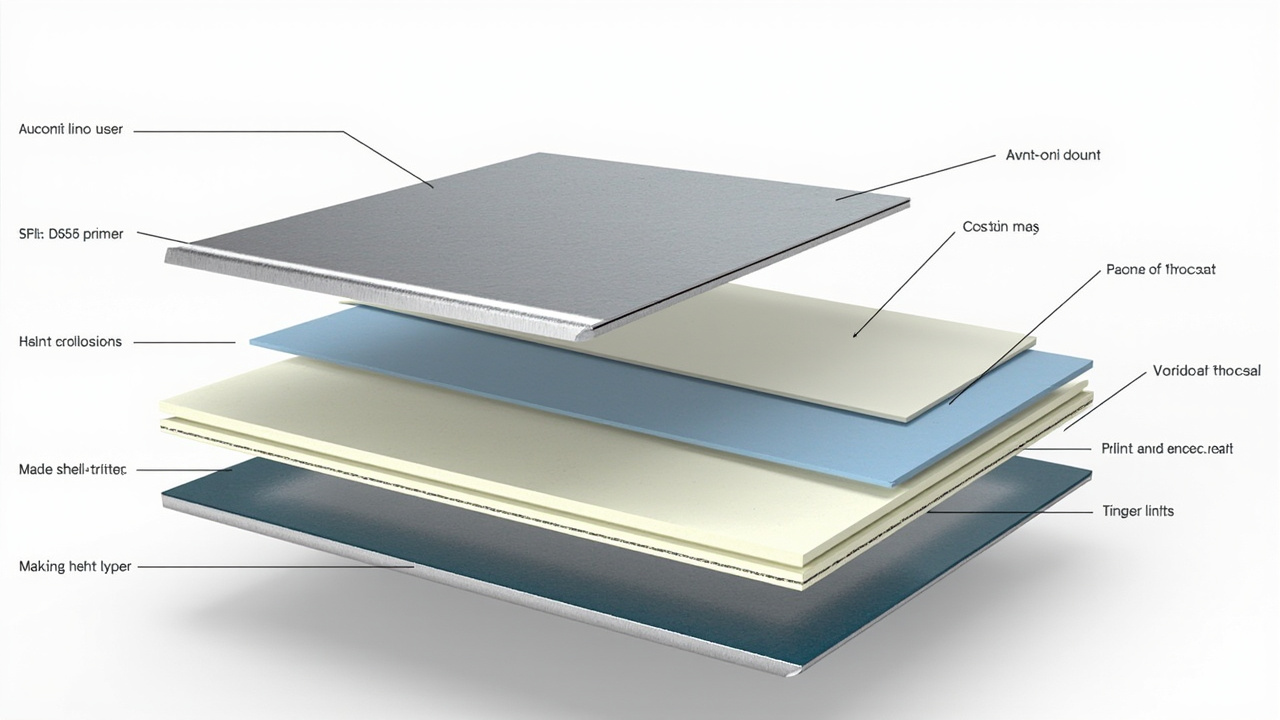
In anti-corrosion projects for steel structures, construction machinery, and industrial facilities, a single coat of paint often cannot simultaneously handle the three functions of "adhesion, barrier, and weather resistance." Truly reliable anti-corrosion performance comes from a systematic rust-preventive paint system design—that is, a three-layer synergistic coating system of primer, intermediate coat, and topcoat. Starting from the corrosion mechanism, this article combines the ISO 12944 corrosion grade system to provide practical film thickness planning and system logic, with all specific values cited from public technical archives and standards. Kexin New Materials (kexinMaterials), in its long-term service to industrial protective projects, has also consistently emphasized the anti-corrosion philosophy of "system compatibility prioritized over single product selection."
I. Why rust prevention cannot rely on a single coat
Metal corrosion is an electrochemical process: water, oxygen, and ions (such as chloride ions) penetrate through coating defects or pores, forming a galvanic cell on the metal surface, where iron loses electrons and dissolves as iron ions. A single coat has three inherent contradictions:
First, the contradiction between adhesion and barrier. The primer needs to be close to the metal, provide good adhesion, and participate in anti-corrosion (such as the cathodic protection of zinc-rich primer), but its weather resistance is usually poor and direct exposure will cause chalking and failure. The topcoat has excellent weather resistance but can hardly directly bite onto smooth metal.
Second, the contradiction between film thickness and defect rate. If a single coat reaches above 200µm, the surface dry and hard dry times are greatly prolonged, and it is highly prone to sagging and pinholes. Applying multiple thin coats in layers can control defects while accumulating total film thickness.
Third, the contradiction between cost and service life. In heavy anti-corrosion environments, simply piling up thickness with ordinary alkyd paint is inferior to the scientific system of "epoxy zinc-rich primer + epoxy micaceous iron oxide intermediate coat + polyurethane topcoat"; the latter can increase service life several times at the same film thickness.
Therefore, the core of rust-preventive paint system design is to break down the three functions of "anti-corrosion, thickening, and weather resistance" into three coating layers, each performing its own role. According to the system principles summarized in the "epoxy polyurethane topcoat" section of the research archive: primer (anti-corrosion/adhesion) + intermediate coat (thickening/barrier) + topcoat (weather resistance/decoration).
II. Role breakdown of the three-layer system
1. Primer: the first line of defense against corrosion
The primer is close to the substrate and bears adhesion and initial anti-corrosion. According to anti-corrosion mechanism, it can be divided into three types:
- Cathodic protection type: represented by epoxy zinc-rich primer, with dry film zinc content ≥80% (mass), zinc powder acts as a sacrificial anode to preferentially corrode and protect the steel substrate. According to the research archive, TEKNOZINC 3480 SE has dry film zinc content ≥80%, complying with EN ISO 12944-5; Jotun Barrier 80 UHS zinc powder complies with ASTM D520 Type II and meets the composition requirements of ISO 12944-5.
- Barrier type: represented by epoxy iron oxide red and alkyd iron oxide red primer, relying on dense paint film and anti-rust pigments to physically block corrosive media. According to the "alkyd anti-rust paint" section of the research archive, it is a single-component alkyd resin + iron oxide red/gray anti-rust pigment system, resistant to 3% NaCl brine for 24h without cracking or blistering.
- Passivation type: contains inhibitive pigments such as zinc phosphate, which passivate the metal surface to form a protective film.
2. Intermediate coat: the main force for thickening and barrier
The intermediate coat is the core of "thickening + barrier" in the system. Epoxy micaceous iron oxide intermediate coat utilizes the flake structure of micaceous iron oxide (MIO) to form a layered, tile-like barrier in the paint film. According to the mechanism description in the research archive: the micaceous iron oxide flakes in epoxy micaceous iron oxide intermediate coat extend the diffusion path of corrosive media, significantly improving barrier service life. The intermediate coat usually has the most application passes and contributes the largest film thickness.
3. Topcoat: the protective layer for weather resistance and decoration
The topcoat directly faces ultraviolet rays, rain, and industrial atmosphere. Polyurethane topcoat and acrylic topcoat have excellent weather resistance, providing gloss and color retention. It should be noted that some topcoat systems contain strong solvents (such as the isocyanate companion solvent in two-component polyurethane curing agents), which will cause lifting and swelling with incompatible primers. According to the "alkyd anti-rust paint" section of the research archive, its limitation is clearly stated: not compatible with two-component strong-solvent paints—that is, directly applying two-component polyurethane/epoxy strong-solvent topcoat over alkyd primer is prone to interlayer dissolution damage.
III. Typical system film thickness and planning
The "epoxy polyurethane topcoat" section of the research archive provides an industry-typical primer + intermediate + topcoat system film thickness, which is also the most commonly used conservative configuration for industrial protection:
| Coating | Recommended product type | Single-pass film thickness | Pass count | Cumulative film thickness | Main function |
|---|---|---|---|---|---|
| Primer | Epoxy zinc-rich primer | 70–80 µm | 1 pass | 70–80 µm | Cathodic protection / adhesion |
| Intermediate coat | Epoxy micaceous iron oxide intermediate coat | 100–150 µm | 1–2 passes | 100–150 µm | Thickening / barrier |
| Topcoat | Epoxy polyurethane topcoat | 100–120 µm | 2 passes | 100–120 µm | Weather resistance / decoration |
| Total | — | — | — | 270–350 µm | System anti-corrosion |
According to the data in that section, the environmental construction requirements for this system are: temperature 5–35℃, relative humidity ≤80%, substrate temperature at least 3℃ above dew point; application preferably by airless spray or air spray, brush and roller only for small-area repair. Packaging is main agent 20kg + curing agent 4kg, stored at 5–35℃, shelf life 12 months.
It is worth noting that the film thickness of zinc-rich primer is not the thicker the better. An excessively thick zinc powder layer (over 150µm) is instead prone to cracking and detachment, and wastes zinc powder. The recommended DFT range for Jotun Barrier 80 UHS is 60–150µm; the research archive notes that under ISO 12944-6 test C5 it achieves "Very High (VH)" durability, which can serve as a reference for the upper film thickness limit of heavy anti-corrosion primers.

IV. ISO 12944 corrosion grades and film thickness increment
ISO 12944-2018 is the international benchmark for anti-corrosion system design of steel structures, classifying corrosion environments as:
- C2 (Low): mostly rural atmosphere, low pollution.
- C3 (Medium): urban and general industrial atmosphere, or low-salinity coastal areas.
- C4 (High): highly polluted industrial zones, near-shore salt spray areas.
- C5 (Very High): high-salinity coastal, heavy industrial zones.
- CX (Extreme): extreme environments such as offshore platforms.
- Im1–Im3: immersion environments (freshwater immersion, seawater immersion, buried).
The higher the corrosion grade, the greater the corrosion rate per unit area, and the total dry film thickness (DFT) of the system must increase. This is because corrosive media penetration is a matter of probability and path: a thicker, denser coating system reduces the probability of perforation.
The research archive clearly states in the general standards section: steel structure anti-corrosion system is based on ISO 12944-2018 (C2–CX corrosion grades, system design), carbon steel blast cleaning Sa 2½, shop primer, primer + intermediate + topcoat system. The following provides a film thickness planning recommendation table for different corrosion grades:
| Corrosion grade | Typical environment | Surface treatment | System example | Total DFT planning | Durability target |
|---|---|---|---|---|---|
| C2 | Dry rural | Sa 2 / St 3 | Alkyd primer + alkyd topcoat | 120–160 µm | Low corrosion life |
| C3 | Urban/general industrial | Sa 2½ | Epoxy primer + polyurethane topcoat (or Würth-type alkyd primer as transport primer) | 160–200 µm | Medium |
| C4 | Industrial zone/near-shore | Sa 2½ | Epoxy zinc-rich primer + epoxy micaceous iron oxide intermediate + polyurethane topcoat | 200–280 µm | High |
| C5 | Heavy industrial zone/high-salinity coastal | Sa 2½ + roughness control | Epoxy zinc-rich primer(70–80) + epoxy micaceous iron oxide intermediate(100–150) + polyurethane topcoat(100–120) | 270–350 µm | Very High (VH) |
| CX/Im | Offshore/immersion | Sa 2½ or stricter | High-solids epoxy zinc-rich + high-build epoxy intermediate + special topcoat | Above 350 µm | Extreme |
It can be clearly seen that: from C2 to C5, the total film thickness increases from approximately 120µm to approximately 350µm, an increase of nearly three times. This increase is not simply "applying a few more coats", but a systematic upgrade that simultaneously enhances the anti-corrosion grade of the primer, the barrier thickness of the intermediate coat, and the weather-resistant layers of the topcoat.
It must be emphasized that the increase in film thickness must be matched with the surface preparation grade. ISO 12944 recommends that carbon steel blasting reach Sa 2½ (ISO 8501-1), corresponding to a roughness of approximately 30–75µm (according to the surface preparation requirements in the alkyd anti-rust paint section). If the surface preparation is not up to standard, no matter how thick the paint film is, it will fail early due to adhesion failure.
V. Key Material Selection Boundaries
1. Adaptation Boundary of Alkyd Primer
Alkyd anti-rust paint has low cost and is user-friendly to apply, but the research archive clearly points out its limitations: poor resistance to solvents/acids and alkalis, slow drying, and incompatibility with two-component strong-solvent paints. Therefore, the alkyd system is suitable for light anti-corrosion in C2–C3, or as short-term protection "transport primer" for steel structures, and is not suitable for direct overcoating with strong-solvent two-component topcoats. If a heavy anti-corrosion upgrade must be done on an alkyd base, it should first be confirmed that the topcoat is an alkyd recoatable system, or a compatible interlayer sealer should be applied first.
2. Positioning of Würth Rust Stop Type Alkyd Primer
According to the "Würth Rust Stop Primer" section of the research archive: the chemical base of this primer is alkyd resin, red-brown in color, with a density of 1.28 g/cm³; salt spray approximately 500h (DIN EN ISO 9227), meeting ISO 12944 corrosion grade C3 "high"; drying approximately 16h, coverage approximately 8 m²/can (750ml), minimum application rate 90 ml/m²; application temperature 15–25℃; recoatable with common topcoat systems; used as transport primer for steel structures. This indicates that this type of alkyd primer is an economical and compliant choice when used as a transport and temporary protective primer at C3 and below.
3. Strong Anti-corrosion Positioning of Zinc-rich Primer
When the environment reaches C4–C5, epoxy zinc-rich primer must be used. According to the research archive, Jotun Barrier 80 UHS has a volume solids of 85±2%, VOC of only 134 g/L (GB 30981 / GB/T 34682), and weight solids of 95±2%; its low VOC characteristics have obvious advantages in environmental compliance; TEKNOZINC 3480 SE has a dry film zinc content ≥80%, and can be used as a primer for polyurethane/epoxy systems, with a certain weather resistance even without a topcoat. In engineering配套 consultation, it is usually recommended that environments above C4 directly adopt zinc-rich primer as the base, rather than barely making up thickness with an alkyd system.
VI. Key Points for Construction and Film Thickness Control
No matter how scientific the film thickness planning is, uncontrolled construction will waste all previous efforts. The配套 design must be implemented into executable construction parameters:
- Environmental window: temperature 5–35℃, relative humidity ≤80%, substrate temperature at least 3℃ above dew point (according to the epoxy polyurethane topcoat section). Low temperature and high humidity will cause amine blushing and poor curing; high temperature will shorten the pot life.
- Surface preparation: carbon steel blasted to Sa 2½, roughness 30–75µm; stainless steel needs to be abraded with non-metallic abrasive to produce scratches to ensure adhesion.
- Film thickness measurement: use a wet film gauge for initial control after each coat, and after drying use a magnetic thickness gauge to take points according to ISO 19840 / GB/T 13452 to ensure DFT falls within the planned range.
- Coat count control: intermediate coat 100–150µm usually in 1–2 coats, topcoat 100–120µm in 2 coats, to avoid sagging from excessive single-coat thickness.
- Safety protection: for topcoat systems containing isocyanate curing agents, construction personnel need ventilation +防毒 mask + goggles + chemical-resistant gloves (according to the safety section of epoxy polyurethane topcoat).
For the trade-off between water-based and solvent-based systems, further reference can be made to How to select water-based paint and oil-based paint and Industrial water-based coating selection guide, to make a comprehensive judgment from the dimensions of VOC, workability, and anti-corrosion grade.
VII. Common Misconceptions in配套 Design
- Misconception 1: The thicker the film, the better. Excessive thickness causes internal stress cracking and pinholes, especially for zinc-rich primers.
- Misconception 2: Randomly mixing paints from different manufacturers. Unverified interlayer compatibility easily leads to lifting and peeling, and intercoat recoating tests must be done.
- Misconception 3: Using alkyd primer for heavy anti-corrosion. Alkyd systems have insufficient service life in environments above C4, and should be upgraded to zinc-rich配套.
- Misconception 4: Ignoring surface preparation. Sa 2½ is the prerequisite for the配套 to take effect; insufficient blasting grade equals wasting paint.
In配套 design services, the film thickness of each layer is usually deduced first based on the ISO 12944 environmental grade and structural design life, and then specific products are selected in combination with on-site construction conditions, to avoid early failure caused by "guessing based on experience".
VIII. Quantitative Relationship between Film Thickness Economy and Service Life
Many engineers are concerned: if the film thickness is doubled, will the service life also double? The answer is no; the relationship is closer to exponential rather than linear, but there are referenceable empirical ranges.
The salt spray baseline given in the general standards section of the research archive is: usually 500h without blistering, single-side rust ≤1–2mm; heavy anti-corrosion can reach 1000–3000h. This range itself is the result of the superposition of film thickness and配套 grade—C3 grade配套 (approximately 200µm) achieves the 500h level, and C5 heavy anti-corrosion配套 (approximately 270–350µm) achieves the 1000–3000h level. In other words, increasing total DFT from 200µm to 350µm (about 1.75 times) jumps salt spray resistance from 500h to 1000–3000h (2–6 times), indicating that the marginal service life benefit of high配套 grade is extremely high.
The reason is that the penetration of corrosive media through the paint film is a probabilistic event of "the thinnest point penetrates first". Increasing the thickness of the intermediate coat (e.g., from 100µm to 150µm) significantly lengthens the average path for the media to reach the substrate, and the labyrinth effect of micaceous iron oxide flakes makes the path non-linear, further reducing the perforation probability. Therefore, in heavy corrosion environments, spending money on "thickening the intermediate coat + upgrading the zinc-rich primer" is more cost-effective than blindly stacking thickness in light environments.
But an upper limit must be set: zinc-rich primer exceeding approximately 150µm is prone to cracking (the DFT upper limit of Jotun Barrier 80 UHS is 150µm); a single coat of intermediate paint exceeding 150µm is prone to sagging and pinholes. Therefore, film thickness planning is "reasonable layered accumulation", not "single-layer hard stacking".
IX. Typical Cases and Mechanisms of配套 Failure
Understanding failure is more important than understanding success. Several high-frequency failures in配套 design:
- Interlayer peeling (lifting): most commonly seen in "alkyd primer + two-component strong-solvent topcoat". The alkyd anti-rust paint section of the research archive clearly states its "incompatibility with two-component strong-solvent paints". The strong solvent dissolves the not-fully-cured alkyd layer, causing overall wrinkling and peeling. The correct approach is to use a recoatable system or add a sealer layer.
- Zinc layer cracking: zinc-rich primer applied in a single coat to above 200µm, internal stress concentrates and cracks, and the zinc powder layer separates from the substrate. Control single coat at 70–80µm, maximum not exceeding 150µm to avoid this.
- Adhesion drops to zero (insufficient surface preparation): only wire brushing St2 instead of blasting Sa 2½, roughness less than 30–75µm, the coating "floats" on the scale, and flakes off in chunks after a few months. ISO 12944 emphasizes that Sa 2½ is the prerequisite for the配套 to take effect.
- Topcoat chalking and loss of gloss: alkyd topcoat misused in C5 environment, UV causes chalking within half a year, exposing the barrier layer and accelerating corrosion. Above C4, polyurethane/acrylic weather-resistant topcoat must be used.
- Pinhole perforation: excessive single-coat thickness or air entrained by stirring not defoamed, leaving pinholes after curing, and corrosion erupts from the pinholes.
These cases all point to one conclusion:配套 design is a systematic project, and any short board in any link will be amplified by corrosion.
X. On-site Film Thickness Measurement and Acceptance Sampling
No matter how scientific the film thickness planning is, implementation relies on measurement. The DFT acceptance of industrial protective paint usually follows the sampling principles of ISO 19840 / GB/T 13452:
- Wet film initial control: immediately after each spray, measure with a wet film gauge in the non-surface-dry area, and convert to dry film (dry film = wet film × volume solids). For example, Barrier 80 UHS with 85% volume solids, wet film 100µm corresponds to dry film approximately 85µm.
- Dry film retest: after drying, use a magnetic thickness gauge to take multiple points. Difficult areas (edges, welds, inner corners) naturally have thinner film, and should be pre-coated or additionally sprayed.
- Judgment threshold: generally require "90% of measurement points ≥ specified minimum film thickness, and the remaining points ≥ 90% of the specified value", and no sag areas exceeding twice the thickness are allowed.
- Record traceability: the film thickness distribution of each span/section should be archived as a basis for defining service life responsibility boundaries.
Embedding measurement into the process, rather than spot-checking after completion, is a key step in closing the loop of配套 design.
XI. Environmental Compliance and VOC Control
With the implementation of GB 30981-2020 "Limits of Harmful Substances in Industrial Protective Coatings",配套 design cannot only calculate the anti-corrosion account, but also the environmental account. The research archive provides several comparative data points:
- Jotun Barrier 80 UHS: VOC 134 g/L (GB 30981 / GB/T 34682), weight solids 95±2%, belongs to ultra-low VOC high-solids epoxy zinc-rich.
- Jotun Jotacote Universal N10: VOC 239 g/L (GB 30981 / GB/T 23985).
- TEKNOZINC 3480 SE: VOC approx. 300 g/L, volume solids approx. 66%.
As can be seen, for the same zinc-rich primer, VOC can be reduced from 300 g/L to 134 g/L, depending on solids content and solvent formulation. When making配套 recommendations, Kexin New Materials (kexinMaterials) prioritizes high-solids low-VOC products for environmentally sensitive projects, reducing compliance risks while meeting ISO 12944 anti-corrosion grades. A reminder: low VOC does not mean low performance; Barrier 80 UHS still achieves "very high (VH)" durability at C5, showing that anti-corrosion and eco-friendliness can coexist.
In addition, polyurethane topcoat systems containing isocyanate curing agents are occupational hazard factors; application requires ventilation + respirator + goggles + chemical-resistant gloves, and avoid sanding uncured paint film (per epoxy polyurethane topcoat safety section).
XII. Differences in配套 for Different Substrates
配套 design cannot be separated from the substrate. Carbon steel, stainless steel, and galvanized steel have different surface characteristics, and primer strategies vary accordingly:
- Carbon steel: Most common; after blasting to Sa 2½, directly apply epoxy zinc-rich or epoxy iron oxide red primer. Research archives clearly state "carbon steel blasting Sa 2½, shop primer, primer+intermediate+topcoat配套" as the ISO 12944 baseline path.
- Stainless steel: The dense chromium oxide film on the surface makes ordinary paint difficult to adhere. Research archives in Jotun Jotacote Universal N10 data point out that stainless steel requires non-metallic abrasive blasting to create scratches to ensure mechanical interlocking, and usually non-zinc primers are selected (zinc-rich primers have limited cathodic protection significance for stainless steel, and may instead cause new problems due to potential difference).
- Galvanized steel: Hot-dip galvanized layer is itself corrosion-resistant, but the surface is smooth and may have zinc salts. Research archives mention Jotun Barrier 80 UHS is suitable for "worn galvanized steel" repair, indicating that when the galvanized layer is locally damaged, epoxy zinc-rich can be used for local reinforcement; overall配套 requires removing zinc salts first, light sanding, then applying compatible primer to avoid whole-sheet peeling.
- Aluminum alloy: Light metal, requires non-zinc, non-strong-alkali primer, paying attention to potential matching and adhesion.
Substrate identification is the first step in配套 design; skipping it and directly applying "zinc-rich primer + micaceous iron intermediate + polyurethane topcoat" may fail on special substrates.
XIII. Connection of Repair and Refurbishment配套
After a structure has been in service for several years, local corrosion is inevitable. Principles for refurbishment配套 design:
- Assess old paint condition: If adhesion is still acceptable and only the topcoat is chalking, sand and directly recoat the topcoat; if the primer has failed, remove to Sa 2½ and redo primer+intermediate+topcoat.
- Interlayer compatibility: If the old system is alkyd, newly applied two-component strong-solvent topcoat will lift the old coat (research archives: alkyd incompatible with two-component strong-solvent paint). Should first use alkyd recoatable topcoat, or remove entirely.
- Local zinc repair: Local damage to zinc-rich primer, use Barrier 80 UHS type high-solids epoxy zinc-rich for spot repair, then repair intermediate coat and topcoat to restore continuous barrier.
- Film thickness leveling: Repair area film thickness should be flush with the original system to avoid liquid accumulation at steps accelerating corrosion.
- Record closure: Each refurbishment records location, process, film thickness, forming a life archive.
In old renovation projects, Kexin New Materials (kexinMaterials) often first performs an adhesion and old paint compatibility diagnosis, then decides "local repair" or "overall redo" to avoid blind construction waste.
XIV. Quick Reference of Key Technical Standards and Test Methods
配套 design cannot be separated from standard references and test verification. The general standards section of the research archives summarizes the core standards for industrial protective paint; below they are categorized by function for easy reference by engineers:
| Test item | Standard number | Key judgment |
|---|---|---|
| VOC determination | GB/T 23985-2009, GB/T 23986-2009 (GC-MS), ISO 11890, ISO 17895 | Industrial protective paint subject to GB 30981-2020 limit constraints |
| Neutral salt spray | GB/T 1771-2007, ASTM B117, DIN EN ISO 9227 | Usually 500h no blistering / unilateral rust ≤1–2mm; heavy anti-corrosion 1000–3000h |
| Adhesion (cross-cut) | GB/T 9286-1998, ISO 2409, ASTM D3359 | 0–5 grades, 0/1 grade excellent (falloff ≤5%) |
| Artificial weathering | GB/T 1865 (xenon lamp), GB/T 23987 (UV), ASTM G154, ISO 11507 | 1000h color change ≤2 grade, chalking ≤1 grade |
| Gloss (60°) | GB/T 9754, ISO 2813, ASTM D523 | High gloss ≥85 GU |
| Pencil hardness | GB/T 6739, ISO 15184 | B–H grade |
| Flexibility/impact | GB/T 1731, GB/T 1732, ASTM D2794 | Bending diameter ≤2mm, impact ≥50cm |
| Steel structure anti-corrosion system | ISO 12944-2018 | C2–CX corrosion grades, primer+intermediate+topcoat配套, Sa 2½ |
| Abrasion (Taber) | GB/T 1768, ASTM D4060 | ≤10–50 mg/1000 rev (depending on grade) |
| Drying time | GB/T 1728 | Surface dry ≤4h, hard dry ≤24h (common for industrial paint) |
In addition, core national standards for environmental hazardous substances include: GB 30981-2020 "Limits of Hazardous Substances in Industrial Protective Coatings", GB 24409-2020 "Limits of Hazardous Substances in Vehicle Coatings"; heavy metal reference limits lead ≤90 mg/kg, cadmium ≤75 mg/kg. EU refers to 2004/42/EC and CARB/SCAQMD Rule 1113.
It should be emphasized that standard numbers should be written in full name + number (e.g., ISO 12944-2018, GB/T 1771-2007), not abbreviated, otherwise easily causes ambiguity in technical agreements and test reports. The end of the配套 design document should attach a "standard reference list", which is both compliance record and convenient for acceptance party to check.
XV. Film Thickness and Spreading Rate Calculation Examples
配套 design often needs to convert "volume solids" to "wet film/dry film" and "theoretical spreading rate"; below demonstrated with real data from research archives.
Example 1: Wet film control of zinc-rich primer. Jotun Barrier 80 UHS volume solids 85±2%. If design requires dry film DFT 80µm, then required wet film WFT ≈ DFT ÷ volume solids = 80 ÷ 0.85 ≈ 94µm. Actual spraying should control wet film gauge reading at about 94µm, and measure dry film after hard dry for verification. If mistakenly spray wet film as dry film to 80µm, dry film only about 68µm remains, below design lower limit, anti-corrosion life discounted.
Example 2: Theoretical spreading rate. Same product theoretical spreading rate labeled 14–5.6 m²/L (corresponding to DFT 60–150µm). Can be verified by formula: spreading rate (m²/L) = volume solids × 1000 ÷ DFT(µm). Taking volume solids 0.85, DFT 80µm, get 0.85×1000÷80 ≈ 10.6 m²/L, within labeled range, indicating data self-consistent. On-site also multiply by loss factor (complex structure 0.6–0.8 utilization), actual consumption higher than theoretical.
Example 3: Economic account of intermediate coat thickening. Epoxy micaceous iron intermediate volume solids about 80%, increasing from 100µm to 150µm, per square meter extra paint (150−100)×0.8÷1000 = 0.04 L, but significantly lengthens medium path, salt spray resistance jumps from 500h grade to above 1000h grade. This "thin layer" marginal investment is one of the most cost-effective actions in heavy anti-corrosion.
Mastering these three groups of conversions,配套 design changes from "reporting film thickness by feel" to "calculable, accountable" engineering decision.
XVI. Greenization and High-Solids Trend
配套 design is moving from "anti-corrosion only" to "anti-corrosion + environmental" dual constraints. Comparison data in research archives already shows the trend: for the same zinc-rich primer, VOC can be reduced from about 300 g/L of TEKNOZINC 3480 SE to 134 g/L of Jotun Barrier 80 UHS, by increasing volume solids (85±2%) and switching to low-toxicity solvents. Under the tightening of GB 30981-2020 limits, high-solids, low-VOC products will become mainstream.
At the same time, water-based industrial paint is gradually replacing solvent-based alkyd in light anti-corrosion scenarios, but in heavy anti-corrosion fields, water-based epoxy/polyurethane salt spray resistance and thick filmization are still limited by process, so in short term solvent-based zinc-rich + micaceous iron + polyurethane配套 remains a safe choice for C4–C5.配套 designers should track standards and product iteration, select the best under compliance premise, rather than blindly chasing new.
XVII. Glossary of Common Terms in配套 Design
For cross-disciplinary communication, summarize core terms involved in this article:
- DFT (Dry Film Thickness): Dry film thickness, coating thickness after curing, unit µm, is the hard indicator of配套 design.
- WFT (Wet Film Thickness): Wet film thickness, immediate thickness during application, used to back-calculate dry film.
- Volume Solids: Volume proportion of film-forming substances in paint, determines conversion rate from wet film to dry film.
- Sa 2½: ISO 8501-1 blasting cleaning grade "near white", recommended starting point of配套 design.
- C2–CX: ISO 12944 atmospheric corrosion categories, from low to extreme.
- Im1–Im3: Immersion/buried corrosion categories, corresponding to fresh water, seawater, and soil respectively.
- Cathodic protection: In zinc-rich primer, zinc powder acts as a sacrificial anode and corrodes preferentially to protect the steel.
- Barrier effect: Lamellar pigments such as micaceous iron oxide extend the diffusion path of media.
- VOC: Volatile organic compounds, restricted by limits such as GB 30981-2020.
- Pot Life: The usable time after mixing a two-component paint; exceeds it and it must be discarded.
Only by mastering this set of terminology can the technical agreement for the配套 design be expressed without ambiguity.
FAQ
Q: Why must anti-rust paint be divided into primer, intermediate coat, and topcoat three layers, instead of applying only one type of paint?
A: A single coat cannot simultaneously fulfill the three functions of adhesion, barrier, and weather resistance. The primer, close to the metal, is responsible for adhesion and cathodic protection; the intermediate coat increases thickness for barrier effect; the topcoat resists UV and atmospheric aging. Only with the three-layer division of labor can service life and cost be balanced.
Q: Is the film thickness set of primer 70–80µm, intermediate coat 100–150µm, topcoat 100–120µm a mandatory standard?
A: This is not a mandatory national standard value, but a "typical system film thickness" summarized in the epoxy polyurethane topcoat chapter of the research archive, representing a commonly used conservative industry configuration. Actual film thickness should be adjusted according to ISO 12944 corrosion category and structural design life: C2 may be lower, C5 and above require higher.
Q: Can epoxy zinc-rich primer be applied very thick?
A: Not recommended. A zinc powder layer exceeding about 150µm is prone to cracking and detachment and wastes zinc powder. The DFT recommended upper limit for Jotun Barrier 80 UHS is 150µm, which is sufficient for C5 "very high" durability, and no thicker is needed.
Q: Can alkyd anti-rust paint be directly topcoated with two-component polyurethane topcoat?
A: No. The research archive clearly states that alkyd paint is "incompatible with two-component strong-solvent paints"; the strong-solvent topcoat will dissolve the alkyd base layer causing lifting and swelling. If upgrading, confirm a recoatable system or add a sealer coat.
Q: What scenarios are suitable for alkyd primers like Würth Rust Stop?
A: According to the research archive, its salt spray is about 500h, meeting ISO 12944 C3, and it can be used as a transport primer for steel structures or as a light anti-corrosion base below C3, and is recoatable with common topcoat systems, positioned as an economical temporary/light anti-corrosion primer.
Q: Why must surface preparation achieve Sa 2½?
A: ISO 12944 recommends carbon steel blasting Sa 2½ (ISO 8501-1) and controls roughness at 30–75µm to ensure coating adhesion. If preparation is substandard, even the most scientific system will fail early due to adhesion loss.
Q: Can construction proceed when relative humidity exceeds 80%?
A: The epoxy polyurethane system requires relative humidity ≤80% and substrate temperature at least 3℃ above dew point. High humidity causes poor curing, blushing, and reduced adhesion, and should be avoided or mitigated with dehumidification.
Q: How to measure film thickness on site?
A: Use a wet film gauge for initial control per coat; after dry, use a magnetic thickness gauge per ISO 19840 / GB/T 13452 to take multiple readings and confirm DFT falls within the planned range.