"Solvent-free epoxy" is one of the most closely watched coating directions in the heavy anti-corrosion field in recent years. It removes almost all of the 30%–60% volatile solvents found in traditional solvent-based epoxy, relying only on resin, curing agent, fillers, and a small amount of reactive diluent to form a film, thereby achieving near-zero VOC and a dry film thickness of hundreds of microns in a single coat. For scenarios such as tank internals, buried pipelines, and offshore platforms—which involve large surface areas, high corrosion, and strict environmental regulation—solvent-free epoxy is almost the preferred solution for "both anti-corrosion service life and compliant emissions." But solvent-free does not mean "just brush it on casually"—it has high viscosity, fast reaction, and demanding requirements for two-component mixing and application equipment; the cost of process errors is greater than that of solvent-based systems. This article systematically explains solvent-free epoxy heavy anti-corrosion coating from mechanism, film formation, application to selection, helping engineers on both the design and field sides to have a basis to rely on.
As a heavy anti-corrosion system supplier, Kexin New Materials (kexinMaterials) extensively adopts solvent-free epoxy in tank lining and offshore structure配套, and designs and verifies according to the solvent-free type VOC limit (≤ 60 g/L level) of GB 30981-2020, providing an integrated process solution of two-component heated spray. The process boundaries in this article also directly originate from these frontline supporting practices.
I. What is solvent-free epoxy
Solvent-free epoxy (solvent-free / 100% solids epoxy) refers to a formulation with extremely low volatile organic solvent content (usually VOC ≤ 60 g/L, according to the solvent-free type limit of GB 30981-2020), where almost all the film-forming substances remain in the dry film. It consists of two components:
- Component A (base): low molecular weight liquid epoxy resin (such as bisphenol A epoxy E-51/E-44 types), reactive diluent (such as butyl glycidyl ether and other mono/polyfunctional epoxy diluents that participate in crosslinking rather than volatilizing), flake or wear-resistant fillers;
- Component B (curing agent): amines (polyamide, modified amine, phenalkamine, etc.), which undergo ring-opening crosslinking with epoxy.
The "reactive diluent" is key: it reduces viscosity without volatilizing, but instead participates in the curing network, hence called "reactive" rather than ordinary solvent. This is the foundation of why solvent-free epoxy is both low VOC and high solids. One common misconception needs clarification: solvent-free epoxy is not "free of any diluent," but free of volatile diluent; its "solvent" is the reactive component that participates in the reaction and ultimately remains in the film, so the volume solids can approach 100%.
II. Advantages of zero VOC and single-coat thick film
Core advantages of solvent-free epoxy over solvent-based epoxy:
- Near-zero VOC: meets the solvent-free type ≤ 60 g/L level limit of GB 30981-2020 (see this batch of Industrial Coating VOC Limit Regulations (GB 30981)), safer and easier to pass environmental review when applied in confined spaces (inside tanks);
- Single-coat thick film: volume solids near 100%, a single coat can form a film of 300–1000 µm (depending on formulation and equipment), eliminating multiple coats and inter-coat waiting;
- No solvent retention: if solvent-based epoxy is applied too thick, solvent trapped in the film causes pinholes, bubbles, and poor curing; solvent-free has no such hidden danger, thick coating is reliable;
- Dense and low permeability: high crosslink density, no solvent channels, water and oxygen permeability lower than solvent-based, superior shielding;
- Wear and chemical resistant: high filler plus dense network, suitable for wear and chemical contact conditions such as tanks, floors, pipelines.
It is worth emphasizing that "single-coat thick film" is not only an efficiency issue, but also a quality risk issue: multiple-coat solvent-based application, if inter-coat contamination or loss of recoat interval control occurs, is prone to inter-coat delamination; solvent-free epoxy reduces the number of coats, systematically lowering the probability of inter-coat failure. But the cost is low single-coat application fault tolerance, with stricter requirements for mixing uniformity, substrate temperature, and ambient humidity.
III. Film formation and crosslinking mechanism
Solvent-free epoxy cures via ring-opening addition reaction between epoxy group —CH(O)CH— and amine group —NH₂ / —NH—:
Epoxy group + amine group → secondary/tertiary amine alcohol (β-hydroxy ether bond)
Curing speed is affected by temperature, curing agent type, and accelerator. Phenalkamine type can cure at low temperature (5℃ or even lower), suitable for winter or low-temperature tank farms; polyamide type has good flexibility but slow low-temperature curing. The formulation must balance "pot life" and "curing speed": solvent-free systems have large reaction heat and fast viscosity rise, pot life is often shorter than solvent-based, must be mixed on demand and used immediately, mixed by amount.
From a microstructural perspective, cured solvent-free epoxy forms a highly crosslinked three-dimensional network, with continuous resin phase and uniformly dispersed fillers (such as quartz powder, mica powder, silicon carbide, etc.), and few defects (micropores, solvent bubbles). This is also the essential reason why its impermeability and chemical resistance are superior to ordinary solvent-based epoxy. It should be noted that excessively high crosslink density brings brittleness, so formulations often adjust toughness through flexible curing agents or a small amount of toughening resin to avoid low-temperature impact cracking.
IV. Key formulation components and selection parameters
Solvent-free epoxy has great formulation freedom; when selecting, attention should be paid to the following quantifiable parameters (all should be supported by TDS):
| Parameter | Typical range / requirement | Description and source |
|---|---|---|
| Volume solids | ≥ 98% (near 100%) | Core of solvent-free definition |
| VOC | ≤ 60 g/L (solvent-free type) | Per GB 30981-2020 |
| Recommended single-coat DFT | 300–1000 µm | Depends on equipment and formulation |
| Mixing ratio (A:B) | Common 4:1, 5:1, 2:1 (mass ratio) | Subject to TDS |
| Pot life (23℃) | 20–60 min varying | Significantly affected by temperature |
| Minimum recoat / put into service | Several hours to several days | Related to temperature and film thickness |
| Temperature resistance (dry) | Usually ≤ 80–120℃ | Special formulation required if exceeded |
Selection tip: for sour crude oil tanks and acid-alkali medium tanks, the chemical resistance grade of the coating should be verified (such as immersion results per GB/T 1763 or ISO 2812), rather than just looking at the word "epoxy." For tank internals requiring static dissipation, it should also be confirmed that the coating volume resistivity meets safety specifications such as GB 6950; if necessary, use static-dissipative solvent-free epoxy with conductive fillers added.
V. Application equipment and process key points
Solvent-free epoxy has high viscosity, two components, and fast reaction; ordinary air spray is almost impossible to apply. The mainstream solutions are:
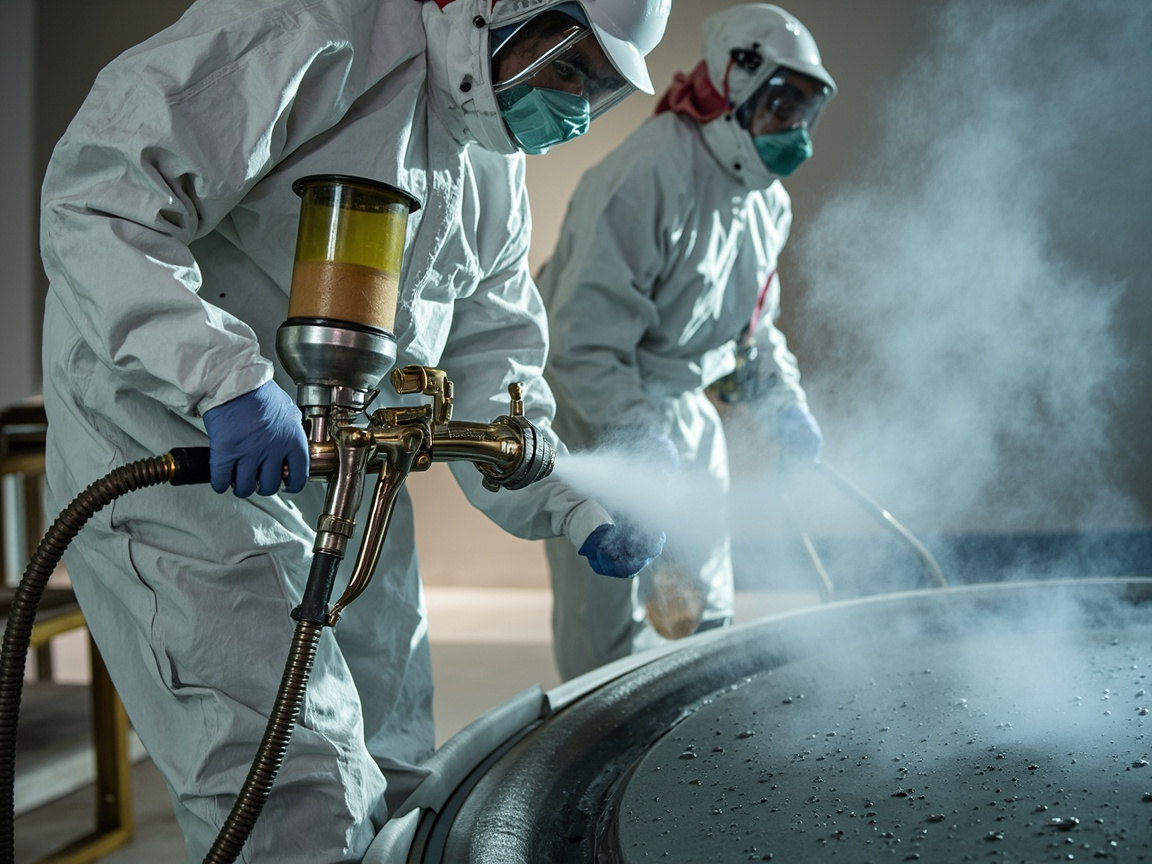
- Two-component heated airless spray (plural component / heated airless): base and curing agent are heated separately, conveyed by metering pump according to ratio to a static mixer, then airless sprayed. Heating reduces viscosity, improves leveling, and ensures accurate ratio;
- Two-component feed + static mixing head: the key is metering accuracy and uniform mixing; ratio drift will directly cause non-curing or softening;
- Substrate and environment protection: substrate temperature at least 3℃ above dew point, relative humidity ≤ 85% (zinc-rich/amine-cured systems often require stricter), avoid condensation and blushing.
Site discipline key points:
- Mix on demand: batch according to shift usage, discard resolutely if beyond pot life;
- Thorough mixing: A and B components must be pre-mixed separately, then combined and stirred, static mixer cleaned regularly;
- Film thickness control: dual control with wet film comb and magnetic thickness gauge, single coat not exceeding design upper limit, avoid sagging and internal exothermic cracking;
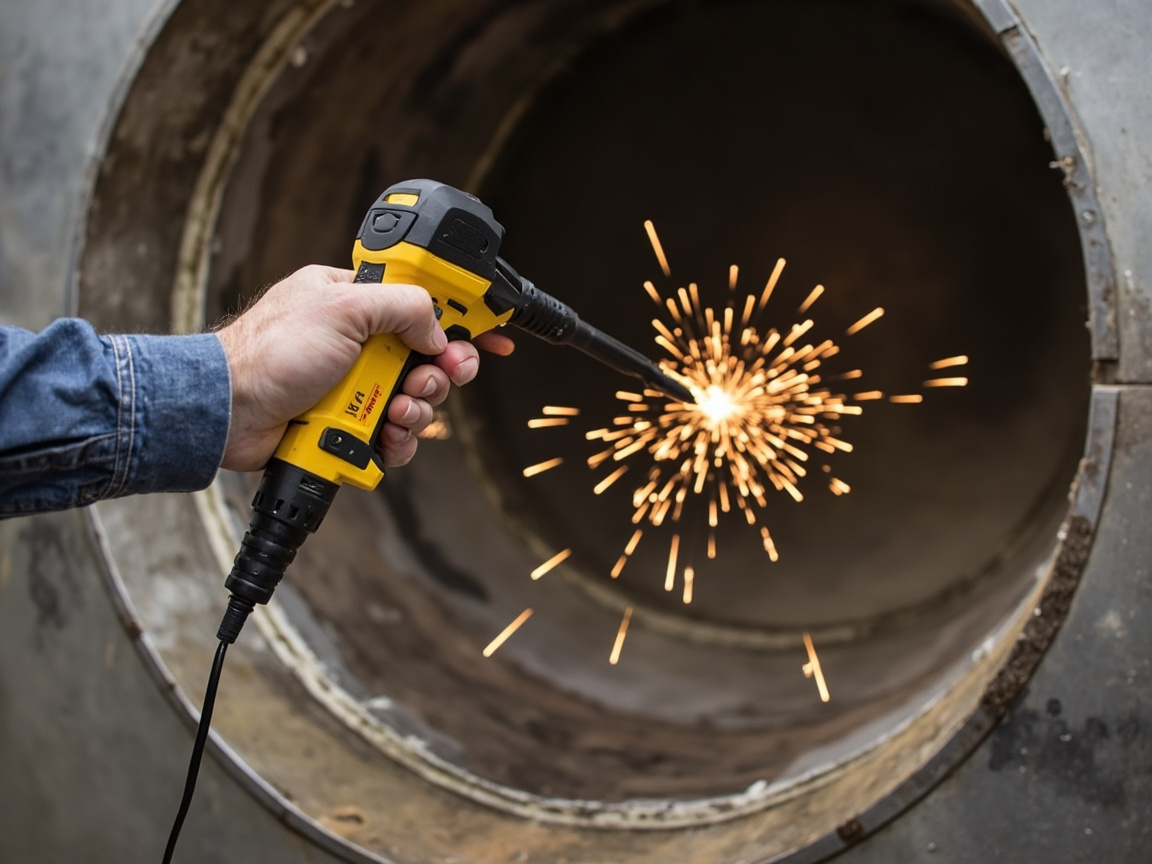
- Pinhole detection: thick film is sensitive to pinholes, after curing do spark holiday test (pinhole detector), scan full area at voltage per specification (related to DFT).
Kexin New Materials (kexinMaterials) in offshore platform and tank lining projects usually provides on-site process cards for two-component heated spray, writing mixing ratio, heating temperature, single-coat DFT, recoat interval, and environmental thresholds as an executable checklist to reduce human error.
VI. Typical application scenarios
The "main battlefield" of solvent-free epoxy is scenarios that require both long service life and low emissions, and can be applied in a single thick coat:
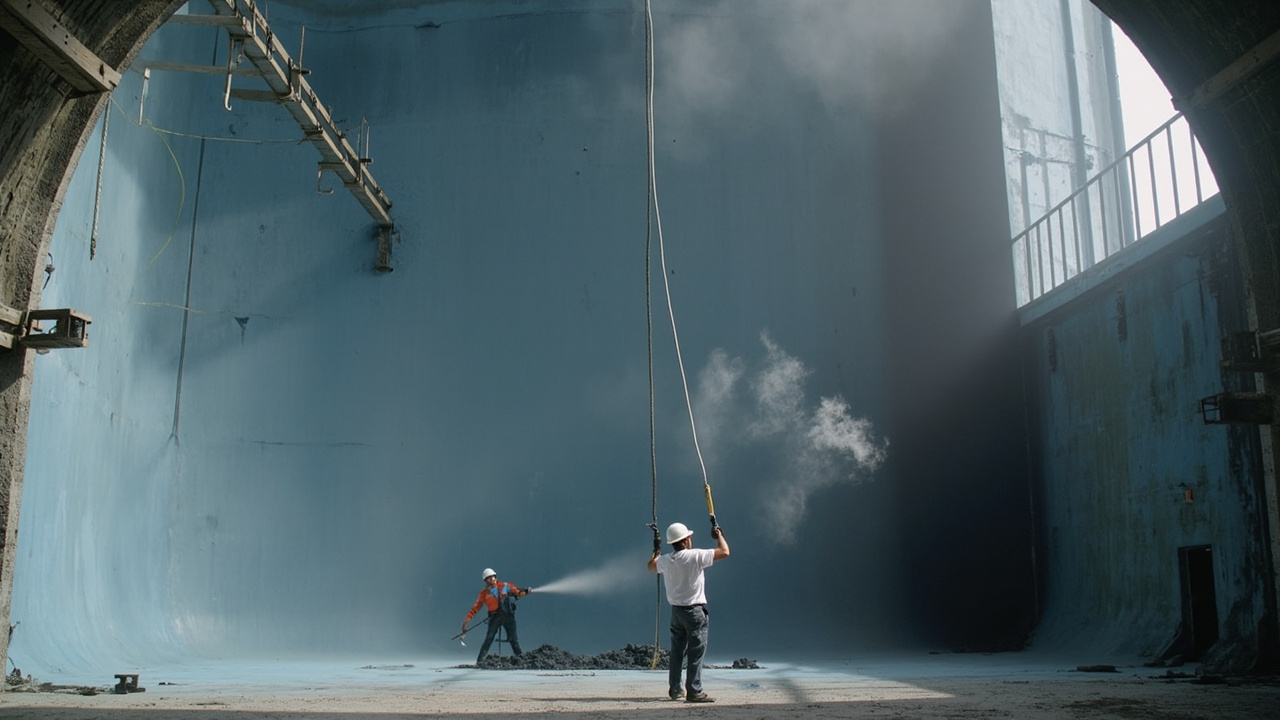
- Tank internals: crude oil, intermediate product, sewage tank linings, resistant to chemical media and reducing coats;
- Buried / river-crossing pipelines: external anti-corrosion and internal drag reduction, thick film resists soil stress and handling damage;
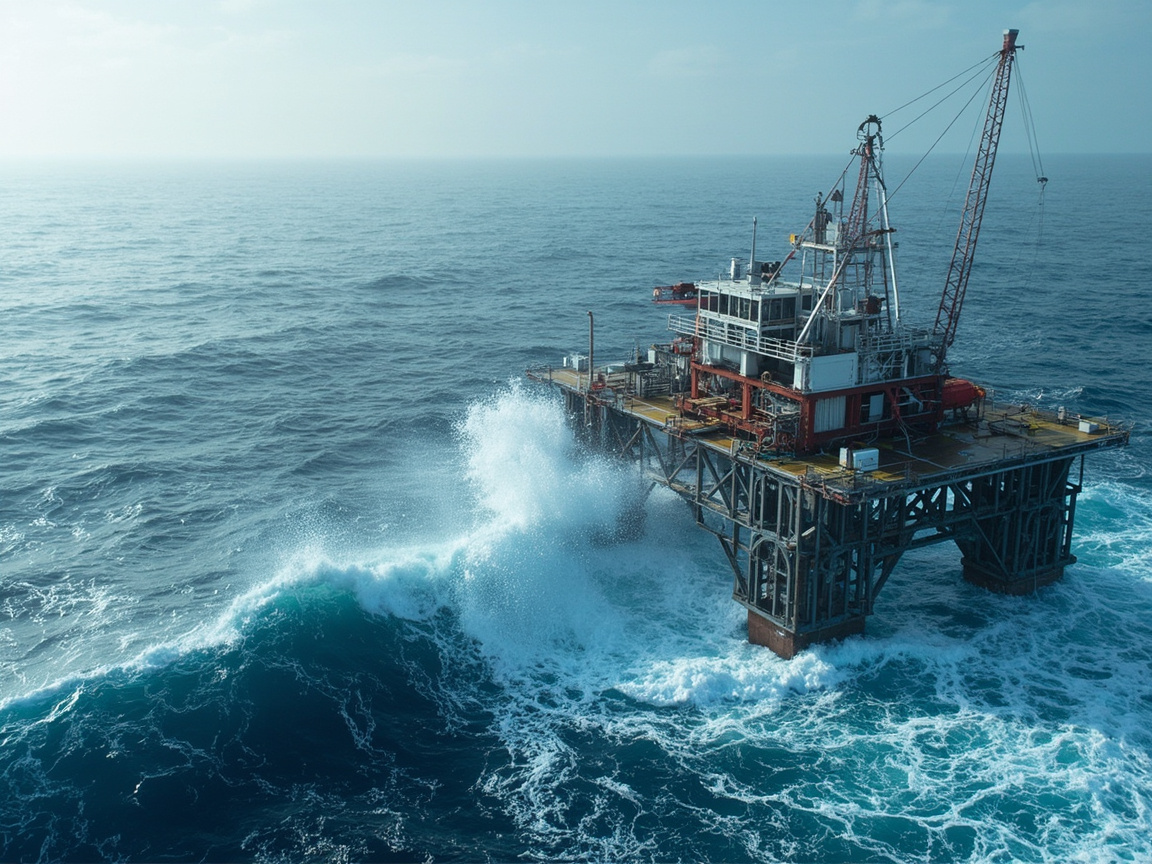
- Offshore platforms: splash zone, tidal zone structures, resistant to chloride ion penetration;
- Floors and wastewater pools: wear-resistant, chemical-resistant, seamless;
- Marine ballast tank: meets PSPC and other thick-film and verification requirements (consistent with the solvent-free epoxy approach).
Correspondingly, solvent-based epoxy is still widely used in light anti-corrosion scenarios with high requirements for construction convenience, low film thickness, and no on-site heating equipment. The two are not a substitution relationship, but a division of labor according to working conditions.
VII. Quality Acceptance and Common Failures
Acceptance should cover both material and finished product ends: on the material side, verify TDS, VOC test report (by GB/T 23985 or GB 30981 method), mixing ratio; on the finished product side, verify DFT (by the 90/10 rule of ISO 19840), adhesion (pull-off method GB/T 5210 / ISO 4624), pinholes (spark test), appearance (no sagging, no bubbles). Common failures and countermeasures:
- Non-curing / tacky: wrong mixing ratio or metering pump drift; must re-measure the ratio and do a small-sample curing test;
- Pinholes and bubbles: substrate has pores or air entrained during construction; thick film must be pinhole tested and repaired;
- Cracking: excessive single-coat film thickness, internal exotherm; should apply in multiple coats with thickness control and select a flexible formulation;
- Intercoat delamination: overcoating interval exceeded without roughening; strictly follow the TDS overcoating window.
VIII. Comparison and Selection with Water-based and High-Solids Epoxy
In the eco-friendly coating family, solvent-free epoxy is at the "top of solids content", but it is not the most suitable for all scenarios:
| Type | Volume Solids | VOC Level | Single-coat Film Thickness | Equipment Requirement | Suitable Scenario |
|---|---|---|---|---|---|
| Solvent-based epoxy | 50%–70% | High (hundreds of g/L) | 100–200 µm | Conventional | Light anti-corrosion, convenient construction |
| High-solids epoxy | 80%–95% | Medium-low | 200–400 µm | Conventional / airless | General heavy anti-corrosion |
| Water-based epoxy | 50%–80% | Extremely low | 80–200 µm | Conventional | Ventilation-restricted indoor, low odor |
| Solvent-free epoxy | ≥98% | ≤60 g/L | 300–1000 µm | Heated two-component | Storage tanks, pipelines, marine thick film |
Selection conclusion: when the single-coat film thickness requirement exceeds about 500 µm and on-site heated two-component equipment can be arranged, solvent-free epoxy has the most obvious comprehensive life and compliance advantages; otherwise high-solids or water-based epoxy may be more economical.
IX. Application Characteristics in Marine Engineering and Immersion Environments
Solvent-free epoxy performs particularly well in the splash zone, tidal zone, and full immersion zone of offshore platforms. These parts are长期处于 a harsh cycle of chloride ion enrichment, wet-dry alternation, and mechanical impact, with extremely high requirements for the coating's chloride ion permeation resistance, cathodic disbondment resistance, and impact resistance. The high cross-link density and solvent-free pore structure of solvent-free epoxy make its chloride ion permeation coefficient significantly lower than that of ordinary solvent-based epoxy, and a single thick film can greatly reduce weak shielding points. In the full immersion zone, the coating also needs to resist seawater pressure and microbial attachment; formulations often add antifouling or antibacterial components to form composite functions. It should be noted: the marine environment is severe, and relying solely on solvent-free epoxy is still insufficient; it should be consistent with the配套 approach of ISO 12944-9 (offshore structures), and if necessary, combined with sacrificial anode or impressed current cathodic protection to form a "coating plus electrochemical" dual defense line. For system selection, refer to this batch's ISO 12944 Anti-corrosion Coating System Selection Guide.
X. Low Temperature and Winter Construction Special Topics
Solvent-free epoxy has large reaction heat and is temperature-sensitive; winter construction is a common engineering difficulty. At low temperatures, viscosity increases and curing slows; if only heated spraying is relied upon while ignoring the ambient temperature, slow surface drying, softening, and insufficient adhesion easily occur. Special measures include: select low-temperature curing amine curing agents (e.g., phenalkamine can start curing at 5℃ or even lower); pre-heat the substrate and coating, but avoid local overheating causing explosive polymerization; strictly control relative humidity and dew point, as low temperature and high humidity are more prone to condensation blushing; extend the minimum overcoating interval and appropriately increase curing maintenance time before putting into use. On-site, a "small-sample curing test" should be done to confirm tack-free and hardness before large-area promotion. For large in-service storage tanks where ambient temperature cannot be guaranteed, it is advisable to arrange construction in warm seasons or set up temporary heating enclosures.
XI. Compatibility Boundaries with Polysiloxane and Polyurethane Topcoats
Heavy anti-corrosion systems often adopt the combination of "epoxy primer/intermediate + polyurethane or polysiloxane topcoat"; solvent-free epoxy is mostly used for primer/intermediate rather than topcoat. There are three reasons: first, solvent-free epoxy has average weather resistance and will chalk and lose gloss under long-term UV exposure; second, aliphatic polyurethane and polysiloxane topcoats have excellent gloss and color retention and weather resistance, undertaking appearance and weathering; third, topcoats usually have small film thickness and can be applied with solvent-based or high-solids, facilitating tinting and repair. Therefore, the reasonable division is: solvent-free epoxy is responsible for bottom thick-film shielding, polyurethane/polysiloxane is responsible for topcoat weathering. If the topcoat also needs to use a solvent-free system (e.g., tank inner wall without weather resistance requirement), then no separate topcoat is needed. Pay attention to intercoat compatibility; overcoating window and interface treatment must be executed according to TDS to avoid intercoat delamination.
XII. Storage, Transportation, and Occupational Health Key Points
The base and curing agent of two-component solvent-free epoxy should be stored separately in a cool warehouse, avoiding high temperature and fire sources. The curing agent mostly contains amines, which are irritating to skin and respiratory tract; operators must wear gloves, goggles, and respirators. Transportation shall be executed according to relevant hazardous chemical regulations to prevent damage and mixing. Construction sites should be well ventilated; confined spaces (inside tanks) must have forced supply and exhaust ventilation and detection of combustible gas and oxygen concentration, complying with confined space work permits. Although VOC is low, amine mist and dust may still be generated, and occupational health cannot be relaxed. Waste coating and packaging shall be managed as hazardous waste, and random dumping is prohibited. The supplier shall list hazards and first-aid measures in the MSDS, and the constructor must provide adequate training.
XIII. Life Cycle Cost Perspective
To evaluate whether solvent-free epoxy is "expensive", one should calculate the life cycle cost rather than just looking at the per-kilogram price. On the surface, its unit price is higher than solvent-based epoxy, but a single thick film reduces the number of coats, shortens the construction period, and lowers labor and equipment occupation; near-zero VOC reduces exhaust gas treatment and environmental compliance costs; long life reduces overhaul frequency and shutdown losses. In scenarios with high shutdown costs such as storage tanks and offshore platforms, the life cycle cost is often lower than multi-coat solvent-based solutions. Conversely, on ordinary components with slight anti-corrosion and frequent repairability, high-solids or water-based epoxy may be more economical. Selection should weight facility design life, shutdown cost, and environmental constraints, rather than simply comparing material unit prices.
XIV. How to Interpret Chemical Resistance Grades
To evaluate whether solvent-free epoxy can be used for a certain medium, one cannot just look at the vague statement of "epoxy chemical resistance", but should look at the chemical resistance grade and immersion data. Common evaluation bases include GB/T 1763 (paint film resistance to chemical reagents), GB/T 9274 or ISO 2812 (determination of resistance to liquid media), and the results are expressed by appearance, adhesion change, and blistering grade after a certain period. For acids, alkalis, solvents, and oils, the data for the corresponding media should be checked separately: alkali resistance is usually better than strong acid resistance; tolerance to polar solvents (such as alcohols, ketones) is limited; tolerance to hydrocarbon oils is better. Engineering selection should require the manufacturer to provide measured reports of the corresponding medium's concentration, temperature, and immersion duration, rather than a general "acid and alkali resistant" statement. For harsh media containing sulfur or halogens, the long-term effect of sulfides or halogen ions on the curing network and fillers should also be evaluated, and if necessary, switch to special chemical-resistant epoxy or lining.
XV. Comparison with Glass Flake Coating
In strong corrosion, high temperature, or wear working conditions, glass flake coating is often discussed alongside solvent-free epoxy. Glass flake coating is a thick-paste system with resin as base and mixed with flake-like glass flakes; the flakes are interlaced layer by layer to form an extremely long permeation path, and heat and chemical resistance are often better than ordinary epoxy, commonly used in flue gas desulfurization and acid-alkali storage tanks; the disadvantage is that construction has high requirements for roller and trowel techniques and is sensitive to substrate flatness. The advantage of solvent-free epoxy lies in mature process, general equipment, and low comprehensive cost. Selection logic: when temperature exceeds the epoxy upper limit or the medium is extremely strong, lean toward glass flake; for general storage tanks and marine structures, solvent-free epoxy is more economical. The two can also be combined, such as epoxy primer plus flake topcoat, to complement each other.
XVI. Construction Safety and Explosion-proof Special Topics
Although solvent-free epoxy has low VOC, the two-component contains amine curing agents that irritate skin, eyes, and respiratory tract, and heated spraying involves high temperature and pressure. Safety measures: operators wear chemical-resistant gloves, goggles, and anti-toxic masks; heating pipelines and mixing head pressure-bearing parts are regularly calibrated to prevent overpressure leakage; confined spaces (inside tanks) must have forced ventilation and detection of combustible gas and oxygen content, executing work permits; waste and empty barrels are managed as hazardous waste, prohibited from being poured into sewers. Amine curing agents easily cause allergies upon skin contact; once contaminated, immediately rinse with soapy water and seek medical attention. Writing safety into the process card, alongside quality control, can avoid "coating qualified but people have problems".
XVII. Extended Application in Pipeline Internal Anti-corrosion
Solvent-free epoxy is also suitable for internal drag reduction and anti-corrosion of buried or river-crossing pipelines: internal coating can reduce transmission resistance, reduce scaling and internal corrosion; external coating combined with cathodic protection resists soil corrosion. Pipeline internal coating is mostly prefabricated in the factory, using centrifugal coating or in-pipe spraying robots to ensure uniform length; field joints require special machinery. It should be noted that small pipe diameter and many elbows have higher requirements for equipment and defect detection, and spark test voltage is calibrated according to pipe diameter and film thickness. Pipeline external anti-corrosion can be combined with fusion bonded epoxy powder or three-layer PE, forming a complete "internal drag reduction external protection" scheme with solvent-free epoxy lining. For related powder process, see this batch's heavy-duty powder coating.
XVIII. Application in Sewage and Wastewater Tank Linings
Solvent-free epoxy is also widely used in sewage treatment plants, wastewater collection tanks, and neutralization tanks. The medium in such environments is complex, often containing various salts, organic matter, and microorganisms, and the water level fluctuation forms a wet-dry alternating waterline zone, with high corrosion and pitting risks. The high-density thick film of solvent-free epoxy can block medium permeation, wear-resistant fillers resist water flow and suspended matter scouring, and the seamless whole reduces joint leakage points. Construction also requires sandblasting to standard, no solvent retention, and pinhole testing. For wastewater containing strong oxidants, the coating's oxidation resistance should be verified, and if necessary, select a special modified type. The life evaluation of such linings should combine water quality monitoring and regular tank opening inspection, and incorporate coating maintenance into the water plant operation and maintenance system.
XIX. Combined Protection with Polyurea Elastomer
In scenarios requiring high elasticity, impact resistance, and fast curing, polyurea is often paired with solvent-free epoxy: epoxy as primer provides adhesion and barrier, polyurea as topcoat provides elastic impact resistance, complementing each other's strengths. Polyurea reacts extremely fast, can be applied thick, and adapts to a wide range of substrates, but has high requirements for surface preparation and primer compatibility; direct application on steel is prone to interlayer issues. Solvent-free epoxy as a base coat can well receive the polyurea, forming a "rigid-flexible combined" system, commonly seen in tank foundations, floor coatings, and vehicle linings. When selecting, attention should be paid to the recoating window and interfacial activity of the two; if necessary, use a sealer layer for transition to avoid delamination between rigid epoxy and flexible polyurea.
20. Recoating Compatibility on Old Coating Surfaces
In maintenance projects, it is often necessary to recoat solvent-free epoxy over old coatings. Compatibility is key: recoating over the same type of epoxy is usually feasible; old coatings such as alkyd and chlorinated rubber are incompatible with epoxy, and direct coverage will cause lifting and peeling. The practice is to use solvent wiping to determine the old paint type, conduct a small-area recoating test to observe the reaction, and if necessary, thoroughly sandblast or sand to expose the substrate. For old coatings that cannot be fully removed, priority should be given to a wide-compatibility high-solid epoxy as a transition, then apply solvent-free epoxy. Before recoating, removing oil, chalking layers, and zinc salts is a common-sense but often overlooked step to avoid interlayer failure.
21. Field Test Methods for Winter Curing
The biggest fear in winter construction is "looks dry but actually not cured". Simple judgment: the touch-dry method can only judge surface dry, not represent complete curing; more reliable is to wipe with acetone or xylene—uncured epoxy will be tacky and dissolve, while cured epoxy shows no change; use a hardness tester to measure Shore or pendulum hardness to track the rising curve; for important structures, do pull-off adhesion. On site, spot-check at multiple locations and record ambient temperature and humidity changes over time. Once large-area softening is found, determine whether it is due to incorrect mixing ratio, too low temperature, or excessive humidity, and handle accordingly rather than blindly increasing thickness.
22. Selection Decision Checklist
Turn the aforementioned points into an executable selection checklist: clarify working conditions (medium, temperature, whether containing solids or bacteria); define film thickness and number of coats; select form (solvent-free or high-solid) and verify VOC; confirm surface preparation grade and salt removal; implement two-component heated spray equipment and process card; set holiday detection voltage and DFT acceptance; arrange pre-commissioning adhesion and (if required) anti-static detection; establish maintenance cycle. Write the checklist into the technical specification, and suppliers, contractors, and supervisors execute accordingly, so that the service life and compliance advantages of solvent-free epoxy can truly be realized, rather than staying at the promotional level.
FAQ
FAQ
Q: Is solvent-free epoxy completely solvent-free and 100% solid?
A: Usually refers to volume solids close to 100% and VOC below the standard limit (solvent-free type ≤ 60 g/L, per GB 30981-2020), allowing the presence of small amounts of reactive diluents that do not volatilize. "Solvent-free" means no volatile organic solvents, not no liquid components at all.
Q: Can ordinary spray guns spray solvent-free epoxy?
A: Not recommended. Its high viscosity and fast reaction require two-component heated airless spraying or professional two-component feeding equipment to ensure ratio accuracy and atomization quality; ordinary air spray guns are difficult to form film and easily clog.
Q: How thick can be sprayed in one coat?
A: Depending on formulation and equipment, commonly 300–1000 µm. But too thick will cause internal exothermic cracking and sagging; thickness should be controlled in layers according to the TDS upper limit, and managed with wet film comb and thickness gauge.
Q: Can solvent-free epoxy be constructed in winter?
A: Yes, but low-temperature curing type (e.g., phenalkamine) should be selected and substrate temperature should be at least 3℃ above dew point. Heated spraying also helps low-temperature leveling, but environmental thresholds must still be met.
Q: Does the inner wall of storage tanks using solvent-free epoxy need to be anti-static?
A: Storage tanks storing flammable and explosive media often require anti-static; the coating volume resistivity should meet specifications such as GB 6950. Anti-static solvent-free epoxy with conductive fillers can be selected instead of ordinary insulating type.
Q: How to judge complete curing and readiness for commissioning?
A: Based on the shortest curing time in TDS, combined with on-site hardness, pull-off adhesion, and simple solvent wipe judgment; for critical conditions, conduct actual adhesion detection and holiday detection before commissioning.
Q: Solvent-free epoxy is much more expensive than solvent-based, is it worth it?
A: Higher cost per kg, but single coat achieves thick film, fewer coats, longer life, and compliance with peace of mind; in scenarios with high overhaul costs such as tanks/marine, the life-cycle cost is often more favorable.
Q: How to set the holiday detection voltage?
A: Spark holiday detection voltage is related to dry film thickness, generally set according to specification formula (e.g., DFT × coefficient + base), specifically following project specification and GB/T vegetable oil/petrochemical industry holiday detection standards.
Q: How high a temperature can solvent-free epoxy withstand?
A: Conventional dry-state temperature resistance is about 80–120℃; beyond that requires special high-temperature formulation or switch to silicone/phenolic type; verify medium temperature and TDS temperature data before selection.
Q: How to read in conjunction with other articles in this batch?
A: Surface preparation determines the adhesion foundation, see Coating Surface Preparation Sa2.5 and Blasting Grades; for environmental limits see Industrial Coating VOC Limit Regulations (GB 30981); for tank lining design see Tank Internal Anti-Corrosion Coating Design and Material Selection.
Further Reading
- Coating Surface Preparation Sa2.5 and Blasting Grades
- Industrial Coating VOC Limit Regulations (GB 30981)
- Tank Internal Anti-Corrosion Coating Design and Material Selection
- Bridge Steel Structure Anti-Corrosion Coating Specification
- Alkyd Anti-Rust Paint: Iron Red/Gray Anti-Rust, Application Characteristics and Limitations