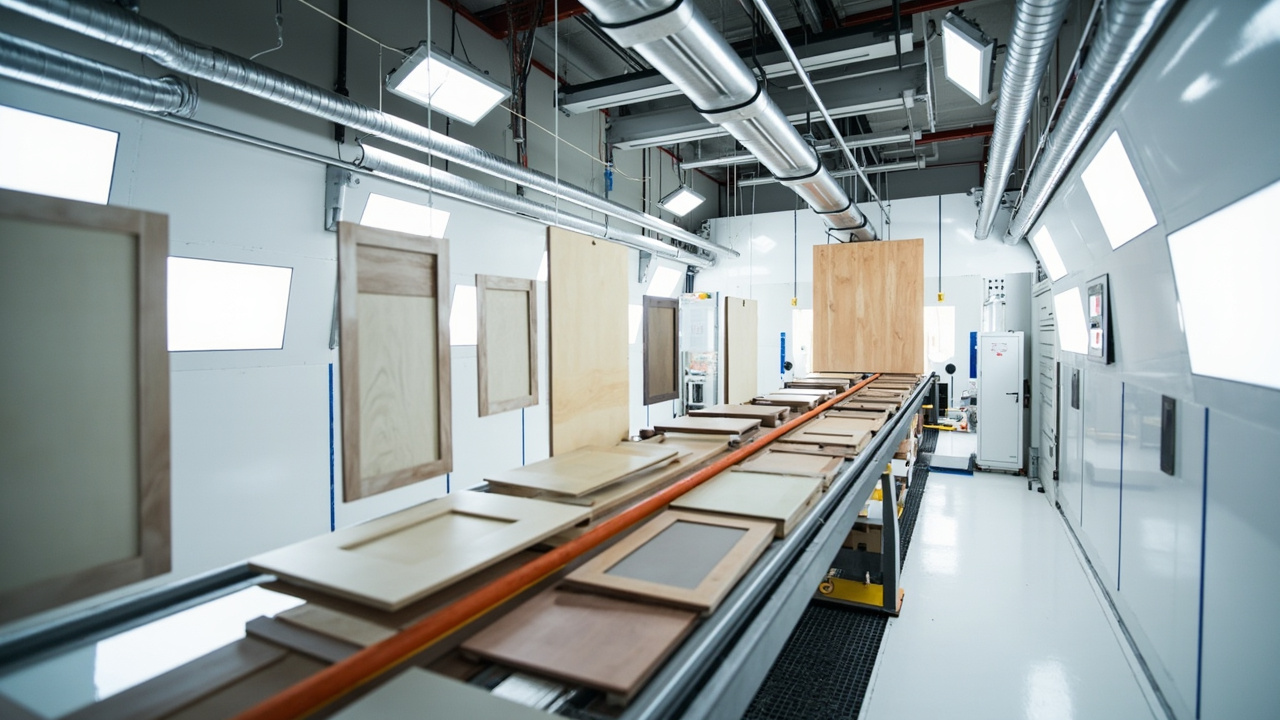
Wood moisture content (MC, symbol W) is the mass of water in timber divided by the mass of the same timber oven-dry to constant weight, expressed as a percentage. Equilibrium moisture content (EMC) is the moisture content timber settles at after long exposure to the surrounding air, when sorption and desorption balance out; it moves with the temperature and humidity of that air. In furniture production the two figures together decide whether an uncoated blank may enter the coating line: too much moisture slows film drying and weakens adhesion, and it triggers blushing, bubbles and pinholes; too little, or too steep a surface-to-core gradient, ends in cracking, edge swelling and distortion once the environment changes. These are not laboratory abstractions but one measuring stick shared by kiln drying, workshop conditioning, the coating window and factory release testing.
TL;DR: six conclusions that can go straight into production planning
- GB/T 3324-2024 (current edition, replacing the 2017 version) limits the moisture content of wooden furniture stock to 8 % up to the annual mean equilibrium moisture content of the region of use plus 1 %. Converted with the Annex B values: Beijing 11.4 % gives an upper limit of 12.4 %, Shanghai 16.0 % gives 17.0 %, Guangzhou 15.1 % gives 16.1 %.
- The oven-drying method is the reference: drying to constant mass at 103 ± 2 °C on specimens not smaller than a 20 mm cube (GB/T 1927.4-2021, replacing GB/T 1931-2009, MOD to ISO 13061-1:2014). Resistance moisture meters are fine for line patrol but must be documented against the oven method.
- The real risk band sits below the fibre saturation point, at 23 %-33 % for most species (about 30 % as a working figure), where water entering or leaving the cell wall changes dimensions; the spread of regional equilibrium moisture content reaches some 8.7 percentage points, from Lhasa 8.6 % to Wenzhou and Haikou 17.3 %.
- The defect mapping is unambiguous: too high gives slow drying, weaker adhesion, blushing in nitrocellulose systems and bubbles or pinholes in polyurethane; too low gives shrinkage cracking; a steep gradient gives distortion and delayed cracking.
- Published evidence: clear-coat adhesion differs significantly across 8 %, 12 % and 15 % moisture levels, with 2K polyurethane at the top of the measured range on oak specimens dried to 8 % (DOI 10.5897/SRE.9000416); a second series at 7 %, 11 % and 15 % shows adhesion falling as moisture content rises (DOI 10.22092/ijwpr.2018.122224.1478).
- Usual factory practice: keep blanks in a band of roughly 8 %-12 % adjusted to destination and season, condition them in workshop air close to the equilibrium value before coating, and interrupt moisture movement first with a sealer coat before entering the primer and topcoat system.
Key data (independently verifiable)
- Moisture-content limit: 8 % up to (annual mean EMC of the region of use + 1 %); converted examples Beijing at or below 12.4 %, Shanghai at or below 17.0 %, Guangzhou at or below 16.1 % (GB/T 3324-2024).
- Regional spread: Annex B annual mean EMC of Lhasa 8.6 %, Beijing 11.4 %, Harbin 13.6 %, Xi'an 14.3 %, Shanghai 16.0 %, Guangzhou 15.1 %, Wenzhou and Haikou 17.3 %, an extreme difference of about 8.7 percentage points.
- Reference test: oven drying to constant mass at 103 ± 2 °C; specimens of at least 20 mm cube; weighing completed within 30 minutes; laboratory humidity kept at or below 60 % RH (GB/T 1927.4-2021).
- Fibre saturation point: 23 %-33 % for most species at ambient temperature (about 30 % taken as the reference); it falls as temperature rises, to roughly 26 % at 60-70 °C, 22 % at 100 °C and 18 % at 120 °C (open chapters of the handbook Practical Technology of Wood Drying).
- Adhesion comparison: two graded series, 8 %/12 %/15 % and 7 %/11 %/15 %, on oak, beech, hornbeam and similar stock, measured by ASTM D4541 pull-off, both showing adhesion falling as moisture content rises (DOI 10.5897/SRE.9000416; 10.22092/ijwpr.2018.122224.1478).
- Release testing: moisture content is a mandatory factory release item, measured as the average of three points; the same edition also caps warpage at 3 mm/m (public interpretation of GB/T 3324-2024).
1. Two reference points: moisture content, equilibrium moisture content and the fibre saturation point
1.1 Moisture content and equilibrium moisture content: definitions and relationship
Moisture content W = (green mass - oven-dry mass) / oven-dry mass x 100 %, so the whole measurement rests on obtaining the oven-dry mass - which is exactly why oven drying is the reference method. The equilibrium moisture content is the value timber reaches when it balances the temperature and humidity of the given air: for a given environment it is a fixed, tabulated number, and the actual moisture content always moves towards it, giving up water above it and absorbing water below it. Drying therefore does not chase a single low figure but brings the stock into the equilibrium band that matches the environment where the furniture will be used.
1.2 Equilibrium moisture content by region: one table sets the target
| City / region | Annual mean equilibrium moisture content (%) | Converted moisture-content upper limit (%) |
|---|---|---|
| Lhasa | 8.6 | 9.6 |
| Beijing | 11.4 | 12.4 |
| Harbin | 13.6 | 14.6 |
| Xi'an | 14.3 | 15.3 |
| Shanghai | 16.0 | 17.0 |
| Guangzhou | 15.1 | 16.1 |
| Wenzhou | 17.3 | 18.3 |
| Haikou | 17.3 | 18.3 |
Values are taken from Annex B of GB/T 3324-2024, whose data derive from the informative annex of GB/T 6491 and industry handbooks; the upper limit column is an example converted as regional annual mean EMC plus 1 %. Contracts and inspection follow the standard text, the agreed terms and the measurements of a testing laboratory.
1.3 The fibre saturation point: the switch for dimensional change
The fibre saturation point is the state in which free water in the cell cavities has evaporated while bound water in the cell wall is still saturated: for most species at ambient temperature it lies between 23 % and 33 %, with about 30 % in common use. Below that boundary, water moving in or out of the cell wall produces shrinkage and swelling, and the effect is strongly anisotropic - small along the grain, larger radially and largest tangentially (the differential shrinkage ratio is tangential divided by radial, and a higher ratio means less stable wood). Total shrinkage from oven-dry is defined by the interval from about 30 % fibre saturation down to 0 %, and range shrinkage is often assessed over the 30 % to 15 % segment. The saturation point falls as temperature rises: about 26 % at 60-70 °C, 22 % at 100 °C and 18 % at 120 °C, so the atmosphere in the high-temperature phase of a kiln is not the equilibrium condition at room temperature.
2. What the standard requires and how it is measured: GB/T 3324-2024
2.1 The limit and its conversion: 8 % up to (regional EMC + 1 %)
Compared with the 2017 edition, the current GB/T 3324-2024 adds terminology and physical-chemical requirements, and moisture content appears among the mandatory factory release tests; the measurement takes the average of three points, while arbitration follows the GB/T 1927.4 method series. The same edition also requires warpage not to exceed 3 mm/m, and excess moisture content is a frequent origin of exactly this kind of dimensional instability, so the two indicators corroborate one another.
2.2 The oven-drying method: how the reference test is executed
The current method standard is GB/T 1927.4-2021 (replacing GB/T 1931-2009, MOD to ISO 13061-1:2014): an oven at 103 ± 2 °C with air circulation, specimens no smaller than a 20 mm cube, the constant-mass judgement made on paired specimens, weighing completed within 30 minutes and laboratory humidity held below 60 % RH.
2.3 Rapid testing: the limits of a resistance moisture meter
Resistance moisture meters are the usual rapid screen on the line: readings are influenced by species, temperature and any impregnation, so they must carry species corrections and be documented against the oven method, while release decisions, arbitration and dispute handling still rest on the oven method. Multi-point patrol should cover the infeed after breakdown sawing, different positions in the kiln stack and different zones of the panel, and should record the distribution of readings rather than a single value.
| Method | Role | Basis and key points | Boundary |
|---|---|---|---|
| Oven drying | Reference and arbitration | GB/T 1927.4-2021: 103 ± 2 °C, constant mass, specimens of at least 20 mm | Needs sampling and time; not suited to full inspection |
| Resistance moisture meter | Line patrol | Reading trend and multi-point distribution | Affected by species and temperature; needs correction and cross-checking |
| Dry-bulb and wet-bulb tables | In-kiln process control | Equilibrium moisture content read from dry-bulb temperature and wet-bulb depression | Describes the medium, not the moisture content of the timber itself |
| Batch records and traceability | Quality management | Drying records linked with pre-line test records | Without records, attributing a defect becomes guesswork |
3. How moisture content affects coating quality: mechanism and evidence
3.1 Too high: slow drying and appearance defects
When the moisture content is high, water migrates outward from the core after coating, and passing through the film it disturbs drying and crosslinking: the film dries slowly and adhesion drops. Evaporative systems such as nitrocellulose blush readily, while 2K polyurethane systems show bubbles and pinholes. This is precisely where a sealer earns its place: it builds a barrier on the bare blank, keeps moisture movement outside the topcoat system and at the same time makes raised grain easy to remove by sanding.
3.2 Too low, and gradients: cracking and distortion
When the ambient humidity is low, the stock keeps losing water and shrinking, and the coating is torn apart as the substrate contracts beneath it. More subtle is the surface-dry, core-wet gradient: the outer layer has already shrunk while the inner layer has not, so once the parts are coated the two fall out of step as conditions change, and distortion or cracking appears only weeks later. Kilns are controlled by final moisture content together with moisture-content deviation precisely against these two risks.
3.3 Evidence: two published graded-series studies
The paper Effect of wood moisture content on adhesion of varnish coatings (Scientific Research and Essays, 2009, DOI 10.5897/SRE.9000416) set three levels, 8 %, 12 % and 15 %, on Scots pine, beech and oak, and tested nitrocellulose, 2K polyurethane and waterborne polyurethane clear coats: moisture content had a significant effect on adhesion, and 2K polyurethane on oak dried to 8 % recorded the highest pull-off values in that series. A second paper (Iranian Journal of Wood and Paper Science Research, 2019, DOI 10.22092/ijwpr.2018.122224.1478) set 7 %, 11 % and 15 % on beech and hornbeam and tested by ASTM D4541 pull-off: adhesion fell as moisture content rose, with the same trend for both clear coats. Species and coating systems differ between the two studies, yet both write into their conclusions that moisture content is a first-order variable for adhesion.
| Defect | Relation to moisture content | Control measure |
|---|---|---|
| Blushing of the film | Too high; moisture passing through the film disturbs evaporative drying | Control the moisture content at line entry; sealer on the bare blank |
| Bubbles and pinholes | Too high; escaping steam leaves channels inside the film | As above, plus system matching and flash-off management |
| Loss of adhesion | Too high (the measured trend in both published studies) | Limit values combined with multi-point testing |
| Shrinkage cracking | Too low, or continued water loss in the environment of use | Set the target from the destination's equilibrium moisture content |
| Distortion and edge swelling | Steep surface-to-core gradient with later re-absorption | Control moisture-content deviation plus workshop conditioning |
| Staining and returns of damp | Locally over-wet areas | Sealer coat plus traceability of the drying records |
4. Plant practice: from the drying kiln to the coating line
4.1 Drying and grading: draw the acceptance line at the kiln door
The drying quality of sawn timber is graded under GB/T 6491 Drying Quality of Sawn Timber (a new edition was issued on 2026-08-28 and takes effect on 2027-03-01), where final moisture content and moisture-content deviation together decide whether stock may enter the machining line. Incoming batch sampling should log final moisture content and deviation, and out-of-tolerance batches should be given a further conditioning cycle rather than going straight to the line.
4.2 Conditioning and matching the destination
After drying, timber is conditioned in workshop air until it approaches the equilibrium moisture content of the region where the furniture will be used - the common language of furniture factories and coatings suppliers alike. The same batch of blanks bound for Lhasa (8.6 %) and bound for Haikou (17.3 %) simply carries different targets. Cross-region and export orders are planned from destination data so that nothing only cracks or swells after delivery.
4.3 Testing before the line, and the sealer coat
Before the line, spot checks follow the three-point averaging rule of GB/T 3324-2024; a sealer then builds a barrier layer on the bare blank before the primer and topcoat system, run together with the temperature and humidity window of the workshop - which cross-checks with our article on the open time and levelling of waterborne wood coatings.
4.4 Seasonal management: two extremes
The spring return of damp and the plum-rain season in the south, and the heated season in the north, are the two extremes: in the first the air moves towards high humidity and the wood absorbs moisture, in the second the air is dry and the wood gives moisture up. Production planning answers with drying further ahead or longer conditioning in humid periods, and with shorter exposure and more effective sealing in dry periods, while the workshop temperature and humidity log is reviewed weekly.
5. Common misconceptions and a troubleshooting order
5.1 Six common misconceptions
- Testing only one batch of stock at the sawing end and ignoring differences between kiln positions and between boards; the multi-point check before line entry cannot be skipped.
- Releasing material on an uncorrected resistance-meter reading, with no comparison file against the oven method.
- Going to the line early because the boards feel dry, skipping the workshop conditioning that brings the wood to equilibrium.
- Drying export orders to a northern domestic standard and ignoring the destination's equilibrium moisture content, which must be higher for humid regions.
- Answering an out-of-limit moisture reading by adjusting thinner and drying temperature instead of going back to the timber.
- Treating the sealer as optional: sealing the bare blank is the process step that interrupts moisture movement, not a decorative stage.
5.2 When something goes wrong: the order of checks
Re-measure moisture content and gradient first, with multi-point resistance readings plus oven-dried samples; then reconcile the drying and conditioning records; only after that should coating parameters and curing conditions be examined. Reverse the order and a great deal of time goes into parameters while the substrate problem stays untouched.
Frequently asked questions
Q1 What moisture content must a blank reach before it can be coated?
Under GB/T 3324-2024 it has to fall inside the band 8 % up to the annual mean EMC of the region of use plus 1 %: stock bound for Beijing is handled at or below 12.4 %, Shanghai at or below 17.0 %, Guangzhou at or below 16.1 %. Industry material quotes a workshop target band of 8 %-12 %, which fits particular destinations and seasons; quoting the standard figure or the contracted value remains the safer course.
Q2 The oven result and the resistance meter disagree - which one rules?
The oven-drying method of GB/T 1927.4-2021 is the reference, and moisture-content arbitration follows the same method series. A resistance meter is influenced by species, temperature and impregnation, so it needs species correction and a comparison file against the oven method: it suits trend patrol and multi-point screening, and should not be used alone as a release criterion.
Q3 Why is moisture content a mandatory factory release item?
Because it is the shared precondition for dimensional stability and coating quality. Once moisture content leaves the equilibrium band, the film in the customer's environment cracks or blisters as the wood swells and shrinks. GB/T 3324-2024 simultaneously caps warpage at 3 mm/m, and excess moisture is a frequent source of that instability, which is why release testing covers moisture content.
Q4 With high moisture content, why do films blush, blister or pinhole?
After coating, water has to travel from the interior of the wood to the surface, passing through a film that has not yet dried or cured and disturbing both levelling and crosslinking. Evaporative nitrocellulose systems blush readily, 2K polyurethane systems develop bubbles and pinholes, and in both cases drying slows while adhesion drops; these correspondences follow the published coating technology literature.
Q5 Must the target differ for stock destined for different regions?
Yes. Annual mean EMC runs from Lhasa 8.6 % to Wenzhou and Haikou 17.3 %, a spread of about 8.7 percentage points. Timber under-dried for a dry destination keeps losing water after delivery and shrinks, tearing the coating; timber dried too hard for a humid destination re-absorbs moisture and the surface is damaged just the same. Planning from destination data is standard practice for cross-region and export orders.
Q6 The film has already cracked and blistered - how do I know whether moisture is the cause?
Work in three steps. Re-measure blanks and coated pieces at multiple points, rough screening with the resistance meter and confirmation by oven drying. Then inspect the moisture gradient, the difference between surface and core, together with the drying records. Finally compare against environmental records: workshop temperature and humidity, transport and storage. If several points on the same batch are out of limits, treat the timber first and discuss coating parameters afterwards.
Q7 Is a lower moisture content always better?
No. Below the equilibrium band there are problems too: the wood re-absorbs moisture in service, lifting the coating or drawing staining through it, and over-drying also causes surface checking and uneven absorption. The objective is a band around the equilibrium moisture content of the region of use, not a single low figure.
Further reading and related articles on this site
- Related on this site: Blushing and early water resistance of waterborne wood topcoats: film formation, crosslinking and formulation countermeasures, Open time and levelling of waterborne wood coatings: balancing temperature, humidity, coalescent and rheology additives, Open grain on oak and pore filling: process choices for waterborne filler, Grain raising with waterborne coatings: fibre swelling and wet-sanding control, Sanding practice in wood finishing: grit sequencing and intercoat sanding control, Flat-panel roller coating for furniture: film thickness, transfer efficiency and common defects in reverse roller coating.
- Public standards and texts: GB/T 3324-2024 General Technical Requirements for Wooden Furniture (Annex B); GB/T 1927.4-2021 Small Clear Specimens for Testing Physical and Mechanical Properties of Wood, Part 4: Determination of Moisture Content (replacing GB/T 1931-2009; MOD ISO 13061-1:2014); GB/T 6491 Drying Quality of Sawn Timber (new edition issued 2026-08-28, effective 2027-03-01); ASTM D4541 Pull-off Adhesion.
- Further reading (academic): Sonmez A., Budakci M., Bayram M., Effect of wood moisture content on adhesion of varnish coatings, Scientific Research and Essays, 2009, 4(12): 1432-1437, DOI 10.5897/SRE.9000416; Fazeli A. et al., An Investigation into the Effect of Moisture Content on Adhesion strength of Half-polyester and Polyurethane Clear Paints Applied to Wood Surface, Iranian Journal of Wood and Paper Science Research, 2019, 33(4): 511-521, DOI 10.22092/ijwpr.2018.122224.1478.
Last updated: 2026-10-09 | Basis and public sources: the limit statement 8 % up to (annual mean EMC of the region of use + 1 %), the Annex B city values for annual mean EMC (Lhasa 8.6, Beijing 11.4, Harbin 13.6, Xi'an 14.3, Shanghai 16.0, Guangzhou 15.1, Wenzhou and Haikou 17.3), the three-point average, the mandatory release item and the warpage cap of 3 mm/m are taken from public interpretation of GB/T 3324-2024; oven drying at 103 ± 2 °C to constant mass, specimens of at least 20 mm, weighing within 30 minutes, laboratory at or below 60 % RH and the paired-specimen reading are taken from public interpretation of GB/T 1927.4-2021; the fibre saturation point of 23 %-33 % (about 30 %) with levels of 26 %, 22 % and 18 % at 60-70 °C, 100 °C and 120 °C and the dry-bulb / wet-bulb table method are taken from open chapters of the handbook Practical Technology of Wood Drying; the usual blank band of 8 %-12 %, blushing and pinholing when high, cracking when low and the function of the sealer are taken from a public coating technology article dated 2024-01-24; the shrinkage reference from 30 % to 0 % and the differential shrinkage ratio are taken from public testing material dated 2026-09; the graded series and trend conclusions of the two adhesion studies appear at DOI 10.5897/SRE.9000416 and DOI 10.22092/ijwpr.2018.122224.1478; the status of the new GB/T 6491 edition is taken from public standards service information (issued 2026-08-28, effective 2027-03-01). All values shift with species, thickness, environment and process state; production release follows the current standard text, the contract and the measurements of a testing laboratory. Author: technical team of Kexin New Materials (Guangdong) Co., Ltd. Trade cooperation is quoted on EXW or FOB terms only.