Key Points:
1. The Dewell Coatings Green Coating New Materials and Robotics R&D Center for Marine and Offshore was inaugurated in Qidong, Jiangsu in June 2026.
2. The center focuses on two major directions: AI robot-integrated coating systems, and solvent-free / high-solid low-viscosity green marine coatings.
3. Marine coating has long faced three major pain points: high VOC emissions, heavy reliance on manual labor, and large quality fluctuations. Robotics + green coatings represent a systematic solution.
Marine coating is one of the segments in the coatings industry with the highest labor intensity, the most concentrated VOC emissions, and the highest quality risks. The total coating area of a 100,000-ton cargo ship can exceed 300,000 square meters—traditional methods rely heavily on manual handheld spray guns for work at height, which is not only inefficient but also accompanied by serious health risks and unorganized VOC emissions. Against this backdrop, the "Green Marine Coating New Materials and Robotics R&D Center for Ships and Offshore Engineering" established by Devoe Coatings in Qidong, Jiangsu undoubtedly provides the industry with a noteworthy technological direction.
Why does ship coating need "machine substitution for human labor"?
Answer directly:The driving forces behind "machine substitution for labor" in ship coating come from three aspects—the continuous tightening of VOC emission reduction regulations, the structural shortage of skilled spraying workers, and shipowners' rigid requirements for coating quality consistency. Relying on manual operations can no longer simultaneously satisfy these three constraints.
Mechanism Details: The core problem with manual spraying lies in its uncontrollability. Even for the same skilled worker, the deviation in coating thickness (DFT) between morning and afternoon can reach 15-20%, while the coating quality of critical areas such as ship ballast tanks and outer plating is directly related to the structural safety of the vessel throughout its 25-year service life. The advantage of robots lies in their constant spraying distance, movement speed, and overlap rate, which can control film thickness deviation within 5% while reducing paint overspray loss by approximately 20-30%.
The "AI robot-integrated coating system" that the Devoe R&D center is explicitly focusing on this time extends its technological vision beyond merely "replacing human hands with machines." Its deeper value lies in the real-time transmission of film thickness data, environmental parameters, and coating consumption data generated during the robotic spraying process back to the digital twin platform, thereby forming a "coating digital profile" for each vessel and providing an accurate coating condition baseline for subsequent drydock repairs and maintenance.
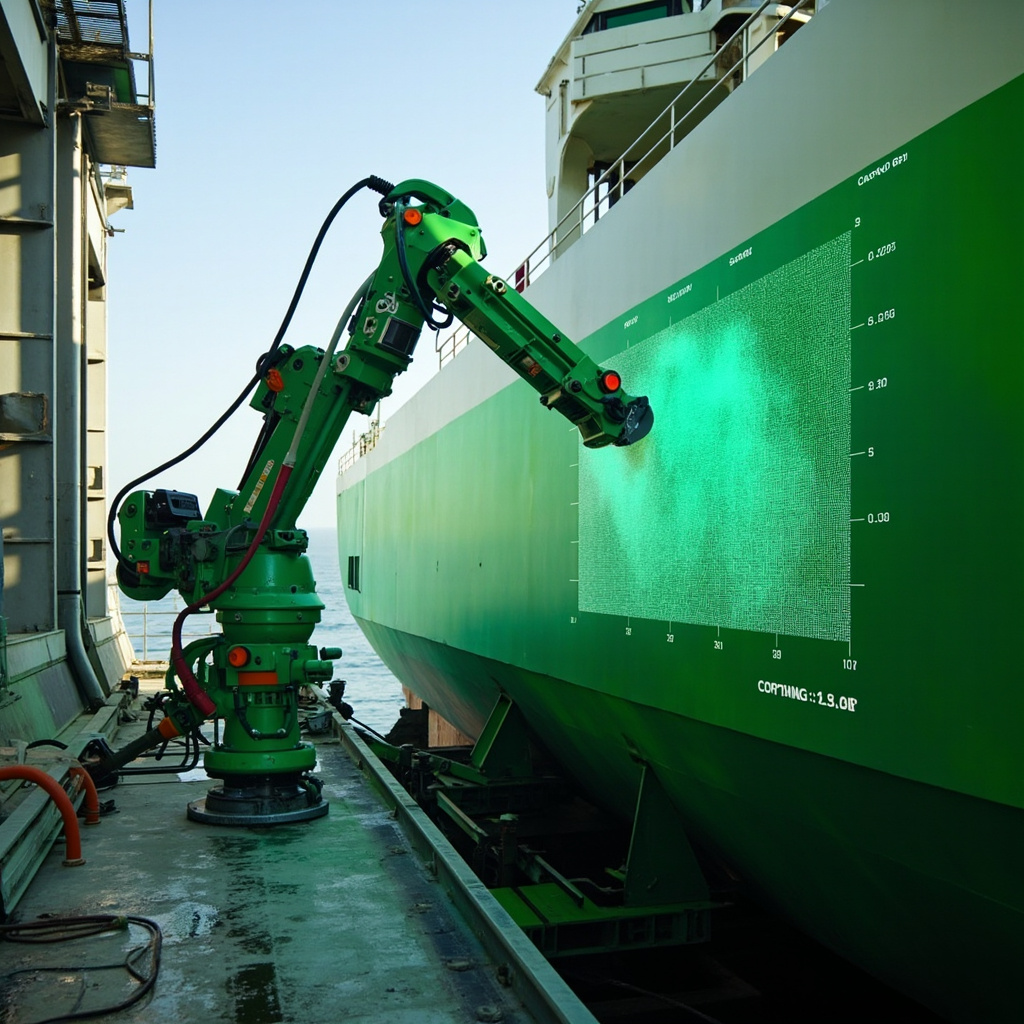
Green coatings + smart equipment: walking on two legs
Another core direction of the Dewell R&D Center is solvent-free, high-solid, low-viscosity green marine coatings. There exists a technical "impossible triangle" among these three — solvent-free means 100% solid content (zero VOC), but the higher the solid content, the greater the viscosity, and the worse the spray applicability. To resolve this contradiction, breakthroughs must be made simultaneously in three dimensions: novel curing agents, reactive diluents, and rheology additives.
Currently, the International Maritime Organization (IMO) incorporated VOC emissions from marine coatings into its regulatory framework in 2023, and the EU Ship Recycling Regulation is also continuously strengthening the control of hazardous substances throughout the full life cycle of ships. In the Chinese market, GB 30981.2-2025 has brought marine coatings into the restricted hazardous substances control system for industrial coatings.
Source: China Coatings Network 2026.07.03, Devoe Paints Official, GB 30981.2-2025
Frequently Asked Questions
How much more expensive is robotic spraying than manual spraying?
The initial equipment investment is approximately 3 to 5 times that of traditional manual methods, but based on a 5-year full life cycle (accounting for coating savings, reduced rework, and improved efficiency), the payback period is about 2 to 3 years.
Are solvent-free marine coatings adequate in corrosion protection?
Through formulation optimization, solvent-free epoxy coatings can achieve ISO 12944-6 C5-M grade certification, with salt spray resistance exceeding 3000 hours. However, the application window is narrower than that of solvent-based coatings, and requirements for temperature and humidity are more stringent.
Which other domestic companies are developing ship coating robots?
Apart from Dewell, Chugoku Marine Paints and some ship design institutes are also advancing related projects, but there are still few publicly disclosed engineering application cases.
Reference sources: China Coatings Network 2026.07.03, Devoe Coatings, GB 30981.2-2025, IMO 2023
Release Date: July 5, 2026