At an industrial protective coating site, what determines the final anti-corrosion service life of a coating is often not just the formulation itself, but more importantly "how it is applied". For the same zinc-rich epoxy primer, whether applied by brush, conventional air spray, or airless spray, the resulting film thickness uniformity, pinhole rate, and intercoat adhesion with the next coat differ greatly. For large-area substrates such as steel structures, storage tanks, bridges, and pipelines, airless spray (Airless Spray) has become the absolutely dominant application method for industrial paint, thanks to its advantages of high efficiency, ability to apply thick coats, and capability to spray high-solid and high-viscosity coatings. This article uses the real parameters in publicly available technical data sheets as anchors to systematically explain the core equipment parameters of airless spray (epoxy-type nozzle 0.4–0.5 mm, pressure 20–25 MPa), the corresponding parameters of conventional air spray, the control logic of dry film thickness (DFT), the overcoating interval of epoxy polyurethane topcoat, as well as on-site windows such as temperature, humidity, and thinning ratio, providing engineering personnel with a practical parameter manual.
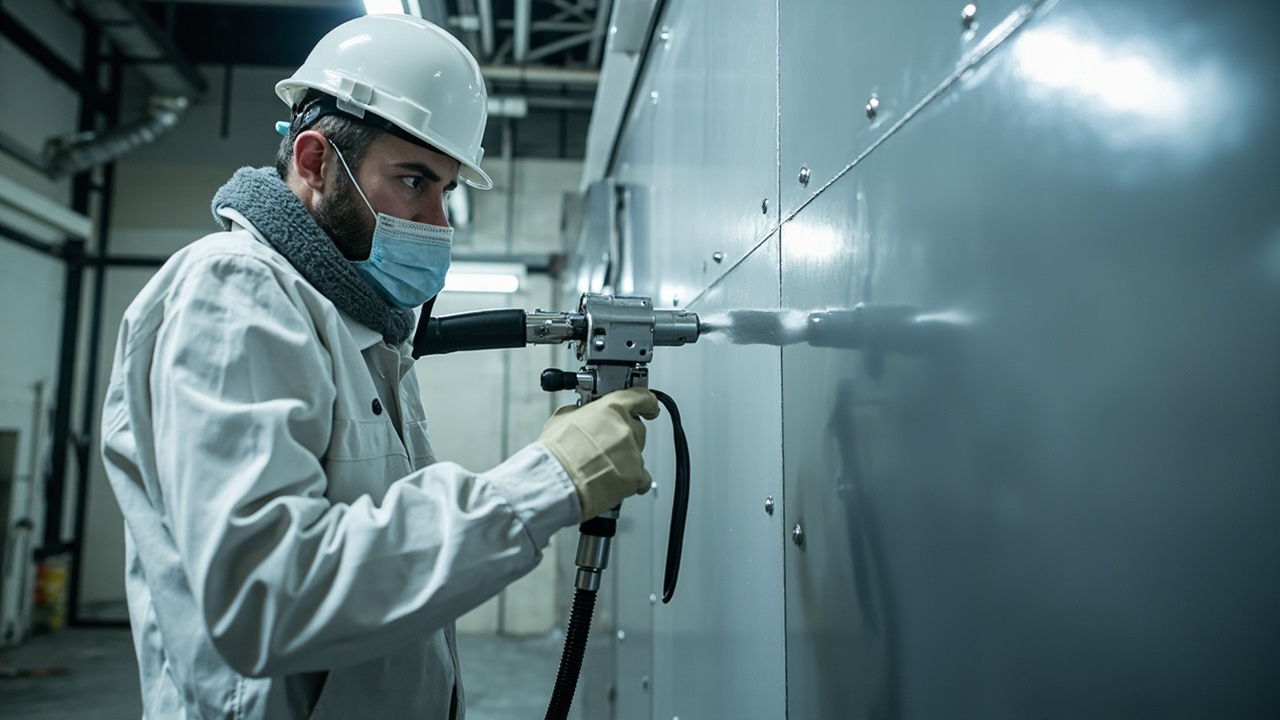
I. First distinguish three application methods: why airless spray is the main character
Common application methods for industrial paint include brush, roller, conventional air spray, and airless spray. Brush and roller are only suitable for small areas, touch-up, or hard-to-spray edges and corners; large-area steel structures almost entirely rely on spraying. Conventional air spray uses compressed air to atomize the coating, offering fine atomization and good decorative quality, but low paint utilization, severe overspray, and high solvent evaporation, making it inferior to airless spray in terms of environmental friendliness and efficiency. Airless spray pressurizes the coating to a dozen to several tens of MPa and ejects it at high speed through a small orifice nozzle, relying on sudden pressure drop for atomization without using compressed air for atomization; therefore:
- It can spray high-viscosity, high-solid coatings (such as epoxy zinc-rich primer with 85% volume solids) without requiring large amounts of thinning;
- A single pass can achieve a relatively thick dry film, reducing the number of coats;
- Less overspray and high paint utilization result in lower overall cost for large-area operations;
- Suitable for both field and factory coating; paired with heated hoses, it can further reduce viscosity and improve leveling.
For this reason, industrial protective systems (epoxy zinc-rich primer + epoxy micaceous iron intermediate coat + epoxy polyurethane topcoat) generally list airless spray as the preferred application method, followed by conventional air spray, with brush and roller only as supplements.
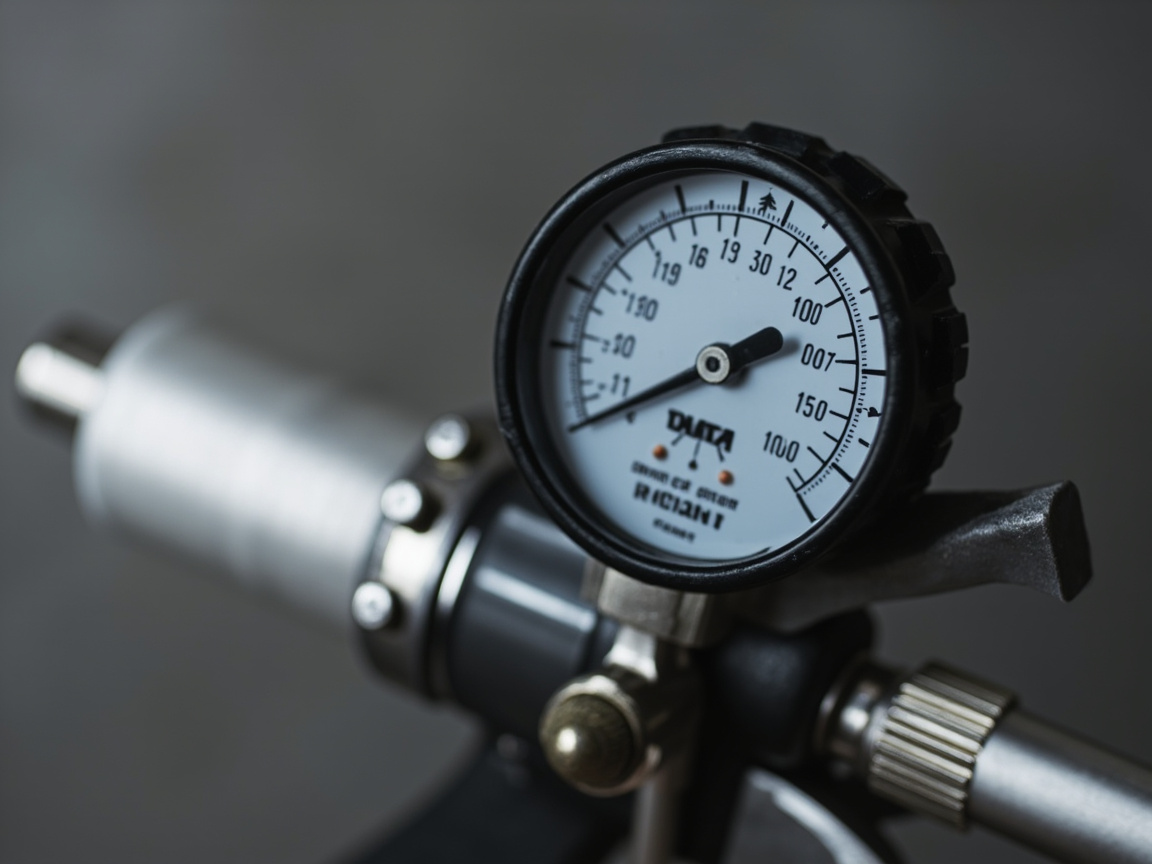
II. Core parameters of airless spray: pressure, nozzle, and flow
The quality of airless spray is determined by three interdependent parameters: pump pressure (coating outlet pressure), nozzle orifice (determines flow and atomization particle size), and nozzle fan width (determines single-pass coverage width). Higher pressure and larger nozzle mean thicker single-pass film and higher efficiency, but also increased risk of spatter and sagging.
For epoxy coatings, mature industry experience gives the following baseline window: nozzle orifice 0.4–0.5 mm, spray pressure 20–25 MPa. This combination can atomize high-solid epoxy paint into a uniform fan-shaped mist without excessive thinning, achieving moderate film thickness in one pass. If pressure is too low, atomization is poor and orange peel is obvious; if pressure is too high, rebound overspray occurs and film thickness becomes uncontrolled. Nozzle fan width is selected according to the shape of the substrate: wide fan (e.g., 40–50° marking) for flat large plates, narrow fan for complex pipe fittings to concentrate the coating.
It must be emphasized that 0.4–0.5 mm is the typical range for "epoxy-type" coatings; specific products must still follow the TDS application section of that product, because ultra-high-solid epoxy (such as UHS epoxy zinc-rich primer with 95 ± 2% weight solids) has extremely high viscosity and may require a larger nozzle or coating heating. The parameter table below summarizes the real application boundaries of different products in the archive.
III. Application parameter summary table: airless vs air spray, multi-product comparison
The table below centrally presents the publicly citable application parameters from the archive for quick on-site reference. All values are from the corresponding technical data sheets or national standard application sections.
| Item / Product | Recommended Application Method | Nozzle / Orifice | Pressure | Thinning Ratio | Source |
|---|---|---|---|---|---|
| Epoxy-type (general baseline) | Airless spray | 0.4–0.5 mm | 20–25 MPa | Minimize thinning | Per industrial paint application experience and TDS |
| Conventional air spray (general) | Conventional air spray | 1.5–2.0 mm | 0.3–0.4 MPa | Depends on viscosity | Per industrial paint application parameters |
| Alkyd anti-rust paint | Airless spray | — | — | Thin 0–5% | Per GB/T 25251-2010 application section |
| Alkyd anti-rust paint | Conventional air spray | — | — | Thin 10–15% | Per GB/T 25251-2010 application section |
| Alkyd anti-rust paint | Roller | — | — | Thin 5–10% | Per GB/T 25251-2010 application section |
| Epoxy polyurethane topcoat | Airless/conventional air spray preferred | — | — | Brush/roller only for small areas | Per epoxy polyurethane topcoat parameter summary |
| Epoxy.com #406 polyurethane topcoat | Spray | — | — | EEP/MAK 9–10% | Per Epoxy.com TDS |
This table illustrates three points: first, the "pressure magnitude" of airless spray and conventional air spray is completely different—airless is at the 20–25 MPa level, while conventional air spray is at the 0.3–0.4 MPa (i.e., about 3–4 bar) level, and their equipment cannot be interchanged; second, the nozzle orifice of conventional air spray (1.5–2.0 mm) is much larger than that of airless nozzle (0.4–0.5 mm), because conventional air spray relies on airflow atomization and needs a larger fluid outlet, while airless relies on high-pressure small-orifice pressure-drop atomization with extremely small orifice; third, the thinning ratio varies by application method—airless spray is barely thinned, conventional air spray requires more thinning, and roller is in between.
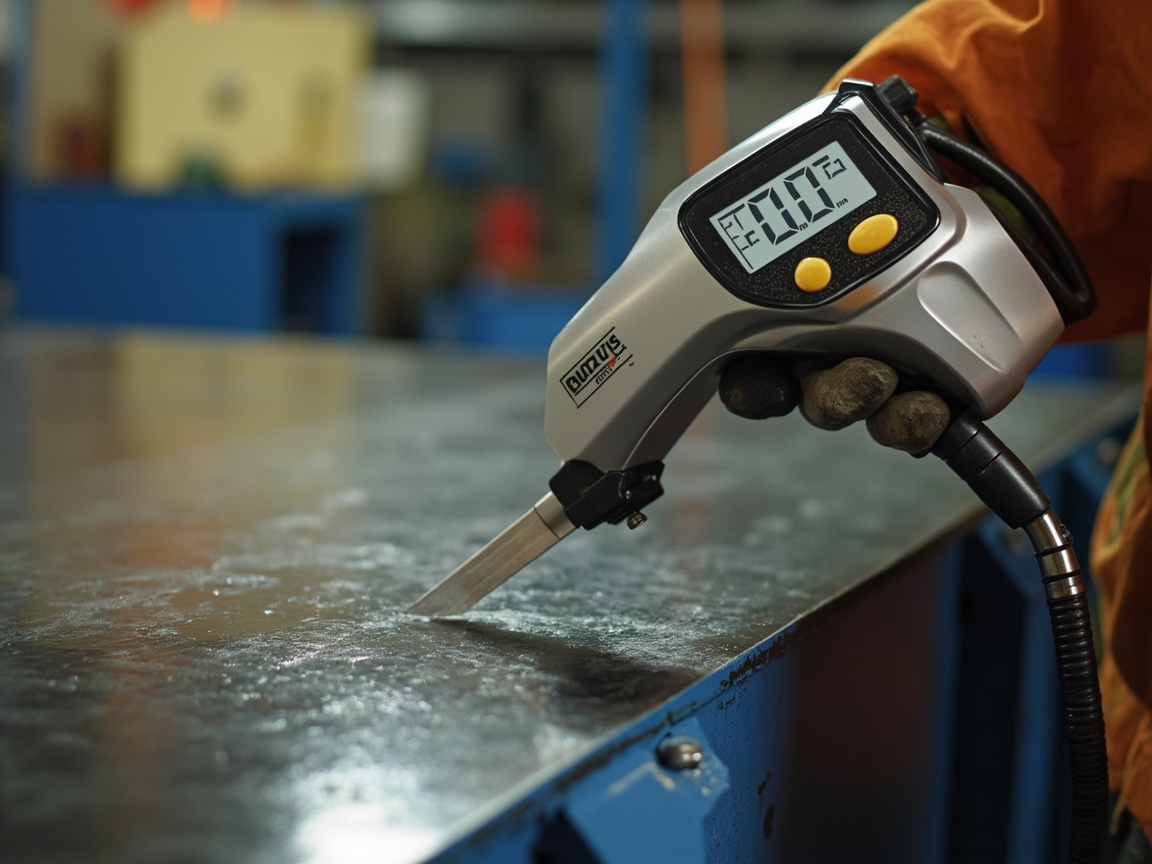
IV. Film thickness control: conversion from wet film to DFT and acceptable window
The "film thickness" of industrial paint usually refers to dry film thickness DFT (Dry Film Thickness), measured in microns (µm), which is the core variable of anti-corrosion design. Under the ISO 12944 system, different corrosion grades (C2–CX) correspond to different total film thickness requirements, while the thickness of a single coat is determined by volume solids and wet film thickness (WFT), with the relationship:
DFT ≈ WFT × Volume Solids (decimal)
Taking Jotun Jotacote Universal N10 as an example, its volume solids are 72 ± 2%, with specified DFT 75–300 µm and corresponding WFT 105–415 µm, theoretical coverage 9.6–2.4 m²/L (per Jotun TDS). On site, first use a wet film comb to measure WFT before the paint film surface-dries, then use the above formula to back-calculate the achievable DFT, and subsequently use a magnetic/eddy-current dry film thickness gauge to verify DFT after curing.
The single-coat DFT window varies by product: Jotacote N10 is 75–300 µm; Jotun Barrier 80 UHS (ultra-high-solid epoxy zinc-rich primer) is 60–150 µm, theoretical coverage 14–5.6 m²/L; in the epoxy polyurethane topcoat system, primer 70–80 µm (1 coat), intermediate coat 100–150 µm (1–2 coats), topcoat 100–120 µm (2 coats) is a typical scheme. Insufficient film thickness means a thin barrier layer and early corrosion; excessive film thickness means high internal stress, easy cracking and sagging, and may also exceed the process limits of single-coat VOC and solvent retention. Therefore, "control DFT via WFT, accept by thickness gauge" is an on-site iron rule.
V. Overcoating interval: why the previous coat must cure before epoxy polyurethane topcoat
In multi-layer systems, the "overcoating interval" refers to the time window for the previous coat to cure to a state where the next coat can be applied. It is divided into minimum interval (previous coat not yet hard enough, causing lifting or wrinkling) and maximum interval (previous coat already so hard that abrading is needed for adhesion). Epoxy polyurethane topcoat is a two-component system containing isocyanate curing agent; its previous coat (epoxy micaceous iron intermediate coat or epoxy primer) must reach the specified curing degree before overcoating, otherwise intercoat delamination and bubbling will occur.
The environmental window given by the epoxy polyurethane topcoat parameter summary is: temperature 5–35℃, relative humidity ≤ 80%, substrate temperature at least 3℃ above dew point. Temperature and humidity directly determine the curing rate—when temperature is low and humidity is high, epoxy curing slows down, and polyurethane is sensitive to water (isocyanate reacts with water to generate carbon dioxide bubbles), forcing the minimum overcoating interval to be extended; if substrate temperature is within 3℃ below dew point, surface condensation easily occurs, causing paint film blushing and adhesion failure. Therefore, on site, substrate temperature, air temperature and humidity must be measured and dew point calculated; construction proceeds only when all three are satisfied.
In addition, the maximum overcoating interval must not be extended indefinitely. If the epoxy intermediate coat is left too long and its surface chalking or contaminated, cleaning or even light sanding is required before overcoating with polyurethane. The specific hours of recoat interval must follow the "recoat time" table in the product TDS, which typically gives overcoatable windows at temperature nodes such as 5℃, 10℃, 23℃, 40℃. The construction plan should include "previous coat curing wait" in the schedule rather than rushing progress by feel.

VI. Thinning ratio: on-site discipline of adding as little as possible
The thinner is already balanced in the factory formulation; adding water or solvent on site will alter VOC, solids content, and rheology, thereby affecting DFT and anti-corrosion service life. The archival data provide clear boundaries:
- Alkyd anti-rust paint (GB/T 25251-2010): airless spray thinning 0–5%, air spray 10–15%, roller 5–10%. It can be seen that airless spray requires the least thinning, consistent with its high atomization efficiency.
- Epoxy polyurethane topcoat: high-pressure airless/air spray preferred; brush and roller only for small areas, meaning normal spraying basically adds no thinner.
- Epoxy.com #406 two-component polyurethane topcoat: thin with EEP or MAK, ratio 9–10% (per Epoxy.com TDS), which is the construction adjustment amount allowed by the formulation.
The choice of thinner is also critical: it must be compatible with the resin system of the paint (epoxy uses epoxy thinner, polyurethane uses ester/ketone types and must avoid alcohol and water); misuse will cause gelling or blushing. A more hidden risk is that excessive thinning lowers volume solids and indirectly raises VOC, which under regulations judging limits by "application state" may directly exceed the standard. Therefore, the on-site discipline is: use airless spray and do not thin; if thinning is necessary, strictly follow the TDS upper limit and record the added amount for reference.
VII. Equipment Selection and Safety Protection: The Overlooked On-site Link
Airless spray equipment includes plunger pump or diaphragm pump, high-pressure hose, airless spray gun and nozzle, and pressure regulating valve. Key selection points: the pump's maximum pressure should be 20–25 MPa above the common operating pressure to leave a margin; hose inner diameter and length should match flow rate, as excessive length causes pressure drop and unstable atomization; the nozzle needs to be wear-resistant (tungsten carbide), because the zinc powder in zinc-rich primer is extremely abrasive. The spray gun should have a safety lock and pressure relief device; pressure must be released before changing the nozzle to prevent high-pressure injury.
In terms of safety, two-component polyurethane contains isocyanate curing agent; spray droplets during application can cause sensitization and are irreversible, so forced ventilation plus respiratory protection are required (at least half-mask with organic vapor/particulate composite filter, PAPR powered air-purifying respirator recommended), along with goggles and nitrile gloves. The zinc dust and solvent of epoxy zinc-rich primer also require protection. When spray booth or site ventilation is insufficient, never rely on ventilation in place of respiratory protection. In addition, no open flame in spraying area, anti-static measures, and compliant disposal of empty coating drums are all basic practices for industrial coating on site.
Kexin New Materials (kexinMaterials), when delivering配套 solutions, habitually provides the "construction parameter table" and "product TDS" together to the applicator, clearly marking the nozzle orifice, pressure, film thickness window, and recoating interval for each coat, and at the first-coat check measures WFT/DFT and dew point on site to avoid whole-batch rework due to parameter drift. For cross-regional, multi-section steel structure projects, this "parameter pre-positioning + first-piece acceptance" approach can significantly reduce intercoat defect rates.
VIII. Stringing Parameters into Process: A Standard Construction Flow
Stringing the aforementioned key points into an executable process, a typical industrial protective coating flow is as follows:
- Surface preparation: carbon steel blasted to Sa 2½ (ISO 8501-1), roughness 30–75 µm; stainless steel abraded with non-metallic abrasive to produce scratches. Contamination removal, grease treated per standard.
- Environment verification: measure substrate temperature, air temperature and humidity, calculate dew point, confirm substrate temperature is 3℃ above dew point and relative humidity ≤ 80%, temperature within 5–35℃.
- Primer spray: epoxy zinc-rich primer (e.g., UHS type) airless spray, nozzle 0.4–0.5 mm, pressure 20–25 MPa, control DFT 60–150 µm (per product), minimize thinning.
- Intermediate coat spray: epoxy micaceous iron oxide intermediate coat airless spray, per TDS film thickness window (e.g., 100–150 µm), note minimum recoating interval with previous coat.
- Topcoat spray: before epoxy polyurethane topcoat, confirm previous coat cured and surface clean; airless/air spray, DFT 100–120 µm (2 coats), strictly control humidity to avoid isocyanate foaming.
- Film thickness acceptance: magnetic/eddy current thickness gauge per ISO 19840 or GB/T 13452 to spot-check DFT, coverage and pass rate meet standard.
- Curing and maintenance: give sufficient curing time per temperature and humidity (polyurethane full cure often takes several days to a week), avoid water and mechanical damage during this period.
In the above flow, each step relies on the specific numerical windows given in sections II, III, IV, and V. Carving numbers such as "pressure 20–25 MPa, nozzle 0.4–0.5 mm, DFT 75–300 µm (general epoxy)/60–150 µm (zinc-rich), dew point +3℃, humidity ≤ 80%" into the work instruction is the bridge from technical article to engineering quality.
Kexin New Materials (kexinMaterials) suggests that in heavy anti-corrosion or offshore, bridge and other critical projects, airless spray parameters should be managed in binding with ISO 12944-2018 corrosion categories: the higher the corrosion category, the higher the selected solids, the thicker the film, and the stricter the requirement for spray uniformity; the construction parameter table should tighten tolerances as corrosion category upgrades, rather than one-size-fits-all.
IX. Spray Defect Atlas and Countermeasures: Twisting Parameters Back on Track
Even when parameters look correct, defects still emerge on site. Recognizing their association with parameters is a core skill for applicators:
- Orange peel: surface shows orange-peel-like unevenness. Main cause: insufficient atomization or high coating viscosity, low pressure, small nozzle. Countermeasure: increase airless pressure, switch to one size larger nozzle (still near the 0.4–0.5 mm epoxy baseline), appropriately raise temperature to reduce viscosity, but avoid excessive thinning to eliminate orange peel.
- Sagging: paint film on vertical surface flows down, uneven thickening. Main cause: single-coat film thickness exceeds WFT upper limit, over-thinning, low temperature slow cure. Countermeasure: control WET film thickness, reduce thinning, wait for previous coat surface dry before next, or increase volume solids to reduce solvent.
- Pinholes/bubbles: tiny holes in film. Most common in two-component polyurethane, due to isocyanate meeting water (humidity > 80% or substrate condensation) generating CO2, or air entrained by stirring not escaped. Countermeasure: strictly keep humidity ≤ 80%, substrate temperature 3℃ above dew point, low-speed stir after induction, briefly de-aerate if necessary.
- Dry spray: droplets half-dry before reaching surface, film rough, poor intercoat adhesion. Main cause: excessive pressure, too wide fan, too far spray distance, high wind. Countermeasure: shorten spray distance, lower pressure, set windbreak, reduce fan width.
- Poor hiding/uneven thickness: main cause: inconsistent gun travel speed, insufficient overlap width. Countermeasure: fix gun speed, maintain ~50% overlap, verify by zone with wet film gauge.
The root of these defects can almost all be traced to the six windows of pressure, nozzle, film thickness, interval, thinning, and temperature/humidity from sections II to VI. Holding the "parameter window" naturally lowers defect rate.
X. Shape of Substrate and Nozzle Fan Selection
Nozzle is described by two dimensions: "orifice + fan angle". Epoxy orifice locked at 0.4–0.5 mm, but fan angle can be chosen by substrate:
- Large flat surface (steel plate, tank wall, box girder outer plate): choose wide fan (e.g., 40–65° marking), one pass covers wide, high efficiency, with 20–25 MPa and steady gun travel, easy to obtain uniform thick film.
- Complex structure (pipe support, grating, angle steel): choose narrow fan or reverse fan nozzle, concentrate coating to recessed corners, reduce overspray and shadow miss; local touch-up if necessary.
- Pipe outer surface: slender parts suit rotating or dedicated ring-spray attachment, ensure uniform circumference.
- Internal cavity and hard-to-reach: airless spray gun extension or elbow, brush/roller only as last remedy.
Fan angle is often printed in nozzle code (e.g., "5xx" indicates a certain fan), must confirm with orifice when purchasing. Wrong fan angle does not expose immediately, but shows at acceptance thickness check as "large thickness variation, thin edges/corners", rework cost far exceeds nozzle selection time.
XI. Parameter Fine-tuning by Season and Temperature
Temperature profoundly affects viscosity and curing, parameters must adjust by season:
- Winter (near 5℃ lower limit): coating viscosity rises, epoxy cure very slow. Countermeasure: preheat coating and thinner (no open flame, use water bath or warm coating room), appropriately raise airless pressure, extend recoating interval and curing period; if necessary use low-temperature cure type (e.g., formula with 4℃ lower limit). Note humidity may still rise, dew point check indispensable.
- Summer (near 35℃ upper limit): solvent flashes fast, easy dry spray, polyurethane moisture-sensitive. Countermeasure: avoid noon high-temperature spray, appropriately increase thinning (within TDS limit), shorten post-induction wait, enhance ventilation but prevent direct dust blow; in high-humidity season prioritize dry periods.
- Transition and coastal: large day-night temperature difference, morning condensation easy, hold "substrate temperature 3℃ above dew point" red line, rather wait for window than rush.
The essence of parameter fine-tuning is small shifts within the baseline frame of "0.4–0.5 mm nozzle, 20–25 MPa pressure, qualified DFT window, dew point +3℃, humidity ≤ 80%", not breaking the frame. Kexin New Materials (kexinMaterials) in cross-season bridge projects provides a "parameter fine-tuning card" by month, stating specific winter/summer shifts for pressure, thinning, interval, for site team leader to execute directly, reducing human judgment error.
XII. Completion Acceptance and Film Thickness Judgment Rules
Spray end is not process complete; film thickness acceptance is the quality loop close. Industrial protective coating usually judges by following logic:
- Measurement standard: dry film thickness by magnetic (carbon steel) or eddy current (non-ferrous) gauge, per ISO 19840 or GB/T 13452 series measure on site by prescribed grid, take several readings per area.
- Pass criterion: common "90/10 rule" — 90% readings not below specified DFT minimum, remaining 10% not below 90% of minimum (i.e., no "thin spot" below 0.9× design film thickness); some standards use average pass and range controlled. Specific per project spec.
- Thin spot and repair: points below lower limit, local touch-up to pass; over-thick points (above design upper limit) recorded but not mandatory, unless with sag, cracking. Touch-up must obey recoating interval, avoid lifting.
- Adhesion spot-check: besides film thickness, per GB/T 9286 cross-cut or pull-off spot-check intercoat adhesion, especially concern epoxy polyurethane topcoat and intermediate coat bonding weakened by wrong interval.
Closing the loop of "First-piece confirmation DFT + in-process wet film control + final grid acceptance" is the key to truly translating the pressure, nozzle, film thickness, and interval discussed in Part 2 into pass rate. Without acceptance, no matter how good the parameters look, they are only on paper.
13. Supplementary Key Points on Site Safety and Waste Management
Beyond construction parameters, on-site safety and waste disposal also affect compliance and cost:
- Coating storage: Store the base and hardener of two-component paint separately in a cool, ventilated place, at 5–35°C, away from fire and sunlight; the hardener of epoxy polyurethane topcoat contains isocyanate and must be sealed and moisture-proof (it clumps and fails upon contact with water), and should be used up as soon as possible after opening.
- Empty drums and leftover paint: Empty drums of solvent-based paint are hazardous waste and must be professionally recycled; they must not be discarded or incinerated at will; leftover paint shall be disposed of according to MSDS regulations, and must not be poured into sewers.
- Leakage and fire protection: The spraying area shall be equipped with anti-static and fire-fighting equipment; solvent leaks shall be collected with absorbent materials, and work may resume only after ventilation replacement; open flame and smoking are prohibited in the spraying area.
- Personnel health records: Personnel with long-term exposure to isocyanate should undergo health surveillance; those showing respiratory symptoms must leave the post and seek medical attention, as isocyanate sensitization is irreversible.
- Environmental records: Record the paint usage, thinner addition, temperature, humidity, and dew point for each shift; this serves both quality traceability and supports the VOC emission ledger, addressing the regulatory compliance needs mentioned earlier.
When Kexin New Materials (kexinMaterials) delivers the construction guideline, it customarily issues "Safety and Waste" as an independent chapter together with the parameter table, clarifying the empty drum recycling path and personal protection checklist, helping the contractor extend environmental compliance from "the coating itself" to the "entire construction process", which is exactly the complete closed loop of industrial paint site management.
FAQ
Q: What pressure and nozzle are generally used for airless spraying of industrial coating?
A: For epoxy coatings, the mature industry baseline is nozzle orifice 0.4–0.5 mm and spraying pressure 20–25 MPa; ultra-high solids epoxy zinc-rich primer has higher viscosity and may require a larger nozzle or paint heating. Specifically, it must follow the product's TDS application section; too low pressure gives poor atomization, too high causes overspray and sagging.
Q: Airless spraying and air spraying have such different pressures, are the equipments interchangeable?
A: No. Airless spraying is a high-pressure plunger/diaphragm pump system at 20–25 MPa level, while air spraying uses compressed air atomization at 0.3–0.4 MPa (about 3–4 bar), and the nozzle orifices also differ (airless 0.4–0.5 mm, air 1.5–2.0 mm). The pumps, hoses, spray guns, and nozzles of the two are not interchangeable.
Q: How is dry film thickness DFT calculated from wet film?
A: Approximate formula: DFT ≈ WFT × volume solids (decimal). For example, Jotacote N10 has 72% volume solids, and wet film 105–415 µm corresponds to dry film 75–300 µm (per Jotun TDS). On site, first measure WFT with a wet film gauge, and after curing verify DFT with a dry film thickness gauge.
Q: Why must epoxy polyurethane topcoat be applied only after the previous coat has cured?
A: Epoxy polyurethane topcoat contains isocyanate hardener; if the previous epoxy primer/intermediate coat has not reached the specified curing level, overcoating will cause interlayer delamination and blistering; moreover, polyurethane is water-sensitive, and when humidity is high or the previous coat is not dry, isocyanate meets water and generates bubbles. Therefore, the temperature must be 5–35°C, humidity ≤ 80%, substrate temperature at least 3°C above dew point, and the minimum recoat interval in the TDS must be observed.
Q: Can airless spraying be done without thinner?
A: Usually yes, and it is recommended to add as little as possible. Alkyd anti-rust paint is thinned only 0–5% for airless spraying, and epoxy polyurethane topcoat is basically not thinned for normal spraying; excessive thinning lowers solids and virtually raises VOC, which may exceed limits under regulations judging by in-use condition. If thinning is necessary, strictly follow the TDS upper limit and record it.
Q: How to judge on site whether spraying can start?
A: Measure three values simultaneously: air temperature, relative humidity, and substrate temperature, then calculate the dew point. The rule is substrate temperature must be at least 3°C above dew point, relative humidity ≤ 80%, and temperature within 5–35°C. If any of the three is not met (especially when substrate is close to dew point and condenses), work should stop, otherwise the paint film turns white and adhesion fails.
Q: How thick should one coat be, is thicker better?
A: No. Insufficient film thickness gives a thin barrier prone to corrosion; too thick causes high internal stress, easy cracking and sagging, and solvent retention. Epoxy general-purpose paint single-coat DFT is commonly 75–300 µm, zinc-rich primer 60–150 µm, topcoat 100–120 µm, to be determined by TDS window and ISO 12944 corrosion class.
Q: What personal protection is needed for two-component polyurethane spraying?
A: It contains isocyanate; mist causes sensitization and is irreversible, so forced ventilation plus respiratory protection are required (at least half-mask with organic vapor/particulate composite filter, PAPR recommended), along with goggles and nitrile gloves; spray booth ventilation alone cannot reduce below safe exposure level, respiratory protection is still needed, and sanding of uncured paint film is prohibited.
Q: Does airless spraying have requirements on spray distance and gun travel speed?
A: Yes. Too far distance causes dry spray, too close causes sagging; epoxy types are usually within 30–50 cm; gun travel speed must be steady and match the overlap width (about 50% overlap), checking WFT zone by zone with a wet film gauge. Once pressure and nozzle are set, distance and gun speed are the final film thickness adjustment knobs in the operator's hands.
Q: Should two-component paint be sprayed immediately after mixing or matured for a while?
A: Generally it needs a TDS-specified "induction" (mature) time after mixing for the resin and hardener to initially react and aid leveling, but it must be used within the pot life; long standing after mixing thickens or even gels. Polyurethane mixed with water easily blisters, so both maturation and construction environment must control humidity.
15. In Conclusion: Parameters Are the Skeleton of Construction Quality
Stringing the whole article together, the quality of industrial coating airless spraying is built on six interlocking windows: nozzle 0.4–0.5 mm, pressure 20–25 MPa, qualified DFT window (epoxy general 75–300 µm, zinc-rich 60–150 µm), recoat interval, minimal thinning, and the temperature/humidity/dew point red line (substrate temperature 3°C above dew point, humidity ≤ 80%). Any broken link will surface in acceptance thickness measurement or interlayer adhesion. For the contractor, pinning this parameter table on the work instruction and clamping both ends with first-piece confirmation and final grid acceptance is more reliable than any empirical intuition. For the site team leader, the most worthwhile habit is to record each shift's pressure, nozzle, temperature, humidity, and dew point on a note before starting, and check item by item against the TDS window—seemingly tedious, yet it nips defects in the bud. When the six parameter windows become daily actions rather than temporary responses, the pass rate and anti-corrosion life of industrial coating airless spraying naturally fall within design expectations.